Most people don’t realize their daily drinks could be quietly destroying their liver. By the time symptoms show up, it’s often too late to reverse the damage. Alcoholic liver disease doesn’t happen overnight. It creeps in silently, stage by stage, turning a healthy organ into a scarred, failing one. But here’s the truth: if you catch it early, your liver can heal itself. If you ignore it, the path leads to cirrhosis, transplant, or death.
Stage 1: Fatty Liver (Steatosis)
This is where it all starts. After just a few days of heavy drinking - think six or more standard drinks daily - fat begins to build up in your liver cells. It’s not cancer. It’s not inflammation. It’s just fat. And it’s incredibly common. Around 90% of people who drink heavily develop this stage. Many don’t even know they have it because there are no symptoms. No pain. No jaundice. Just a liver that’s swollen with fat.
Doctors see it in blood tests. Your AST and ALT levels rise, but AST is usually higher than ALT - that’s a classic sign. The ratio of AST to ALT being over 2:1 is a red flag. But even if your numbers look normal, you could still have fat in your liver. That’s why many people only find out after a routine ultrasound or a biopsy done for another reason.
The good news? This stage is 100% reversible. If you stop drinking for 4 to 6 weeks, your liver clears out the fat. A 2017 clinical trial showed 85% of people who quit alcohol completely saw their fatty liver vanish. No pills. No surgery. Just time and sobriety. That’s the power of your liver - it’s one of the few organs that can regenerate itself if given the chance.
Stage 2: Alcoholic Hepatitis (Alcohol-Associated Hepatitis)
If you keep drinking after fatty liver, the damage escalates. Fat turns into inflammation. Liver cells die. Your immune system starts attacking your own tissue. This is alcoholic hepatitis - now called alcohol-associated hepatitis (AH) to remove stigma and focus on the cause, not the person.
It doesn’t take decades. Some people develop it after 5 to 10 years of heavy drinking. Others get it after a single binge - more than 100 grams of alcohol in 24 hours (that’s about 8 standard drinks). Women are more vulnerable. They develop AH after less alcohol than men because their bodies process alcohol differently.
Symptoms show up now. Yellow skin and eyes (jaundice). Swollen belly from fluid buildup (ascites). Fever. Nausea. Confusion. Fatigue so deep you can’t get out of bed. If you’re feeling this bad and you drink, your liver is in crisis.
Doctors use the Maddrey Discriminant Function (mDF) to measure severity. A score above 32 means severe AH. Without treatment, 30-40% of these patients die within 30 days. Steroids like prednisolone can help - the STOPAH trial showed a small but real drop in early death rates. But steroids only work for about 40% of people. The real game-changer? Stopping alcohol completely. Those who quit at this stage have a 70% chance of surviving the next year. Those who don’t? Their odds plummet.
Stage 3: Cirrhosis
Cirrhosis is the point of no return - or so people think. It’s when your liver is mostly scar tissue. Healthy cells are gone. Blood can’t flow right. The organ is stiff, shrunken, and failing. About 10-20% of heavy drinkers reach this stage, usually after 10 to 20 years of drinking. But some get there faster, especially if they have other risks like obesity, diabetes, or hepatitis C.
There are two types: compensated and decompensated. Compensated means your liver is scarred, but still doing enough to keep you alive. You might feel tired, lose weight, or have spider veins on your skin. Many people live like this for years without knowing they have cirrhosis.
Decompensated cirrhosis is a medical emergency. Fluid floods your belly. You vomit blood from burst veins in your esophagus. You get confused or fall into a coma because your liver can’t filter toxins. Your kidneys start shutting down. At this point, half of all patients die within two years - unless they get a transplant.
Here’s what most don’t know: cirrhosis isn’t always permanent. If you stop drinking completely, 50-60% of people with compensated cirrhosis stabilize. Their liver stops getting worse. Their survival jumps from 30% to 70-90% over five years. Abstinence is the most powerful treatment you have. No drug, no supplement, no diet beats quitting alcohol at this stage.
Liver transplants work. Five-year survival after transplant is 70-75%. But most centers won’t list you unless you’ve been sober for at least six months. That’s not punishment. It’s proof you can stick with treatment. And it’s the only way to give your new liver a real chance.
What Makes Progression Worse?
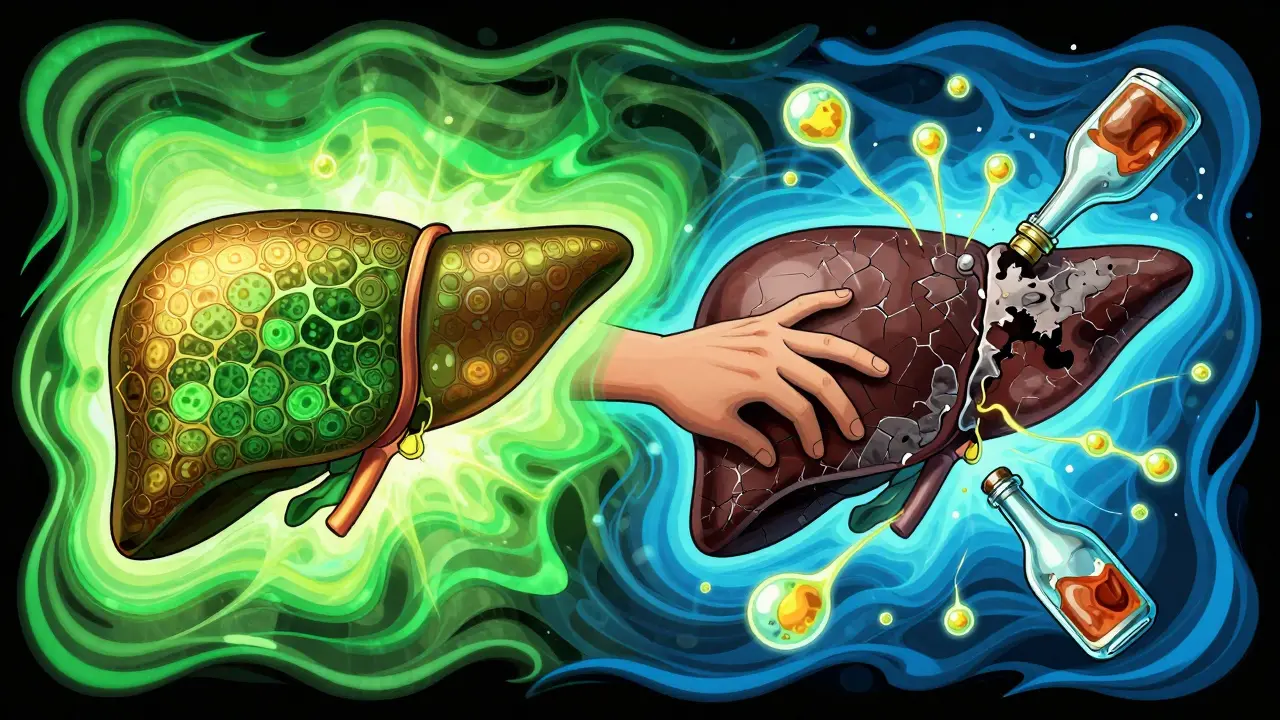
Not everyone who drinks gets liver disease. Why? Genetics. Women. Obesity. Viral hepatitis. If you have a mutation in the PNPLA3 gene, your risk triples. If you’re a woman, you develop damage faster - even at lower doses. If you’re overweight or have type 2 diabetes, your liver gets hit twice: once by alcohol, once by fat. And if you have hepatitis B or C, alcohol speeds up scarring by 300%.
Even moderate drinking - two to four drinks a day - can make fatty liver worse if you already have it. One study showed fibrosis advanced 0.3 units per year in drinkers with NAFLD, compared to just 0.1 in those who quit. That’s a huge difference over time.
And then there’s stigma. Many patients delay seeing a doctor because they’re ashamed. They think, “I’m not an alcoholic,” so it’s not serious. But the American Association for the Study of Liver Diseases made it clear: this isn’t about addiction. It’s about liver injury from alcohol. You don’t have to be dependent to damage your liver.
How Is It Diagnosed?
Doctors don’t need to cut you open anymore. Blood tests check liver enzymes. Ultrasounds show fat. A FibroScan - a painless device that taps your liver - measures stiffness. If it’s too stiff, you have fibrosis or cirrhosis. It’s 85-90% accurate. Liver biopsy? That’s the old way. Now it’s only used when the diagnosis is unclear.
Prognostic scores like the Glasgow Alcoholic Hepatitis Score (GAHS) help predict survival. A score of 9 or higher means you have a 50% chance of dying within six months without a transplant. These tools help doctors decide who needs steroids, who needs rehab, and who needs a transplant list.
Treatment: What Actually Works
There’s no magic pill. No supplement cures alcoholic liver disease. Only two things matter: stopping alcohol and managing complications.
- Fatty liver: Quit drinking for 6 weeks. That’s it.
- Alcoholic hepatitis: Quit drinking. Steroids if severe. Nutrition support. Some patients need ICU care.
- Cirrhosis: Quit drinking. Take beta-blockers to prevent bleeding. Use lactulose to clear brain toxins. Get vaccinated for hepatitis A and B. Avoid NSAIDs like ibuprofen. Monitor for liver cancer with ultrasound every 6 months.
Emerging treatments show promise. Fecal microbiota transplants (FMT) improved survival by 40% in early trials. New drugs like emricasan reduce inflammation. But none replace abstinence.
Integrated care works best. A 2023 study found that patients who saw both a liver specialist and an addiction counselor had a 65% success rate staying sober after one year. Those who only saw a liver doctor? Only 35% stayed off alcohol.
Real Stories, Real Outcomes
One man, 42, found out he had fatty liver after a routine check-up. He drank six beers a night. He quit cold turkey. Six months later, his liver enzymes were normal. His ultrasound looked clean. He’s still sober five years later.
A woman, 39, was hospitalized with alcoholic hepatitis. She was jaundiced, confused, barely breathing. Her doctor said she had 48 hours to decide: stop drinking or die. She quit. She got steroids. She survived. She’s now in recovery, with a new job and a daughter who doesn’t know her mother ever drank.
But there are others. A 50-year-old man kept drinking after three hospitalizations for hepatitis. He developed cirrhosis. He was told he needed a transplant. He refused to quit. He died within a year.
The pattern is clear: those who act early live. Those who wait, die.
What If You’re Not Ready to Quit?
If you’re not ready to stop drinking, that’s okay. But you need to know the cost. Every drink after fatty liver increases your risk of hepatitis. Every drink after hepatitis increases your risk of cirrhosis. Every drink after cirrhosis cuts your life short by months - sometimes weeks.
You don’t have to do it alone. Support groups. Counseling. Medications like naltrexone or acamprosate can reduce cravings. Insurance covers these. Doctors will help. But you have to ask.
The liver doesn’t care if you’re a “social drinker.” It doesn’t care if you’re “not an alcoholic.” It only responds to alcohol. And it’s always listening.
Can you reverse alcoholic liver disease?
Yes - but only if you stop drinking. Fatty liver reverses completely in 4-6 weeks of abstinence. Alcoholic hepatitis can improve significantly if you quit early. Cirrhosis can stabilize and survival can double if you stop drinking, though scar tissue doesn’t disappear. The liver can regenerate, but only if alcohol is removed.
How much alcohol causes liver damage?
More than 40 grams of pure alcohol daily - about 3-4 standard drinks - raises your risk of fatty liver. For women, damage can start at just 20 grams (1.5 drinks). Heavy drinking over 5-10 years leads to hepatitis. About 10-20% of heavy drinkers develop cirrhosis. There’s no safe level if you’re drinking daily.
Do you have to be an alcoholic to get alcoholic liver disease?
No. The term "alcoholic" is outdated. The medical community now uses "alcohol-associated" to focus on the cause, not the person. You can have a full-time job, a family, and still drink enough to damage your liver. Addiction isn’t required - consistent overconsumption is.
What are the first signs of liver damage from alcohol?
There often aren’t any. Most people feel fine until the disease is advanced. Early signs - if they appear - include unexplained fatigue, mild discomfort in the upper right abdomen, or nausea. Blood tests showing elevated AST and ALT (with AST higher than ALT) are the first objective clue. Jaundice, swelling, or confusion mean it’s already serious.
Can a liver transplant cure alcoholic liver disease?
Yes - but only if you stop drinking permanently. Transplant replaces the damaged liver, but if you start drinking again, the new liver will get damaged too. Most transplant centers require 6 months of verified abstinence before listing. Survival rates are 70-75% at 5 years - among the highest of any organ transplant - but only if sobriety is maintained.
How long does it take for alcohol to damage your liver?
Fat can build up in as little as 72 hours of heavy drinking. Inflammation (hepatitis) usually takes 5-10 years of regular heavy use. Cirrhosis takes longer - often 10-20 years - but can develop faster in women, obese individuals, or those with genetic risks. There’s no fixed timeline. Damage can happen faster than you think.
What Comes Next?
If you’ve been diagnosed with fatty liver, your next step isn’t a pill. It’s a conversation. With your doctor. With a counselor. With someone who’s been there. If you’re still drinking, ask yourself: Do I want to live with a damaged liver - or do I want to heal it?
The liver doesn’t ask for much. Just a break. And if you give it that, it will give you back your life.
Neil Ellis
January 22, 2026 AT 23:48Man, I read this and felt like someone just handed me a mirror I didn’t know I needed. I thought my six beers a night were ‘social drinking’-turns out my liver was throwing a silent rave and I was the only one dancing. I quit cold turkey last week. No fancy apps, no rehab. Just… stopped. Feels weird not reaching for a cold one after work, but my energy’s already better. My wife says I’ve stopped snoring. Who knew?
Alec Amiri
January 23, 2026 AT 03:51Wow. So you’re saying if you drink like a normal person, you’re just one step away from dying? Cool. I’ll just keep drinking and hope for the best. At least I’m not a zombie on a couch like some of you.
Lauren Wall
January 24, 2026 AT 06:16I knew someone like this. Died at 48. Liver transplant. Didn’t quit. Guess what? The new liver didn’t stand a chance. Now I don’t drink. Ever.
arun mehta
January 25, 2026 AT 12:13This is one of the most important posts I’ve read this year. 🙏 I’m from India, where alcohol is often seen as ‘manly’ or ‘celebratory’-but this breakdown? It’s a wake-up call. My uncle had cirrhosis-he quit after his first bleed. Now he walks 5km daily. No magic. Just discipline. Thank you for writing this with clarity and heart.
Patrick Roth
January 26, 2026 AT 06:43Actually, the stats here are misleading. Most of these studies are funded by rehab centers. And ‘abstinence’ isn’t the only path-moderation therapy works for many. You’re ignoring the data on controlled drinking in Europe. This feels like fear-mongering dressed as medicine.
Rob Sims
January 28, 2026 AT 03:31Oh, so now it’s not about willpower? It’s about ‘liver injury’? So I’m not a loser for drinking-I’m just a victim of biology? Cute. I’ll take my ‘alcohol-associated’ diagnosis with a side of self-pity and a six-pack. Thanks for the validation.
Tatiana Bandurina
January 29, 2026 AT 07:37Let’s be real: if you’re drinking enough to damage your liver, you’re not ‘a social drinker.’ You’re an addict. The language here is too soft. Stop sugarcoating. The truth is, most people who get here are in denial. And denial kills.
Keith Helm
January 30, 2026 AT 23:33AST/ALT ratio over 2:1 is diagnostic. Period. If your doctor doesn’t mention it, get a second opinion. Fatty liver is not a diagnosis-it’s a warning label. And yes, you can reverse it. But only if you stop. No exceptions. No ‘I’ll cut back.’ Stop. Full stop.
Philip House
February 1, 2026 AT 04:40It’s funny how we pathologize alcohol but ignore the systemic rot that makes people drink. Jobs suck. Life’s empty. The American dream is a treadmill. So people drink. And now we blame the liver? The real disease is capitalism. The liver’s just the messenger.
Chiraghuddin Qureshi
February 2, 2026 AT 07:04Bro, I’m from India too. My dad drank two pegs every night for 30 years. No liver issues. Genetics? Luck? Maybe. But I still quit after reading this. Why? Because I don’t want to be the guy who says ‘I didn’t know.’ Now I drink soda with lime. And I’m proud. 🍋
Lana Kabulova
February 4, 2026 AT 05:19I got diagnosed with fatty liver last year. My doctor said ‘cut back.’ I cut to one drink a day. Three months later, my enzymes were worse. I quit. Full stop. Six months in. Liver’s normal. I’m not ‘sober.’ I’m just not poisoning myself anymore. And honestly? I feel more alive than I have in years. No drama. No guilt. Just… quiet peace.