Bariatric Medication Adjustment Calculator
Medication Adjustment Calculator
Enter your surgery type and medication to get personalized dosage recommendations based on published research
Results will appear here after calculation
After bariatric surgery, many patients start noticing something strange: their medications don’t seem to work like they used to. A pill that once kept their blood pressure steady now feels useless. Their thyroid medicine stops controlling symptoms. Their painkiller doesn’t last half the day. This isn’t in their head. It’s physics, anatomy, and chemistry changing under their skin.
Why Your Pills Don’t Work the Same After Surgery
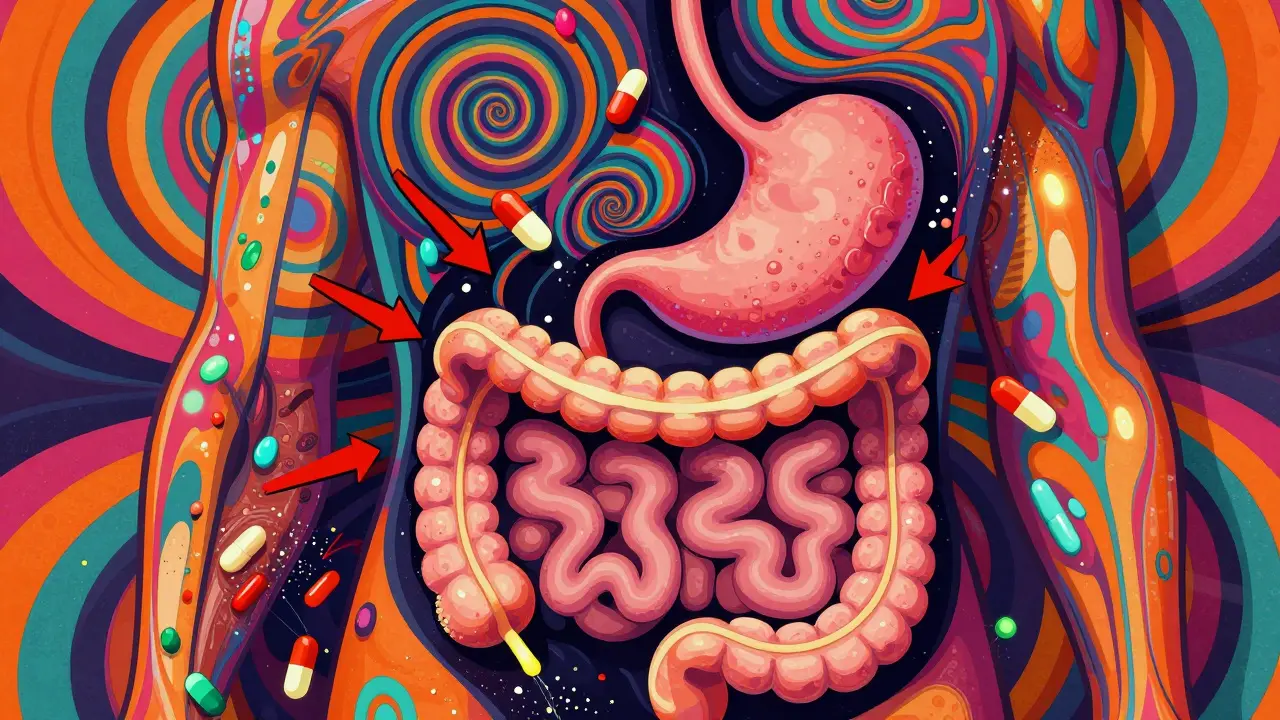
Bariatric surgery isn’t just about shrinking your stomach. It rewires your digestive system. Procedures like Roux-en-Y gastric bypass (RYGB) and sleeve gastrectomy physically alter how food-and medications-move through your body. The stomach gets smaller. Parts of the small intestine are bypassed. Acid levels rise. Transit time drops. All of this changes how drugs are absorbed.Before surgery, most pills dissolve in a highly acidic stomach (pH 1.5-3.5). After RYGB, the new stomach pouch has a pH of 4.0-6.0. That’s like switching from vinegar to weak lemonade. Drugs that need acid to dissolve-like ketoconazole or itraconazole-may not break down at all. Enteric-coated pills, designed to avoid stomach acid and dissolve in the intestine, can pass through too quickly and never release their full dose.
Then there’s the bypass. In RYGB, the first 100-150 cm of the small intestine-the duodenum and proximal jejunum-are skipped. That’s where most drugs get absorbed. Calcium, iron, levothyroxine, and many antibiotics rely on this section. Without it, your body gets only half the dose. One study found that after RYGB, calcium absorption dropped by 35%. Levothyroxine absorption fell by 25-30%. For patients on warfarin, that’s not just inconvenient-it’s dangerous.
Not All Surgeries Are the Same
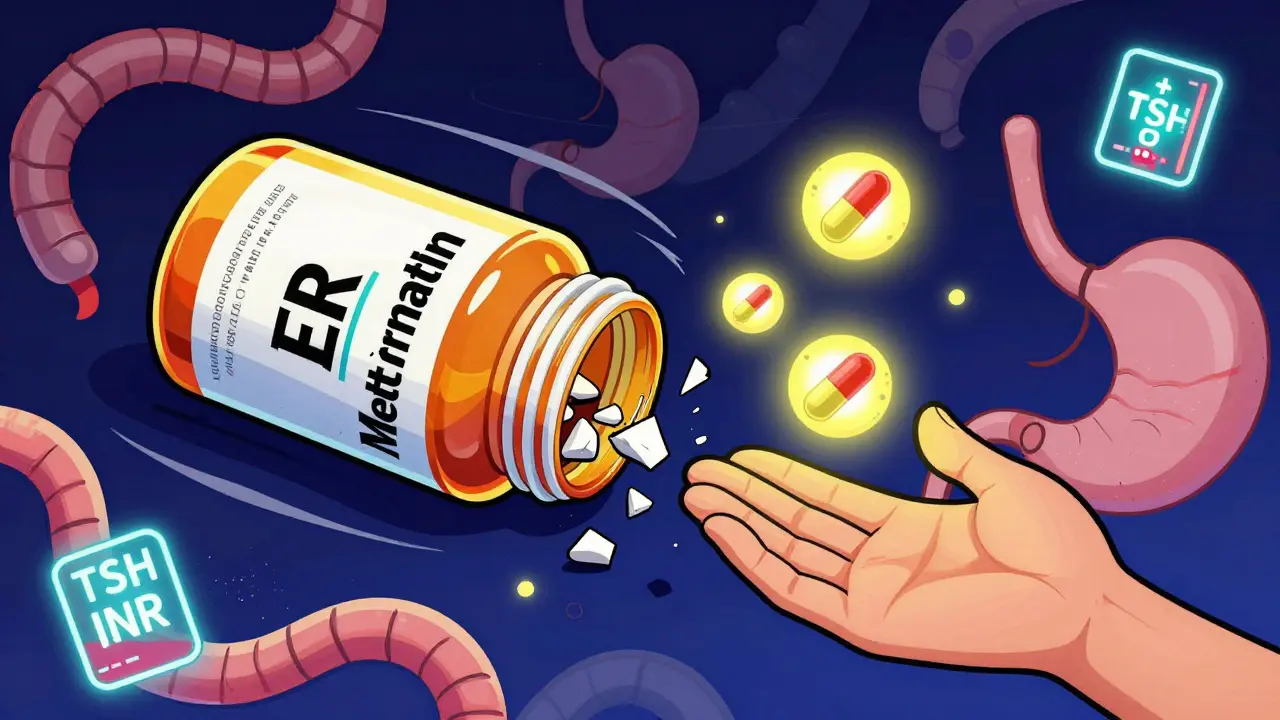
Sleeve gastrectomy and gastric bypass don’t affect medications the same way. Sleeve gastrectomy removes about 80% of the stomach but leaves the intestines untouched. Gastric acid still flows, and food still passes through the duodenum. That means most drugs still get absorbed normally-though the smaller stomach can cause tablets to sit there longer, sometimes not dissolving properly. Patients often report pills feeling like rocks in their chest.RYGB, on the other hand, is a full system overhaul. It cuts off the duodenum. It speeds up gastric emptying from 2-5 hours to under an hour. That’s why extended-release pills fail so often. A metformin ER tablet is designed to release its dose over 8-12 hours as it travels the full length of the gut. After RYGB, it hits the colon in under 2 hours. The drug doesn’t have time to release. Mayo Clinic found that 47% of patients on extended-release medications needed them switched to immediate-release forms after RYGB.
Biliopancreatic diversion with duodenal switch is even more extreme. It bypasses over 70% of the small intestine. Drug absorption here can drop by 50-70%. That’s why patients on this procedure often need twice the dose of most oral meds-or switch to injections.
Which Medications Are Most at Risk?
Some drugs are more sensitive than others. Here’s what you need to watch for:- Levothyroxine: Absorption drops 25-30% after RYGB. Many patients need a 20-50% dose increase. TSH levels must be checked every 6-8 weeks after surgery.
- Warfarin: Bioavailability becomes unpredictable. 60% of RYGB patients need higher doses. One study found average increases of 25-35%. Weekly INR checks for the first 3 months are standard.
- Metformin ER: Plasma concentrations drop 30-40%. Switch to immediate-release metformin 2-3 times daily. Many patients report fewer GI side effects after the switch.
- Glipizide XL: 50-75% less effective. Immediate-release glipizide works better and is easier to titrate.
- Oxycodone CR: Bioavailability drops 60%. Patients report breakthrough pain. Immediate-release oxycodone every 4-6 hours is often needed.
- Calcium and Vitamin D: Absorption drops sharply. Patients need 1,200-1,500 mg of calcium citrate daily (not carbonate) and 3,000 IU of vitamin D3. Bone density scans are recommended yearly.
- Antidepressants and antiepileptics: Levels of sertraline, lamotrigine, and phenytoin can drop unpredictably. Therapeutic drug monitoring is critical.
Extended-release, enteric-coated, and acid-dependent drugs are the biggest red flags. If a pill says “XL,” “ER,” “CR,” or “SR,” assume it’s compromised after bypass surgery.
What Should You Do?
Don’t guess. Don’t wait for symptoms. Here’s what works:- Meet with a pharmacist before surgery. Not your doctor. A pharmacist who specializes in bariatric care. They’ll review every medication you take and flag high-risk ones.
- Switch extended-release pills to immediate-release at least 2 weeks before surgery. This gives your body time to adjust.
- Use liquids or crushable tablets in the first 3 months. Pills that need to dissolve in the stomach should be taken as liquids or crushed (if safe) to ensure absorption.
- Take meds on an empty stomach if they’re acid-dependent (like levothyroxine). Wait 30-60 minutes before eating. For lipophilic drugs (like some antifungals), take them with a small fat-containing meal.
- Get blood levels checked. For warfarin, thyroid meds, antiepileptics, and immunosuppressants, monthly blood tests for the first 6 months are non-negotiable.
Many patients don’t realize their pharmacist can help. Community pharmacists often have no training in bariatric care. A 2022 survey found 78% of pharmacists felt unprepared to advise these patients. That’s why you need to ask: “Do you have experience with post-bariatric medication changes?” If they say no, ask for a referral.
Real Stories, Real Consequences
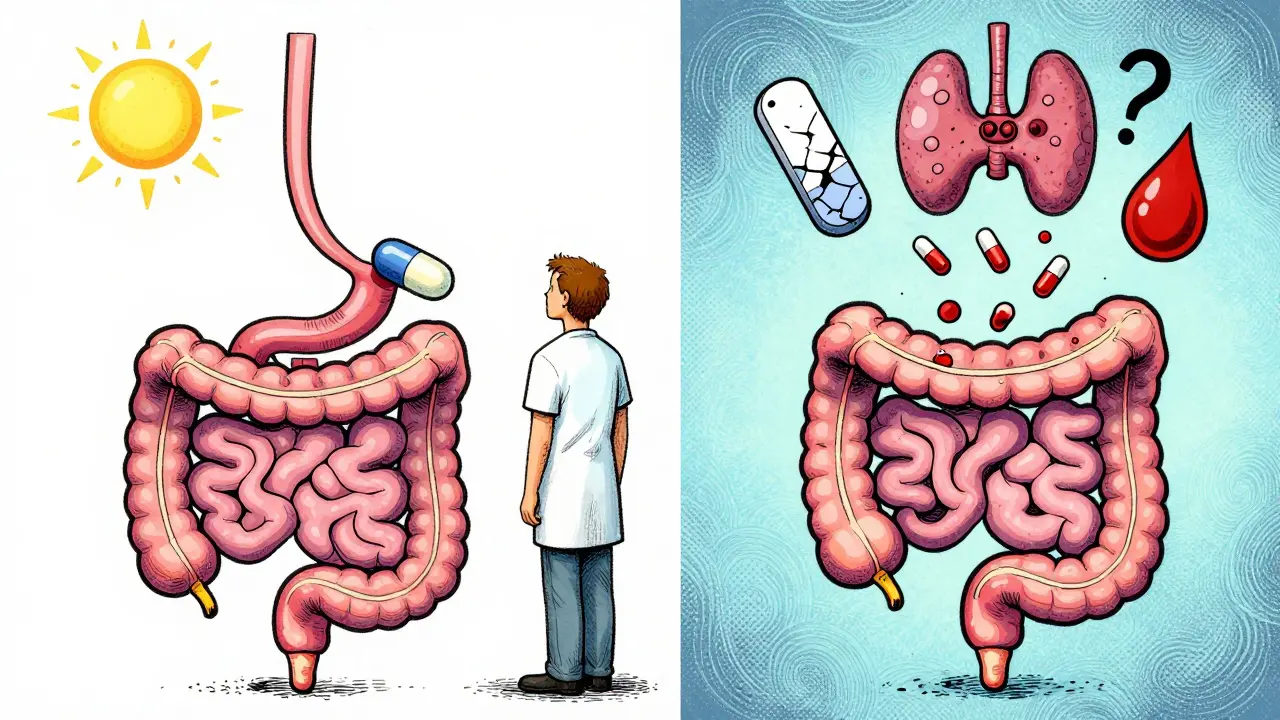
One patient, a 48-year-old woman in New Zealand, had a sleeve gastrectomy in 2023. Her antidepressant dose stayed the same. Six months later, she was crying daily again. Her TSH was normal, but her free T4 was low. Her doctor didn’t connect the dots. She didn’t know to ask about thyroid meds. By the time she saw a specialist, she’d lost 12 pounds unintentionally and couldn’t work.Another man, after RYGB, kept taking his metformin ER. His blood sugar kept climbing. His doctor blamed him for “not eating right.” He switched to immediate-release metformin, took it three times a day, and his HbA1c dropped from 8.2 to 5.9 in 6 weeks.
These aren’t rare cases. A University of Michigan study tracked 312 patients for two years. 38% needed at least one medication change within six months. The most common? Thyroid meds, calcium, and antidepressants.
The Future Is Personalized
New tools are emerging. The American College of Clinical Pharmacy launched an AI-powered dosing calculator in 2024. It takes your surgery type, weight, meds, and lab values-and gives you a recommended dose. It’s now used in 83 U.S. hospitals.Researchers are testing pH-adaptive capsules that dissolve even in weak acid. One study showed 85% absorption in post-surgery patients-compared to just 45% with standard pills.
And soon, genetic testing may play a role. At Mayo Clinic, they’re testing CYP450 enzyme profiles before surgery to predict how someone will metabolize drugs. That could mean personalized dosing from day one.
For now, the rule is simple: if you’ve had bariatric surgery, your meds are not the same. Don’t assume. Don’t delay. Ask. Test. Adjust. Your life depends on it.
Do all bariatric surgeries affect medication absorption the same way?
No. Sleeve gastrectomy mainly reduces stomach size but leaves the small intestine intact, so most medications are still absorbed normally. Roux-en-Y gastric bypass and biliopancreatic diversion bypass parts of the small intestine, which drastically reduces absorption of many drugs. RYGB affects about 68% of patients needing dose changes, while sleeve gastrectomy affects only 32%.
Can I still take extended-release pills after bariatric surgery?
Generally, no. Extended-release formulations are designed to release medication slowly over 8-12 hours as they travel the full length of the intestines. After bypass surgery, pills move through too quickly, so they don’t have time to release properly. Most patients need to switch to immediate-release versions. For example, metformin ER should become metformin immediate-release taken 2-3 times daily.
Why does my thyroid medicine not work after surgery?
After RYGB, the part of the small intestine where levothyroxine is absorbed is bypassed. Studies show absorption drops by 25-30%. Many patients need a 20-50% increase in dose. TSH levels should be checked every 6-8 weeks after surgery until stable. Take levothyroxine on an empty stomach, 30-60 minutes before food, for best results.
Should I crush my pills after surgery?
Only if your pharmacist or doctor says it’s safe. Some pills have coatings or time-release mechanisms that can be ruined by crushing. Enteric-coated or extended-release pills should never be crushed. But for standard tablets that aren’t designed for slow release, crushing or using liquid forms in the first 3 months can improve absorption.
How often should I get blood tests after bariatric surgery?
For high-risk medications like warfarin, levothyroxine, or antiepileptics, monthly blood tests are recommended for the first 3-6 months. After that, every 3-6 months is typical if levels are stable. Calcium, vitamin D, iron, and B12 should be checked every 6 months for life.
Can I take supplements with my medications?
Be careful. Calcium and iron can interfere with absorption of thyroid meds, antibiotics, and some antidepressants. Take them at least 4 hours apart. For example, take levothyroxine in the morning on an empty stomach, and take calcium with dinner. Always check with your pharmacist before combining supplements and meds.
Palesa Makuru
January 2, 2026 AT 05:21I’ve been on levothyroxine since 2020 and had RYGB last year. My endo said ‘just increase it’ like it’s a lightbulb. No. It’s not. I went from 100mcg to 175mcg and still felt like a zombie. Then I found a pharmacist who actually knew what she was talking about. She switched me to Tirosint. Liquid. No fillers. No nonsense. My TSH dropped to 1.2 in 3 weeks. If your doctor doesn’t know this, find someone who does. This isn’t optional-it’s survival.
Also, stop taking calcium with your thyroid med. I did that for 6 months and nearly ended up in the ER. Four hours apart. Always. I write it on my fridge.
PS: Crushed metformin ER? Yes. It tastes like chalk but it works. I mix it with yogurt. Don’t judge me.
Hank Pannell
January 3, 2026 AT 21:19The real issue here isn’t just anatomical-it’s epistemological. We’ve built a pharmacological framework predicated on a normative GI tract, but bariatric surgery creates a new physiological ontology. The body isn’t broken-it’s reconfigured. And yet, our clinical protocols remain anchored in preoperative paradigms.
What’s needed isn’t just dose adjustments, but a paradigm shift: from ‘one-size-fits-all’ to ‘surgery-specific pharmacokinetics.’ We’re treating patients as if their GI tract is a linear pipeline, when in reality, it’s a topology transformed. The duodenum isn’t just bypassed-it’s rendered semantically irrelevant to drug absorption.
And the AI dosing tools? They’re a start. But they still rely on historical data from a system that no longer exists in these patients. We need real-time, adaptive, patient-specific modeling-not just algorithms trained on pre-op norms.
Also, the fact that 78% of pharmacists feel unprepared? That’s a systemic failure. Not a knowledge gap. A structural one.
Sarah Little
January 5, 2026 AT 10:42My mom had gastric bypass in 2021. She’s on 5 meds. She took them all like normal. One year later, she was hospitalized for a seizure. Turns out her lamotrigine levels were undetectable. No one told her. Not her surgeon. Not her PCP. Not even the ‘bariatric support group’ she paid $200 for.
Now she’s on liquid levothyroxine, immediate-release metformin, and a daily vitamin injection. She’s fine. But she almost died because no one in the system gave a damn.
Why is this still not standard protocol? Why are we still acting like this is rare?
innocent massawe
January 7, 2026 AT 04:27Thank you for this. I had sleeve in 2022 and thought my anxiety was back because I was ‘not eating right.’ Turns out my sertraline wasn’t absorbing. I didn’t know pills could just… disappear.
I switched to liquid Zoloft. Took it with a little olive oil. And now I can breathe again. 🙏
Doctors don’t know this stuff. But you do. Thank you.
veronica guillen giles
January 7, 2026 AT 20:38Oh sweet mercy. So after spending $30k on surgery, the real cost is becoming a pharmaceutical guinea pig? Congrats, America. You’ve turned weight loss into a full-time job of pill roulette.
Let me guess-the next step is ‘Bariatric Patient: Daily Medication Compliance Coach’ certification. Maybe they’ll sell you a subscription for $9.99/month to remind you to take your calcium 4 hours after your thyroid med.
And don’t get me started on the ‘crush your pills’ advice. You know what else you can crush? Your dignity. And your insurance won’t cover that.
Ian Detrick
January 8, 2026 AT 08:13This is the kind of post that makes me believe medicine can still be human. Not just a checklist. Not just a profit center. This is science with soul.
People think bariatric surgery is ‘the fix.’ But it’s just the beginning of a whole new relationship with your body. And your meds. And your pharmacist.
What’s wild is how many of us are walking around with half-doses of life-saving drugs, thinking we’re ‘just not trying hard enough.’
We need a national campaign. Not for weight loss. For drug absorption awareness. Because if your thyroid med doesn’t work, you’re not lazy. You’re just pharmacologically neglected.
Angela Fisher
January 10, 2026 AT 00:36This is all a lie. Big Pharma and the bariatric industry are in cahoots. They want you to keep taking pills because they make money off you. The real fix is fasting. Or alkaline water. Or maybe just stop eating carbs and your body will ‘heal itself.’
Why do you think they don’t want you to know that crushing pills is dangerous? Because then you’d realize they’re selling you useless junk. And why do you think they push ‘blood tests’? To keep you hooked on the system.
I’ve been off all meds since my bypass. I eat lemon water and turmeric. My TSH is ‘normal’ according to my cousin’s home test strip. And I feel better than ever.
They’re scared of you finding out the truth. Don’t be fooled. 💊💀
Neela Sharma
January 10, 2026 AT 14:39After my bypass I felt like a ghost in my own skin - tired, foggy, hollow
Then I found a pharmacist who looked me in the eye and said ‘your pills are ghosts too’
So we turned my metformin ER into dust and mixed it with honey
My thyroid med became a drop under the tongue
My calcium? Taken like tea, after dinner
And suddenly - I remembered what it felt like to be alive
They told me I was broken
I was just waiting for someone to speak my body’s new language
Thank you for translating
Love from Mumbai
-Neela
Shruti Badhwar
January 11, 2026 AT 08:42While the clinical recommendations outlined here are evidence-based and clinically sound, it is imperative to acknowledge the significant disparities in access to specialized pharmacy services across socioeconomic strata. The proposed interventions-such as pharmacist-led preoperative reviews, therapeutic drug monitoring, and formulation switching-are resource-intensive and often inaccessible to Medicaid recipients, undocumented patients, and those in rural communities.
Without systemic reform in healthcare delivery and pharmacist reimbursement models, these life-saving protocols remain aspirational for the majority of bariatric patients. The onus should not be placed solely on the patient to navigate this labyrinth.
Policy change is not optional. It is urgent.
Brittany Wallace
January 12, 2026 AT 06:52I’m from the U.S. but I spent a year in India after my bypass and was stunned by how much more open pharmacists were there about adjusting meds. One guy in Delhi just looked at my list and said, ‘Ah, you’re a bypass patient. Let’s fix this.’ No paperwork. No wait. Just care.
Here, I had to beg, cry, and threaten to leave my doctor to get a simple switch from ER to immediate-release metformin.
Why is this so hard in the richest country on earth?
Also-yes, crush your pills if your pharmacist says it’s safe. I did. I didn’t die. I got my energy back. 🌍❤️