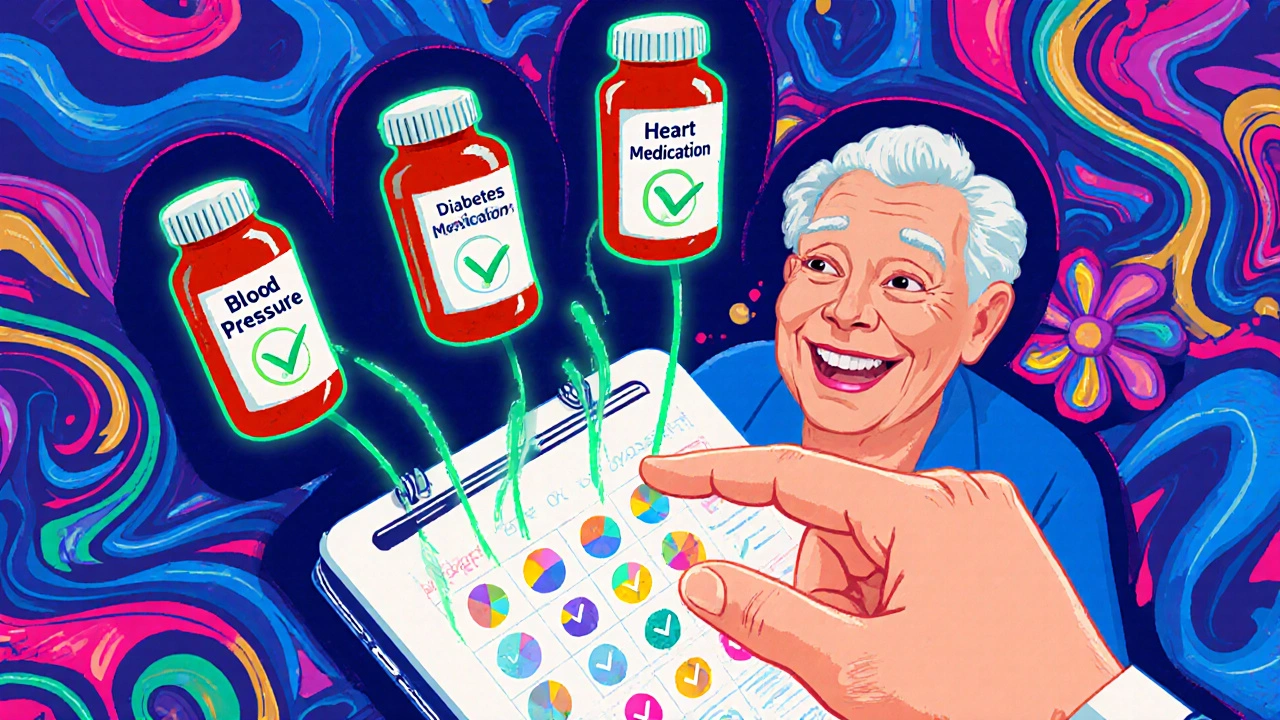
Half of all people taking medication for chronic conditions like high blood pressure, diabetes, or heart disease don’t take it as prescribed. That’s not because they’re forgetful or careless-it’s because managing multiple pills at different times of day is confusing, overwhelming, and easy to mess up. And the cost? In the U.S. alone, non-adherence adds up to medication adherence problems that cost over $300 billion every year. But there’s a simple, powerful solution that’s working for millions: medication reminder apps.
How Medication Reminder Apps Actually Work
These aren’t just alarm clocks with pill names. Modern medication reminder apps like Medisafe and MyTherapy sync with your phone’s calendar, send customizable alerts, track when you’ve taken your meds, and even warn you about dangerous drug interactions. They work on both iOS and Android, and most sync across devices so your tablet, phone, and even your partner’s phone can stay in sync.What makes them effective isn’t just the beep or buzz. It’s the feedback loop. When you mark a dose as taken, the app logs it. Later, you can see a visual chart of your adherence-like a streak of green checkmarks. That little bit of visual progress triggers something in the brain. It’s not magic. It’s behavioral science.
Studies show that people using these apps are about twice as likely to take their meds correctly compared to those who don’t. One 2023 analysis of 9 studies involving over 1,100 patients found app users had significantly better adherence than control groups. And the effect? Bigger than motivational interviews or printed education materials.
Top Apps That Actually Deliver Results
Not all apps are created equal. Out of over 1,200 medication management apps on the app stores, only a handful have proven track records. Here are the ones that consistently show up in clinical studies and user reviews:- Medisafe: Launched in 2012, it’s one of the oldest and most trusted. It supports up to 10 medications per schedule, sends voice reminders, and integrates with pharmacy systems. In a 2023 NIH study at community health centers, users saw a 43% improvement in adherence-nearly five times better than the control group.
- MyTherapy: Popular for its clean design and medication history graphs. Users love the ability to log how they’re feeling alongside doses, which helps spot patterns like "I always skip my blood pressure pill after lunch." It also has a feature that alerts you if you’re due for a refill.
- Round Health: Built for caregivers and families. If your parent lives alone and takes 8 pills a day, you can get alerts if they miss a dose. It’s not just for the user-it’s for the whole support system.
- CareZone: Combines medication tracking with a digital pharmacy organizer. You can scan pill bottles to auto-populate dosing info, store insurance cards, and even share medication lists with doctors via email or PDF.
- Mango Health: Uses rewards and points to boost motivation. Earn gift cards for consistent use. It’s gamified, but not in a gimmicky way. People stick with it because they’re actually getting something back.
These five apps account for 63% of all downloads in the space. The rest? Many are outdated, poorly designed, or no longer updated. In fact, a 2025 review found that 7 out of 14 apps studied were no longer maintained-meaning they might stop working or have security holes.
Why Condition-Specific Apps Work Better
A generic reminder for "take pill at 8 AM" isn’t enough. People with heart disease, diabetes, or hypertension need context. Why does this pill matter? What happens if they skip it?Apps designed for specific conditions-like the MedApp-CHD tool for coronary heart disease patients-include educational content tailored to that illness. For example, instead of just reminding you to take your statin, it might say: "Taking this daily lowers your chance of a heart attack by 30%. Skipping it today raises your risk." That kind of personalized messaging sticks.
One 2025 study in JMIR found that 9 out of 14 top apps were condition-specific. Of those, 4 focused on hypertension. And guess what? Those apps had the highest adherence rates. Why? Because they connect the action (taking the pill) to the outcome (avoiding stroke).
The Hidden Hurdles: Who Struggles-and Why
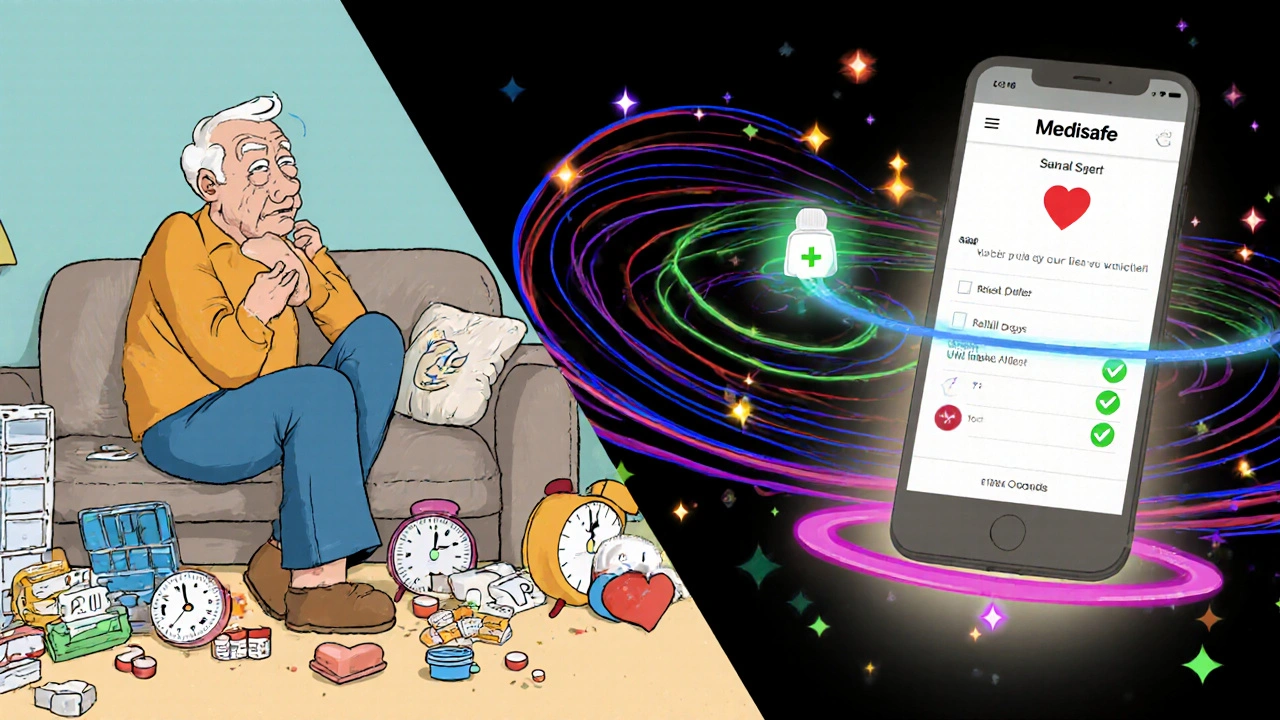
You might assume older adults would have the hardest time with apps. But here’s the twist: a 2023 NIH study found that medically underserved seniors-many over 70-were just as likely to use Medisafe successfully as younger users. After a single 15-minute training session, 87% could set up the app on their own.So why do only 29% of adults 65+ use these tools? It’s not about digital skills. It’s about access. Many don’t own smartphones. Others can’t afford data plans. And some are told by doctors, "Just use a pill organizer," without ever mentioning apps as an option.
There’s also the issue of motivation. If your condition isn’t causing symptoms-like high cholesterol or early-stage diabetes-you might not feel the urgency. That’s where apps with AI-driven nudges come in. Medisafe’s 2025 update now predicts when you’re likely to miss a dose based on your past behavior. If you’ve skipped doses after weekends for the last three weeks, it might send a message: "You usually skip after Sunday brunch. Want to set a reminder for 10 AM?"
What Makes an App Truly Effective
Not every feature matters. Here’s what actually moves the needle:- Customizable reminders: Can you set different times for each pill? Can you choose between sound, vibration, or pop-up alerts?
- Visual tracking: Do you see a calendar or graph of your adherence? Humans respond to visuals.
- Integration with pharmacies: Can it alert you when a refill is due? Can it send your prescription directly to your pharmacy?
- Security: Does it use HIPAA-compliant encryption? Your health data should be protected.
- Family access: Can a caregiver monitor your progress without needing to take over your phone?
Apps that lack these features often fail. One user on Reddit said: "I tried three apps. Two didn’t let me set different times for my morning and night pills. One kept dying on me. I gave up."
Also, battery drain is a real complaint. Some apps run constantly in the background. Look for ones that use push notifications instead of constant polling. That saves battery and data.
What’s Next: AI, Smart Pills, and the Future
The next wave of tools won’t just remind you-they’ll predict and adapt. Medisafe’s AI now analyzes your usage patterns and adjusts reminders automatically. If you consistently take your insulin at 7:30 AM but miss it on weekends, the app learns and nudges you earlier on Friday nights.By 2027, experts predict 35% of apps will connect to smart pill bottles that log when they’re opened. Imagine your app knowing you didn’t open your blood thinner bottle at 8 AM-and sending a text to your daughter: "Mom hasn’t taken her pill yet. Can you check?"
And it’s not just tech. Health systems are starting to pay for it. A 2025 Rock Health report found apps that prove real outcomes-like the 43% adherence jump in the NIH study-are 3.2 times more likely to be covered by insurance or included in value-based care programs.
Getting Started: Simple Steps
If you’re ready to try one:- Choose one app from the top five listed above.
- Download it from the App Store or Google Play.
- Open it and enter your medications: name, dose, time, frequency.
- Set up reminders. Don’t just use the default. Adjust for your real schedule.
- Turn on notifications. Test them. Make sure they’re loud enough.
- Let a family member or caregiver link their phone to yours (if the app allows).
- Check your weekly adherence chart every Sunday. Celebrate your streaks.
It takes about 22 minutes to set up. But the payoff? Fewer hospital visits, less stress, and more control over your health.
Do medication reminder apps really work?
Yes, when used correctly. Studies show people using apps like Medisafe and MyTherapy are about twice as likely to take their meds as prescribed. One analysis found these apps improved adherence more than educational pamphlets, motivational interviews, or basic alarm clocks. Effectiveness increases when the app is personalized, tracks progress visually, and integrates with your daily routine.
Are these apps safe for my health data?
Top apps like Medisafe and MyTherapy use HIPAA-compliant security with AES-256 encryption for stored data and TLS 1.2+ for data in transit. That means your medication history is protected the same way banks protect financial data. Avoid apps that don’t mention security or compliance-stick to ones used in clinical studies or recommended by pharmacies.
Can I use these apps if I’m not tech-savvy?
Absolutely. A 2023 NIH study found seniors over 70, many with limited tech experience, could set up Medisafe after just one 15-minute training session. The key is choosing a simple, well-designed app and getting help once to set it up. Most apps have step-by-step guides and customer support. You don’t need to be a tech expert-just willing to try.
What if I miss a dose? Will the app punish me?
No. Good apps don’t shame you. They help you understand patterns. If you miss a dose, the app might show you: "You missed this pill 3 times last week. Was it because you were out of the house?" That’s not guilt-it’s insight. Some apps even let you add notes like "Felt dizzy, skipped it" so you can spot triggers and talk to your doctor.
Can my doctor see what I’m taking?
Most apps let you generate a PDF of your medication log to share with your doctor. Some, like CareZone and Medisafe, can integrate with electronic health records through FHIR APIs-but only if your provider supports it. Always ask your doctor if they accept digital logs. Many do now, especially in larger health systems.
Are these apps covered by insurance?
Most aren’t covered yet-but that’s changing. Apps that prove real health improvements, like reducing hospital visits or improving blood pressure control, are starting to be reimbursed under value-based care programs. If your doctor recommends one, ask if it’s part of a pilot program. Some Medicare Advantage plans now offer them as a benefit.
What if I have trouble remembering to use the app?
That’s normal. Start small. Link app use to a daily habit you already do-like brushing your teeth or having coffee. Set a phone alarm for 8 PM that says, "Check your meds app." Over time, using the app becomes automatic. And remember: even using it 3 days a week is better than not at all. Progress, not perfection, is the goal.
Ezequiel adrian
November 26, 2025 AT 06:10Bro, I just downloaded Medisafe after reading this and set it up for my dad’s 7 meds. He’s 78, doesn’t use smartphones, but I did it for him in 10 mins. Now I get alerts if he misses a dose. 🙌
JAY OKE
November 27, 2025 AT 11:04Honestly? I’ve tried 4 of these apps. Only Medisafe and MyTherapy didn’t glitch out or vanish after a month. The rest? Dead apps with dead notifications. Stick to the ones with real data behind them.
Brittany Medley
November 28, 2025 AT 13:47One thing no one talks about: battery optimization. I used to have my phone die by 3 PM because some app was polling every 2 minutes. Switched to Medisafe with push notifications only-now my battery lasts all day. Also, HIPAA compliance isn’t optional. If it doesn’t say it, don’t trust it.
And yes, caregivers should have access. My mom’s app lets me see her adherence without logging into her account. That’s privacy-respecting design.
Don’t underestimate the power of the weekly chart. Seeing 6/7 green checkmarks on Sunday? That’s dopamine. That’s motivation. That’s behavioral science working.
Also-don’t use the default alarm tone. Set something you’ll actually hear. I use a soft chime. My neighbor thought I was having a seizure for a week because I had it on siren mode.
And if you’re on Medicare Advantage? Ask your plan if they cover Medisafe. Mine does. It’s listed under ‘digital health tools.’
Bottom line: It’s not about tech literacy. It’s about access, trust, and design. Pick the app that feels like a tool, not a taskmaster.
Rachel Whip
November 29, 2025 AT 13:48I work in geriatric pharmacy. We hand out printed pill organizers all the time. But patients who use Medisafe? Their refill rates go up 40%, ER visits drop. It’s not magic-it’s consistency. The visual feedback? That’s the key. Humans are wired for patterns. A streak of green checkmarks is more powerful than a doctor’s lecture.
Also-don’t let anyone tell you seniors can’t use apps. We’ve trained 80+ year olds with zero tech experience. 15 minutes. One-on-one. Done. The barrier isn’t ability-it’s awareness. Most doctors still don’t mention these tools.
Marissa Coratti
November 30, 2025 AT 10:35While I appreciate the comprehensive overview of digital adherence tools, I must emphasize the epistemological underpinnings of behavioral reinforcement theory as it pertains to medication compliance. The phenomenon of gamified reward systems-exemplified by Mango Health-operates through operant conditioning paradigms, wherein positive reinforcement (e.g., gift card accrual) increases the probability of target behavior repetition. This is not merely motivational; it is neurobiologically grounded in dopaminergic pathways activated by consistent reward anticipation.
Moreover, the integration of FHIR APIs into platforms like CareZone represents a paradigmatic shift toward interoperable health data ecosystems, aligning with the broader movement toward value-based care models. The fact that 3.2 times more apps demonstrating clinical efficacy are being reimbursed underscores a systemic recalibration in healthcare economics.
Furthermore, the assertion that condition-specific applications yield superior adherence rates is empirically validated by the JMIR 2025 study, which demonstrated that contextualized educational prompts-such as linking statin intake to a 30% reduction in myocardial infarction risk-activate cognitive salience, thereby enhancing behavioral retention beyond generic reminders.
It is also noteworthy that the 2023 NIH study’s finding regarding elderly users’ capacity to independently configure Medisafe after a single 15-minute session challenges the pervasive ageist assumption of digital incompetence among older adults. This is not a technological gap-it is a pedagogical one.
Therefore, I urge all stakeholders-clinicians, policymakers, and patients alike-to recognize these applications not as peripheral digital novelties, but as evidence-based, clinically validated interventions worthy of institutional endorsement and insurance coverage.
And yes-battery drain is a legitimate concern. Push notifications over background polling are non-negotiable for sustainable usage.
Finally, trust is not an afterthought. It is the foundational architecture upon which adherence is built.
Aaron Whong
November 30, 2025 AT 12:01Let’s not confuse digital nudges with systemic intervention. These apps are Band-Aids on a hemorrhaging healthcare system. $300 billion wasted annually on non-adherence? That’s not a user problem-it’s a structural one. Pharma pricing, fragmented care, lack of social support, and physician neglect are the real culprits. An app can’t fix a $120 insulin co-pay or a 12-minute doctor visit.
Yes, Medisafe works. But why are we outsourcing responsibility to consumers while the system continues to fail them? This is techno-solutionism dressed up as empowerment. It’s not about better reminders-it’s about better access, better pricing, better care.
And don’t get me started on the ‘gamification’ narrative. Turning health into a mobile game doesn’t heal-it commodifies. You’re not a player. You’re a patient. And patients deserve dignity, not points.
Still… I use MyTherapy. It helps. But I’m angry it has to.
Sanjay Menon
December 1, 2025 AT 09:57Wow. Another ‘here’s a list of apps’ article. How utterly pedestrian. Did you even read the 2024 Lancet Digital Health meta-analysis? The effect sizes are negligible when adjusted for socioeconomic confounders. And let’s not pretend these apps are ‘proven’-most studies are industry-funded, underpowered, and lack long-term follow-up.
Also, ‘gamification’? Please. Mango Health is just a loyalty program with a pill icon. And ‘AI nudges’? That’s just predictive analytics masquerading as intelligence. It’s not adaptive-it’s algorithmic repetition.
Meanwhile, real solutions-like community health workers, home visits, or pill dispensers with biometric locks-are ignored because they cost money. But hey, let’s just push another app onto the elderly and call it innovation. How very Silicon Valley of you.
I’m not saying apps are useless. I’m saying they’re a distraction. A digital placebo. And we’re all being sold a bill of goods.
Ali Miller
December 1, 2025 AT 12:03USA only. That’s it. That’s the tweet. All these apps? Built for Americans with smartphones and data plans. What about the rest of the world? Nigeria? India? Mexico? You think grandma in Lagos has a $800 iPhone and a $30/month data plan? No. She has a flip phone and a handwritten list. And you’re writing a 2,000-word essay on ‘AI nudges’?
Stop acting like this is a global solution. It’s a first-world luxury. And you’re patting yourselves on the back like you solved world hunger.
Meanwhile, real people are skipping insulin because they can’t afford it. Not because they forgot. Because they’re broke. But sure, let’s blame them for not downloading an app. 🤡
Cynthia Springer
December 3, 2025 AT 06:02I’ve been using Medisafe for 18 months for my hypertension meds. I didn’t think I’d stick with it-but the weekly chart changed everything. I started noticing patterns: I always missed my pill on weekends if I went out for brunch. So I set a reminder for 10 AM Sunday. Worked. No guilt. Just insight.
I also let my sister link her phone. She’s not controlling me-she just gets a heads-up if I haven’t opened the app in 24 hours. It’s not surveillance. It’s care.
And yes-I used to skip doses because I didn’t feel sick. But the app’s little note-‘Taking this lowers your stroke risk by 40%’-made it real. Not abstract. Real.
One thing I wish it had: a way to log side effects. I felt dizzy after my new BP med. I wrote it in the notes. Then showed it to my doctor. We adjusted the dose. That’s power.
It’s not perfect. But it’s mine. And that matters.