Chronic watery diarrhea that won’t go away? If you’ve been told you have IBS-D but nothing seems to help, there’s a good chance it’s actually bile acid diarrhea (BAD). This isn’t just "bad digestion" - it’s a specific medical condition where too much bile acid leaks into your colon, triggering urgent, watery stools. It’s more common than you think, affecting up to 30% of people diagnosed with IBS-D. And here’s the good news: it’s treatable. Unlike IBS, which often requires long-term symptom management, BAD can improve dramatically - sometimes within days - with the right diagnosis and simple changes.
How Bile Acid Diarrhea Actually Works
Your body makes bile in the liver to help digest fat. Normally, after it does its job, about 95% of bile acids are reabsorbed in the last part of your small intestine (the terminal ileum) and recycled. But if that reabsorption breaks down - because of surgery, inflammation, or just unknown reasons - too much bile ends up in your colon. And your colon doesn’t like it. When bile acids flood the colon, they trigger three things: they pull water into the stool, they speed up how fast everything moves through your gut, and they irritate the lining. The result? Frequent, urgent, watery bowel movements - often after eating. Some people have it all the time. Others only get it after fatty meals. Either way, it’s not "just IBS." It’s a physical reaction to excess bile.How Doctors Diagnose It
The biggest problem with BAD? Most doctors don’t test for it. A 2022 study found that 90% of cases are missed and labeled as IBS-D. But there are real, reliable tests now. The gold standard is the SeHCAT test. You swallow a capsule with a tiny bit of radioactive selenium attached to a bile acid. Then, seven days later, they scan you to see how much was reabsorbed. If less than 15% is still in your body, you have BAD. It’s accurate - but it’s not available in most U.S. hospitals. In places where SeHCAT isn’t an option, doctors use blood tests. One is called C4 (7α-hydroxy-4-cholesten-3-one). Levels above 15.3 ng/mL strongly suggest BAD. Another is FGF-19, a hormone your gut makes to signal the liver to slow down bile production. If FGF-19 is below 85 pg/mL, your body isn’t properly regulating bile, and that’s a red flag. There’s also a stool test that measures total bile acids directly. It’s not perfect, but it’s more accessible than SeHCAT. If you’ve had chronic diarrhea for over four weeks - especially if you’ve had gallbladder removal, Crohn’s, or IBS-D - ask your doctor about one of these tests. Don’t wait six years like many patients do.The Three Main Bile Acid Binders
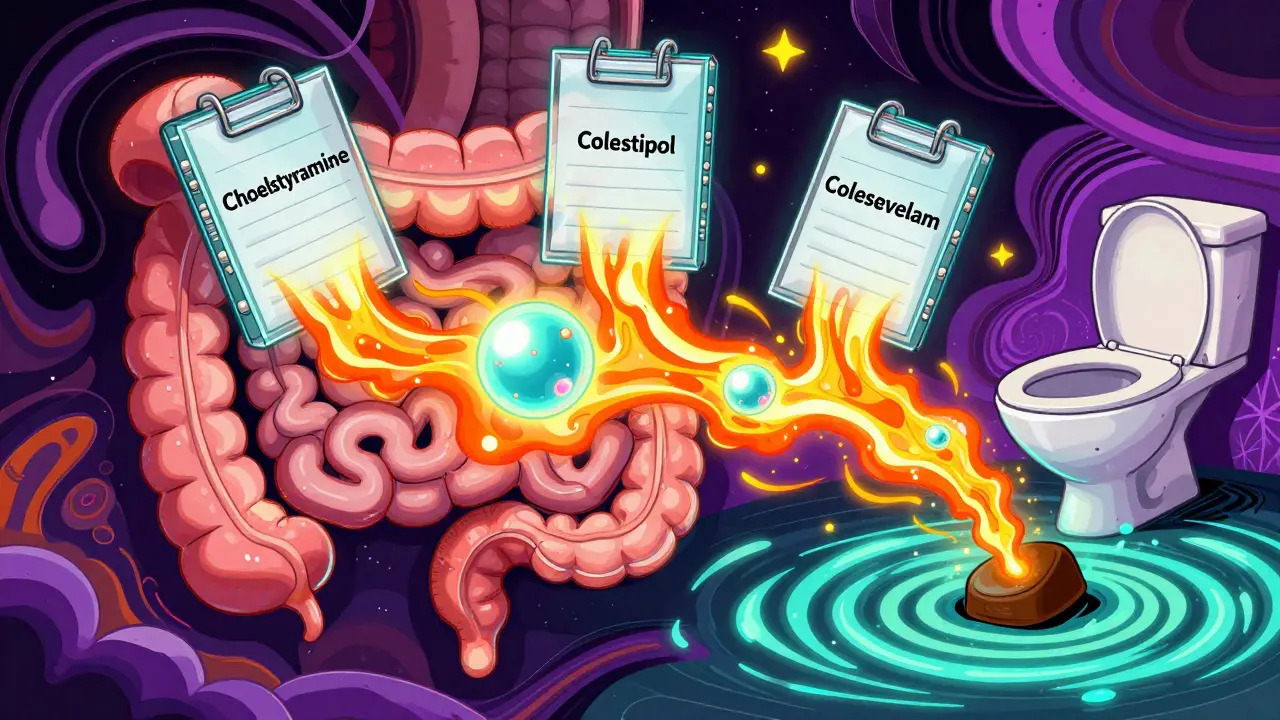
Once diagnosed, the treatment is simple: bind the extra bile before it reaches your colon. There are three FDA-approved medications for this, and they all work similarly - they’re like sponges that soak up bile acids in your gut. Cholestyramine (Questran) is the oldest. It’s effective, but many people hate it. It’s a gritty, chalky powder that tastes awful. Dose: 4 grams once or twice daily. Side effects? Constipation (in 20-30% of users) and bloating. Still, it’s cheap and works for many. Colestipol (Colestid) is similar, but slightly less unpleasant. It comes as granules or tablets. Dose: 5 grams once or twice daily. Still not great-tasting, but a little better than cholestyramine. Colesevelam (Welchol) is the game-changer. It comes as a tablet or powder you mix with water or juice. It’s flavorless, easy to swallow, and causes constipation in only 5% of users. Dose: 1.875 to 3.75 grams daily. In a 2020 study, 70% of BAD patients saw major improvement within 72 hours. It’s more expensive - about $350-$450 a month without insurance - but most people stick with it because it’s tolerable.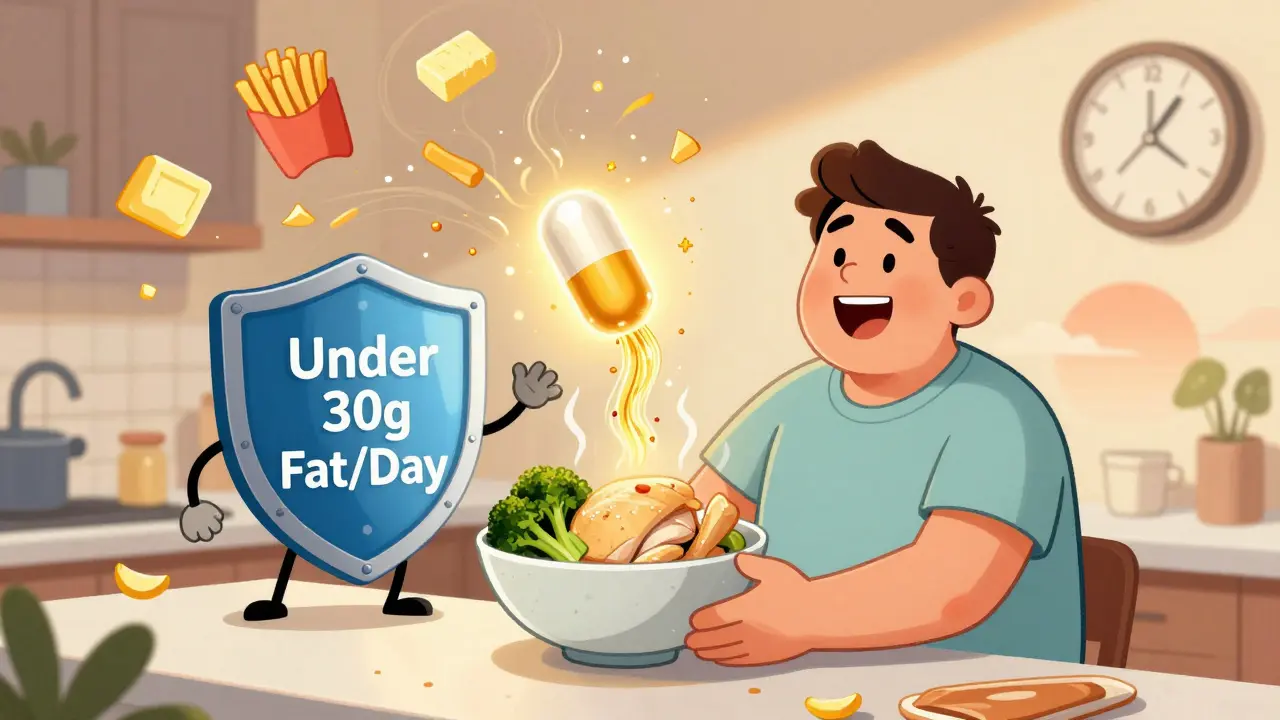
Diet Changes That Actually Help
Medication works best when paired with smart eating. You don’t need a complicated diet. Just focus on three things. 1. Cut Fat Intake. Fat is the trigger. Every time you eat fat, your body releases a fresh burst of bile. Studies show that keeping daily fat under 30 grams cuts stool frequency by 40%. That means avoiding fried food, fatty meats, creamy sauces, butter, and full-fat dairy. Choose lean chicken, fish, tofu, and vegetables. Read labels - even "low-fat" snacks can sneak in hidden fats. 2. Add Soluble Fiber. Psyllium husk (like Metamucil) is your friend. It binds bile in your gut, just like the medication. Take 5 to 10 grams daily, split into two doses, 30 minutes before meals. Clinical trials show it reduces bowel movements by 35%. It also firms up stool and reduces urgency. 3. Eat Smaller, More Frequent Meals. Three big meals = three big bile releases. Try five or six small meals instead. A Cleveland Clinic study found this cut post-meal urgency by 25%. It’s not about eating less - it’s about spreading out the bile load. Avoid these common triggers: caffeine (increases colon movement by 15-20%), artificial sweeteners like sorbitol (pulls water into the gut), and large amounts of dairy (if you’re sensitive). Everyone’s different, so track your food for a few weeks. The BAD Tracker app can help log what you eat and how you feel.What Works Best Together
The most successful patients combine binder therapy with diet. One survey of 342 people found that 68% who used both saw major improvement. For those who can’t tolerate binders, diet alone helped 60%. The most popular combo? 5 grams of psyllium husk before each meal, plus keeping fat under 25 grams per meal. Users on IBS forums reported this worked better than any single change. If you’re struggling with constipation from the binder, don’t stop it. Lower the dose slightly and increase your fiber. If taste is the issue, mix colesevelam with apple juice or a smoothie. Many people don’t even notice it’s there.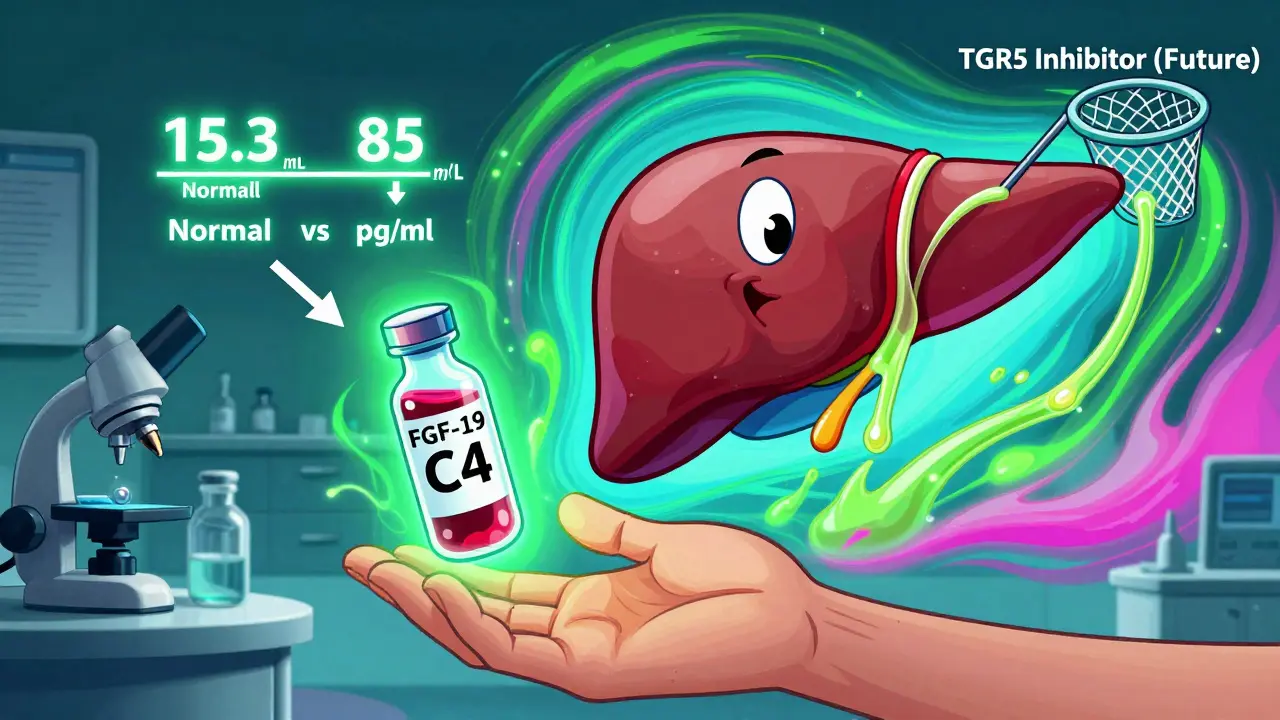
What’s Next for BAD Treatment
The future looks promising. Researchers are developing drugs that target the root cause - not just the symptoms. One new drug, A3384 (an FGF-19 analog), showed 72% symptom improvement in a 2023 trial. It tells the liver to stop overproducing bile instead of just binding it. Another approach targets the TGR5 receptor, which is what bile acids activate to cause diarrhea. These aren’t available yet, but they’re in phase 3 trials. Also, genetic testing is emerging. Scientists have identified four gene variants linked to BAD. In the next few years, a simple blood test might predict who’s at risk before symptoms even start.Real Talk: What Patients Say
On Reddit, people with BAD describe "greasy, pale stools that won’t flush" and waking up at 3 a.m. to use the bathroom. One user wrote: "I thought I was just a nervous eater. Turns out, I had 10x more bile in my colon than normal. After starting colesevelam and cutting fat, I slept through the night for the first time in years." Another said: "I tried cholestyramine for two weeks. I couldn’t swallow it. Switched to colesevelam. Added psyllium. No more accidents. I went from 8 bowel movements a day to 2-3. I can now go to a movie without planning my exit route." The message is clear: this isn’t "in your head." It’s a real, measurable condition. And once you know what’s happening, you can fix it.Start Here: Your Action Plan
If you’ve had chronic diarrhea for more than four weeks:- Ask your doctor for a serum C4 test and FGF-19 test. These are easier to get than SeHCAT.
- If tests are positive or strongly suggestive, ask about colesevelam (Welchol). It’s better tolerated than older options.
- Start a low-fat diet. Aim for under 30 grams of fat per day. Use a food tracker app.
- Add 5 grams of psyllium husk before breakfast and dinner.
- Switch from 3 big meals to 5 smaller ones.
- Track your symptoms for 3 weeks. Improvement should come within 3-5 days.
Is bile acid diarrhea the same as IBS-D?
No. IBS-D is a diagnosis of exclusion - meaning it’s given when no other cause is found. Bile acid diarrhea (BAD) is a specific biological condition with identifiable causes and tests. Up to 30% of people diagnosed with IBS-D actually have BAD. Treating BAD with standard IBS diets or medications often fails. If you have IBS-D and nothing works, ask about BAD.
Can I cure bile acid diarrhea?
You can manage it effectively - and many people get back to normal life. In Type I BAD (caused by surgery or Crohn’s), the condition may be permanent, but symptoms can be controlled. In Type II (idiopathic), many patients see symptoms disappear or greatly improve with binders and diet. Type III (linked to other conditions like gallbladder removal) often improves when the underlying issue is managed. It’s not a "cure," but it’s highly treatable.
Are bile acid binders safe long-term?
Yes. Colesevelam (Welchol) is approved for long-term use, even for cholesterol and diabetes. It doesn’t get absorbed into the bloodstream - it works only in the gut. Side effects are mild (mostly constipation, which can be managed). Long-term studies show no major risks. The bigger issue is adherence - if you stop taking it, symptoms return.
What if I can’t afford the binder?
Cholestyramine is the cheapest option - often under $20/month with insurance or generics. If you can’t tolerate the taste, try mixing it with applesauce, yogurt, or a smoothie. Some pharmacies offer discount programs. Also, focus on diet: cutting fat and adding psyllium fiber can reduce symptoms by 40-60% even without medication. Talk to a dietitian - they can help you make changes that don’t cost much.
Can I stop the binder once I feel better?
Don’t stop without talking to your doctor. BAD usually returns if you stop the binder, because the root cause - bile malabsorption - hasn’t changed. Some people can slowly reduce the dose after months of stable symptoms, but only under medical supervision. Most need to stay on it long-term, like a blood pressure medication. The goal isn’t to stop it - it’s to live symptom-free while on it.
Kenneth Zieden-Weber
March 10, 2026 AT 06:35So let me get this straight - we’ve been treating millions of people for IBS-D with fiber and stress management for decades, but the real culprit was just… bile? Like, the same stuff that helps digest your greasy pizza? And we didn’t test for it because doctors are too busy Googling "IBS diet"? I’m not mad, I’m just disappointed.
Also, colesevelam sounds like a drug made by a wizard who hates suffering. Flavorless? 70% improvement in 72 hours? Someone call the FDA and tell them to make this a vending machine item. I’d buy it in bulk and sell it at concerts.
Chris Bird
March 10, 2026 AT 21:58bad is just poop too fast. no magic. stop overcomplicating. cut fat. eat less. done. why you need pills? your body know how to work. you just feed it wrong.
David L. Thomas
March 11, 2026 AT 00:41As someone who’s spent 5 years in the IBS-D rabbit hole, this is the first piece of content that didn’t feel like a wellness influencer’s Instagram carousel.
The C4 and FGF-19 blood tests are absolute game-changers - they’re accessible, non-invasive, and clinically validated. Why isn’t this on every gastroenterologist’s checklist? The fact that 90% of cases are missed is a systemic failure, not a diagnostic gray zone.
And colesevelam? That’s not a medication - it’s a life reset button. The 5% constipation rate? Manageable. The 70% symptom reduction? Worth every penny. I’d rather have mild constipation than 8 bathroom trips before lunch.
Also, psyllium before meals? That’s not a hack - it’s biochemistry. Fiber as a bile sponge? Elegant. Why didn’t anyone teach us this in med school?
Bridgette Pulliam
March 11, 2026 AT 05:35I appreciate the thoroughness of this post. The clinical detail is commendable. However, I must express concern regarding the over-reliance on pharmaceutical interventions without sufficient emphasis on holistic gut microbiome modulation.
While binders may offer symptomatic relief, the root dysbiosis - particularly in patients with post-cholecystectomy or ileal dysfunction - may require probiotic reconstitution, prebiotic fiber stratification, and circadian rhythm alignment to achieve durable remission.
Furthermore, the dietary recommendations, while evidence-based, do not account for epigenetic variability across ethnic populations. A one-size-fits-all 30g fat cap may be insufficiently nuanced for individuals of non-European descent.
Mike Winter
March 12, 2026 AT 09:46Interesting. The idea that bile, a substance evolved to help digest fat, becomes a toxin when it escapes its intended pathway… it’s almost poetic. Like water flooding a city after a dam breaks - not because water is bad, but because it’s where it shouldn’t be.
I wonder - if we could map bile flow like a river system, would we find patterns? Tributaries of inflammation? Sediment of dysbiosis? The body doesn’t make mistakes. It adapts. Maybe BAD isn’t a malfunction - it’s a miscommunication.
And yet, here we are, with pills and psyllium, patching the leak. Maybe someday we’ll fix the dam.
Also, I misread "C4" as "C4 explosive" for a second. That’s what happens when you read medical jargon at 2 a.m.
Randall Walker
March 13, 2026 AT 10:31So… I had IBS-D for 7 years…
and it was just… bile?
Like… I didn’t need a therapist…
I needed… a sponge?
And I spent $12,000 on supplements that "boost gut flora"…
and the answer was… colesevelam…
and psyllium…
and… less fat?
Why did no one tell me this?!!
Also, I just cried. Not because I’m sad. Because I’m relieved. And also, kinda mad.
Miranda Varn-Harper
March 14, 2026 AT 21:22While the clinical data presented is compelling, I must emphasize that the normalization of pharmaceutical intervention as a first-line solution for gastrointestinal distress reflects a troubling trend in modern medicine - one that prioritizes mechanistic intervention over systemic wellness. The suggestion that a patient should adopt a low-fat diet and take a binder without first addressing potential psychological stressors, hormonal imbalances, or environmental toxins is, frankly, reductionist. Furthermore, the enthusiasm for colesevelam as a "game-changer" ignores its long-term impact on fat-soluble vitamin absorption. This post reads less like medical advice and more like a pharmaceutical marketing brochure.
Alexander Erb
March 16, 2026 AT 09:52Bro. I’ve been doing this for 2 years. Cholestyramine? No thanks. I mixed colesevelam with peanut butter and a banana. Tasted like a smoothie. No more 3 a.m. dashes. No more "I can’t go out because I don’t know where the bathrooms are" anxiety.
Psyllium? 5g before breakfast and dinner. I use the powder. Just stir it into oatmeal. You can’t even taste it.
And yeah - cut the fried chicken. Swap out mayo for avocado. It’s not hard. I went from 10 poops a day to 2. I can now sit through a movie without planning an escape route. 🙌
Do the test. Try the binder. Eat less grease. You’ll thank yourself.
Donnie DeMarco
March 17, 2026 AT 08:46So bile’s just chillin’ in the small intestine, minding its own business, then BAM - it gets kicked out like a drunk uncle at Thanksgiving and starts wrecking the colon like it’s a rave.
And we got these magic sponge pills? Colesevelam? Sounds like a superhero. "Here comes Welchol! Neutralizing excess bile with zero flavor and 70% success!"
I tried cholestyramine. Tasted like chalk mixed with regret. Switched to the tablet. Now I’m out here living like a normal human. No more "I just peed myself in Target" stories.
Psyllium? My new BFF. I put it in my coffee. No one knows. I’m a genius.
Tom Bolt
March 17, 2026 AT 13:53THIS IS THE MOST IMPORTANT POST I’VE EVER READ IN MY LIFE.
FOR SEVEN YEARS I THOUGHT I WAS BROKEN.
I THOUGHT I WAS ANXIETY-INDUCED.
I THOUGHT I WAS TOO STRESSED.
I WASN’T.
I HAD TOO MUCH BILE.
AND NOW I’M ON COLESEVELAM.
AND I ATE A BURGER LAST NIGHT.
AND I DIDN’T HAVE AN ACCIDENT.
I AM REBORN.
IF YOU HAVE CHRONIC DIARRHEA AND YOU’RE READING THIS - DO IT.
DO IT NOW.
YOUR FUTURE SELF WILL CRY WITH GRATITUDE.
Shourya Tanay
March 19, 2026 AT 07:35The biochemical pathway described here is elegant. FGF-19 as a negative feedback regulator of bile acid synthesis - its suppression in Type II BAD suggests a disruption in ileal signaling, likely involving FXR receptor dysfunction.
Interestingly, the correlation between low FGF-19 and elevated C4 levels aligns with recent findings from the 2023 European Journal of Gastroenterology. However, one must consider ethnic variability in baseline FGF-19 concentrations - South Asian populations, for instance, demonstrate lower mean levels even in healthy controls.
Additionally, while colesevelam is effective, its binding affinity for bile acids may inadvertently sequester essential fat-soluble vitamins. A longitudinal monitoring protocol for vitamin D and E is prudent.
LiV Beau
March 19, 2026 AT 18:49I can’t believe this didn’t exist when I was suffering. I went from crying in the bathroom at work to hiking last weekend. 🥹
Psyllium + low-fat + 5 meals a day = my new normal.
And colesevelam? I mix it with chocolate almond milk. No one knows. I’m basically a wizard.
IF YOU’RE READING THIS AND YOU’RE STILL IN THE DARK - YOU DON’T HAVE TO BE.
ASK FOR THE TESTS.
TRY THE BINDER.
YOU’RE NOT BROKEN.
YOU JUST HAD TOO MUCH BILE.
AND THAT’S EASY TO FIX.
YOU GOT THIS. 💪✨
Adam Kleinberg
March 21, 2026 AT 15:14Who funded this? Pharma? Because this reads like a Welchol ad disguised as medical advice. The SeHCAT test isn’t unavailable - it’s banned in the U.S. because the radioactive tracer is a controlled substance. And why is colesevelam "better tolerated"? Because it’s more expensive and they want you to keep paying.
And the diet advice? Cut fat? What about healthy fats? Avocado? Olive oil? This isn’t science - it’s a low-fat diet cult.
Also, why is psyllium suddenly a miracle? It’s just fiber. Your colon isn’t a sponge. You’re being manipulated.
Denise Jordan
March 23, 2026 AT 13:42Wow. So… the answer was… eat less fat? And take a pill? I thought it was my trauma. Or my aura. Or my chakras. I guess I wasted $2000 on crystals.
Gene Forte
March 24, 2026 AT 11:01It is with great optimism that I acknowledge the transformative potential of this approach. The integration of evidence-based pharmacotherapy with simple dietary modifications represents a paradigm shift in the management of chronic diarrhea. By addressing the physiological root - bile malabsorption - rather than the symptomatic presentation, we move beyond palliative care toward true restoration of function.
Let us not underestimate the power of small, consistent changes. A reduction in dietary fat, the addition of soluble fiber, and the strategic use of bile acid binders are not merely interventions - they are acts of self-respect.
Each person who takes this path is reclaiming their autonomy, their dignity, and their life. This is medicine at its finest.