For most people, the idea of testing a new drug means volunteers swallowing pills and having blood drawn over hours or days. But for many generic medications, that step is skipped entirely. The FDA doesn’t always require human trials to prove a generic drug works the same as the brand name. If the science checks out, they’ll accept a simple dissolution test in a lab instead. This is called a bioequivalence waiver-or a biowaiver-and it’s one of the most efficient tools in modern drug regulation.
What Exactly Is a Bioequivalence Waiver?
A bioequivalence waiver lets drugmakers skip in vivo studies-those are the ones involving people-to prove their generic drug behaves the same in the body as the original. Instead, they submit data from lab tests that measure how quickly the pill dissolves in fluids mimicking stomach and intestinal conditions. If the dissolution profiles match closely enough, and the drug meets specific criteria, the FDA accepts it as proof of bioequivalence. This isn’t a loophole. It’s based on decades of research showing that for certain types of drugs, dissolution rate is the only thing that matters. If the pill breaks down the same way in the lab, it’ll absorb the same way in the body. No need to involve volunteers. The legal basis comes from 21 CFR 320.22 and 320.24(a), which say the FDA must accept the most accurate, sensitive, and reproducible method available. For many drugs, that’s in vitro testing-not human trials.Which Drugs Qualify?
Not every drug can get a waiver. The FDA limits this to immediate-release solid oral tablets and capsules. That means pills you swallow, not liquids, injections, creams, or extended-release capsules. The key is the Biopharmaceutics Classification System (BCS). It groups drugs by two things: solubility (how well they dissolve in water) and permeability (how well they cross into the bloodstream). Only two classes qualify for standard waivers:- BCS Class I: High solubility, high permeability. These are the easiest to qualify. Examples include metformin, atenolol, and ciprofloxacin.
- BCS Class III: High solubility, low permeability. These are trickier. The FDA requires the generic to have the exact same excipients (inactive ingredients) as the brand name, and proof the drug isn’t absorbed in a specific part of the gut.
What Does the FDA Require for Approval?
Even if your drug is BCS Class I, you still need to prove three things:- High solubility: The drug dissolves completely across all pH levels from 1.2 to 6.8. For example, if a 100mg dose dissolves in under 250mL of fluid at all pH levels, it passes.
- High permeability: At least 90% of the drug is absorbed in the body. This is often backed by human absorption data from the original brand drug.
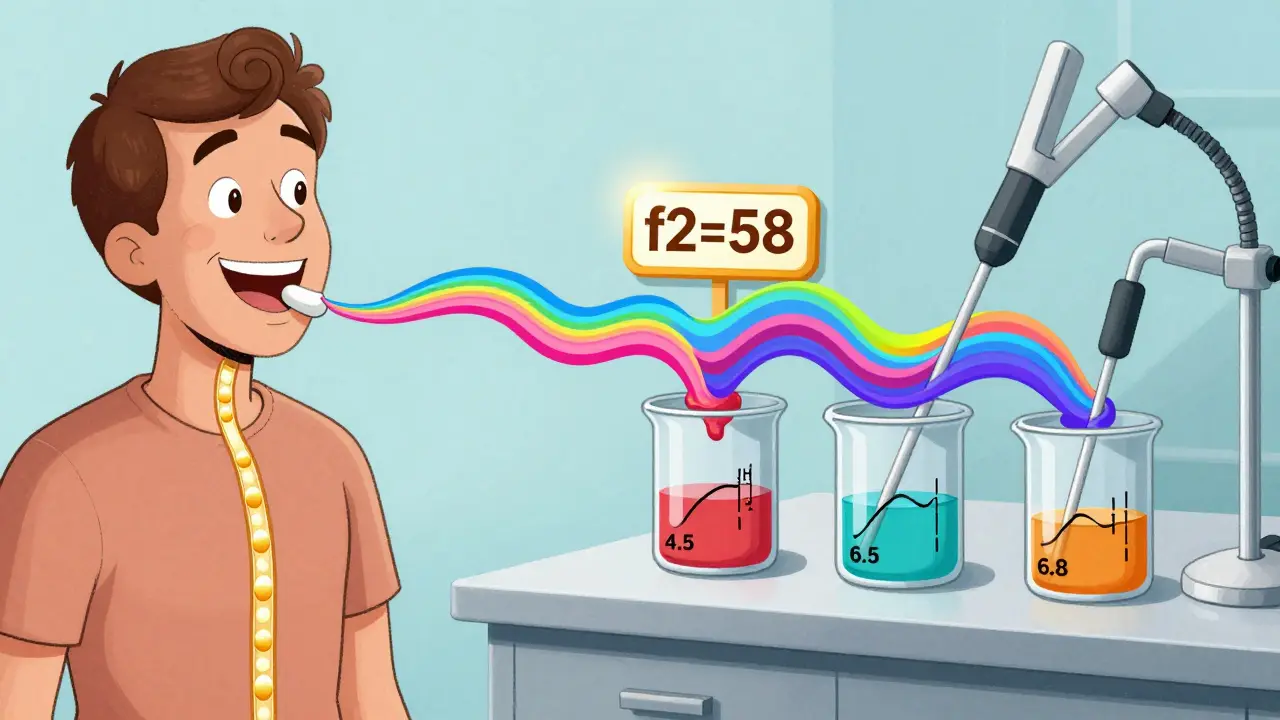
- Similar dissolution: The generic and brand-name drug must dissolve at nearly the same rate. The FDA uses an f2 similarity factor of 50 or higher. That means the dissolution curves must overlap closely at 10, 15, 20, 30, 45, and 60 minutes using pH 1.2, 4.5, and 6.8 buffers.
Why Does This Matter?
The cost savings are massive. A single human bioequivalence study runs between $250,000 and $500,000 and takes 6 to 12 months. A dissolution test? Around $15,000 and 2 to 3 months. For generic drug companies, this means faster market entry and lower prices for patients. Between 2012 and 2016, about 15% of ANDA submissions included biowaiver requests. Of those, 78% were approved when the data was solid. In 2022, nearly 18% of all solid oral generic applications used this pathway-up from 12% in 2018. The impact is real. IQVIA estimates biowaivers have cut approval times by an average of 7.3 months per product. That’s over $1.2 billion in earlier market access for generic drugs every year.Where It Gets Complicated
The system works well for Class I drugs. But problems pop up elsewhere. Class III drugs are a headache. Even if you meet all the technical criteria, the FDA sometimes still asks for human studies. One regulatory specialist reported three out of five Class III waiver requests required extra in vivo data-despite following the guidance exactly. Narrow therapeutic index (NTI) drugs are mostly excluded. These are drugs where small differences in blood levels can cause serious side effects or treatment failure. Think warfarin, levothyroxine, or phenytoin. The FDA doesn’t trust dissolution tests alone for these. (Though there’s a 2023 pilot program looking at exceptions for some antiepileptic drugs.) Another issue? Inconsistent review. A 2022 PhRMA survey found 42% of companies felt the FDA applied the rules differently across divisions. One team approves a waiver; another rejects the same data. That creates uncertainty and delays.
What’s Next?
The FDA is working to expand this. Their 2023-2027 strategic plan aims to increase biowaiver opportunities by 25% by improving the science behind in vitro-in vivo correlations. There’s growing interest in applying this to some modified-release products and even locally acting drugs like inhalers or gut-targeted tablets. But right now, 85% of complex generics still can’t use this path. The agency is also investing $15 million a year through GDUFA to improve dissolution methods and build better predictive models. That means more drugs may qualify in the next few years.Who Benefits?
Patients get cheaper drugs faster. Generic manufacturers save millions and bring products to market quicker. Regulators reduce the burden of human testing without compromising safety. It’s a rare win-win. But it only works if the science is rock solid. A poorly designed dissolution test won’t cut it. The FDA isn’t cutting corners-they’re just using better tools. If you’re a generic drug developer, mastering dissolution method development is no longer optional. It’s the gateway to faster approvals and lower costs. If you’re a patient, know that the pill you’re taking might have been approved without a single person ever swallowing it.Frequently Asked Questions
Can any generic drug get a bioequivalence waiver?
No. Only immediate-release solid oral dosage forms that meet BCS Class I or Class III criteria qualify. Extended-release pills, liquids, injections, and topical products are excluded. Narrow therapeutic index drugs are generally not eligible unless under a specific FDA pilot program.
How do I know if my drug is BCS Class I?
You need to prove two things: high solubility and high permeability. Solubility means the entire dose dissolves in 250 mL or less of fluid across pH 1.2 to 6.8. Permeability means at least 90% of the drug is absorbed in the body, typically shown using data from the original branded drug. The FDA publishes a list of BCS-classified drugs you can reference.
What’s the f2 similarity factor, and why does it matter?
The f2 factor is a statistical measure that compares the dissolution profiles of your generic drug and the brand-name version. An f2 value of 50 or higher means the curves are similar enough to be considered equivalent. It’s calculated using dissolution data collected at 10, 15, 20, 30, 45, and 60 minutes under three different pH conditions. If your f2 is below 50, the FDA will likely ask for human studies.
Do I still need to test for impurities or stability?
Yes. A bioequivalence waiver only removes the need for human studies. You still must prove your drug is chemically stable, free from harmful impurities, and manufactured under good practices. The waiver doesn’t lower quality standards-it just changes how you prove bioequivalence.
How long does a biowaiver application take to approve?
A complete biowaiver submission typically takes 10 to 14 months for FDA review, which is 6 to 10 months faster than a traditional in vivo BE study. However, if your application is incomplete or lacks strong dissolution data, the FDA may issue a deficiency letter, adding months to the timeline. Early consultation through the Pre-ANDA program increases approval chances by 22%.