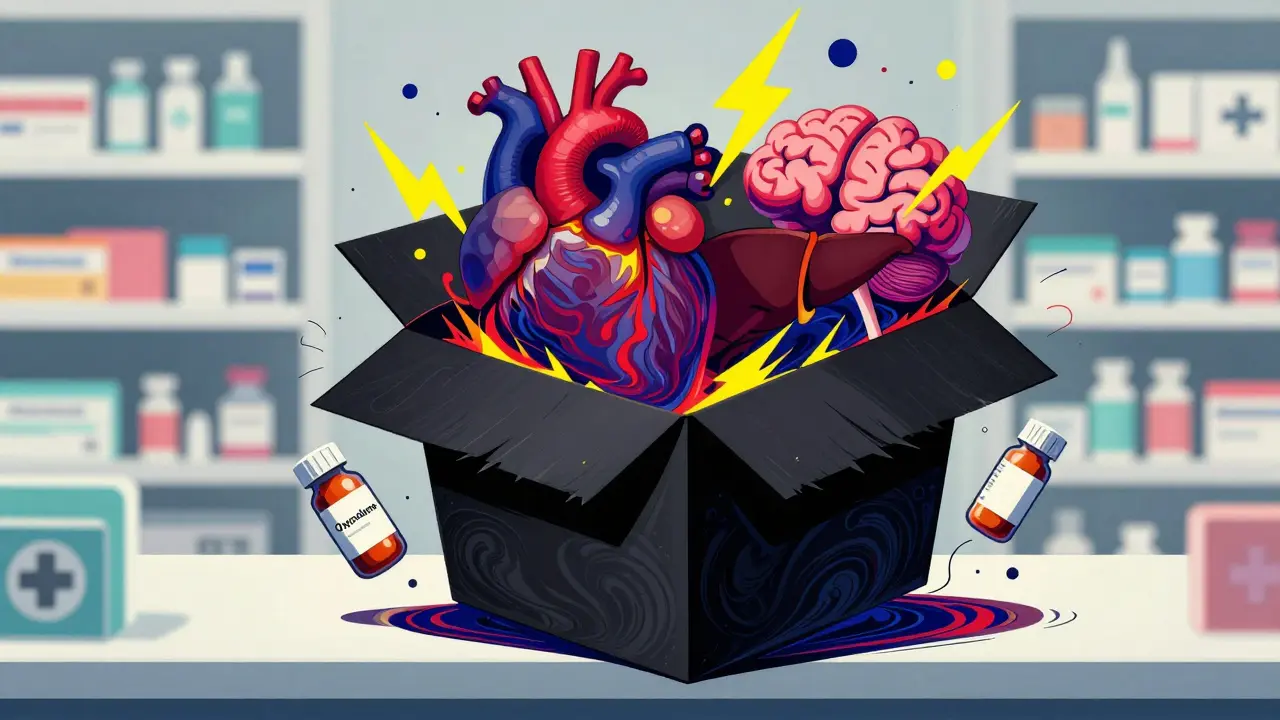
Medication Safety Checklist for Black Box Warnings
If you're prescribed a medication with an FDA black box warning, this checklist will help you verify you're taking all necessary safety precautions. Follow the steps below to ensure you're making an informed choice and staying safe.
Step 1: Understand Your Medication
Step 2: Safety Checklist
Check each item below to ensure you've followed the safety requirements for your medication:
When a drug comes with a black box warning, it’s not just another caution label. It’s the FDA’s loudest possible alarm - a red flag that says: this medicine can kill you. You won’t find this warning buried in fine print. It’s bold, it’s black, and it’s right at the front of the prescription label. If you or someone you care about is taking a medication with this warning, you need to understand what it really means - and what to do next.
What Exactly Is a Black Box Warning?
A black box warning, officially called a boxed warning, is the strongest safety alert the U.S. Food and Drug Administration (FDA) can require. It appears in a thick black border at the top of a drug’s prescribing information, on its packaging, and in promotional materials for healthcare providers. This isn’t a suggestion. It’s a legal requirement. The FDA only puts this warning on drugs that have been proven to carry a serious risk of death or life-threatening injury. These aren’t side effects like a headache or nausea. These are events like liver failure, heart attacks, suicidal behavior, or severe allergic reactions that can happen even when the drug is used exactly as directed.Why Does the FDA Use Black Box Warnings?
The goal isn’t to scare people away from medicine. It’s to make sure no one takes a dangerous drug without fully understanding the stakes. Before a drug gets a black box warning, the FDA reviews years of data - from lab tests and animal studies to clinical trials and real-world reports after the drug hits the market. Most black box warnings aren’t assigned during initial approval. They come later, after doctors and patients start using the drug in large numbers. That’s when rare but deadly side effects show up - like the heart risks linked to rosiglitazone (a diabetes drug) or the suicidal thoughts tied to certain antidepressants in young adults. Between 2004 and 2022, the FDA added over 400 black box warnings to medications. That number keeps growing.What Do These Warnings Actually Say?
Each black box warning is specific. It doesn’t just say “dangerous.” It tells you what the danger is, who it affects, and what you must do to stay safe. Common elements include:- Specific life-threatening conditions the drug can cause
- Who should avoid the drug entirely (like pregnant women, people with liver disease, or those on certain other medications)
- Required monitoring - like monthly blood tests or heart scans
- Instructions for how to safely stop the drug if needed
Black Box Warnings vs. Other FDA Alerts
The FDA issues many types of safety notices - safety alerts, drug communications, label updates. But none carry the same weight as a black box warning. Regular warnings and precautions sections in drug labels mention common side effects or possible interactions. Black box warnings are reserved for risks so severe, they can change whether a drug should be prescribed at all. Think of it like this: a regular warning says, “Watch out for dizziness.” A black box warning says, “This could stop your heart.” One study found that after the FDA issued a black box warning on rosiglitazone, prescriptions dropped by 70%. But for another drug with a similar warning - pioglitazone - prescriptions barely changed. Why? Because rosiglitazone got heavy media coverage. The warning alone isn’t enough. Awareness, media attention, and doctor education all play a role in whether the warning actually changes behavior.Does a Black Box Warning Mean You Can’t Take the Drug?
No. That’s the biggest misunderstanding. A black box warning doesn’t mean the drug is banned or useless. It means the risks are real - and the benefits must be carefully weighed. Many patients with serious conditions rely on drugs with black box warnings. For someone with treatment-resistant depression, a medication that carries a suicide risk might still be the only option that works. For a patient with severe rheumatoid arthritis, a drug that can cause liver damage might be better than constant pain and joint destruction. The key is informed choice. A 2023 guide from the Cleveland Clinic says doctors should always discuss three things with patients: the specific risk, how it will be monitored, and what alternatives exist. If you’re prescribed a drug with a black box warning, ask:- What exactly could go wrong?
- How often do I need blood tests or check-ups?
- Are there safer alternatives that work just as well?
- What signs should I watch for and call my doctor about right away?
What Should You Do If Your Medicine Has a Black Box Warning?
Don’t panic. Don’t stop taking it suddenly. Do this:- Read the warning carefully. Ask your pharmacist for a copy of the full prescribing information if it’s not clear.
- Make sure your doctor knows every other medication, supplement, or herb you’re taking. Some interactions turn a risky drug into a deadly one.
- Follow all monitoring instructions - blood tests, EKGs, liver function checks. Skipping these defeats the whole purpose of the warning.
- Report any unusual symptoms immediately. Even if it seems minor - fatigue, bruising, chest pain, mood changes - call your doctor.
- Use the FDA’s MedWatch program to report side effects. Your report helps the FDA spot new dangers and update warnings.
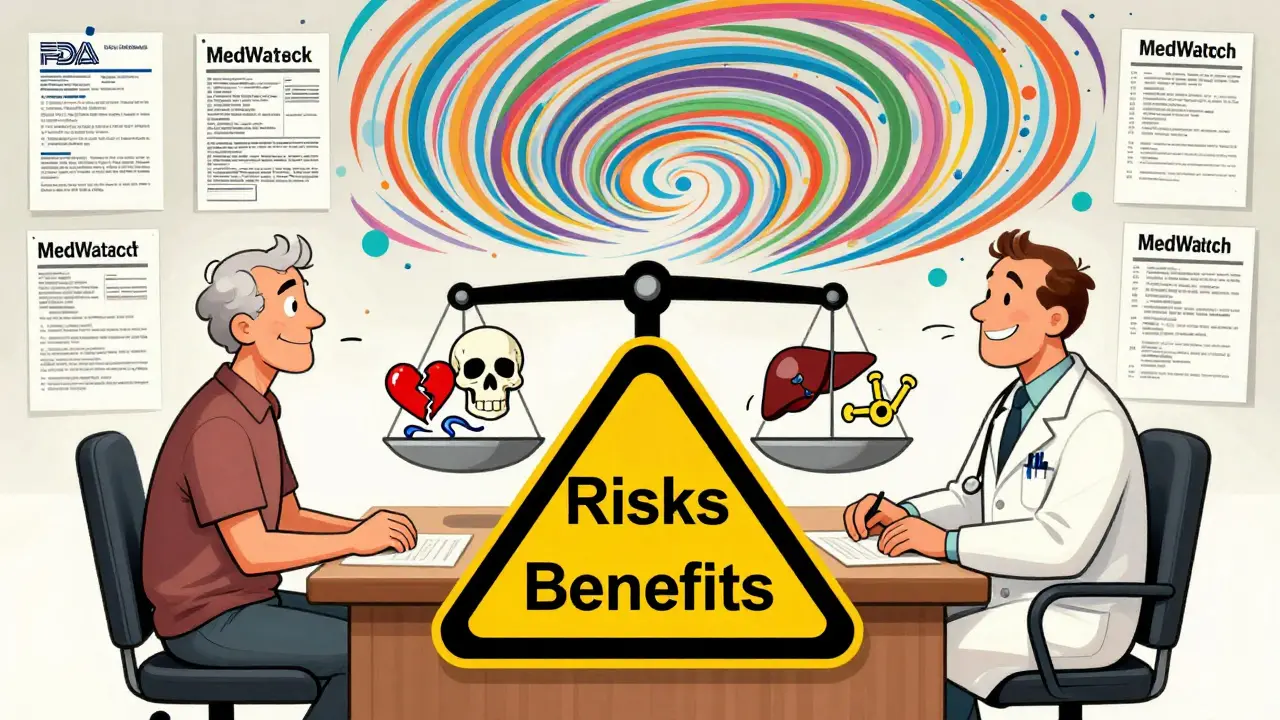
How Do Doctors Decide to Prescribe These Drugs?
Doctors don’t take black box warnings lightly. Many use a framework called STEPS: Safety, Tolerability, Effectiveness, Price, Simplicity. When a drug has a black box warning, Safety becomes the top priority. They’ll ask: Is this the best option? Can we try something else first? Do the benefits outweigh the risks for this patient? Do we have the resources to monitor them properly? The American Academy of Family Physicians recommends doctors use independent tools like the Drug Effectiveness Review Project or Consumer Reports Best Buy Drugs to compare treatment options - not just rely on drug company marketing.What’s Changing in the Future?
Experts agree the black box system works - but it can be better. Right now, warnings often use vague language like “risk of serious injury.” Patients don’t know if that means a 1 in 100 chance or a 1 in 10,000 chance. The FDA is exploring ways to make warnings clearer - using plain language, showing actual risk numbers, and even testing new formats like icons or color coding. There’s also more focus on patient understanding. If a warning doesn’t help a patient make a smart decision, it’s not working. Meanwhile, the FDA continues to monitor drugs after approval using the FDA Adverse Event Reporting System (FAERS). Every report from a doctor, pharmacist, or patient adds to the picture. That’s how new black box warnings get added - because real people spoke up.Final Thought: Knowledge Is Power
A black box warning isn’t a death sentence. It’s a conversation starter. It’s a signal that this drug demands attention - from you, your doctor, and your pharmacist. If you’re prescribed a medication with this warning, you’re not being treated as a statistic. You’re being given the chance to make an informed, life-saving choice. Don’t let fear silence you. Ask questions. Do your homework. Stay alert. And never assume that because a drug is FDA-approved, it’s automatically safe for you - especially when that black box is there.Do all drugs with black box warnings have to be taken with extreme caution?
Yes. Any drug with a black box warning carries a risk of serious harm or death. That doesn’t mean it’s unsafe for everyone - but it does mean every prescription must be carefully considered. Your doctor should explain the specific risks, how they’ll monitor you, and whether alternatives exist. Never take it without understanding those details.
Can a black box warning be removed from a drug?
Yes, but it’s rare. The FDA can remove a black box warning if new evidence shows the risk is lower than originally thought, or if safety measures (like mandatory monitoring) have made the drug much safer in real-world use. For example, some warnings on older psychiatric drugs have been revised after years of data showed better outcomes with proper management.
Are black box warnings only for prescription drugs?
Yes. Black box warnings only apply to prescription medications approved by the FDA. Over-the-counter drugs, supplements, and vitamins don’t carry these warnings - even if they have serious risks. That’s why it’s critical to talk to your doctor before mixing any supplement with a prescription drug.
If I have a black box warning on my medication, should I avoid it during pregnancy?
Many drugs with black box warnings are specifically contraindicated during pregnancy because they can cause birth defects or fetal death. But not all. Some - like certain antidepressants or epilepsy medications - may still be necessary for the mother’s life. Always consult your doctor. Never stop or start a medication during pregnancy without medical advice.
How do I report a side effect from a drug with a black box warning?
Use the FDA’s MedWatch program. You can report online at fda.gov/medwatch, by phone at 1-800-FDA-1088, or by mail. Reports from patients and caregivers are just as important as those from doctors. Your report helps the FDA identify patterns and update warnings to protect others.
Do black box warnings affect drug prices?
Not directly. But they can indirectly affect pricing. Drugs with black box warnings often face lower demand because doctors are more cautious prescribing them. This can make them cheaper than similar drugs without warnings - or more expensive if they’re the only effective option for a rare condition. Insurance coverage may also be stricter, requiring prior authorization.
Can I get a second opinion if my doctor prescribes a drug with a black box warning?
Absolutely. You have the right to seek another doctor’s opinion, especially when a medication carries serious risks. Many patients do this to feel more confident in their treatment plan. Bring the prescribing information and your questions to the second doctor. They can help you weigh the risks and explore alternatives.
Juan Reibelo
January 24, 2026 AT 23:46Black box warnings aren't just bureaucracy-they're lifelines. I had a cousin on clozapine; weekly blood draws felt like a chore until she nearly lost her neutrophils. The system works when you listen. Never skip the labs.
Jamie Hooper
January 25, 2026 AT 13:40frankly i think the fda is overreacting again. like yeah, some drugs kill people-but so does coffee and walking downstairs. why not just put a black box on everything? 🤷♂️
Izzy Hadala
January 25, 2026 AT 23:01It is imperative to underscore that the FDA’s imposition of black box warnings is grounded in post-marketing surveillance data derived from the FAERS database, which constitutes a critical component of pharmacovigilance infrastructure. The statistical significance of adverse event reporting directly correlates with regulatory action thresholds, necessitating rigorous epidemiological evaluation prior to labeling modifications.
Patrick Gornik
January 26, 2026 AT 12:09Let’s be real-the black box is just capitalism’s guilt trip wrapped in regulatory velvet. We’re told these drugs can kill us, but we’re also told they’re the only option. That’s not safety. That’s coercion dressed as care. The system doesn’t want you to be healthy-it wants you dependent. And if you die? Well, there’s always another patient in the pipeline. The real tragedy isn’t the drug-it’s the illusion that we have a choice.
Luke Davidson
January 27, 2026 AT 12:51My mom’s on a black box med for RA and honestly? She’s got more life now than she did in years. Yeah, the blood tests suck-but they’re keeping her out of the hospital. Don’t let fear scare you off something that lets you hug your grandkids again. Ask questions, sure-but don’t quit before you give it a real shot.
Karen Conlin
January 28, 2026 AT 20:53As a nurse who’s seen patients drop like flies because they stopped their meds cold turkey-PLEASE don’t panic and quit. That’s way more dangerous than the warning itself. The black box is there so you can live-not die from misinformation. Talk to your doc. Get the facts. Then decide. You’ve got this.
asa MNG
January 30, 2026 AT 02:36OMG I JUST FOUND OUT MY ANTIDEPRESSANT HAS A BLACK BOX 😱 I’M GONNA DIE 😭 I’M SO SCARED MY DOCTOR DIDN’T TELL ME 😭😭😭
Heather McCubbin
January 30, 2026 AT 19:16People don’t understand that black box warnings are the FDA’s way of saying ‘you’re not smart enough to handle this’-and honestly? They’re right. Most folks won’t read the fine print. They’ll just pop the pill and hope. That’s not empowerment. That’s negligence dressed up as freedom.
Tiffany Wagner
January 30, 2026 AT 23:33I’m on one of these meds and I’m alive. That’s all I needed to know. I do my bloodwork. I tell my doctor everything. That’s all it takes. No drama. Just responsibility.
Viola Li
January 31, 2026 AT 13:07Black box warnings are just corporate loopholes. If these drugs were truly dangerous, they’d be banned-not just labeled. The FDA’s just letting pharma off the hook while scaring patients into compliance. It’s a scam. You’re being manipulated.
venkatesh karumanchi
February 1, 2026 AT 12:45In India, we don’t have black box warnings. We have trust. My uncle took the same drug for 12 years. He’s still here. Maybe the warning is more about fear than facts?
Jenna Allison
February 3, 2026 AT 03:18As a pharmacist, I see this every day. Patients panic at ‘black box’ and stop cold. Then they come back with withdrawal symptoms or worse. The warning isn’t a stop sign-it’s a speed bump. Read it. Ask me. I’ll explain it in plain English. No jargon. Just facts.
Kevin Waters
February 5, 2026 AT 02:49My dad’s on a black box med for bipolar. We thought it was the end of the world. Turns out? It’s the only thing that kept him from ending it. The warning isn’t there to scare you-it’s there so you don’t have to guess. Knowledge is the real safety net.
Kat Peterson
February 5, 2026 AT 21:18Ugh, another corporate puppet warning. The FDA is just a PR arm for Big Pharma. They don’t care if you live or die-they care if you keep buying. 🤮 I’d rather die on my own terms than be medicated into a zombie by a system that profits from my suffering.