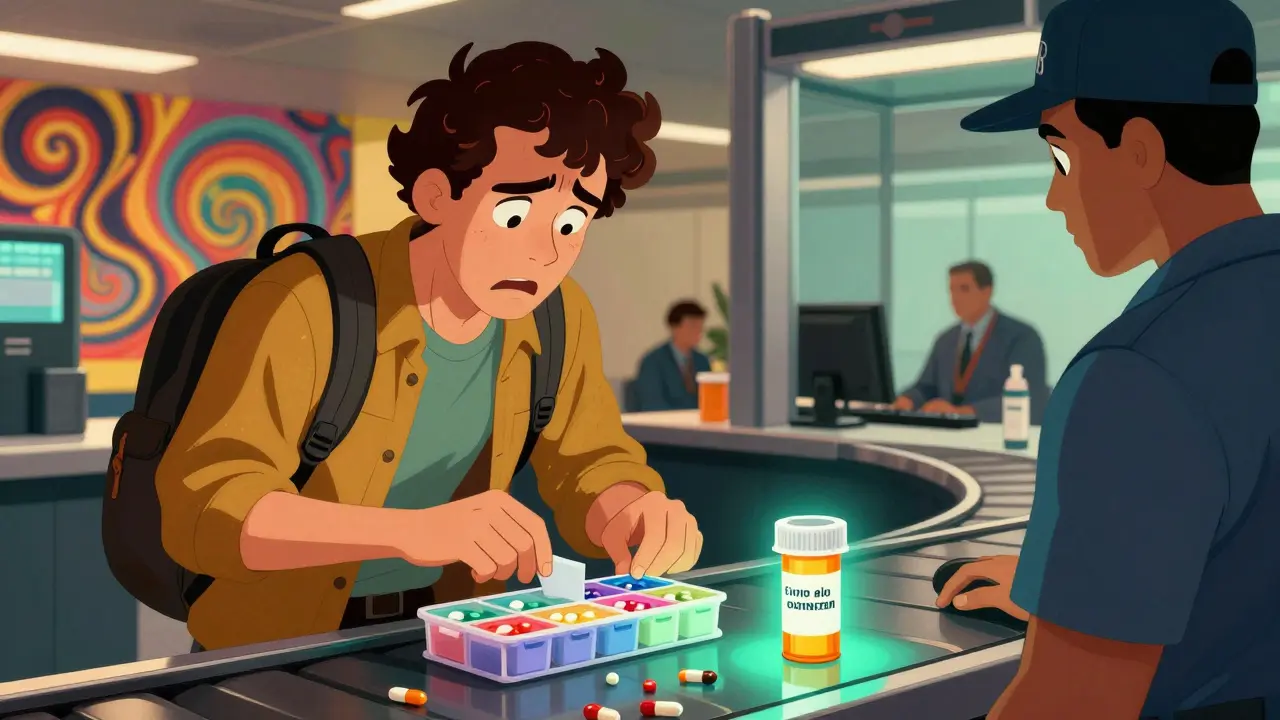
It’s December 2025. You’re packing for a trip to Tokyo, and your heart sinks when you realize your anxiety meds are in a pill organizer. You remember hearing that TSA doesn’t require original bottles-but you also heard someone got detained at customs in Singapore for having Adderall in a plastic case. You’re not alone. Millions of travelers face this same confusion every year. The truth? Carrying medications in original containers isn’t just a good idea-it’s often the only way to avoid delays, fines, or worse.
Why Original Containers Matter More Than You Think
The Transportation Security Administration (TSA) says you don’t have to keep your pills in their original bottles. That’s technically true. But here’s what they don’t tell you: TSA doesn’t control what happens after you clear security. That’s where customs officers, state laws, and foreign governments step in-and they don’t care about TSA’s leniency. In the U.S., 37 states require prescription medications to be in their original containers with pharmacy labels. That includes California, New York, Texas, and Florida. If you’re pulled over during a road trip or flagged at a state border, you could face legal trouble if your pills aren’t labeled. Internationally? It’s worse. Countries like Japan, South Korea, and the UAE ban common over-the-counter meds like Sudafed. Codeine, Adderall, and even some sleep aids are illegal in places like Thailand, Singapore, and the UAE. If you’re caught with them in a pill case, you’re not just inconvenienced-you could be arrested. Original containers aren’t just about rules. They’re about proof. A pharmacy label shows the drug name, dosage, prescriber, and expiration date. That’s the only thing that tells a customs officer you’re not smuggling drugs. Without it, you’re just a person with unknown pills. And in a world where counterfeit meds are rampant-especially in Southeast Asia-authorities are trained to be suspicious.TSA Rules vs. Real-World Reality
TSA allows you to bring any amount of solid medication in your carry-on. Liquids? You can bring more than 3.4 ounces if it’s medically necessary-but you have to tell the officer at the start of screening. That’s it. No bottles required. Sounds simple, right? But here’s what happens in practice: If you pull out a plastic pill organizer filled with 12 different pills, the TSA agent has no way to verify what they are. They’ll likely send you to secondary screening. You’ll be asked to explain each pill. You’ll be asked for a prescription. If you don’t have one, you’ll be delayed-sometimes for hours. In 2023, travelers with medications in original containers passed through screening 42% faster than those using pill organizers, according to research from Johns Hopkins University. And here’s the kicker: TSA agents aren’t trained pharmacists. They don’t know what “Mirtazapine” looks like. They know what a pharmacy label looks like. That’s why they prefer original bottles. It’s not a rule-it’s a shortcut. And if you want to avoid being treated like a suspect, you give them the shortcut.International Travel? It’s a Different Game
Flying abroad? You’re entering a patchwork of drug laws that change with every border. The U.S. Department of State lists 187 countries with specific medication restrictions. Some require permits. Some ban entire classes of drugs. And none of them care about your U.S. prescription. Japan allows only a one-month supply of most medications. The UK allows 30 days. Canada requires a doctor’s letter for controlled substances. Australia bans many common ADHD meds. And if you’re flying into the UAE, don’t even think about bringing any opioid painkillers-even if they’re prescribed. The U.S. Embassy in Mexico tracked over 1,200 medication-related incidents in 2023. Travelers who had their meds in original containers with doctor’s letters had a 68% lower chance of being denied entry. Those using pill organizers? They were turned away nearly twice as often. Why? Because international customs officers rely on labels to verify authenticity. A bottle with a U.S. pharmacy stamp and your name on it says, “This is legitimate.” A plastic case says, “I’m hiding something.”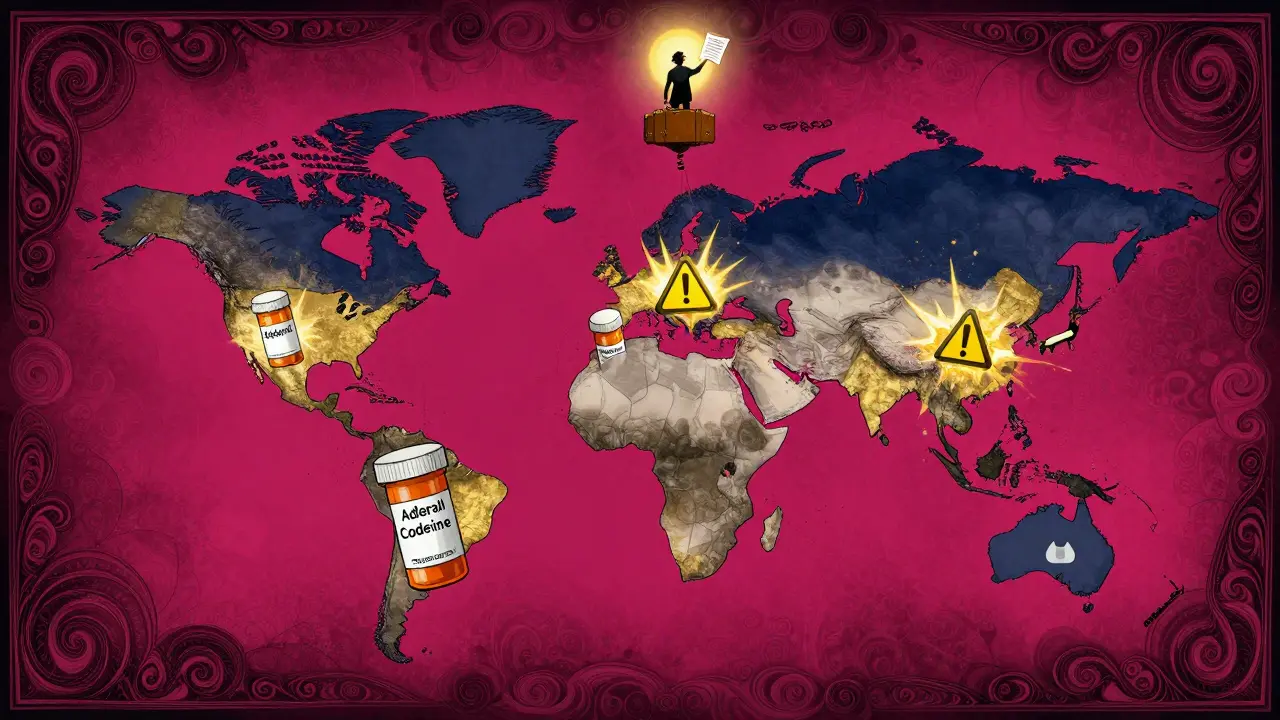
What to Do With Liquid, Injectable, and Temperature-Sensitive Meds
Pills are easy. Liquids? Injectable pens? Insulin? These need special handling. TSA allows medically necessary liquids in amounts larger than 3.4 ounces-but you must declare them. Don’t wait until you’re at the checkpoint. As soon as you walk up, say, “I have liquid medication.” That’s it. No explanation needed. But keep them in their original bottles. If your insulin pen has no label, you’re asking for trouble. For temperature-sensitive meds like insulin or certain biologics, the cold chain matters. The Cleveland Clinic found that 23% of travelers experienced medication degradation during flights in 2023 because they stored meds in checked baggage or left them in hot cars. Checked bags can hit 140°F in the cargo hold. Never put meds there. Use a small insulated bag with an ice pack. Ice packs are allowed-but you must declare them too. And if you’re flying internationally, check your destination’s rules. Some countries restrict gel packs or dry ice.Documentation: The Silent Hero
Your original container is your first line of defense. Your doctor’s letter is your second. A good letter includes:- Your full name and date of birth
- The generic and brand names of each medication
- The dosage and frequency
- The reason for the prescription
- The prescribing doctor’s name, license number, and contact info
- The doctor’s signature and official letterhead
What If You Can’t Use Original Containers?
Sometimes, you can’t. Maybe your pills are in a monthly pill organizer. Maybe your bottle broke. Maybe you’re traveling light. Here’s your backup plan:- Label your pill case clearly: drug name, strength, dosage, and expiration date.
- Take a photo of the original bottle and save it on your phone. Include the pharmacy label.
- Carry your doctor’s letter. Always.
- Never mix different medications in the same container.
- Keep a printed list of all your meds and their purposes.
What Not to Do
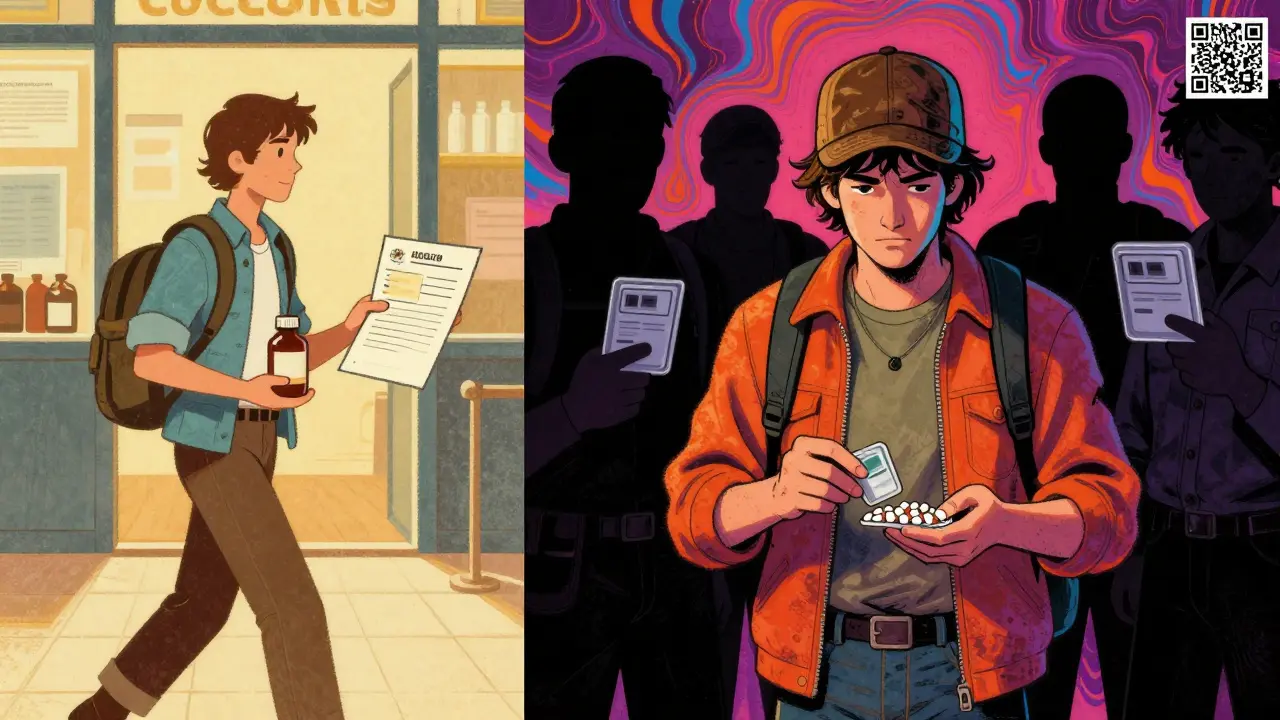
Don’t assume your prescription is okay everywhere. Just because it’s legal in the U.S. doesn’t mean it’s legal in Thailand or Dubai. Don’t put meds in checked luggage. Ever. Bags get lost. Temperatures swing. Delays happen. You need your meds with you. Don’t buy meds abroad. The FDA found that 11.7% of medications purchased overseas in 2023 were fake or substandard. In Southeast Asia, that number jumped to 28.4%. You could be risking your life. Don’t wait until you’re at the airport to check your meds. Look up your destination’s drug laws on the U.S. State Department’s website or the CDC’s travel health site. Do it before you book your flight.Final Checklist Before You Fly
- ✅ All pills in original containers with pharmacy labels
- ✅ Liquids declared at security
- ✅ Ice packs declared if used
- ✅ Doctor’s letter printed and signed
- ✅ Extra copies of prescriptions
- ✅ Photos of original bottles saved on phone
- ✅ Meds in carry-on only
- ✅ Check destination country’s drug rules on the U.S. State Department site
- ✅ Bring 20% extra supply in case of delays
Nancy Kou
December 21, 2025 AT 09:20Original containers aren't just about rules-they're about not getting locked up in a Thai prison for having your anxiety meds in a Ziploc. I learned this the hard way when my cousin got detained in Singapore with a pill organizer. No one cared that it was prescribed. They saw unknown pills and assumed the worst. Don't be that person.
Dominic Suyo
December 22, 2025 AT 22:52Let’s be real-TSA doesn’t give a flying fuck what’s in your bag. They’re just middle managers trying to avoid liability. The real threat is customs officers who’ve seen too many drug mules smuggle Adderall in mints. Original bottles? They’re not a suggestion. They’re a fucking shield. If you’re too lazy to keep your meds labeled, you deserve the 8-hour interrogation at JFK.
Adrienne Dagg
December 23, 2025 AT 15:45OMG YES. I had my insulin pen in a clear case once and got pulled aside at Heathrow. The officer looked at me like I was smuggling cocaine. I had the prescription and doctor’s letter but still had to empty my whole bag. 🥲 Never again. Original bottles = peace of mind. Also, never put meds in checked luggage. I’ve seen people lose their entire month’s supply. RIP.
Chris Davidson
December 25, 2025 AT 13:06benchidelle rivera
December 26, 2025 AT 18:56For anyone who thinks this is overkill-you’re not thinking about the people who’ve lost their jobs because they missed a flight due to medication confusion. Or the ones who got deported because their antidepressants weren’t labeled. This isn’t about being paranoid. It’s about being responsible. Print the letter. Keep the bottles. Bring extras. Your future self will thank you.
Anna Sedervay
December 28, 2025 AT 13:57Did you know that in 2023, the U.S. Department of State recorded 1,200+ medication-related incidents abroad? And yet, 78% of travelers still use pill organizers because they’re ‘convenient.’ Convenient? Convenient is how you end up on a no-fly list. The FDA, CDC, WHO-all of them agree: original containers are non-negotiable. If you don’t follow this, you’re not just risking your trip-you’re risking global public health policy. And yes, I’ve read the treaties.
Matt Davies
December 29, 2025 AT 07:30Man, I used to think this was all drama until I saw my buddy get pulled over in Dubai because his sleeping pills were in a cute little box. They thought he was trafficking. He had the prescription but no bottle. Got held for 14 hours. Now he carries his meds in a little leather case with the original label taped inside. Smart. Simple. Safe. Don’t be a hero. Just do the thing.
bhushan telavane
December 30, 2025 AT 17:18In India, we don’t even use original bottles for daily meds-pharmacies hand out pills in plain paper packets. But when I flew to Canada last year, I was told to repackage everything in original containers. I didn’t have the receipts anymore. Had to call my doctor at 3am and get a letter emailed. Worth it. Don’t assume your home country’s norms work abroad. Traveling isn’t about comfort-it’s about adapting.
holly Sinclair
December 31, 2025 AT 11:37It’s fascinating how a simple plastic bottle becomes a symbol of legitimacy in a world where authenticity is increasingly mediated by bureaucracy. The original container isn’t just a container-it’s a legal artifact, a performative act of compliance that bridges the gap between personal medical autonomy and state control. We’ve turned pharmaceuticals into geopolitical objects, and the label becomes the only language that transcends borders. And yet, we treat it like a chore. What does that say about how we value our own health? Or is it just easier to ignore the system until it bites you?
Monte Pareek
January 1, 2026 AT 05:18I’m a pharmacist and I’ve worked airport clinics. The number of people who show up with 20 different pills in a Ziploc and expect to be waved through is insane. You don’t need to be a genius to know this is dangerous. Label your meds. Carry your letter. Keep them in your carry-on. It takes 10 minutes. Your life isn’t worth gambling over convenience. If you’re too busy to do this, maybe you shouldn’t be traveling. Seriously. This isn’t rocket science.
Kelly Mulder
January 3, 2026 AT 01:52People who think this is 'overregulation' are the same ones who think vaccines cause autism. The fact that you’d rather risk arrest than carry a bottle with a label on it says everything about your relationship with authority. And let’s not forget-your meds might be legal in the U.S. but they’re classified as narcotics in 18 countries. You’re not a rebel. You’re a liability. And your ignorance is expensive.
mark shortus
January 4, 2026 AT 12:35Okay so I had my insulin pump in a TSA-approved case but the label got torn off during a layover. I got detained for 3 hours. They thought I was injecting something illegal. I had the prescription, the doctor’s letter, the bottle with the original label in my checked bag-which they didn’t let me retrieve because it was still in transit. I cried in the security room. Don’t be me. Tape the label to the case. Bring a spare. Don’t wait until you’re in Bangkok with no meds and no hope.
Alex Curran
January 5, 2026 AT 06:39Just got back from Sydney. Had my meds in original bottles, doctor’s letter printed, photos on phone. Got asked three questions and waved through. Meanwhile, the guy behind me had 12 different pills in a plastic box and spent 40 minutes explaining each one to a bored officer who clearly didn’t care. Original containers save time. They save stress. They save your dignity. Do the thing.
Hussien SLeiman
January 7, 2026 AT 04:52Let me tell you something about the TSA. They don’t care if you have a prescription. They don’t care if you’ve been on the same meds for 15 years. They care about one thing: paperwork they can scan. That’s why they love original bottles. It’s not about safety-it’s about liability reduction. You think they’re protecting you? No. They’re protecting themselves from a lawsuit if you get arrested overseas with unmarked pills. So yes, carry your bottles. Not because it’s right. But because it’s the only way to make the system tolerate you. And if you’re still using a pill organizer? You’re not a rebel. You’re just someone who doesn’t understand how broken the system is.