Why Environmental Monitoring Isn't Optional in Manufacturing
If your product touches food, medicine, or cosmetics, then the air around it, the surfaces it touches, and the water used in production aren’t just background noise-they’re potential threats. Environmental monitoring isn’t about checking boxes. It’s about stopping contamination before it ruins a batch, triggers a recall, or worse, makes someone sick. The CDC says up to 87% of foodborne outbreaks tied to manufacturing could’ve been prevented with better environmental sampling. That’s not a small number. That’s billions in losses and lives at risk.
What Exactly Is Being Tested?
It’s not just dirt. Environmental monitoring looks at four main types of contaminants:
- Microorganisms-bacteria like Listeria monocytogenes and Salmonella, molds, and yeasts. These are the big ones in food and pharma.
- Airborne particles-tiny bits of dust, skin flakes, or fibers. In cleanrooms, even one particle can ruin a vial of injectable medicine.
- Chemical residues-cleaning agents, lubricants, or heavy metals like lead or arsenic. These show up in water systems or on equipment surfaces.
- Water quality-tested for total organic carbon (TOC), conductivity, and microbial load. Purified water in pharma must meet USP <645> standards. In food, it’s about meeting EPA drinking water rules.
Each one needs a different method. Swabs and sponges for surfaces. Liquid impingers and solid impactors for air. ICP mass spectrometry for metals. HPLC for chemicals. You can’t use one tool for all jobs.
The Zone System: How to Prioritize Your Testing
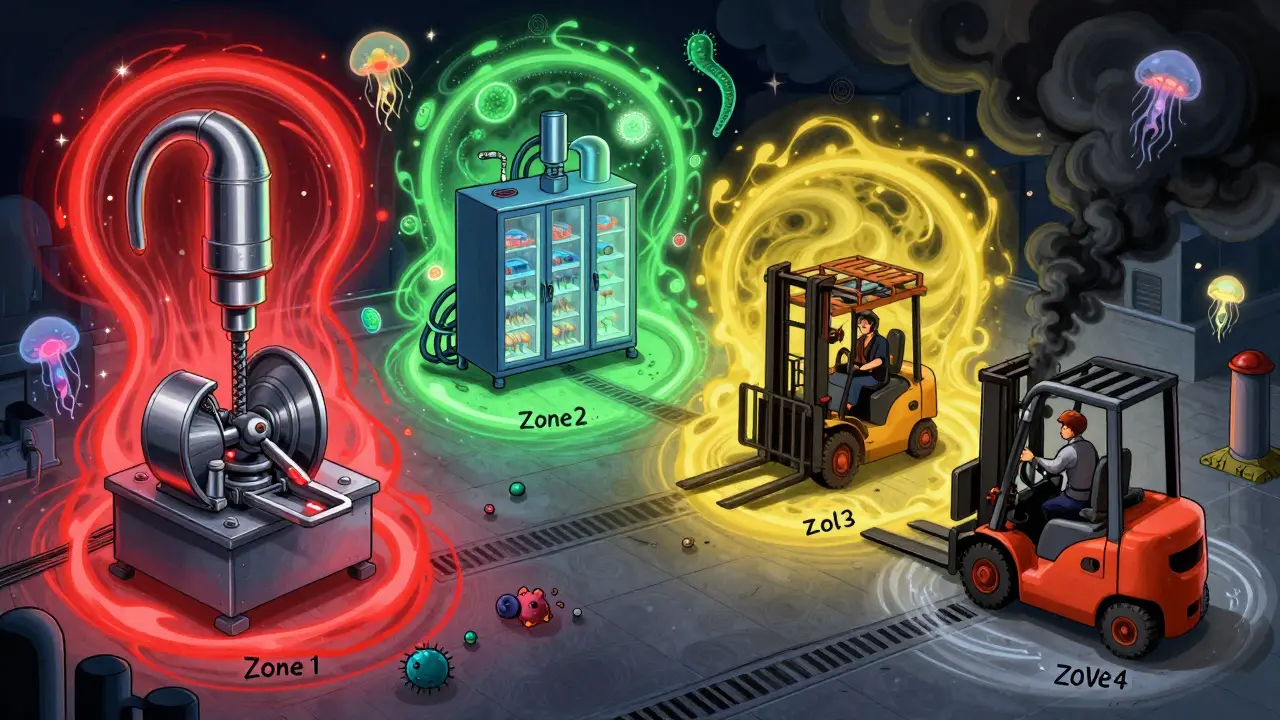
Not all surfaces are created equal. That’s why every serious facility uses the Zone Classification System. It’s simple, but powerful:
- Zone 1-Direct food or drug contact surfaces. Think slicers, mixers, filling nozzles, conveyor belts. These get tested daily or every shift. A single Listeria here can trigger a recall.
- Zone 2-Surfaces near Zone 1. Equipment housings, refrigeration units, nearby tools. Tested weekly. This is where contamination often spreads before anyone notices.
- Zone 3-Areas close to production but not directly involved. Forklifts, storage racks, maintenance carts. Tested monthly.
- Zone 4-The rest. Floors, walls, ceilings, offices. Tested quarterly. Sounds low priority? Think again. A 2013 PPD Laboratories study found 62% of all contamination events traced back to floors and drains.
Here’s the catch: one facility’s Zone 1 might be another’s Zone 2. A pipe dripping condensation? Some treat it as Zone 1. Others ignore it. That inconsistency is one of the biggest problems in the industry.
How Testing Works: From Swab to Result
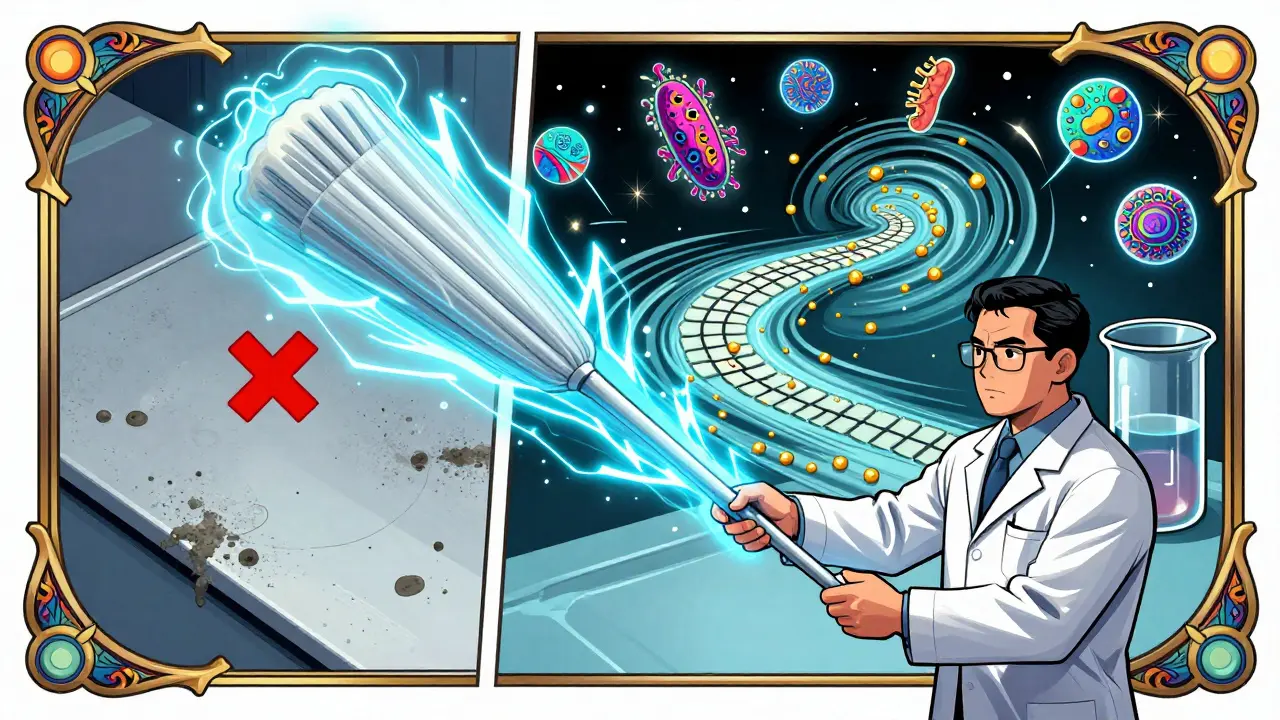
Sampling sounds simple, but it’s easy to mess up. Here’s how it’s done right:
- Use sterile swabs or sponges. Never reuse them. The CDC warns that unsterilized samplers can contaminate the very surfaces you’re testing.
- Swab a 10x10 cm area with consistent pressure. Too light? You miss microbes. Too hard? You damage the surface and get false results.
- For air, use a solid impactor sampler. These suck in 100-1000 liters of air in minutes. Results? Measured in CFU/m³ (colony-forming units per cubic meter).
- Send samples to a lab. Microbial tests take 24-72 hours. That’s why many facilities now use ATP testing-results in 10 seconds. ATP detects organic residue, not microbes, but it tells you if cleaning worked. Facilities using ATP report 32% faster turnaround between production runs.
Industry Differences: Pharma vs. Food vs. Cosmetics
Not all industries play by the same rules:
| Feature | Pharmaceutical | Food Processing | Cosmetics |
|---|---|---|---|
| Primary Regulator | EMA (Annex 1), FDA | FSIS, FDA | FDA (cosmetic GMP) |
| Key Contaminants | Particles, endotoxins, sterile pathogens | Listeria, Salmonella, mold | Mold, Pseudomonas, preservative failure |
| Air Monitoring | Continuous, ISO Class 5 (Grade B) | Spot checks, no continuous monitoring | Weekly, non-viable particles |
| Water Testing | USP <645> (TOC, conductivity) | EPA drinking water standards | USP <645> for rinse water |
| Frequency | Daily in critical zones | Zone 1: daily to weekly | Weekly in manufacturing zones |
Pharma demands near-sterile environments. Food focuses on pathogens that survive refrigeration. Cosmetics worry about mold in jars and preservative breakdown. The tools overlap, but the goals don’t.
The Hidden Cost of Poor Monitoring
It’s not just about recalls. The USDA says foodborne illness costs the U.S. economy $77.7 billion annually. But the real damage is hidden:
- Lost production time
- Regulatory shutdowns
- Brand reputation collapse
- Legal liability
One FDA inspection can shut down a line for weeks. And if you’re found non-compliant? Your next audit gets stricter. Your next product gets scrutinized harder. It becomes a cycle.
And here’s the kicker: 76% of food processing facilities still don’t have a formal environmental monitoring program. That’s not laziness. It’s often because they think it’s too expensive. But the average medium-sized facility spends $15,000-$25,000 a year on testing. Compare that to a single recall, which can cost over $10 million.
What’s Changing in 2026?
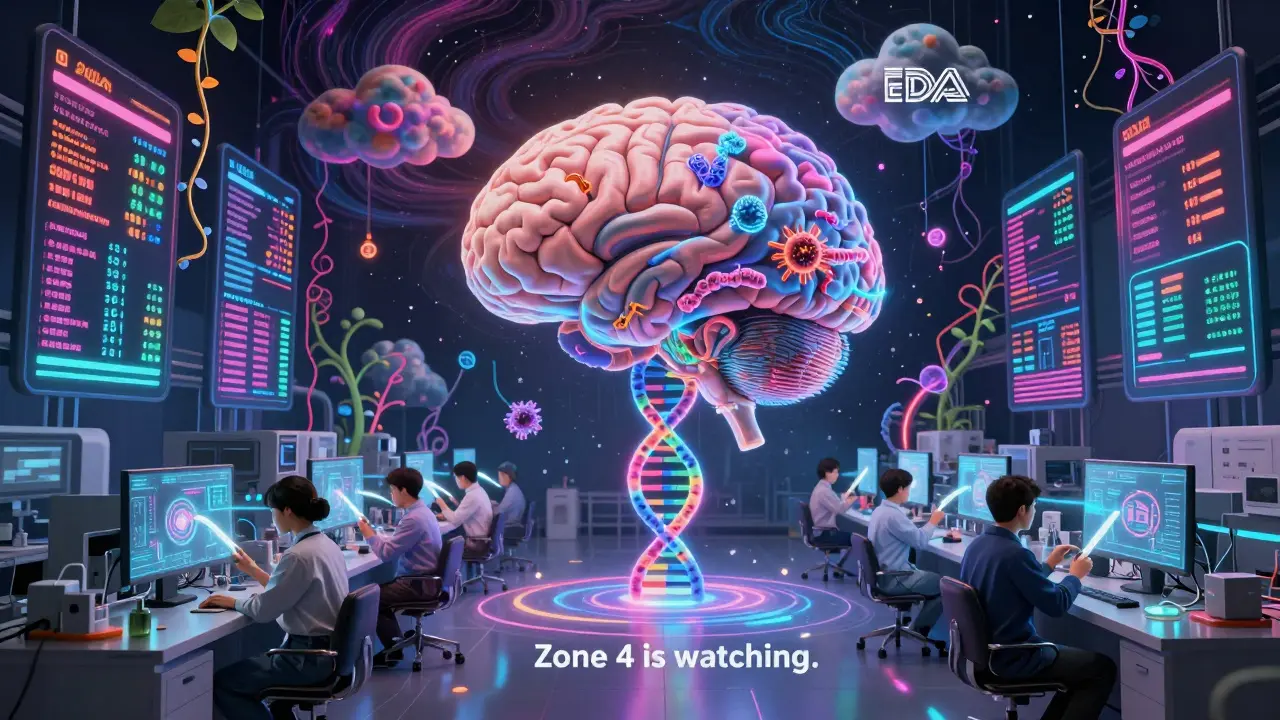
The rules are tightening. EU GMP Annex 1 got updated in August 2023. Now, pharmaceutical facilities must monitor temperature, humidity, and particle counts in real time and trend the data. No more monthly reports. You need live dashboards.
Next-generation sequencing (NGS) is starting to replace traditional culturing. Instead of waiting 3 days to identify a microbe, you get a full DNA profile in 24 hours. The FDA is pushing this hard. It’s not science fiction-it’s happening in pilot labs now.
AI is coming too. By 2027, nearly 40% of monitoring systems will use AI to predict contamination risks based on historical data, weather, and equipment use. That’s not a luxury. It’s the new baseline.
Where Most Facilities Fail
It’s not the equipment. It’s the process. Here are the three biggest mistakes:
- Inconsistent zone classification-If one manager treats a pipe as Zone 1 and another as Zone 3, your data is useless. Document your zones. Train everyone. Revisit them every 6 months.
- Poor sampling technique-Using non-sterile swabs, swabbing too lightly, or not documenting location and time. The CDC found this happens in 68% of facilities.
- Isolated data-ATP results, microbial tests, and allergen checks are tracked in separate spreadsheets. No one sees the full picture. You need one system that brings it all together.
And don’t forget training. The FDA says sampling staff need at least 40 hours of hands-on training before they’re allowed to collect official samples. Many facilities skip this. Don’t.
What Should You Do Next?
If you’re not doing environmental monitoring yet, start here:
- Map your facility. Label every surface. Assign zones.
- Pick your key contaminants. What’s most likely to ruin your product? Listeria? Mold? Particles?
- Choose your methods. Swabs? Air samplers? ATP?
- Set frequency. Zone 1 daily. Zone 2 weekly. Zones 3-4 monthly.
- Train your team. Don’t assume they know how to swab.
- Track everything in one place. Use a simple digital log or software. No more paper.
You don’t need to be perfect. You just need to be consistent. The goal isn’t zero contamination. It’s knowing where it comes from-and stopping it before it reaches the customer.
What’s the difference between environmental monitoring and product testing?
Product testing checks the final item-for example, does the pill have the right dose? Environmental monitoring checks the surroundings: the air, the floor, the conveyor belt. It’s proactive. Product testing is reactive. You want to catch contamination before it gets into the product.
Do small facilities need environmental monitoring?
Yes. Even if you have under 50 employees. The USDA found only 48% of small facilities have fully compliant programs. But regulators don’t care how big you are. If you make food, medicine, or cosmetics, you’re subject to the same rules. Skipping monitoring doesn’t make you safer-it makes you a target for shutdowns.
Can ATP testing replace microbial testing?
No. ATP tests for organic residue-like food, sweat, or grease. It tells you if cleaning worked. But it doesn’t tell you if bacteria are still alive. You still need microbial swabs to confirm the absence of pathogens like Listeria or Salmonella. Use ATP for quick checks. Use swabs for proof.
Why is Zone 4 important if it’s not near production?
Because contamination doesn’t always move the way you think. A dirty floor in Zone 4 can kick up dust that gets pulled into air vents. A forklift in Zone 3 can track in dirt from outside. The PPD study showed 62% of contamination events came from Zone 3 and 4 surfaces. Ignoring them is like locking your front door but leaving the back window open.
How often should I update my zone classification?
At least every six months. If you add new equipment, change production lines, or move machinery, your zones change too. A pipe that didn’t drip last year might be dripping now. A new cleaning schedule might mean a surface is no longer a risk. Review your zones with your team every six months-and document why you made each decision.
Brandie Bradshaw
February 28, 2026 AT 02:52Martin Halpin
March 1, 2026 AT 09:25Eimear Gilroy
March 3, 2026 AT 05:11Ajay Krishna
March 4, 2026 AT 09:53Noah Cline
March 4, 2026 AT 16:50Lisa Fremder
March 4, 2026 AT 18:06Sophia Rafiq
March 5, 2026 AT 11:58Full Scale Webmaster
March 6, 2026 AT 18:12Byron Duvall
March 8, 2026 AT 12:15Charity Hanson
March 9, 2026 AT 03:14Justin Ransburg
March 10, 2026 AT 08:24Sumit Mohan Saxena
March 11, 2026 AT 13:08