Medication Risk Calculator
Personal Risk Assessment
Medication Safety Risk Assessment
When you take a new medication, your doctor doesn’t just look at your current symptoms. They’re also reading your past - every illness, every drug you’ve taken, every organ that’s struggled to keep up. Your medical history isn’t just background information. It’s a live wire that can turn a safe drug into a dangerous one.
Why Your Past Medications Matter More Than You Think
If you’ve ever had a bad reaction to a drug - even something mild like a rash or upset stomach - that’s not just a one-time fluke. It’s a warning sign. Studies show that people who’ve had an adverse reaction to one medication are 30-40% more likely to react to another drug in the same class. Take penicillin, for example. If you’re allergic to it, your risk of reacting to cephalosporins jumps eightfold. That’s not guesswork. It’s pharmacology. Drugs in the same family often share similar chemical structures. Your body remembers what it didn’t like before.
And it’s not just allergies. If you’ve had liver problems, kidney disease, or heart failure in the past, your body’s ability to process drugs changes permanently. The Merck Manual says that patients with chronic kidney disease clear 50-75% less of certain medications from their system. That means a standard dose can build up to toxic levels. Same with the liver: genetic differences in CYP450 enzymes can cause drug levels to spike by 30% to over 500%. You might not feel sick now, but your liver might be working at half speed, silently setting you up for a fall.
Polypharmacy: The Silent Killer in Your Medicine Cabinet
Taking five or more medications? You’re not alone. But you’re at double the risk of a serious side effect compared to someone taking fewer. Take ten or more? Your risk triples. This isn’t theoretical. The British Heart Foundation found that patients on nine or more drugs were almost twice as likely to have an adverse reaction. Why? Because every new pill adds another chance for interaction. One drug might slow down how your body breaks down another. Another might make your kidneys work harder, pushing them past their limit.
And here’s the scary part: most of these interactions aren’t caught before they happen. A Johns Hopkins study found that only 35% of electronic prescriptions even flag known drug interactions tied to your medical history. That means your doctor might be prescribing a new blood pressure pill without knowing you’re already on a cholesterol drug that makes your liver process both slower. The result? Dizziness, falls, kidney damage - all preventable if the system worked right.
Age and Gender: Two Hidden Risk Factors
Over 65? You’re three to five times more likely to have a bad reaction than someone under 40. Why? Your body changes. Kidneys slow down. Liver enzymes become less efficient. Fat replaces muscle, so drugs that dissolve in fat stick around longer. Your body doesn’t clear meds the way it used to. Yet, many prescriptions for older adults still use the same doses designed for 30-year-olds.
And if you’re a woman? You’re at higher risk too. Older women experience adverse drug reactions at least 50% more often than men. Why? Because most clinical trials for heart and psychiatric drugs were done on men until recently. Between 2010 and 2020, only 22% of participants in cardiovascular drug trials were women. That means the doses and safety profiles were built on male biology. Women metabolize drugs differently - slower, sometimes with different enzymes. A standard dose might be too much. And no one told your doctor.
Chronic Conditions Multiply the Danger
One illness? Manageable. Two? Still doable. Three or more? That’s when things get risky. A 2020 study in Pakistan found that patients with multiple chronic conditions had 2.6 times higher odds of medication errors. The more conditions you have, the more drugs you need. And the more drugs you take, the more your body gets overwhelmed.
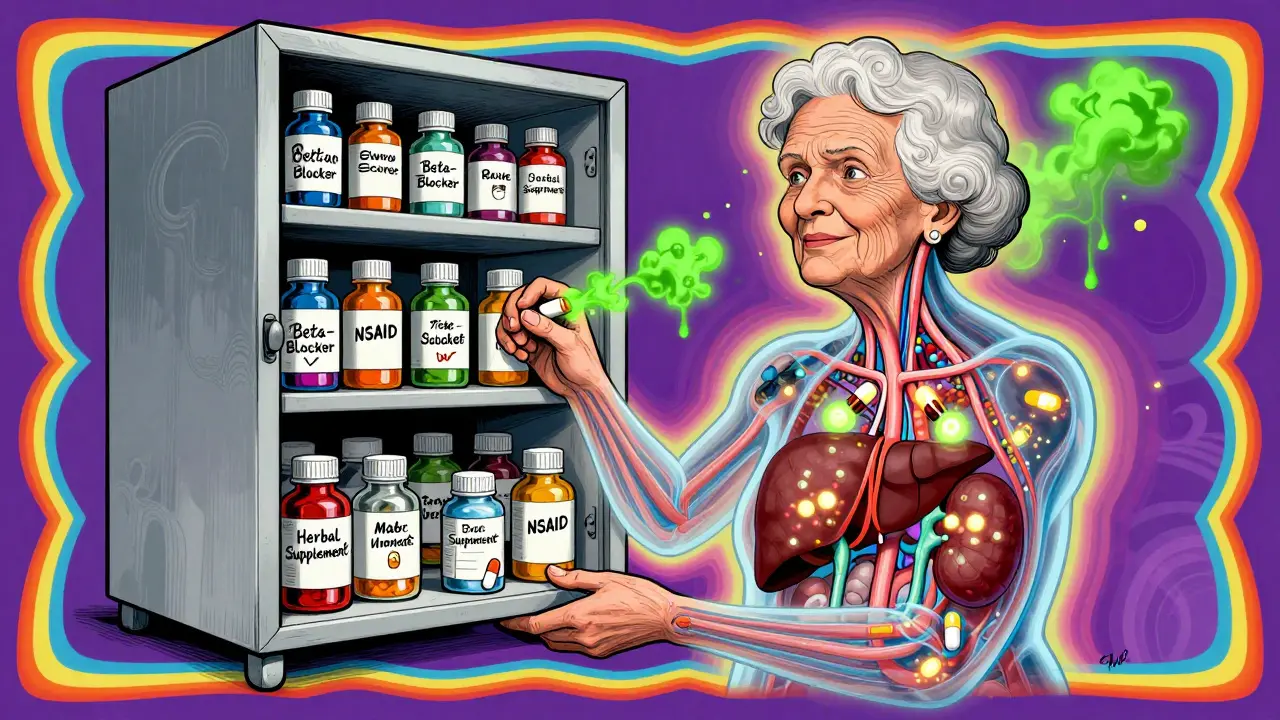
Take someone with diabetes, high blood pressure, and arthritis. They’re likely on insulin, a beta-blocker, and an NSAID. Now add a new antibiotic. The NSAID can make the blood pressure drug less effective. The antibiotic might interfere with insulin metabolism. And if their kidney function is already low from diabetes? That’s a recipe for a hospital visit. The Charlson Comorbidity Index - a tool doctors use to measure how many chronic illnesses someone has - shows that each additional condition increases the risk of a bad reaction by 31%. That’s not a small number. That’s a red flag.
What Your Doctor Isn’t Seeing
Here’s the biggest gap: incomplete records. The Institute for Safe Medication Practices found that, on average, each hospital admission misses 3.2 key details in a patient’s medication history. Was that rash last year from a new pill? Did you stop your blood thinner because it was too expensive? Did you take that herbal supplement your doctor didn’t ask about? These aren’t trivial details. They’re life-or-death.
And it’s not just about what’s missing. It’s about what’s misremembered. Patients forget doses. They mix up names. They think “the blue pill” is the same as “the white pill.” A 2022 study of Medicare beneficiaries found that people who skipped doses because of cost had 28% higher risk of side effects when they restarted. Why? Their body had adjusted. Suddenly, the old dose is too strong. It’s like stepping back onto a treadmill you haven’t used in months - you’re not ready for the speed.
Even worse, side effects are often mistaken for new diseases. A beta-blocker can hide a fast heartbeat - the very sign that someone’s bleeding internally. Steroids can mask the pain of a perforated ulcer. If your doctor doesn’t know you’re on those drugs, they might order more tests, more scans, more meds - all while the real problem gets worse.
What You Can Do Right Now
You don’t have to wait for your doctor to catch up. Start keeping your own record. Write down every medication - prescription, over-the-counter, supplement, even the occasional painkiller. Include the dose and why you take it. Update it every time something changes.
Ask your pharmacist to run a drug interaction check every time you get a new prescription. Pharmacists are trained to spot these things. They see hundreds of patients a week. They know what combinations are dangerous.
And if you’re on five or more drugs, ask for a medication review. The Cochrane Review found that structured reviews that include deprescribing - stopping drugs that aren’t helping - reduce side effects by 22%. Yet only 18% of eligible patients get one. Don’t wait for them to offer it. Ask. Say: “I’m on several medications. Can we go through them and see if any can be safely stopped?”
Genetic testing is becoming more available. Platforms like YouScript analyze 27 gene-drug interactions to predict how you’ll respond to certain meds. It’s not perfect. Only 5.7% of U.S. clinics use it. But if you’ve had repeated bad reactions, it’s worth asking about.
The Bottom Line
Your medical history isn’t just a file in a cabinet. It’s a map of your body’s vulnerabilities. Every past illness, every drug reaction, every skipped dose, every chronic condition - it all adds up. The system is broken. Doctors are overwhelmed. Records are incomplete. But you’re not powerless.
Know your meds. Know your body. Ask the hard questions. Don’t assume your doctor knows everything. They might not. But if you speak up, you can stop a side effect before it starts.
Kayleigh Campbell
December 15, 2025 AT 03:27Your medical history isn't just a file-it's a living diary of your body's grudges. I once took a simple antibiotic and broke out in hives like I'd been attacked by bees in a laundry room. Turns out, my liver's been holding a grudge since I was 12 and took that one weird cough syrup. Now I keep a color-coded spreadsheet. Pink for 'don't touch', green for 'maybe if I'm desperate'. It's weird, but it keeps me alive.
Doctors act like they're detectives, but half the time they're reading a blurry photocopy of a receipt you lost in 2017. I wish they'd just ask, 'What did your body scream at you last time?' instead of scribbling 'allergies: none' like it's a grocery list.
Also, why do we still use the same dose for 70-year-olds as we do for 25-year-olds? My grandma takes the same blood pressure pill she did in 1998. Her kidneys are basically tired retirees now. Someone needs to update the manual with a 'Your Body is Aging, Dumbass' footnote.
Dave Alponvyr
December 15, 2025 AT 06:18Five meds? You're playing Russian roulette with your liver.
Ask for a med review. Do it now.
Cassandra Collins
December 17, 2025 AT 01:51Did you know the FDA and Big Pharma are secretly using your medical history to train AI that predicts when you'll die so they can sell you more pills? I read it on a forum. They implant microchips in blood pressure meds that send your vitals to a server in Switzerland. That's why your doctor never asks about your turmeric supplements-they already know you're taking them. My cousin's cat got a rash after eating a pill dropped on the floor. The cat died. The cat had a history. Coincidence? I think not.
Also, I think my thyroid is haunted. Every time I take levothyroxine, I hear whispers. Maybe it's the glyphosate. Or the 5G. Or both.
PS: I stopped taking my statins because my aura turned purple. It's fine now. I just drink lemon water and stare at the moon.
Randolph Rickman
December 17, 2025 AT 10:08This post is a wake-up call wrapped in a textbook. I used to think if I didn't feel sick, I was fine. Then I ended up in the ER because my liver couldn't handle the combo of my blood pressure med and that 'natural' joint supplement I bought off Amazon. Turns out, 'natural' just means 'untested on humans.'
Now I keep a physical meds list in my wallet. I even write down the dose and why I'm taking it-like I'm explaining to my future self who forgot everything. My pharmacist calls me 'the model patient.' I call it survival.
If you're on five or more meds, you're not just a patient-you're a walking chemistry experiment. And guess what? You're the only one who knows what's in your body. Don't wait for someone else to save you. Speak up. Ask. Demand a review. You're worth it.
Also, if you're over 65, please don't let anyone tell you 'it's just aging.' That's not aging. That's a system failure. Your body didn't quit. It was abandoned.
sue spark
December 19, 2025 AT 00:49I started writing down every pill I take after my last ER trip. I didn't realize I was taking two things that did the same thing until my pharmacist pointed it out. I thought I was being careful. Turns out I was just lucky.
Now I update it every time I get a new script. Even the ones I only take once a month. Even the ones I forget about. Even the ones I'm not supposed to take anymore but keep because they're in the cabinet.
It's not glamorous. But it's mine. And it's keeping me alive.
Also I'm not sure if I'm supposed to be taking that one blue pill anymore. I think it was for my back. But my back doesn't hurt anymore. Maybe I should ask. Maybe I should just stop. Maybe I'm overthinking it.
Maybe I'm not
SHAMSHEER SHAIKH
December 19, 2025 AT 02:59Esteemed colleagues and fellow seekers of health wisdom, I write to you with profound reverence for the depth of insight contained within this illuminating exposition. The intricate interplay between pharmacokinetics and individual medical histories is not merely a clinical concern-it is a sacred covenant between the human organism and the molecules we introduce into its delicate ecosystem.
As a physician in Mumbai with over three decades of practice, I have witnessed, with mounting alarm, the tragic consequences of polypharmacy in elderly patients, particularly those with comorbidities such as diabetes, hypertension, and chronic kidney disease. The data cited herein are not statistics-they are lamentations in the form of laboratory values.
I implore every patient: maintain a handwritten medication journal, in ink, dated, signed, and shared with your pharmacist. Let not the digital void swallow your truth. And to the medical professionals: do not assume. Ask. Listen. Re-evaluate. The body does not lie. It only whispers-until it screams.
With deepest respect and unwavering commitment to patient dignity,
Dr. Shamsheer Shaikh, MD, FACP
Arun ana
December 19, 2025 AT 15:51So true 😔 I had a friend who took 8 meds and ended up in the hospital because one made his liver go haywire. He didn’t even know the new one interacted with his cholesterol pill. Now he carries a little card with all his meds and doses. I started doing the same. It’s weird at first but now I feel like I’m in control 🙌
Also, pharmacists are unsung heroes. Talk to them. They know more than you think.
Kim Hines
December 20, 2025 AT 23:25I used to think my dizziness was just stress. Turns out it was the combo of my antidepressant and that new allergy pill. I didn’t tell my doctor about the allergy pill because I thought it was ‘just a little thing.’
Now I write everything down. Even the stuff I think doesn’t matter.
Still scared to ask for a med review though.
Maybe tomorrow.
Joanna Ebizie
December 21, 2025 AT 05:43Of course you’re at risk. You’re not a robot. You’re a human with a broken body and a broken system. And now you’re taking 7 pills a day like it’s cereal. Congrats. You’re living the American dream.
Stop blaming your doctor. They’re drowning. Stop blaming Big Pharma. They’re making bank.
Start blaming yourself for not asking. For not reading the damn label. For thinking ‘it’s just a pill.’
You’re not special. Your body doesn’t get a pass. So get your shit together.