The U.S. Food and Drug Administration (FDA) runs one of the largest public safety databases in the world: the FAERS (FDA Adverse Event Reporting System). It’s not a secret system. It’s not locked behind paywalls. It’s free, open, and updated every quarter with over two million new reports of side effects, medication errors, and product problems. But if you’ve ever tried to use it, you know it’s not easy. You might see a spike in reports about a drug you’re taking, or hear a researcher mention a potential link between a medication and a rare reaction-and wonder how to check it yourself. This isn’t about fear. It’s about transparency. And understanding how to use FAERS can help you make smarter decisions, whether you’re a patient, a student, a clinician, or a researcher.
What FAERS Actually Contains
FAERS isn’t a list of confirmed dangers. It’s a collection of reports-anyone can submit one: doctors, pharmacists, patients, or drug manufacturers. Each report includes basic info: patient age and gender (anonymized), what drug was taken, when, and what happened. The adverse event is coded using MedDRA, a standardized medical terminology system used globally by regulators. That’s important. If someone reports "dizziness," it might be coded as "vertigo," "syncope," or "lightheadedness," depending on how the reporter described it. That’s why you can’t just search for "headache" and get everything.
The system holds about 30 million reports total. Around 75% come from drug companies-they’re legally required to report. The other 25% come from the public through the MedWatch program. That means the data reflects real-world use, not just controlled clinical trials. A drug might seem safe in a trial of 5,000 people, but when millions start taking it, rare side effects show up. FAERS is designed to catch those.
But here’s the catch: a report doesn’t mean the drug caused the problem. Maybe the person had another illness. Maybe they took other meds. Maybe the event was unrelated. FAERS doesn’t prove causation. It flags patterns. And those patterns need investigation.
How to Access the Data-Three Ways
You don’t need to be a programmer to start exploring. The FDA gives you three main ways in:
- FAERS Public Dashboard-This is your best starting point. It’s a web tool with filters for drugs, adverse events, patient age, gender, and time. You can see bar charts of how often a side effect was reported with a specific drug over the last year. No login. No download. Just pick a drug, pick an event, and click. It’s designed for non-experts.
- Quarterly Data Extracts-These are raw files (ASCII or XML) you can download. Each one is 1-5GB. You’ll need software like Python, R, or Excel with plugins to open them. These are for people who want to run their own analyses, combine data across years, or look for patterns the dashboard doesn’t show.
- OpenFDA API-If you’re building an app or automating reports, this is your tool. It returns data in JSON format. You can query it with simple URLs:
https://api.fda.gov/drug/event.json?search=drugname:lisinopril+AND+reaction:renal+failure. It’s fast, reliable, and free.
The Public Dashboard is perfect for a quick look. If you’re doing academic research or need to compare drugs side-by-side, you’ll need the raw data. And if you’re building something that pulls this info automatically, the API is the way to go.
Why It’s Hard to Use (And What to Watch Out For)
Even with these tools, FAERS is full of traps. Most people who use it for the first time get misled.
First: reporting bias. Serious events get reported more often. If a drug causes a rare stroke, it’ll show up. But if it causes mild nausea that 1 in 10 people get, it probably won’t. Consumers report more often for drugs they take themselves-like painkillers or antidepressants. Doctors report more for hospitalizations or deaths. So the data skews toward severe, noticeable events.
Second: no denominator. FAERS tells you how many people reported a side effect-but not how many people took the drug. If 100 people report nausea from Drug A, and 50 from Drug B, is Drug A riskier? Maybe. But if 10 million people take Drug A and only 1 million take Drug B, then Drug B is actually causing nausea at a much higher rate. FAERS can’t tell you that. You need population data from elsewhere.
Third: inconsistent data. About 30% of reports are missing key info-age, dose, start date, or even which drug was suspected. Some reports are vague: "feeling bad." Others are detailed. That makes analysis messy. And MedDRA codes? They’re complex. A single event like "chest pain" can have 15 different codes depending on whether it’s sharp, dull, radiating, or associated with breathing. Learning them takes 40-60 hours of training.
Don’t mistake a high number of reports for proof of danger. A drug that’s widely used-like ibuprofen or metformin-will naturally have more reports. That doesn’t mean it’s unsafe. It means lots of people take it.
Who Uses FAERS-and Why
Academic researchers use FAERS for about 55% of U.S.-based pharmacovigilance studies. They’ve found hidden links between diabetes drugs and pancreatitis, between antidepressants and suicidal ideation in teens, and between antibiotics and tendon rupture. Patient advocacy groups have used it to push for label changes. One group found a rare interaction between a common antidepressant and a diabetes medication that affected about 1 in 10,000 people-something no clinical trial caught.
Pharmaceutical companies use it too-but not the public tools. They use commercial platforms like Oracle Argus or ArisGlobal that integrate FAERS data with internal records, electronic health records, and claims databases. These systems can spot trends faster and filter out noise. But they cost tens of thousands of dollars a year. That’s why FAERS is so valuable for small labs, students, and nonprofits: it’s free and powerful.
Regulators use FAERS to decide when to issue warnings, update labels, or even pull a drug off the market. The 21st Century Cures Act and FDASIA require the FDA to make this data public. That’s why FAERS exists-not to scare people, but to make safety monitoring transparent.
What’s Changing in 2025
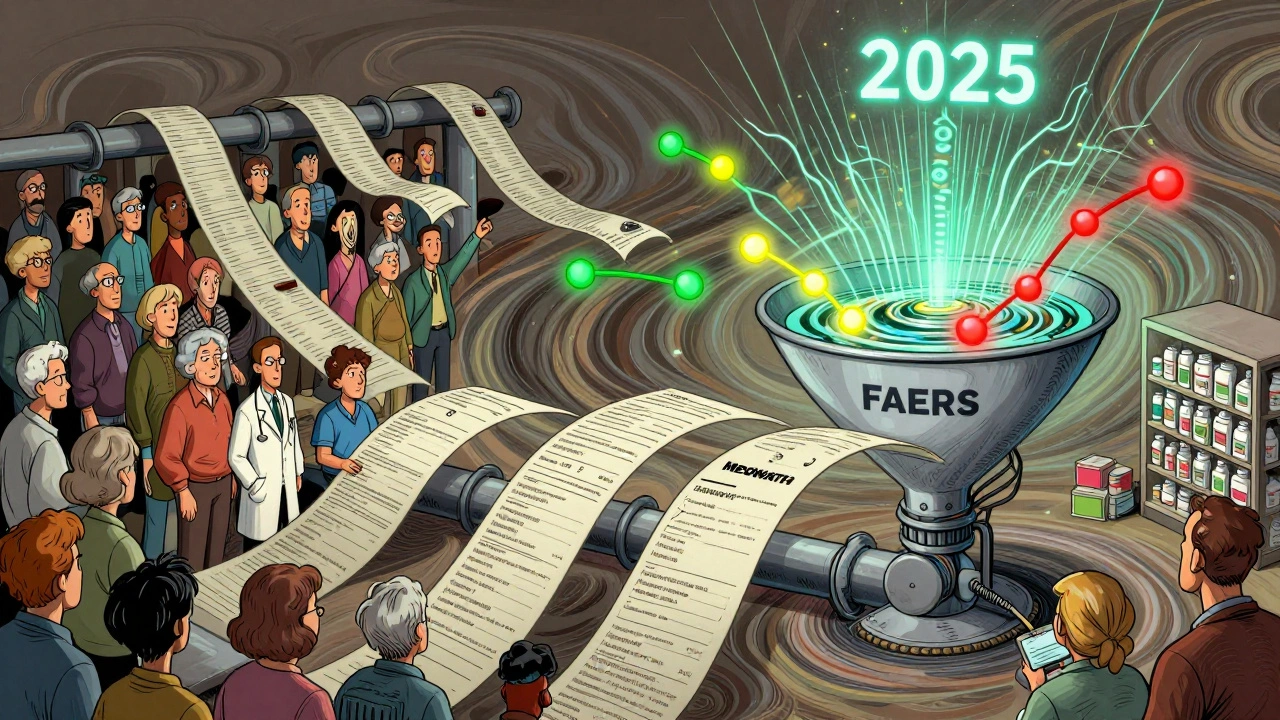
Since January 2024, all drug companies must submit reports in the new ICH E2B(R3) format. That means more detailed data: exact dosages, timing, medical history, and even lab results. It’s harder to submit, but the data is richer.
The FDA is also working on upgrades. By late 2024, they plan to launch an API that lets you query the dashboard’s analytics directly-no need to download files. By Q3 2025, they’ll add natural language processing so you can type "heart palpitations after starting this pill" and get results without knowing MedDRA codes.
Long-term, the FDA’s Sentinel Initiative is linking FAERS with real-world data from Medicare, Medicaid, and private insurers. That will finally give us denominators-how many people were exposed. That’s the holy grail: turning FAERS from a signal detector into a true risk calculator.
What You Should Do Next
If you’re curious about a drug’s safety:
- Go to the FAERS Public Dashboard.
- Type in the drug name.
- Select an adverse event from the dropdown (start with common ones like "nausea," "headache," "fatigue").
- Look at the trend line. Is the number going up? Is it clustered in a specific age group?
- Don’t panic. Check the total number of reports compared to the drug’s usage.
If you’re a student or researcher:
- Download the latest quarterly data extract from the FDA’s FAERS page.
- Use Python with pandas and openFDA to clean the data.
- Learn MedDRA hierarchies-start with the top-level terms.
- Always compare against other sources like PubMed or clinical trial registries.
FAERS isn’t perfect. But it’s the best public window we have into how drugs behave in the real world. Used right, it’s a tool for accountability. Used wrong, it’s a source of misinformation. The goal isn’t to find danger-it’s to find questions worth asking.
Can I trust FAERS data to know if a drug is dangerous?
No-not directly. FAERS collects reports, not proof. A high number of reports doesn’t mean a drug causes harm. It could mean the drug is widely used, or that people are more aware of side effects now. FAERS flags patterns that need further study. Always look for follow-up research from the FDA or peer-reviewed journals before making decisions.
Do I need to be a programmer to use FAERS?
No. The FAERS Public Dashboard is designed for anyone. You can search, filter, and view charts without any technical skills. But if you want to do deep analysis-like comparing multiple drugs or spotting trends over time-you’ll need to use the raw data files and tools like Python or R. That takes time to learn.
How often is FAERS updated?
FAERS releases new data every quarter-March, June, September, and December. The latest public data available as of December 2025 includes reports up to September 30, 2025. The FDA typically publishes the new data set about 3-4 months after the end of the quarter.
What’s the difference between FAERS and MedWatch?
MedWatch is the program you use to report adverse events. FAERS is the database that stores all those reports. If you’re a doctor or patient and you submit a side effect report to the FDA, you’re using MedWatch. That report then goes into FAERS. Think of MedWatch as the input system and FAERS as the archive.
Why are some reports missing drug doses or patient age?
Because not all reporters provide complete information. Patients may not know the exact dose. Doctors might not record it in their notes. Sometimes reports are faxed in by hand and data gets lost. About 30% of FAERS reports have incomplete fields. That’s why researchers filter for complete cases or use statistical methods to account for missing data.
Can I use FAERS data in a research paper?
Yes, absolutely. FAERS is one of the most common sources for real-world evidence studies in pharmacology. Many peer-reviewed papers use it to identify safety signals. Just be sure to clearly state the limitations: no causation, reporting bias, missing data, and no denominator. Cite the FDA’s FAERS documentation and the specific data release quarter you used.
Deborah Jacobs
December 5, 2025 AT 07:20I used FAERS last month when my mom started that new blood pressure med. Saw a weird spike in "fatigue" reports among women over 65. Didn't panic, but brought it up with her doctor. Turns out, the dose was too high for her weight. That dashboard saved us from a bad reaction. Thanks for making this so clear.
It's not scary data-it's power. People think big numbers mean danger, but really, it's just showing us where to look closer.
Lucy Kavanagh
December 6, 2025 AT 01:03Of course the FDA’s database is "free"-they want you to think it’s transparent. But have you seen how they redact the drug makers’ names in 40% of the reports? And why does every single report from a big pharma company have perfect dosage info while patient reports are missing everything? This isn’t transparency-it’s a controlled narrative. They let you see the mess so you don’t ask who’s cleaning it up.
Also, why is the API only in English? Are non-Americans supposed to guess MedDRA codes? This is surveillance disguised as service.
Chris Brown
December 6, 2025 AT 18:58It is deeply concerning that the general public is being encouraged to interpret pharmacovigilance data without formal training in epidemiology or biostatistics. The FAERS database is not a consumer tool-it is a signal detection instrument designed for regulatory professionals with years of specialized education. To suggest that a layperson can "make smarter decisions" by filtering bar charts is not merely irresponsible-it is dangerously naive.
The FDA’s own documentation explicitly warns against inferring causality from this data. Yet here we are, normalizing amateur data mining as if it were equivalent to clinical judgment.
Mellissa Landrum
December 7, 2025 AT 05:42you ever notice how every time a new drug hits the market, like 3 weeks later, boom-suddenly everyone’s reporting "heart palpitations"? like... did they all just get the same dream? or is someone in the FDA quietly nudging people to report certain things? i swear half these reports are copy-pasted from reddit threads.
and why do they even let patients report? my cousin once said "i felt weird after taking tylenol" and it went into the system as "cardiac arrhythmia" because some intern clicked the wrong box. this whole thing is a joke.
Mark Curry
December 9, 2025 AT 02:59It’s not about trust. It’s about curiosity.
I don’t need to know if a drug is dangerous. I just want to know if it’s *different* than what I expected. FAERS doesn’t give answers. It gives questions. And sometimes, that’s enough to start a conversation-with your doctor, your family, even yourself.
It’s like looking at the stars. You don’t need to understand gravity to wonder why one is brighter.
:-)
Mark Ziegenbein
December 10, 2025 AT 15:56Let us be absolutely clear: the notion that a layperson can meaningfully interpret FAERS data without understanding the statistical underpinnings of disproportionality analysis, the intricacies of MedDRA hierarchy, or the inherent biases of spontaneous reporting systems is not merely misguided-it is an affront to the integrity of clinical pharmacology. The dashboard is a toy. The raw data is a minefield. And the API? A beautifully engineered trap for the untrained.
Those who mistake volume for validity are not empowered-they are misled. And those who promote this as "transparency" are either profoundly ignorant or willfully deceptive. The FDA does not owe the public simplified access to complex data. It owes them accurate interpretation. And that requires expertise, not Google.
Norene Fulwiler
December 12, 2025 AT 05:36As someone who grew up in a family that didn’t trust doctors, I used FAERS to finally feel like I had a voice. My aunt had a reaction to a statin that no one believed-until I pulled up 12 other reports from women her age. We changed her med. She’s fine now.
This isn’t about being a scientist. It’s about being a human who deserves to know what’s in the pills they’re told to swallow. The system’s flawed? Sure. But it’s the only one we’ve got that doesn’t cost $20,000 a year.
Don’t knock it because it’s messy. Knock it when it’s gone.
William Chin
December 13, 2025 AT 06:05While I appreciate the intent behind democratizing access to pharmacovigilance data, the current implementation constitutes an unacceptable risk to public health. The absence of standardized validation protocols, the lack of mandatory metadata completeness, and the non-uniform reporting thresholds across jurisdictions render this data statistically invalid for any clinical or policy application.
It is not merely inconvenient-it is ethically perilous to encourage non-professionals to derive conclusions from a system designed for hypothesis generation, not decision-making. The FDA must immediately restrict public access to the raw data extracts and limit the dashboard to aggregated, anonymized, and statistically corrected metrics only.
Ada Maklagina
December 13, 2025 AT 19:05used it once. looked up my antidepressant. saw 5000 reports of "weight gain". shrugged. took it anyway. still alive.
also, the dashboard is kinda fun to scroll through. like a weird medical soap opera.
no drama. no panic. just data.
Harry Nguyen
December 15, 2025 AT 10:42Oh great. Let the masses play detective with life-or-death data. Next they’ll be diagnosing cancer from TikTok trends. FAERS is a garbage pile of hearsay and typo-ridden fax forms. The fact that people think this is "transparency" instead of "regulatory theater" proves we’ve lost all sense of expertise.
And don’t get me started on the API-some kid in Ohio is probably building a Chrome extension that says "this pill will kill you" based on 3 reports. Brilliant.
Katie Allan
December 16, 2025 AT 23:00This is one of those rare moments where public data actually empowers people instead of just feeding corporate interests. I teach undergrads how to use FAERS now-it’s the first time they’ve ever seen real-world science that doesn’t come from a textbook.
Yes, it’s messy. Yes, it’s biased. But that’s real life. We don’t fix problems by hiding data-we fix them by teaching people how to read it. And if someone’s scared of a few extra reports? Good. That means they’re paying attention.
Keep going, FDA. We’re learning.
Michael Dioso
December 17, 2025 AT 18:13Let me be blunt: if you’re using FAERS without knowing that the signal-to-noise ratio is 1:100, you’re not being proactive-you’re being reckless. I’ve seen students panic over a 0.03% increase in "anxiety" reports for a drug taken by 10 million people. That’s not vigilance. That’s hysteria dressed up as science.
And don’t even get me started on the "MedWatch" myth-people think they’re reporting to the FDA, but 90% of those reports never even make it into the database. They’re just deleted by automated filters because they say "I feel bad" or "my dog barked after I took it".
Real research uses FAERS as a starting point. Amateur sleuths treat it like a crystal ball. There’s a difference.
Krishan Patel
December 18, 2025 AT 14:44As a global citizen, I find it deeply troubling that the most critical pharmacovigilance system in the world is designed exclusively for English-speaking, Western-centric medical frameworks. MedDRA is not universal-it is imperial. Why are non-Western adverse event descriptors not accommodated? Why are traditional medicines excluded? Why does FAERS ignore the fact that 80% of the world uses herbal remedies alongside pharmaceuticals?
This is not transparency. This is epistemic colonialism wrapped in a free API. The FDA must open this system to global medical knowledge systems, or it remains nothing more than a tool of Western hegemony disguised as public service.