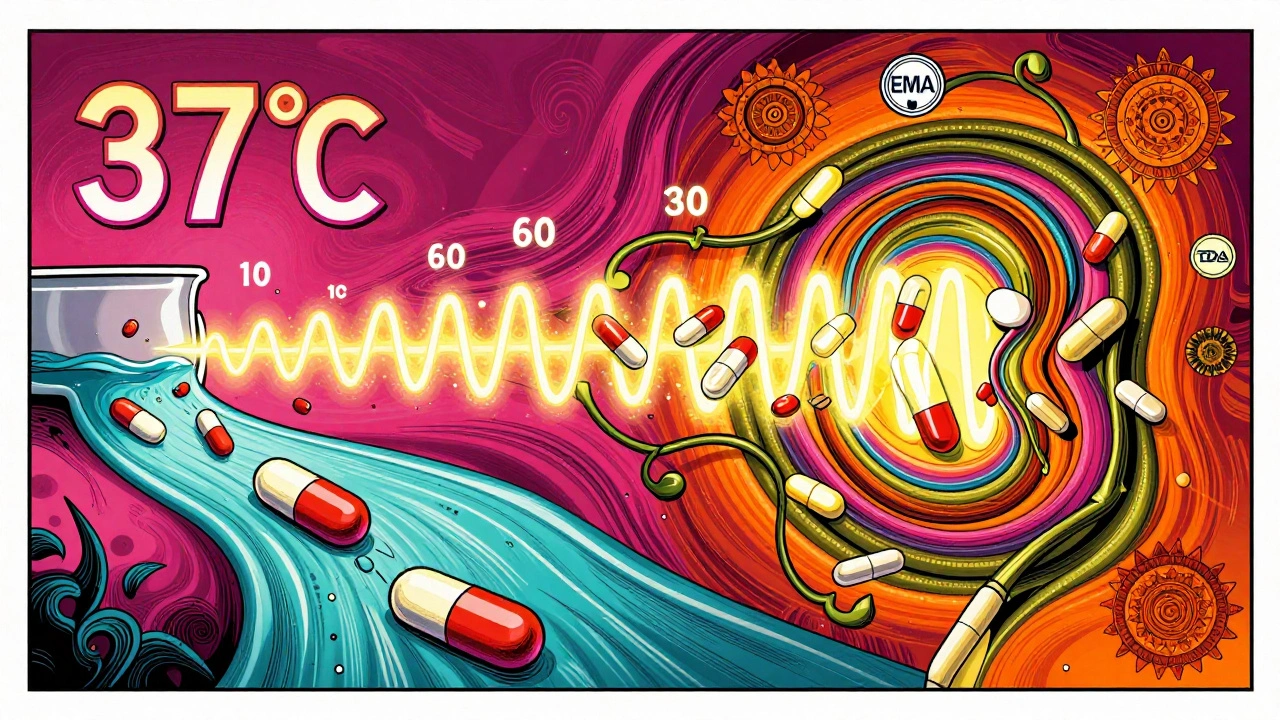
When you pick up a generic pill at the pharmacy, you expect it to work just like the brand-name version. But how do regulators know it really does? The answer lies in something called dissolution profile comparison. This isn’t just lab jargon-it’s the quiet backbone of generic drug approval. Without it, we wouldn’t have affordable medicines for millions.
What Is a Dissolution Profile?
A dissolution profile shows how quickly a drug releases from its tablet or capsule into a liquid that mimics your stomach or intestines. Think of it like watching sugar dissolve in tea-but instead of sugar, it’s medicine, and instead of tea, it’s a carefully controlled solution at body temperature (37°C). The test runs over time-usually at 10, 15, 30, 45, and 60 minutes-and measures how much of the drug has come out at each point. That creates a curve: a visual story of release. For brand-name drugs, this curve is established during development. For generics, the goal is to match that curve as closely as possible. If the generic dissolves the same way, under the same conditions, it’s likely to behave the same way in your body. That’s the whole point.Why Does This Matter for Generic vs Brand?
Not all pills are created equal, even if they have the same active ingredient. A generic tablet might use different fillers, binders, or coatings. These can change how fast the drug comes out. If it releases too quickly, you might get side effects. Too slowly, and it won’t work. Regulators like the FDA and EMA don’t require every generic to go through expensive human trials to prove it works the same. Instead, they use dissolution profiles as a stand-in. If the profile matches closely enough, they assume the drug will perform the same in your bloodstream. This cuts development time by 12-18 months and saves companies up to 60% in costs. That’s why generics cost less-and why you can buy them at all.The f2 Similarity Factor: The Industry Standard
The most common tool to compare two dissolution profiles is the f2 factor. It’s a number between 0 and 100. A value of 100 means the profiles are identical. Between 50 and 100? They’re considered similar enough for regulatory approval. Here’s how it works: You test 12 tablets of the brand-name drug and 12 of the generic under the same conditions-same machine, same temperature, same pH. You plot the percentage dissolved over time for each. Then you plug those numbers into a formula. The f2 score drops if the curves look different early on, even if they end up at the same point. For example, if the brand releases 70% of the drug in 15 minutes and the generic only releases 45%, the f2 score might fall below 50-even if both reach 85% by 60 minutes. That’s because the speed matters. Your body absorbs drugs differently depending on how fast they come out.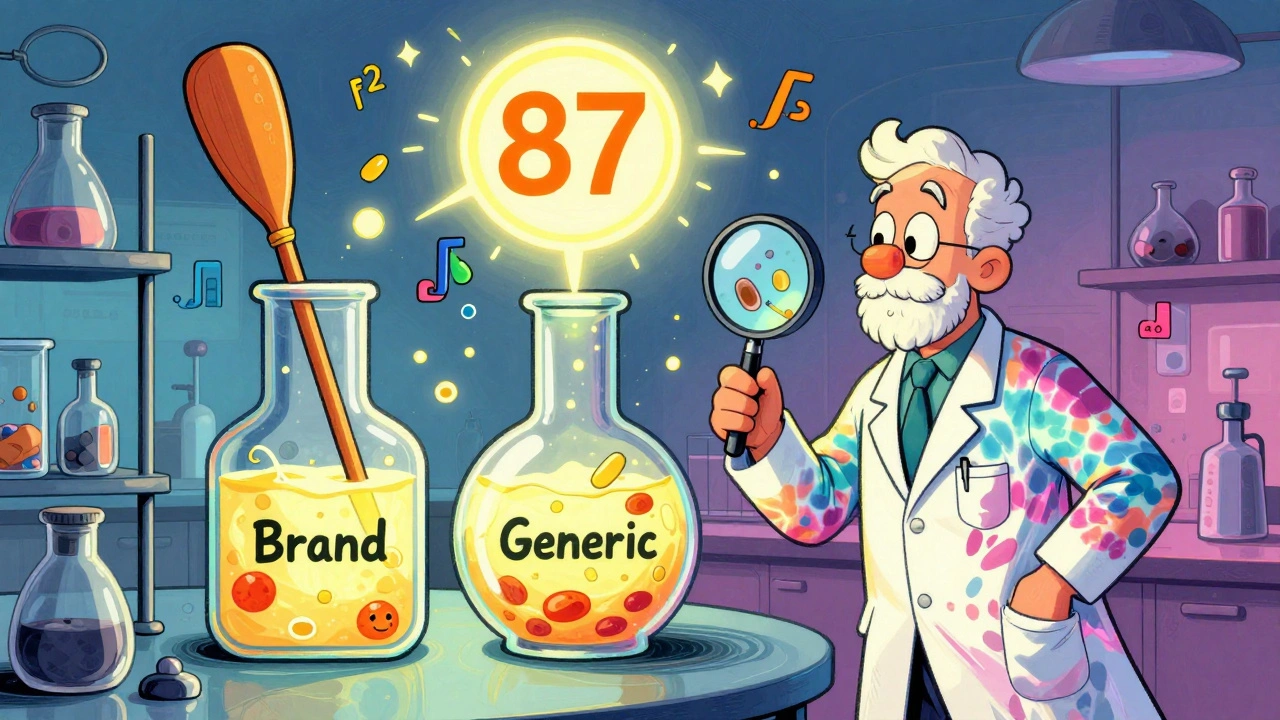
When f2 Isn’t Enough
The f2 method works well for most drugs. But it has blind spots. If a drug dissolves too fast-like many BCS Class I drugs (highly soluble and permeable)-small variations in the test can make the f2 score jump around. One lab might get f2=52, another f2=48. Same drug. Same batch. Just minor differences in equipment calibration. That’s why experts now recommend looking beyond f2. A 2019 study showed that combining f2 with the area under the dissolution curve (AUC) improves accuracy. If f2 is 51 and the AUC ratio is between 0.80 and 1.25, the chances of true bioequivalence go up significantly. In fact, this combo is 23% more predictive than f2 alone. For drugs with high variability, regulators now accept advanced methods like bootstrapped f2 (running the calculation 1,000 times to account for randomness) or the Mahalanobis Distance Test (MDT). MDT can spot differences that f2 misses-like a profile that releases the same total amount but in a different pattern. One 2021 study found MDT correctly identified dissimilar profiles 94% of the time, compared to 82% for f2 bootstrapping.What the Regulators Really Want
The FDA doesn’t just look at one number. They want to see the whole story:- 12 individual units tested for both products
- Identical dissolution apparatus (usually USP Apparatus 2 with paddles)
- Temperature held within ±0.5°C
- Media pH matching stomach (pH 1.2), small intestine (pH 4.5), and colon (pH 6.8)
- Time points until at least 85% of the drug dissolves
- Full dissolution curves, not just summary stats
- Calibration records for every piece of equipment
Real-World Problems in the Lab
It sounds simple, but getting consistent results is harder than you think. A 2022 survey of 127 quality labs found that 73% of failed dissolution comparisons were due to lab error-not product differences. Things like:- Wobbly paddles (more than 1.0mm of movement)
- Temperature drift outside ±0.3°C
- Wrong volume of dissolution medium
- Not maintaining sink conditions (where the solution can’t hold any more drug)
How to Get It Right
If you’re working with generics, here’s what actually works:- Use USP Apparatus 2 (paddles) with calibrated equipment. 65% of successful submissions use this.
- Test in at least three pH media if it’s a BCS Class I drug.
- Use a volume of dissolution medium that’s at least three times the drug’s solubility to avoid saturation.
- Add surfactants like sodium lauryl sulfate if the drug doesn’t dissolve well in water.
- Validate your method by testing stressed samples-overheated, under-compressed, or aged tablets. If your method can’t tell the difference, it’s not discriminatory enough.
- Always report full curves and statistical code. Regulators want reproducibility, not just numbers.
What’s Changing in 2025
The field is evolving. Biorelevant dissolution testing-using media that mimic real stomach fluid-is now standard for new drugs. The FDA and EMA are pushing to make this mandatory by 2026. Why? Because plain water doesn’t reflect what happens in your gut. Adding bile salts and enzymes gives a truer picture. Machine learning is also entering the scene. Top pharma companies are testing AI models that predict in vivo performance from dissolution curves. In 2023, 37% of the top 20 drugmakers were piloting these tools. It’s not replacing f2 yet-but it’s getting close.What This Means for You
If you’re a patient: You can trust generics. Dissolution testing is one of the most rigorously validated parts of drug approval. The system works. Over 84% of biowaivers based on dissolution profiles are approved today-up from 68% in 2015. If you’re in pharma: Don’t treat f2 like a checkbox. It’s a tool, not a rule. Use it with context. Validate your method. Understand the drug’s behavior. And always ask: Does this profile reflect what happens in the body? If you’re a student or researcher: This is where science meets real-world impact. Dissolution testing isn’t just about numbers. It’s about making life-saving drugs accessible. The next breakthrough might come from a better dissolution medium-or a smarter way to compare curves.What is the f2 similarity factor in dissolution testing?
The f2 similarity factor is a mathematical value between 0 and 100 used to compare two dissolution profiles. A score of 100 means the profiles are identical. Regulatory agencies accept f2 values between 50 and 100 as evidence of similarity between generic and brand-name drugs. It’s calculated using dissolution data from 12 units of each product across multiple time points.
Why is f2 not always reliable for fast-dissolving drugs?
For drugs that dissolve very quickly-like BCS Class I drugs-small variations in equipment, temperature, or sampling can cause large fluctuations in early time points. This makes the f2 score unstable. A score of 49.8 might appear to fail, even if the drug performs identically in the body. In these cases, regulators recommend using bootstrapped f2 or combining it with AUC analysis for better accuracy.
Do all generic drugs need dissolution profile comparisons?
Yes-for immediate-release solid oral dosage forms, dissolution profile comparison is required for nearly all generic drug applications submitted to the FDA. About 95% of ANDAs include this data. It’s the standard method to demonstrate equivalence without running full bioequivalence studies in humans.
Can two drugs with the same f2 score still behave differently in the body?
Yes. The f2 factor measures overall similarity but doesn’t capture the shape or timing of the release curve. Two profiles might have the same f2 score but release the drug in different patterns-like one releasing quickly then plateauing, and another releasing slowly but steadily. This can affect absorption, especially for drugs with narrow therapeutic windows. That’s why experts now recommend looking at the full curve and using additional methods like MDT.
What’s the difference between f1 and f2 factors?
The f1 factor measures the difference between two profiles on a scale of 0-15, where 0 means identical and higher numbers mean more difference. The f2 factor measures similarity on a scale of 0-100, where 100 is identical. f2 is preferred for regulatory submissions because it’s more sensitive to early release differences and easier to interpret. f1 is rarely used alone in modern applications.
How do regulatory agencies ensure dissolution test accuracy?
Regulators require strict calibration of equipment: vessel concentricity within 0.5mm, shaft wobble under 1.0mm, and temperature stability within ±0.3°C. Labs must use NIST-traceable thermometers and document every step. The FDA also requires validation of the method using stressed samples to prove it can detect meaningful differences. Without this, results aren’t trusted.
Justin Hampton
December 2, 2025 AT 17:36Look, I get the whole f2 thing, but let's be real - if a generic dissolves 49.8% at 15 minutes and the brand does 50.2%, you're telling me that’s a failure? That’s not science, that’s bureaucracy playing whack-a-mole with decimals. I’ve seen generics work better than the brand in real patients, and the lab just says ‘nope’ because some paddle wobbled 1.1mm. This system is broken.
Pooja Surnar
December 2, 2025 AT 21:37so u guys are actaully trusting some dumb formula to decide if a pill works or not?? like wtf?? if u take a pill and it dont make u feel diffrent then its fine!! why do u need all this fancy math?? i mean i took a generic omeprazole and it worked better than the brand, so who cares if f2 is 48?? ur doctors are just scared of saving money lol
Sandridge Nelia
December 4, 2025 AT 10:06This is such a clear breakdown - thank you! I work in a clinic and get asked all the time if generics are ‘just as good.’ Now I can point to this. The part about AUC + f2 being 23% more predictive? That’s gold. Also, the note about biorelevant media by 2026? Huge step forward. 🙌
Wendy Chiridza
December 5, 2025 AT 14:45The f2 factor is a useful tool but not a substitute for clinical understanding. The real issue is when labs treat it as a binary pass/fail instead of a starting point for deeper analysis. Validation, calibration, and method discrimination matter more than the number itself. Consistency over perfection.
Pamela Mae Ibabao
December 6, 2025 AT 03:57Okay but let’s talk about the 73% failure rate due to lab error. That’s wild. I bet half those labs are using equipment that’s older than the pharmacists. And yet they’re deciding whether millions of people get affordable meds? I mean… wow. The system’s one bad calibration away from a public health hiccup. 😅
Gerald Nauschnegg
December 7, 2025 AT 06:56So if I’m a patient and I get a generic that works fine, why should I care about dissolution curves? Honestly, if I feel better on the brand, I’ll pay the extra $10. If I don’t, I’ll take the generic. Stop overcomplicating it for people who just want to feel okay.
Sara Larson
December 9, 2025 AT 06:42YESSSS this is so important!! 🌟 I’m a pharmacy student and this was the first time I actually *got* why dissolution matters. It’s not just math - it’s about making sure someone with diabetes, epilepsy, or heart disease gets consistent care. The fact that we’re moving toward biorelevant media and AI? That’s the future. Keep pushing this forward!! 💪💊
Josh Bilskemper
December 9, 2025 AT 13:25f2 is a toy metric for people who don’t understand pharmacokinetics. Real scientists use AUC, Cmax, Tmax. If you’re relying on f2 alone, you’re not a regulator - you’re a spreadsheet jockey. The FDA’s 2023 draft? Still too soft. Mandate PK studies for all narrow TI drugs. End of discussion.
Storz Vonderheide
December 11, 2025 AT 02:23Coming from Nigeria, I’ve seen generics save lives where branded meds are unaffordable. But I’ve also seen bad batches - not because of the formula, but because of storage, humidity, or fake labs. The science here is solid, but implementation? That’s where the real challenge is. We need global standards, not just US/EU rules. The world needs this info.
dan koz
December 12, 2025 AT 23:29Bro this whole thread is overthinking it. If the pill works, it works. Who cares if the paddle moved 1.2mm? My cousin took a generic blood pressure med for 5 years and never had a problem. Stop making science sound like a magic trick.