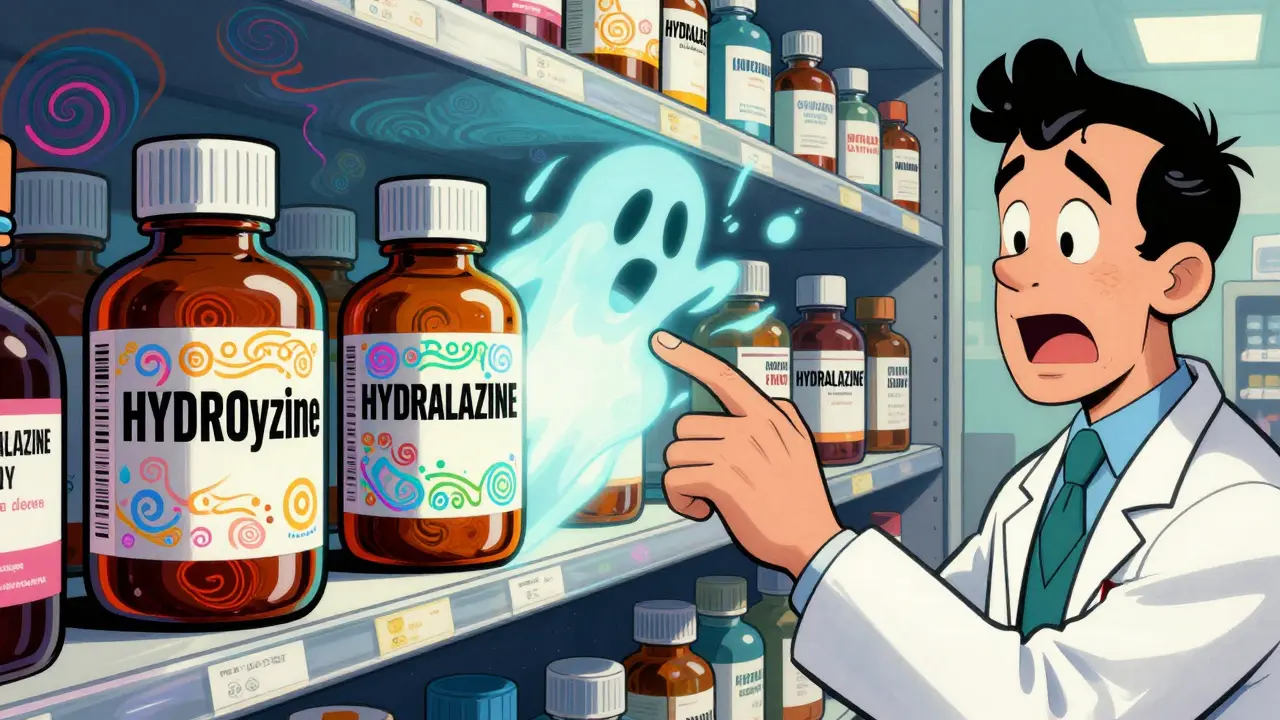
Every year, thousands of patients in the U.S. receive the wrong medication-not because of a doctor’s mistake, but because two pills look too much alike. One bottle says hydralazine, another says hydroxyzine. One label reads spironolactone, another spiramycin. To the untrained eye, they’re nearly identical. In a busy pharmacy, under pressure, with a stack of prescriptions waiting, it’s easy to grab the wrong one. And when you do, the consequences can be deadly.
Look-alike packaging confusion isn’t rare. It’s a silent, persistent threat in pharmacies across the country. According to the Institute for Safe Medication Practices (ISMP), about 18% of all medication error reports in the U.S. are tied to drugs that look or sound too similar. That’s roughly 10,000 reports annually. And behind every report? A patient who almost died-or did.
Why Packaging Confusion Is So Dangerous
It’s not just about the names. It’s about the whole package: the shape of the bottle, the color of the label, the font size, even the placement of the drug name. Two drugs can have different active ingredients, but if their packaging mirrors each other, a pharmacist might pick up the wrong one without even realizing it.
Take insulin products. There are multiple types-long-acting, rapid-acting-and they come in similar-looking pens and vials. In one hospital, pharmacists were accidentally grabbing long-acting insulin when they meant to grab rapid-acting. The result? Patients got doses that lasted all day instead of just a few hours. Blood sugar crashed. Some ended up in the ER.
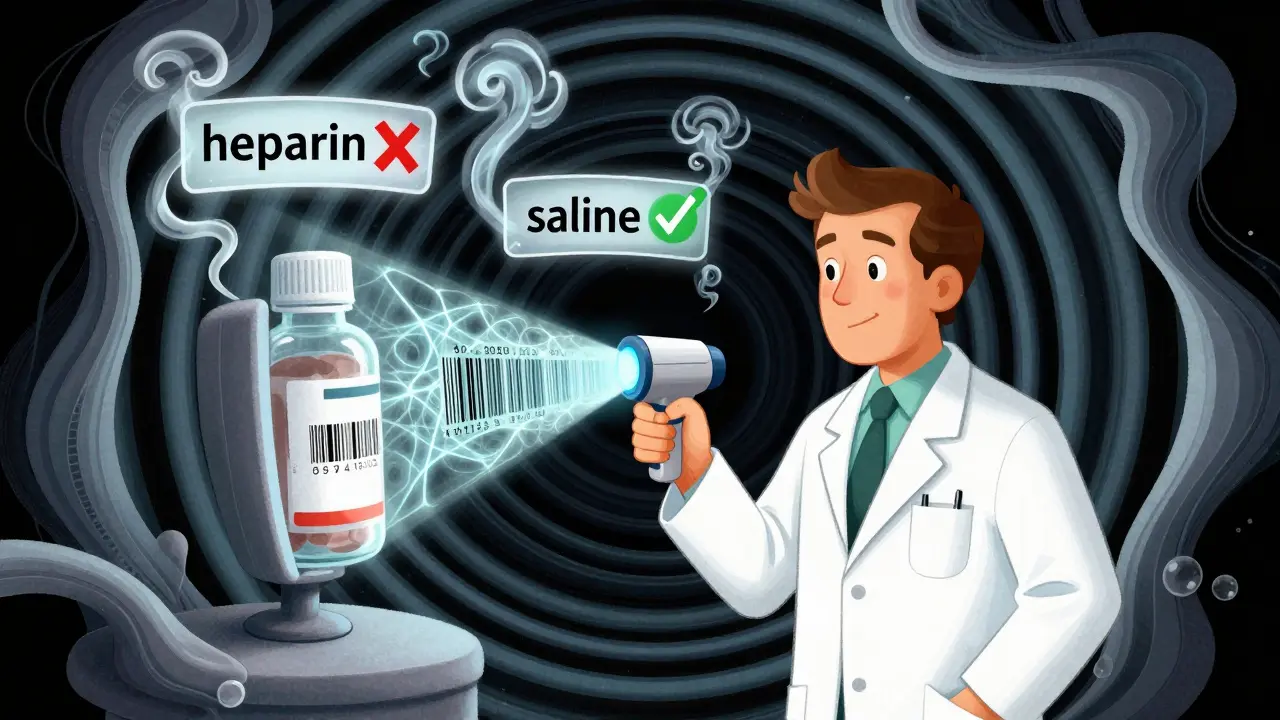
Or consider heparin and saline. Both are clear liquids in small bottles. One prevents blood clots. The other is just salt water. Mix them up, and you could cause a stroke-or worse.
The FDA estimates that 20% of medication errors come from confusing packaging. That’s not a glitch. It’s a design flaw. And it’s fixable.
Physical Separation: The Simplest Fix
One of the most effective ways to stop look-alike errors? Just keep the drugs apart.
It sounds obvious. But in many pharmacies, especially smaller ones, shelves are crammed. Everything’s in one aisle. A new drug arrives, and there’s no room, so it goes next to the closest-looking one. That’s how mistakes happen.
A 2020 study from the University of Arizona found that physically separating look-alike drugs reduced errors by 62%. That’s not a small number. That’s life-saving.
You don’t need fancy equipment. Just use shelf dividers-plastic or metal strips that cost $200 to $500 total. Put high-risk pairs on different shelves, even if they’re in the same cabinet. Keep insulin types in separate bins. Store heparin far from saline. Label the zones clearly: “High-Risk: Double-Check Before Dispensing.”
One hospital pharmacist reported that after separating insulin products, their wrong-insulin errors dropped from 3-4 per month to zero in 18 months. All it took was rearranging a shelf.
Tall Man Lettering: Make the Differences Visible
When two drug names are almost the same, the fix isn’t to change the name-it’s to make the difference impossible to miss.
That’s where Tall Man Lettering (TML) comes in. It’s simple: capitalize the parts of the name that differ. Instead of “dopamine” and “dobutamine,” you write DOPamine and DOBUtamine. The brain catches the uppercase letters faster than it reads the whole word.
Studies show TML reduces selection errors by 47%. The FDA and ISMP both recommend it for high-risk pairs. And it’s free-if your pharmacy system supports it.
But here’s the catch: not everyone uses it the same way. A 2022 survey found only 68% of hospitals use standardized TML formats. One system writes “HYDROxyzine” and “HYDRALAZINE.” Another writes “Hydroxyzine” and “Hydralazine.” That inconsistency causes confusion when patients move between hospitals or pharmacies.
That’s why you need to enforce consistency. Work with your EHR vendor to make sure TML is turned on for every high-risk pair on ISMP’s 2024 updated list. Don’t assume it’s already there. Check it yourself.
Barcode Scanning: Your Last Line of Defense
Physical separation and TML help prevent mistakes before they happen. But what if someone still grabs the wrong bottle?
That’s where barcode scanning comes in.
When a pharmacist scans the medication and the patient’s wristband, the system checks: Is this the right drug? Right dose? Right patient? If not, it alerts them-immediately.
According to the Agency for Healthcare Research and Quality (AHRQ), barcode scanning reduces medication administration errors by 86%. That’s the highest success rate of any single strategy.
But it only works if staff actually use it. A 2021 study from UC San Francisco found that 5-12% of scans were bypassed. Why? Too slow. Too many alerts. Staff got tired of the beeps.
The fix? Don’t just install scanners-train people on why they matter. Make scanning part of your daily checklist. Reward compliance. And never let a scan become a formality. If the system says “Warning: This drug looks like another,” stop. Look. Confirm.
Combining Strategies: The Only Way to Get Near 100% Safety
No single method is perfect. TML doesn’t fix packaging. Separation doesn’t help if someone grabs from the wrong shelf. Scanners fail if skipped.
The real solution? Layer them.
A 2023 study in the American Journal of Health-System Pharmacy found that pharmacies using all three strategies-physical separation, TML, and barcode scanning-reduced errors by 94%. That’s almost complete prevention.
Mayo Clinic did exactly this with heparin and saline. They separated the bottles, applied TML to all labels, and enforced scanning. In a 12-month period, they had zero look-alike errors.
It’s not expensive. Mayo’s program cost $42,000 to implement. But it saved $287,000 in avoided errors and patient complications. That’s a 580% return on investment.

How to Get Started Today
You don’t need a big budget or a tech overhaul to start protecting patients.
- Run a risk assessment. Use ISMP’s free Tool for Evaluating the Risk of Confusion Between Drug Names. It takes 8-12 hours for a typical pharmacy. Identify your top 5-10 look-alike pairs.
- Separate them. Use dividers, bins, or different shelves. Put the riskiest pairs as far apart as possible.
- Enable Tall Man Lettering. Check your pharmacy software. If TML isn’t on for high-risk drugs, turn it on. If it’s inconsistent, fix it.
- Enforce scanning. Make barcode scanning mandatory. Add it to your daily safety checklist. No exceptions.
- Train and remind. Post signs near storage areas: “Double-Check: Hydralazine vs. Hydroxyzine.” Hold a 10-minute safety huddle once a week. Share real stories-not just stats.
And don’t wait for a near-miss to act. If you haven’t reviewed your look-alike risks in the last year, you’re already behind.
What’s Coming Next
The FDA just released new draft guidance in February 2024, requiring standardized Tall Man Lettering for 25 high-risk drug pairs. ISMP added 17 new look-alike pairs to their 2024 list-including buprenorphine and butorphanol.
Next up? AI that can scan drug packaging and flag visual similarities before they reach the shelf. Pilot programs at Johns Hopkins are already detecting 98% of potential look-alike errors before dispensing.
By 2030, experts say comprehensive prevention will be standard. Not optional. Not nice-to-have. Essential.
Right now, only 32% of community pharmacies have full prevention programs. That’s not good enough. Every pharmacy-big or small-can take one step today. And that one step could save a life.
Frequently Asked Questions
What are the most common look-alike drug pairs in pharmacies?
The most frequent look-alike pairs include hydralazine/hydroxyzine, spironolactone/spiramycin, heparin/saline, dopamine/dobutamine, and insulin types (Lantus vs. Humalog). ISMP updates its official list quarterly, and as of January 2024, it includes 17 new pairs such as buprenorphine/butorphanol and metoprolol/methadone.
Is Tall Man Lettering required by law?
No, it’s not legally required, but it’s strongly recommended by the FDA and the Joint Commission. Under Standard MM.05.01.09, pharmacies must identify and address risks from look-alike/sound-alike drugs. Using Tall Man Lettering is the most accepted way to meet that requirement. Many insurers and accrediting bodies now expect it.
Can small community pharmacies afford barcode scanning?
Yes. Entry-level barcode scanning systems for community pharmacies start at $5,000-$10,000, including scanners and software integration. Many vendors offer payment plans. The cost of a single medication error-legal fees, patient harm, reputational damage-can easily exceed $100,000. The return on investment is clear.
Why do staff sometimes skip barcode scans?
Staff skip scans when the system is slow, when alerts are too frequent, or when they feel pressured to move quickly. The fix isn’t to disable scanning-it’s to streamline the process. Reduce unnecessary alerts, train staff on why it matters, and make scanning part of the workflow-not an extra step.
How often should pharmacies review their look-alike risks?
At least every six months. New drugs enter the market constantly. During drug shortages, substitutions increase the risk of look-alike errors. Every time a new medication is added to your formulary, run a quick check against ISMP’s current list. Don’t wait for an error to happen.
Christina Widodo
January 11, 2026 AT 21:58I used to work in a busy ER pharmacy and once almost gave a patient hydralazine instead of hydroxyzine. I didn’t even notice until the family asked why their mom was suddenly shaking. That day changed everything. Now I double-check every label like my life depends on it-because it kinda does.
Prachi Chauhan
January 11, 2026 AT 23:41why do we still let humans do this? machines dont get tired. machines dont mix up hydralazine and hydroxyzine. we are still using paper charts and sticky notes in 2025. its like flying a plane with a slide rule.
Katherine Carlock
January 12, 2026 AT 21:12This is so real. My aunt got the wrong insulin last year-ended up in the hospital for three days. We didn’t even know it was a packaging issue until the pharmacist showed us side-by-side. It’s wild how something so small can kill. I’m gonna share this with my local pharmacy. They need to see this.
Sona Chandra
January 13, 2026 AT 22:46THIS IS A SCAM. The FDA is letting this happen on purpose so they can sell more expensive scanners. Look at the profit margins on barcode systems. They’re pushing this so hospitals buy their crap. I’ve seen it before-same playbook with opioids. They create the problem, then sell you the fix.
Jennifer Phelps
January 14, 2026 AT 13:22barcodes are great but what if the scanner breaks or the battery dies or the system crashes what then you just wing it and hope for the best right
we need backups not just tech crutches
beth cordell
January 15, 2026 AT 19:59😭 This post made me cry. My cousin died because of this. Not because of negligence-because the labels looked the same. Please, if you work in a pharmacy… do something. Don’t wait for a tragedy. 💔💉
Lelia Battle
January 16, 2026 AT 19:14It is worth noting that the structural and perceptual similarities in pharmaceutical packaging are not merely coincidental. They are the product of cost-driven design decisions, prioritizing aesthetic uniformity over cognitive distinction. The human visual system, particularly under stress, is prone to pattern completion errors-rendering capitalization and spatial separation not merely helpful, but fundamentally necessary. The absence of standardized visual encoding constitutes a systemic failure in human factors engineering.
Rinky Tandon
January 16, 2026 AT 20:10Of course you’re talking about Tall Man Lettering and barcode scanning-you think that’s enough? You’re ignoring the real issue: pharmacists are overworked, underpaid, and treated like disposable robots. No amount of TML fixes a 12-hour shift with 200 scripts and zero breaks. Fix the workforce crisis first. Then we can talk about fonts.
Daniel Pate
January 17, 2026 AT 18:05Let’s not pretend this is just about labels. This is about a healthcare system that treats safety as an afterthought. We spend billions on fancy imaging tech but won’t spend $200 on shelf dividers? We optimize for speed, not survival. It’s not a design flaw-it’s a moral failure.
Jose Mecanico
January 18, 2026 AT 09:46I’ve seen the Mayo Clinic results. I’ve also seen small clinics that can’t afford scanners. Maybe we need a tiered approach-mandatory separation and TML for all, scanners for high-volume sites. Not everyone needs a Ferrari to drive safely.
Alex Fortwengler
January 18, 2026 AT 21:30Y’all are missing the point. This isn’t about packaging. It’s about the FDA letting Big Pharma get away with naming drugs like they’re trying to confuse toddlers. Why does hydralazine even exist? Why not just call it ‘BP Med A’ and stop the nonsense? This is all corporate greed wrapped in medical jargon.
Cecelia Alta
January 20, 2026 AT 10:22Okay so I work at a community pharmacy and we did all this stuff-separated the drugs, turned on TML, got the scanners-and then the owner said ‘we’re losing too much time’ and made us turn off the scanner alerts during peak hours. So now we just beep and ignore it. I’ve been trying to get people to care for two years. I’m exhausted. I just want to go home without someone dying on my watch. Why is this so hard?
George Bridges
January 21, 2026 AT 04:40Thank you for writing this. I’ve worked in pharmacies for 18 years and never once saw a training on look-alike drugs until last year. We just assumed we’d remember. We didn’t realize how much our brains were cutting corners. This isn’t about blame-it’s about building systems that work for humans, not against them.
Faith Wright
January 22, 2026 AT 23:35Wow. So the solution is… to do the bare minimum that should’ve been standard since 2010? Congrats, we’ve all been doing this wrong for decades and now you’re giving us a gold star for not killing people. 🙃