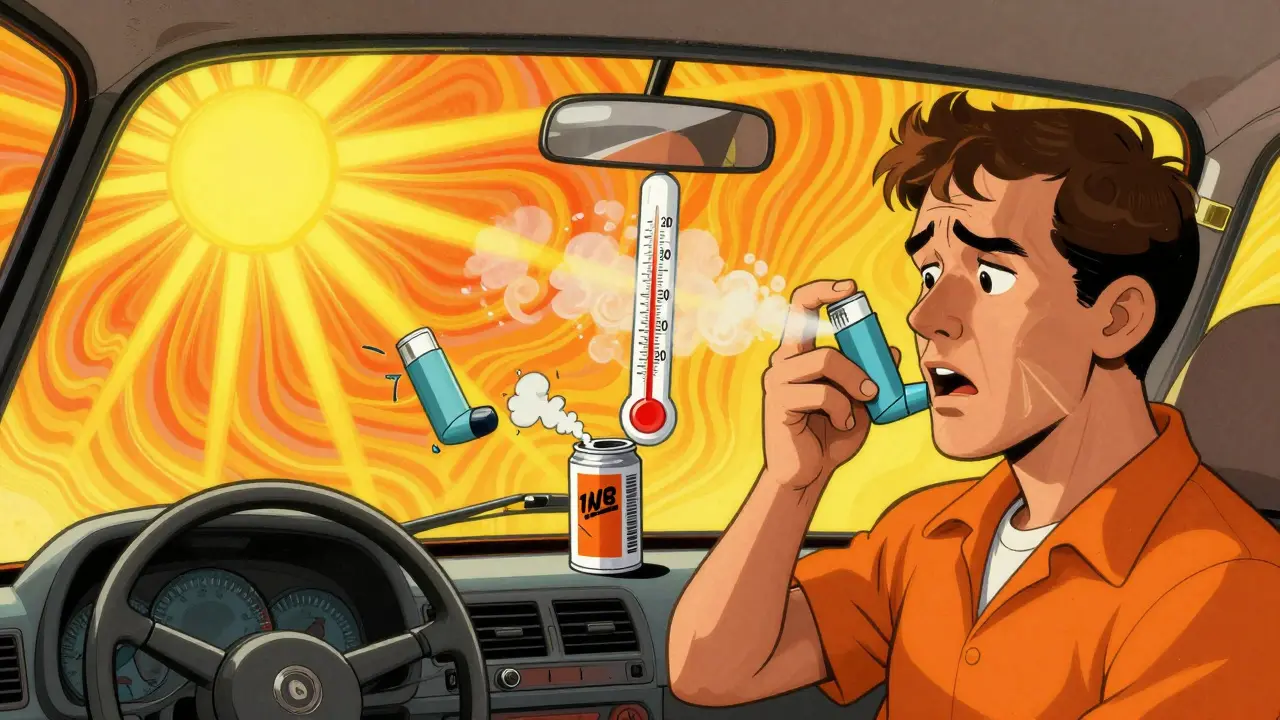
Keeping your inhaler or nebulizer medication working when you need it most isn’t just about following instructions-it’s about keeping your life safe. If your inhaler doesn’t deliver the right dose during an asthma attack, it could mean a trip to the ER. And the worst part? Many people think they’re storing their meds correctly… but they’re not. According to the Asthma and Allergy Foundation of America, only 38% of patients store their inhalers properly, even though 92% believe they are. That gap between belief and reality is dangerous.
What Temperature Is Safe for Inhalers?
Most inhalers need to stay between 59°F and 77°F (15°C to 25°C). That’s room temperature-nothing too hot, nothing too cold. But here’s where people get it wrong: they leave their inhalers in the car. On a 90°F day, the inside of a parked car can hit 130°F in under 30 minutes. At that heat, the medicine inside can break down completely. A 2022 study in the Journal of Aerosol Medicine found that albuterol in a metered-dose inhaler lost over 40% of its effectiveness after just 24 hours in a 95°F car. That’s not a slight drop-it’s a failure. Pressurized inhalers (like ProAir HFA or Ventolin) are in aluminum canisters under pressure. Heat doesn’t just weaken the drug-it can cause the canister to burst. The FDA warns against leaving these near stoves, radiators, or in direct sunlight. Dry powder inhalers (like Spiriva or Advair) have a different problem: moisture. If humidity rises above 60%, the powder clumps and the capsules get brittle. That means you won’t get the full dose when you inhale.Nebulizer Medications: More Fragile Than You Think
Nebulizer solutions like albuterol, Pulmicort, or Xopenex come in small plastic ampules. Unlike inhalers, many of these need refrigeration before opening. Pulmicort Respules, for example, must be kept at 36°F-46°F (2°C-8°C) until first use. Once opened, they’re good for only 7 days at room temperature. After that, they start losing potency. A 2022 Mayo Clinic study showed that after 10 days at 80°F, the active ingredient dropped by 30%. And don’t assume your medicine is safe just because it’s in the fridge. If it freezes, the chemical structure can change. Never put nebulizer solutions in the freezer. Also, avoid putting them near the back of the fridge where temperatures can dip below 32°F. The ideal spot? The middle shelf, away from the cooling vents.Where NOT to Store Your Medication
The bathroom is the #1 worst place for inhalers. Why? Humidity. Every time you shower or run the sink, moisture fills the air. A 2023 study from St. Jude Children’s Research Hospital found that storing an albuterol inhaler in a bathroom for just 14 days reduced its concentration by 35%. That’s enough to make a rescue inhaler useless during an attack. Other bad spots:- Car glove compartment-even in winter, dashboards can hit 120°F
- Window sills or near radiators
- Inside gym bags or purses left in hot cars
- Next to electronic devices like Wi-Fi routers (for nebulizer compressors)
Different Inhalers, Different Rules
Not all inhalers are the same. Here’s how they differ:| Inhaler Type | Temperature Range | Moisture Risk | Special Notes |
|---|---|---|---|
| Pressurized MDI (e.g., ProAir HFA) | 59°F-77°F (15°C-25°C) | Low | Avoid heat and puncturing. Never freeze. |
| Dry Powder (e.g., Spiriva, Advair) | 68°F-77°F (20°C-25°C) | Very High | Keep in dry place. Moisture causes powder to clump. |
| Breath-Actuated (e.g., Proventil RespiClick) | 68°F-77°F (20°C-25°C) | High | More sensitive than standard MDIs. Avoid humidity. |
| Nebulizer Solution (e.g., Pulmicort) | 36°F-46°F (unopened) 68°F-77°F (opened) |
Medium | Refrigerate until first use. Discard after 7 days. |
One common mistake? Storing different inhalers together. If you keep a dry powder inhaler next to a pressurized one, moisture from the canister’s propellant can leak out and ruin the powder. Always store them in separate containers.
Travel Tips: Keeping Medication Safe on the Go
If you’re flying, driving, or traveling, your inhaler needs protection. The American College of Physicians recommends the “Rule of 15”: never leave your inhaler unattended in a non-climate-controlled environment for more than 15 minutes. That means if you’re at the beach, in a hot car, or at a summer festival, keep it with you. Insulated cases work. The MediSafe case, for example, has been tested to maintain stable temperatures for up to 15 hours-even in 100°F heat. Users on Reddit’s r/Asthma community report success with these, especially in Florida and Arizona summers. Some newer options, like the SmartInhale case (FDA-cleared in May 2023), even have Bluetooth sensors that alert your phone if the temperature goes out of range. For air travel, always carry inhalers in your carry-on. Checked baggage can sit in unheated cargo holds where temperatures drop below freezing. The FAA allows inhalers through security without restriction, but keep them in their original packaging to avoid questions.How to Check If Your Inhaler Is Still Good
You can’t always tell by looking. A worn-out inhaler might still spray-but it won’t deliver the right dose. Here’s how to know:- Check the expiration date-but remember, expiration doesn’t mean “safe until then.” If stored poorly, it fails long before.
- Use a temperature strip like Timestrip. Stick it to the outside of your inhaler case. It changes color if exposed to heat above 86°F.
- Test the spray-if the mist is weak, uneven, or you hear a different sound, it’s time for a new one.
- Track usage-most inhalers have a counter. If you’ve used all your puffs before the date, replace it.
Some manufacturers are starting to build in sensors. GlaxoSmithKline’s Ellipta inhalers now have humidity-indicating packaging that changes color if moisture got in. These aren’t widespread yet-but they’re coming.
What About Refrigeration?
There’s confusion here. The American Thoracic Society says never refrigerate multi-dose inhalers. The European Respiratory Society says it’s okay during extreme heat (above 95°F). The truth? It depends on the drug.- For single-dose nebulizer ampules like Pulmicort: refrigerate until opened, then store at room temp.
- For multi-dose inhalers like Symbicort: keep at room temp. Refrigeration can cause the propellant to separate or the valve to freeze.
If you’re unsure, check the package insert or call your pharmacist. Don’t guess.
Storage in Schools and Workplaces
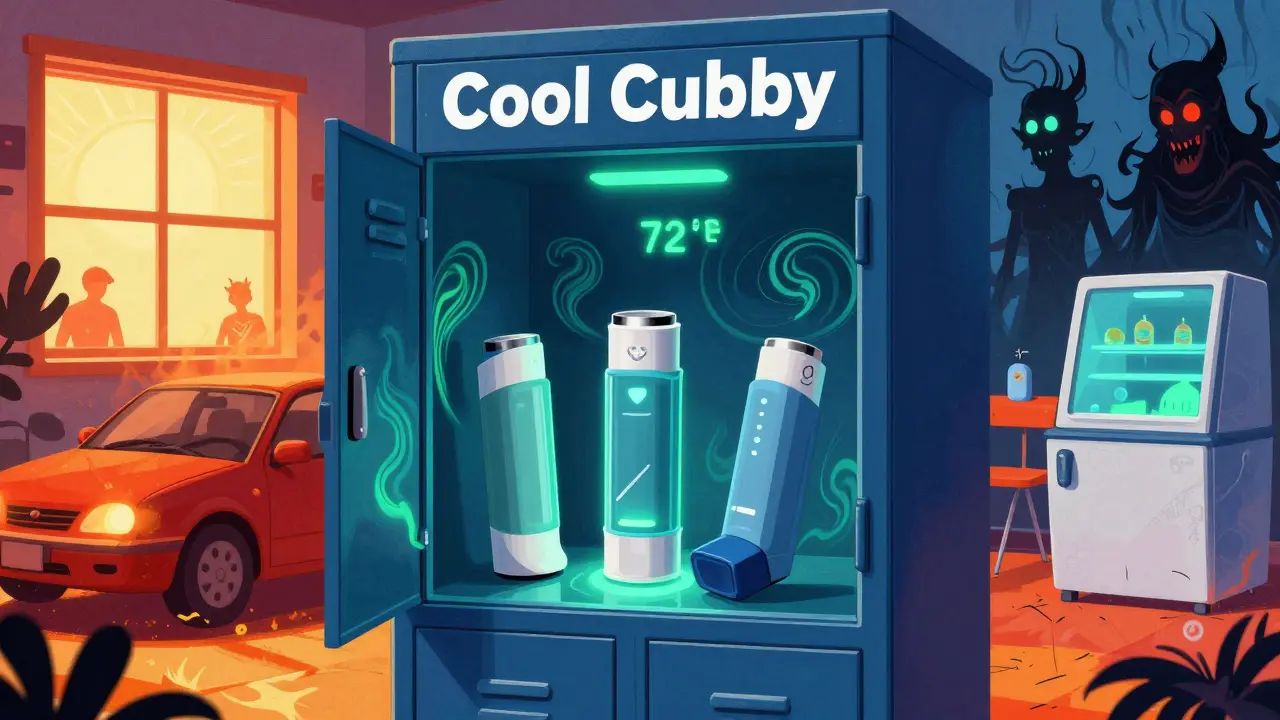
A 2022 CDC report found that 63% of school asthma emergencies involved inhalers stored improperly-often in nurse’s offices that were too hot. Many schools keep inhalers in cabinets near windows or above radiators. The solution? Temperature-monitored storage. St. Jude Children’s Research Hospital created “Cool Cubbies”-small, climate-controlled lockers in classrooms that keep inhalers at 72°F±2°F. Their pilot program cut medication failures by 89%. Workplaces should follow similar rules. HR departments should train employees on asthma safety, and include proper storage in their emergency response plans. If you work in a warehouse, gym, or outdoor job, ask your employer for a climate-controlled storage option.What’s Changing in 2026?
The FDA is pushing for change. In its 2023 draft guidance, it proposed that all rescue inhalers must include built-in temperature sensors by 2026. That means your inhaler might soon alert you if it’s been exposed to unsafe conditions. The NIH’s 2024 Asthma Action Plan update will include mandatory storage checklists for patients. Meanwhile, the global market for medication storage solutions is growing fast. It’s projected to hit $18.7 billion by 2027. More companies are making smart cases, humidity sensors, and even app-connected inhaler trackers. These aren’t luxury gadgets-they’re becoming essential tools.Final Checklist: Are You Storing Your Inhaler Right?
Use this quick checklist to make sure you’re safe:- Is your inhaler kept between 59°F and 77°F?
- Is it away from bathrooms, windows, cars, or direct sunlight?
- For dry powder inhalers: Is the container sealed and dry?
- For nebulizer solutions: Was it refrigerated before opening? Is it discarded after 7 days?
- Do you use a temperature strip or smart case when traveling?
- Do you replace your inhaler if it’s been exposed to extreme heat?
If you answered no to any of these, it’s time to change your routine. Your life depends on this medication working exactly when you need it. Don’t risk it.
Can I store my inhaler in the fridge?
It depends on the type. Single-dose nebulizer solutions like Pulmicort must be refrigerated before first use, then kept at room temperature after opening. Multi-dose inhalers like Symbicort or Ventolin should never be refrigerated-cold temperatures can damage the valve and cause the medicine to separate. Always check the package insert or ask your pharmacist.
What happens if my inhaler gets too hot?
Heat can break down the active ingredient, reduce spray pressure, or cause the canister to burst. In tests, inhalers left in a 95°F car for 24 hours delivered as little as 62% of the labeled dose. That’s not enough to stop an asthma attack. Always avoid leaving inhalers in cars, near windows, or in direct sun.
Why shouldn’t I store inhalers in the bathroom?
Bathrooms are humid. Moisture causes dry powder inhalers to clump and can reduce the potency of liquid medications. A 2023 study from St. Jude found that storing an albuterol inhaler in a bathroom for 14 days lowered its concentration by 35%. Always store inhalers in a dry, cool place like a bedroom drawer or closet.
How long do nebulizer solutions last after opening?
Most nebulizer solutions are good for 7 days after opening, even if there’s medicine left. After that, the risk of contamination and loss of potency increases. Always write the opening date on the ampule and throw it away after 7 days, regardless of how much is left.
Can I use an expired inhaler in an emergency?
If you have no other option and you’re having a severe attack, using an expired inhaler is better than nothing. But don’t rely on it. Expired inhalers may not deliver the full dose. Replace them before they expire. If you’re frequently using an expired inhaler, talk to your doctor about getting a backup.
Lyle Whyatt
February 8, 2026 AT 00:02Man, I never realized how much I was risking just by keeping my inhaler in the bathroom. I mean, I thought it was convenient-close to the sink, easy to grab after a shower. But reading that St. Jude study about the 35% drop in potency after two weeks? That’s terrifying. I’ve been using the same ProAir HFA for over a year, and I’ve definitely left it out in the bathroom more times than I can count. I’m switching to a sealed plastic container in my bedroom drawer tonight. Also, I just ordered one of those Timestrip temperature stickers. If my inhaler’s been exposed to heat, I want to know before I need it most. This post literally saved me from a potential ER trip.
Random Guy
February 8, 2026 AT 02:45so u mean like… my inhaler in the glovebox during my 3hr drive to the beach last summer? yeah that wasnt a ‘storage solution’ it was a death wish lmao
Brett Pouser
February 8, 2026 AT 13:39As someone who grew up in a household where asthma was a daily thing, I can’t tell you how many times I saw my mom leave her inhaler on the windowsill because ‘it’s just sitting there.’ This post hits hard. I’ve started using a small insulated case for mine, and I keep a backup in my work bag. The thing I didn’t know? That nebulizer solutions lose potency after 7 days. I’ve been using the same ampule for weeks. I’m throwing them out today. Also, I didn’t know about the electromagnetic interference with compressors-my router’s been right next to my nebulizer for years. Moving it now. Thanks for the clarity.
Joshua Smith
February 9, 2026 AT 07:59Just checked my inhaler’s expiration date-2024. I’ve had it since 2022. Should I replace it even if it still sprays? Also, any recommendations for affordable temperature strips? I’m not rich, but I’m not risking my breathing either.
Jessica Klaar
February 9, 2026 AT 10:24I’m a mom of two kids with asthma, and this post is a game-changer. We used to keep all their inhalers in the bathroom because it was the only place we could find a drawer. Now I’ve got a small locked box in the hall closet with a temperature strip on it. I even labeled each one with the opening date. My 8-year-old now checks the strip before school. It’s small, but it feels like we’re finally doing right by them. Also, I bought those MediSafe cases for travel-worth every penny. I wish I’d known this stuff five years ago.
PAUL MCQUEEN
February 11, 2026 AT 09:22So… let me get this straight. You’re telling me people don’t just keep their inhalers in their pants pocket like a wallet? That’s what I’ve been doing for 12 years. And it’s worked fine. The FDA says 59-77°F? That’s a range wider than my ex’s emotional stability. Also, ‘temperature-monitored storage’? Sounds like a scam to sell overpriced plastic boxes. My inhaler’s been fine. Maybe the real problem is people overthinking everything.
John Watts
February 11, 2026 AT 18:19Hey Paul, I hear you. But here’s the thing: asthma doesn’t care if you’re ‘overthinking.’ It just shows up when you’re not ready. I’ve been on the other side of an attack where the inhaler didn’t work. It’s not dramatic-it’s terrifying. I’m not selling anything. I just want you to know: the 40% drop in albuterol potency isn’t theoretical. I’ve tested my own inhaler after leaving it in my car. The spray felt weak. The puff was thin. That’s not ‘it’s fine.’ That’s a failure. I’m not mad you’re skeptical. I’m just glad you’re reading this. Maybe try the strip for a week. See if it changes your mind.
Chima Ifeanyi
February 12, 2026 AT 05:43Let’s deconstruct this. The cited studies are all from U.S.-based institutions with funding from pharma-aligned entities. The 38% statistic is statistically dubious without confidence intervals. Furthermore, the notion that ‘room temperature’ is universally defined ignores global microclimates-Nigeria’s ambient temperature rarely dips below 28°C. The recommendation to refrigerate nebulizer solutions contradicts WHO guidelines for low-resource settings where refrigeration is unreliable. The entire narrative is a manufactured crisis designed to sell smart cases and temperature sensors. The real issue? Access to affordable medication, not whether you stored it in a drawer or a glovebox. This is medical paternalism disguised as public health.