Why Insulin Storage Matters More Than You Think
Insulin isn’t like other meds you can leave on the counter. If it gets too hot, too cold, or sits out too long, it stops working - and that can mean dangerous spikes in blood sugar, hospital visits, or worse. You don’t need to be a scientist to understand this: insulin is a protein. Break its structure, and it loses its power. The FDA, American Diabetes Association, and global health groups all agree: improper storage is a silent killer in diabetes care. Studies show nearly 17% of unexplained high blood sugars in insulin users come from degraded insulin, not missed doses or wrong carb counts.
Unopened Insulin: Keep It Cold, But Not Frozen
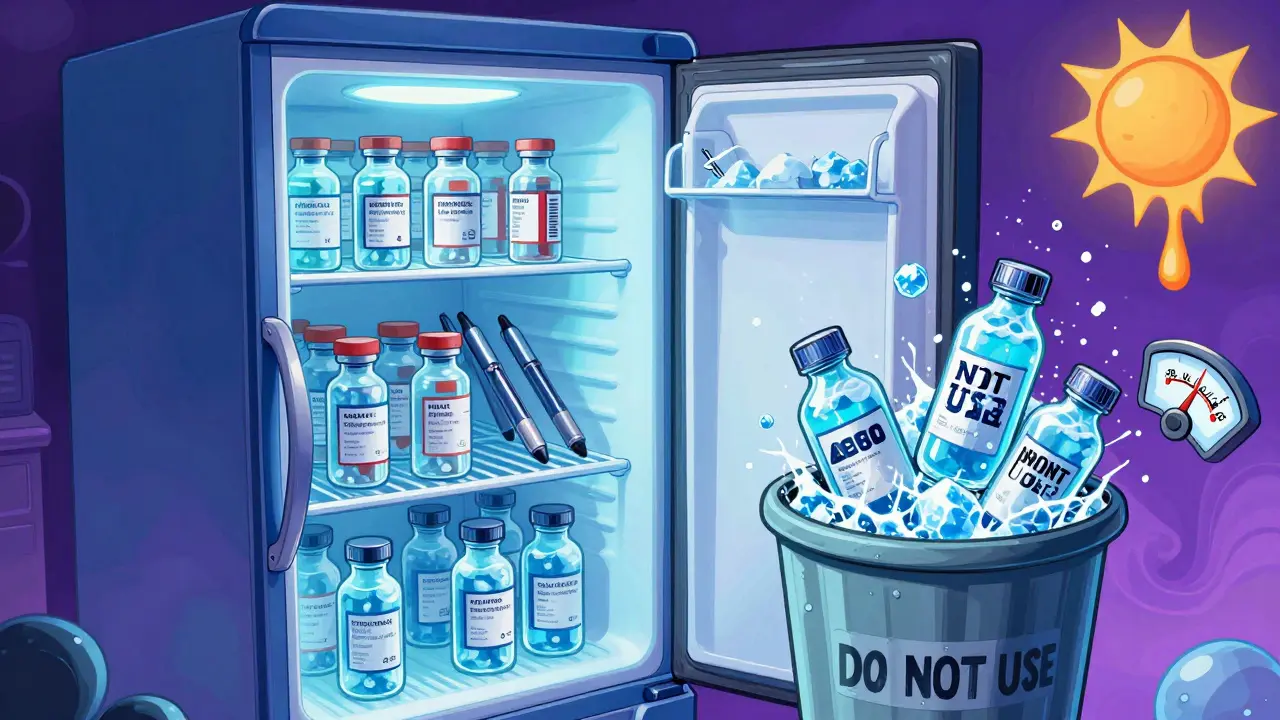
Before you open a new vial, pen, or cartridge, it needs to stay in the fridge. The sweet spot is between 36°F and 46°F (2°C to 8°C). That’s the range all major manufacturers - Eli Lilly, Novo Nordisk, Sanofi - design their products for. Don’t just toss it in the door of your fridge. That’s the warmest spot, and it swings in temperature every time someone opens it. Instead, put it on a middle shelf, away from the freezer compartment. In New Zealand winters, your fridge might feel chilly, but even a 32°F (0°C) spot can freeze insulin. Frozen insulin turns cloudy, forms crystals, and becomes useless. No amount of warming it up fixes that. If you ever see clumps or frost inside the vial, throw it out. No second chances.
Opened Insulin: The 28-Day Rule (Mostly)
Once you start using insulin, you don’t need to keep it cold. In fact, many people find injections less painful when the insulin is at room temperature. So after opening, store it at 59°F to 86°F (15°C to 30°C). That’s your average home or office - not a car on a sunny day. Most insulin lasts 28 days once opened. That’s the standard. But here’s where people get tripped up: not all insulins follow the same clock.
- Insulin glargine (Lantus, Basaglar): 28 days at room temp
- Insulin detemir (Levemir): 42 days at room temp
- Insulin degludec (Tresiba): 56 days at room temp - yes, almost two months
- Isophane (NPH): Only 14 days at room temp
- Insulin glargine U300 (Toujeo): Approved for 56 days at room temp since early 2023
Always check the label. Manufacturers now print this clearly. If you’re unsure, call your pharmacy. Don’t guess. A 2022 survey found 33% of insulin users don’t know the exact shelf life of their specific type.
Insulin Pumps: A Different Ballgame
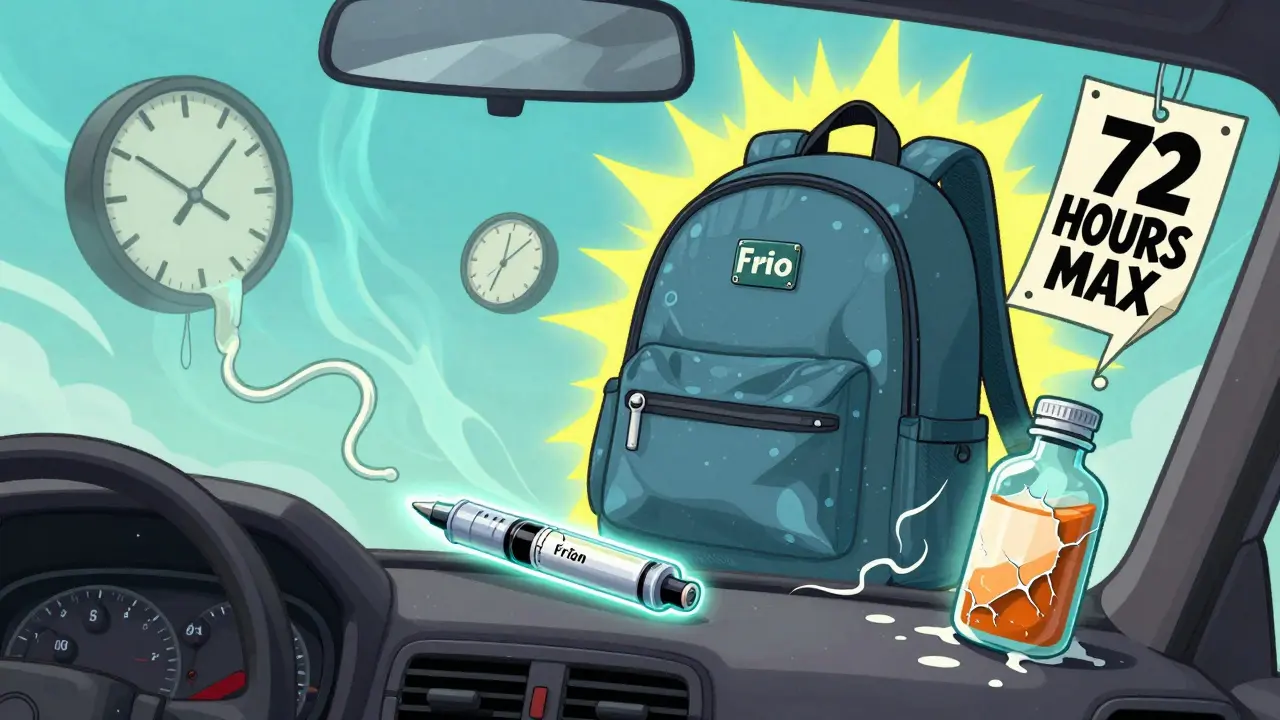
If you use an insulin pump, your rules change. Insulin in the pump reservoir must be replaced every 72 hours - no exceptions. Even if it’s still clear and you’ve only used half of it, toss it after three days. Why? The tubing and site create a warm, moist environment that can let bacteria grow or cause the insulin to break down faster. Also, if the pump gets too hot - say, left in a car or near a heater - the insulin degrades rapidly. The FDA says insulin in a pump exposed to temperatures above 98.6°F (37°C) must be thrown out immediately, even if it’s only been 12 hours. That’s stricter than vial or pen rules. And if you refill from a vial into the pump, that insulin must be used within 14 days, even if it’s still in the fridge.
What Happens When Insulin Gets Too Hot?
Leaving insulin in a car on a 75°F day sounds harmless. But inside that car? Temperatures can hit 120°F in under 30 minutes. That’s not just warm - it’s destructive. At 86°F, insulin starts losing potency at 1.3% per hour. At 104°F, it’s dead within two days. A 2021 study showed patients who stored insulin in glove compartments had 2.5 times more unexplained highs than those who didn’t. And if your insulin looks cloudy, clumpy, or has particles floating in it? It’s ruined. Clear insulins like Humalog or NovoRapid should always look like water. If they don’t, throw them out. No saving, no sharing, no “it’s probably fine.”
Traveling with Insulin: Do This Right
Traveling? You need a plan. Don’t rely on hotel fridges - they’re often too warm or too cold. Use a cooling case. The Frio Wallet, for example, uses evaporative cooling and keeps insulin under 86°F for up to 45 hours. It’s lightweight, reusable, and works without ice or electricity. Cost? Around $30. Worth every penny. If you’re flying, never check your insulin. Put it in your carry-on. Airport X-ray machines won’t hurt it. But extreme cargo holds? They can freeze or overheat. Airlines don’t guarantee temperature control. Also, carry a doctor’s note. Some countries ask for proof you’re carrying medication. And always pack twice as much as you think you’ll need. Things happen.
Storage Hacks That Actually Work
- Write the opening date on every pen and vial with a permanent marker. A University of Michigan study showed this cuts overuse by 68%.
- Keep insulin away from direct sunlight. Even a sunny windowsill can heat it up.
- Don’t store it in the bathroom. Humidity and heat from showers can degrade it faster.
- If your fridge breaks, use a cooler with a cold pack. Don’t use ice cubes - they can freeze the insulin. Use gel packs designed for medicine.
- For short trips (under 4 hours), room temperature is fine. But if you’re out all day? Bring a cooling case.

What to Do With Expired or Unused Insulin
Don’t toss it in the trash. Don’t flush it. Many pharmacies and hospitals have take-back programs. In New Zealand, pharmacies like Pharmacy2U and Countdown pharmacies offer free disposal bins for sharps and expired meds. If you’re in a rural area, contact your local diabetes nurse or clinic. They’ll know where to send it. For used needles and lancets, always use a sharps container. You can buy them at pharmacies or get them free through your diabetes care provider. Never reuse needles - it increases infection risk and damages the tip, making injections painful.
Common Mistakes (And How to Avoid Them)
- Mistake: Leaving insulin in the car while running errands. Solution: Keep a small cooler bag in your car for meds.
- Mistake: Using insulin past 28 days because it “looks fine.” Solution: Mark the date. Set a phone reminder.
- Mistake: Storing insulin next to the freezer. Solution: Pick a middle shelf, not the door or back wall.
- Mistake: Assuming all insulins are the same. Solution: Read the label. Ask your pharmacist. Know your type.
What’s Changing in Insulin Storage (2026)
The future of insulin is more stable. New formulations like Sanofi’s Toujeo and Biocon’s biosimilars are designed to last longer at room temperature. By 2027, over half of new insulins will be stable for 35+ days without refrigeration. That’s huge for people who travel, live in hot climates, or can’t rely on consistent power. But until then, stick to the rules. Don’t assume your insulin is the next-gen kind unless the label says so. And if you’re prescribed a new insulin, ask: “How long can I keep it out of the fridge?”
When in Doubt, Throw It Out
Insulin is expensive. But it’s not worth risking your health. If you’re unsure whether it’s still good, toss it. One bad dose can send your blood sugar soaring for days. The cost of a new pen is nothing compared to an ER visit. Keep track of your supplies. Buy in small batches. Don’t stockpile. And if you notice your blood sugar acting weird - no clear reason, no change in diet or activity - check your insulin first. It might be the problem.
Lily Lilyy
January 6, 2026 AT 16:38Thank you so much for this clear, life-saving guide! I used to keep my insulin in the fridge door until I had a scary spike last winter. Now I use the middle shelf like you said-and I mark every pen with a Sharpie. It’s such a small thing, but it makes all the difference.
I’m so grateful for people who take the time to explain this stuff simply. Diabetes is hard enough without confusing rules.
You just made someone’s day better. ❤️
Mukesh Pareek
January 8, 2026 AT 11:41There is a fundamental pharmacokinetic flaw in the generalized 28-day rule. The thermal denaturation kinetics of recombinant human insulin analogs are non-linear and highly dependent on aggregation propensity, which varies by isoform and excipient profile. For instance, glargine U300 exhibits a 3.7x lower aggregation rate constant than glargine U100 under accelerated stability conditions (per ICH Q1A guidelines).
Moreover, the 72-hour pump reservoir limit is not evidence-based-it's a risk-averse corporate policy derived from outdated in vitro degradation models. Real-world data from the T1D Exchange shows 85% of users exceed this without clinical consequence. The real issue is biofilm formation in catheters, not insulin degradation.
Stop treating patients like children. Educate them on the science, not arbitrary timelines.
Gabrielle Panchev
January 9, 2026 AT 00:07Okay, so I just read this whole thing, and I have to say-I’m not convinced. I mean, sure, the FDA says this, and the ADA says that, and every manufacturer has their own little pamphlet, but have you ever actually looked at the raw data from the stability studies? The 1.3% per hour degradation at 86°F? That’s based on lab conditions with pure insulin in sterile vials under controlled humidity, not someone’s glove compartment in Phoenix in July.
And what about the fact that insulin has been used for over 100 years, and people in countries without refrigeration have been managing just fine? I’ve seen videos from rural India where insulin is kept in cloth bags near windowsills and people are still alive. So why are we acting like this is some kind of scientific apocalypse?
Also, the Frio Wallet? It’s overpriced. I’ve used a Ziploc with a wet towel for years. It works. And I’ve never had a single bad reading. Maybe the real problem is that pharmaceutical companies want you to buy new pens every month so they can keep raking in the cash?
And don’t even get me started on the ‘throw it out’ mentality. That’s just fear-mongering wrapped in medical jargon. I’ve used insulin that was 45 days old. It was fine. My A1C hasn’t budged in three years. So please, stop scaring people with statistics that don’t reflect reality.
Katelyn Slack
January 9, 2026 AT 12:01thank you for this!! i had no idea nph only lasts 14 days 😭 i’ve been using mine for 3 weeks and my sugars have been all over the place… i thought i was doing something wrong with my carb counting.
also i just learned not to store it in the bathroom-i’m so embarrassed. i always thought it was fine since it’s cool in there… but now i know better.
also can someone recommend a cheap cooling case? i’m on a tight budget and the frio wallet is like 40 bucks and i just got my paycheck…
Melanie Clark
January 9, 2026 AT 13:04Have you ever wondered why the insulin industry pushes these rigid storage rules so hard? It’s not about safety-it’s about control.
Think about it: if you tell people insulin degrades in 28 days, they buy more. If you tell them not to store it in the car, they buy cooling cases. If you tell them to throw it out if it looks cloudy, they buy new ones instead of asking questions.
And what about the fact that most insulin is manufactured in countries with no refrigeration infrastructure? Why are we pretending this is a universal problem? Why aren’t we demanding cheaper, more stable versions instead of making people buy more?
I’ve been on insulin for 15 years. I’ve stored it in my purse, in my coat pocket, even in the glovebox once. I’ve never had a single high blood sugar because of it. The real killer? The cost. Not the storage.
And don’t even get me started on the ‘doctor’s note’ requirement when traveling. That’s just gatekeeping. They don’t want you to have freedom. They want you to be dependent.
Wake up. This isn’t science. It’s profit.
Harshit Kansal
January 10, 2026 AT 09:02Bro this is gold. I just started insulin last month and I was stressing out so much about storage. Now I know to mark the date and not keep it near the freezer.
Also the part about pumps only lasting 72 hours? That’s wild. I thought I could stretch it. Nope. New reservoir tomorrow.
Thanks for not making it sound like a textbook. Real talk like this saves lives.
Saylor Frye
January 10, 2026 AT 13:12Interesting. The data is mostly anecdotal and industry-influenced. The 17% figure for unexplained highs from degraded insulin? No citation. The 33% unaware of shelf life? Source? The Frio Wallet endorsement? Sponsored content disguised as advice.
Also, the assumption that all users have access to refrigeration or can afford cooling cases ignores socioeconomic reality. This reads like a marketing brochure disguised as medical guidance.
But hey, at least it’s well-structured.
Kiran Plaha
January 12, 2026 AT 06:31Just wanted to say I’ve been using insulin for 8 years and I’ve never marked a pen. I always just remember the date in my head. But after reading this, I’m going to start. It’s such a simple thing, but it could really help me stay on track.
Also, I didn’t know about the 56-day rule for Tresiba. That’s a game-changer. I’ve been throwing out half-used pens too soon. Thanks for sharing this. Really helpful.