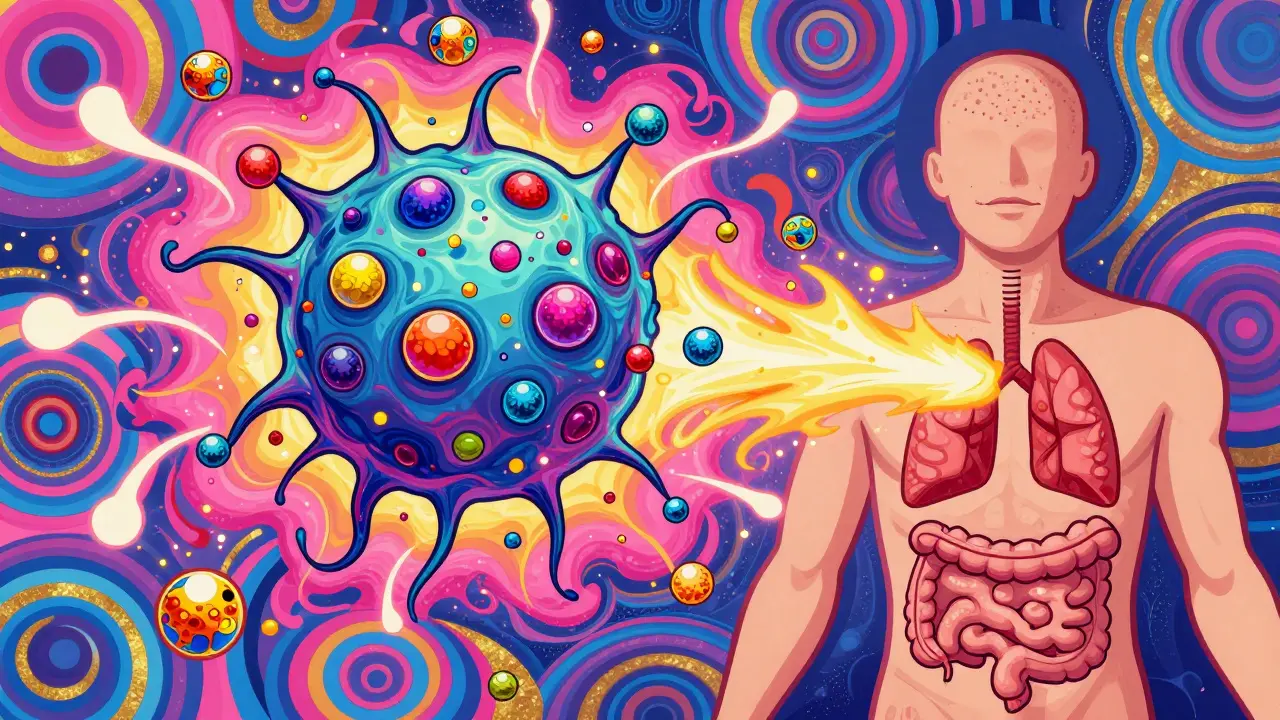
When your body reacts to something harmless-like pollen, a food, or even stress-with a sudden rush of itching, flushing, stomach cramps, or even trouble breathing, it’s not always an allergy in the classic sense. More often, it’s mast cell activation-a hidden driver behind many mysterious, multi-system symptoms that doctors often miss.
What Happens When Mast Cells Activate?
Mast cells are like immune sentinels, sitting quietly in your skin, lungs, gut, and other tissues where your body meets the outside world. They’re packed with chemicals ready to be released the moment they sense danger. In a healthy response, they help fight infections, heal wounds, and defend against parasites. But when they activate too easily or too often, they flood your body with inflammatory mediators-and that’s when trouble starts.Activation can come from many sources: IgE antibodies binding to allergens (the classic allergy trigger), bacterial components, stress hormones, heat, NSAIDs like ibuprofen, alcohol, or even emotional trauma. Once triggered, mast cells don’t just dump everything at once. They release mediators in waves.
Within seconds, pre-formed chemicals like histamine and tryptase burst out of their granules. Histamine causes itching, swelling, and stomach acid release. Tryptase, a protein that makes up 20-30% of the granule’s content, is a key marker doctors test for. Within minutes, lipid mediators like prostaglandin D2 and leukotriene C4 kick in, driving inflammation, bronchoconstriction, and mucus production. Hours later, cytokines like TNF-alpha and IL-6 flood the system, creating long-lasting fatigue, brain fog, and joint pain.
This isn’t random chaos. It’s a precise, timed release-and when it happens too often, it leads to Mast Cell Activation Syndrome (MCAS). First formally recognized in 2010, MCAS affects up to 17% of people with chronic hives and an estimated 1 in 1,000 to 1 in 10,000 people overall. Many patients spend years being told they have anxiety, IBS, or fibromyalgia before someone connects the dots.
The Mediators: What’s Actually Being Released
Understanding MCAS means understanding the chemicals involved. Not all mediators are the same, and not all are blocked by the same drugs.Pre-formed mediators are stored in granules like tiny bombs. Histamine makes up 10-15% of granule dry weight-enough to trigger hives, low blood pressure, and diarrhea. Tryptase is the most reliable blood test marker for mast cell activation. Chymase and carboxypeptidase damage tissues and activate other immune cells. Heparin, a glycosaminoglycan that makes up 30-50% of granule content, keeps these proteins locked in until activation.
Newly made mediators are more complex. Prostaglandin D2 (PGD2) causes flushing and headaches. Leukotriene C4 (LTC4) tightens airways-think asthma attacks without asthma. Platelet-activating factor (PAF) can trigger anaphylaxis. And cytokines? They’re the slow burners. TNF-alpha, IL-5, IL-6, and IL-13 don’t cause immediate symptoms but fuel chronic inflammation, fatigue, and pain that lingers for days.
What makes MCAS so hard to treat is that no single drug blocks all of these. Antihistamines help with histamine but do nothing for tryptase or PGD2. Leukotriene blockers like montelukast help with breathing but not with flushing or brain fog. That’s why stabilizers are so important-they stop the release at the source.
Mast Cell Stabilizers: How They Work and Who They Help
Mast cell stabilizers like cromolyn sodium and ketotifen don’t block mediators after they’re released. They prevent the release in the first place.Cromolyn sodium, approved by the FDA in 1973, works by stabilizing the mast cell membrane and blocking calcium from entering the cell. Without calcium, the granules can’t fuse with the membrane and explode. It’s not a fast fix. Peak levels take 2-4 hours, and it takes weeks to build up. Many patients don’t feel better for 6-8 weeks. But when it works, the results are profound.
A 2022 survey of 1,200 MCAS patients found 87% saw improvement with cromolyn. One patient, a 42-year-old woman, cut her anaphylactic episodes by 70% after taking 200 mg four times daily. She had to stick with it-therapeutic effects don’t come overnight.
Ketotifen, approved in the U.S. in 1990, does something similar but also has mild antihistamine effects. Studies show it reduces MCAS symptoms by 50-70% at doses of 1-4 mg twice daily. It’s often used off-label because it’s cheaper and easier to take than cromolyn.
But here’s the catch: stabilizers don’t stop everything. Cytokines can still be made through other pathways. You can block degranulation and still have inflammation from TNF-alpha. That’s why many patients need a cocktail: stabilizers plus antihistamines, leukotriene blockers, and sometimes even low-dose corticosteroids.

Limitations and Real-World Challenges
Mast cell stabilizers aren’t magic pills. They’re prophylactic-meaning they only work if taken before exposure. If you forget your dose before eating a trigger food, you’re vulnerable. They don’t help in acute attacks. For those, you need epinephrine, antihistamines, or steroids.Side effects are common. In one 2021 study, 35% of cromolyn users had nausea and diarrhea. Fifteen percent quit because of it. The taste? Patients rated it 2.1 out of 5. Some kids need it delivered through feeding tubes because they can’t swallow the bitter solution.
And diagnosis? It’s a mess. The average patient sees 6-10 doctors over 3-5 years before getting a correct diagnosis. Many are labeled as having anxiety because their symptoms shift-headache one day, diarrhea the next, flushing after a shower. There’s no single test. Doctors look for elevated serum tryptase (a 20% rise above baseline plus 2 ng/mL), elevated urinary methylhistamine (over 1.3 mg in 24 hours), or high N-methyl-β-hexosaminidase. But even these aren’t perfect. Some patients have normal labs but clear clinical symptoms.
Diagnostic criteria are still debated. The International Consensus (ICON-MCD) demands strict lab evidence. The AAAAI says if your symptoms match MCAS and respond to treatment, that’s enough. This gap leaves many patients stuck in limbo.
Triggers and Daily Management
Knowing your triggers is half the battle. Community surveys from over 15,000 MCAS patients show consistent patterns:- NSAIDs (ibuprofen, naproxen) - 68%
- Alcohol - 63%
- Heat - 57%
- Emotional stress - 52%
- Specific foods (aged cheeses, shellfish, fermented foods) - 49%
Many use the “mast cell trigger wheel”-a visual tool that maps common triggers so patients can spot patterns. Avoiding them isn’t always possible, but reducing exposure cuts flare-ups dramatically.
Starting cromolyn? Most doctors begin at 100 mg four times daily, then slowly increase to 200-400 mg four times daily over 4-6 weeks. Ketotifen usually starts at 1 mg at night, then increases to 1-2 mg twice daily. Consistency matters more than dose. Missing doses can undo progress.
The Future: What’s Coming Next
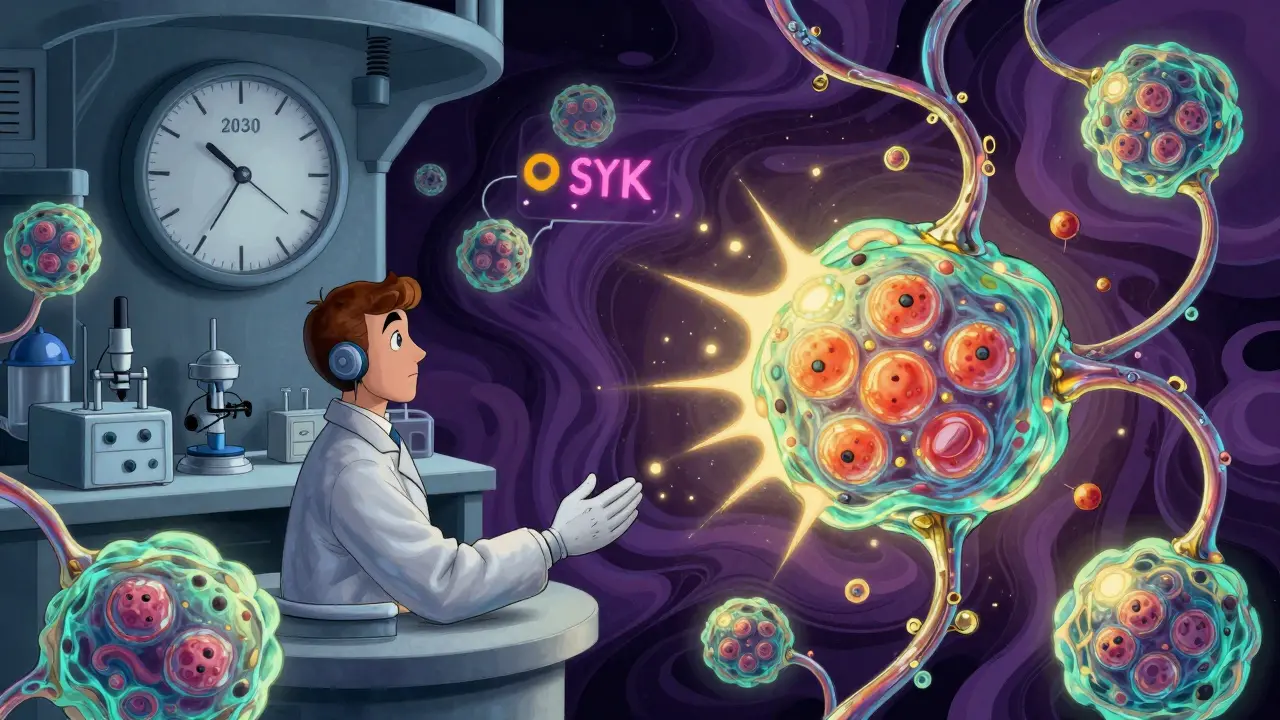
The mast cell treatment landscape is changing fast. In 2023, the FDA approved avapritinib for advanced systemic mastocytosis-a drug that targets the KIT D816V mutation found in 30% of MCAS patients. It’s not for everyone, but it’s a breakthrough.Next-generation drugs are in the pipeline. SYK kinase inhibitors, currently in Phase II trials, reduce mediator release by 75% at 100 mg daily. Mast cell-specific monoclonal antibodies are being designed to silence overactive cells without suppressing the whole immune system. By 2030, experts predict these therapies could control symptoms in 80-90% of patients.
For now, mast cell stabilizers remain the backbone of treatment. They’re not glamorous, but they’re the most accessible tool we have to prevent the cascade before it starts. They don’t cure MCAS-but for many, they turn a life of constant crisis into something manageable.
Where to Go From Here
If you suspect mast cell activation is behind your unexplained symptoms, start with your doctor. Ask for:- Serum tryptase (drawn within 1-2 hours of a flare)
- 24-hour urinary methylhistamine
- N-methyl-β-hexosaminidase
Keep a symptom diary: note time, triggers, and symptoms. Bring it to a specialist. The Mast Cell Disease Society has a directory of 350 verified doctors trained in MCAS. Don’t wait years to get answers. Your symptoms are real-and help is available.
What is the difference between MCAS and mastocytosis?
Mastocytosis is a rare condition where the body makes too many mast cells, often due to a KIT gene mutation. These cells can build up in skin, bone marrow, or organs. MCAS is different-it’s not about having too many cells, but about having normal numbers that activate too easily. You can have MCAS without mastocytosis, and vice versa. The symptoms overlap, but the underlying cause and treatment approach differ.
Can you outgrow MCAS?
Some people see improvement over time, especially with consistent trigger avoidance and treatment. A subset of patients, particularly those whose MCAS started after an infection or trauma, may stabilize or even reduce symptoms significantly. But for most, MCAS is a chronic condition that requires ongoing management. There’s no cure yet, but control is possible.
Why do antihistamines sometimes not work for MCAS?
Antihistamines only block histamine, but mast cells release dozens of other mediators-tryptase, prostaglandin D2, leukotrienes, cytokines. If your symptoms are driven by PGD2 (causing flushing) or LTC4 (causing wheezing), antihistamines won’t help. That’s why combination therapy is often needed: stabilizers to prevent release, plus blockers for specific mediators.
Is cromolyn sodium safe for long-term use?
Yes. Cromolyn has been used safely for over 50 years. It’s not absorbed well by the gut, so it rarely causes systemic side effects. The main issues are gastrointestinal upset and poor taste. Long-term studies show no liver, kidney, or bone marrow toxicity. Many patients take it daily for years with no major problems.
How do I know if my mast cell stabilizer is working?
Look for fewer flares, less severity, and longer gaps between episodes. Lab markers like urinary methylhistamine and N-methyl-β-hexosaminidase should drop by at least 30% after 3-6 months of consistent use. But don’t wait for labs alone-if your daily life improves (less brain fog, fewer GI attacks, no more flushing), that’s the best sign.
Ashley Karanja
January 26, 2026 AT 00:54Okay, but have we considered that mast cell activation isn't just a biological phenomenon-it's a metaphysical echo of modern life's chronic dissonance? We're bombarded with toxins, emotional neglect, and systemic stress, and our bodies respond by screaming through histamine. The real stabilizer isn't cromolyn-it's radical self-compassion. We've pathologized survival.
When your gut flares after a Zoom meeting, is it the cheese... or the fact that you haven't felt seen in 17 days? The mediators are just the language. The trauma is the dialect.
Karen Droege
January 26, 2026 AT 13:58As a clinician who's seen 300+ MCAS patients, I can tell you: stabilizers work-but only if you treat the whole damn ecosystem. You can't just dump cromolyn on someone who's sleeping 4 hours, drinking kombucha, and crying through 3 therapy sessions a week.
Trigger avoidance isn't 'being dramatic.' It's biohacking your survival. I hand out trigger wheels like candy. And yes, the taste of cromolyn is like licking a battery, but so is life when you're constantly on the edge of anaphylaxis. Stick with it. Your future self will high-five you.
Also-ketotifen at night? Game. Changer. Sleep + less flushing? Yes please.
Jessica Knuteson
January 26, 2026 AT 15:0517% of chronic hives patients have MCAS? That’s a nice number. Where’s the double-blind placebo-controlled trial? Where’s the peer-reviewed validation? You’re giving people a diagnosis based on symptom lists and hope. That’s not medicine. That’s astrology with lab coats.
George Rahn
January 27, 2026 AT 03:47It is the height of Western decadence to reduce the sacred architecture of immune defense to a chemical cascade governed by pharmaceuticals. The mast cell is not a malfunctioning valve-it is the ancient sentinel of the body’s covenant with the world. To stabilize it with sodium cromolyn is to domesticate the wild fire of vitality.
Our ancestors did not have antihistamines. They had fasting. They had silence. They had the wind on their skin and the sun in their eyes. The true stabilizer is not a pill-it is the reclamation of rhythm. Reconnect with the earth. Walk barefoot. Breathe deep. Let the body remember its sovereignty.
Pharmaceuticals are the crutches of a civilization that has forgotten how to be alive.
Angie Thompson
January 27, 2026 AT 22:21OMG YES. I’ve been on ketotifen for 3 months and my brain fog lifted like a foghorn. I actually remembered my dog’s name yesterday 😭
Also-avoiding heat? I stopped taking hot showers. I swear I’ve never felt more alive. It’s not about being weird. It’s about not dying. 🙏
Neil Thorogood
January 28, 2026 AT 18:37So let me get this straight. You’re telling me I need to take a bitter, chalky liquid 4x a day to stop my body from treating my coffee like a grenade… and the side effects are nausea and diarrhea?
And this is better than just… not drinking coffee?
Also, why does this feel like a cult? 🤔
TONY ADAMS
January 29, 2026 AT 17:26bro why are you so into this? just take an antihistamine and chill. you’re not special. everyone gets stomach cramps. stop making it a personality.
rasna saha
January 31, 2026 AT 03:59Thank you for writing this. As someone from India where doctors still think 'stress' is the answer to everything, this is a lifeline. I’ve been told I’m 'overreacting' for 7 years. Now I know it’s not anxiety-it’s mast cells. I’m starting cromolyn next week. Pray for me 🙏
bella nash
February 1, 2026 AT 21:16The diagnostic criteria for Mast Cell Activation Syndrome remain scientifically untenable. The reliance on subjective symptom clusters and non-specific biomarkers constitutes a diagnostic paradigm that lacks epistemological rigor. Without standardized, reproducible laboratory validation, the classification constitutes a form of medical nihilism disguised as patient advocacy.
Betty Bomber
February 2, 2026 AT 23:08my mom has this. she won’t eat anything that’s been in the fridge more than 2 days. she wears a cooling vest in summer. she carries epinephrine in her purse like a phone.
i used to think she was weird. now i get it. she’s just… not broken. she’s just wired differently.
Renia Pyles
February 4, 2026 AT 14:17Oh great. Another ‘mystery illness’ that’s just people being dramatic and blaming their diet. I bet if you just stopped being so sensitive and drank more water, you’d be fine. Stop being a victim.
John Wippler
February 4, 2026 AT 20:13What’s fascinating isn’t just the science-it’s the cultural silence around it. We live in a world that rewards productivity, ignores pain, and pathologizes sensitivity. MCAS isn’t just a medical condition-it’s a mirror. It reflects a society that has forgotten how to listen to the body.
Stabilizers don’t cure MCAS. They buy time. But the real healing? That comes when we stop treating chronic illness as a personal failure and start treating it as a systemic failure.
We need better diagnostics. Better insurance coverage. Better doctors. And maybe… less judgment.
Simran Kaur
February 5, 2026 AT 13:16As an Indian woman who’s been told ‘it’s just your hormones’ for 12 years, I’m crying right now. This is the first time I’ve seen my symptoms named without shame. I’ve been avoiding spicy food, heat, stress-and now I know why. Thank you for giving me words when no doctor would.
Also, ketotifen at night? I started it last week. Slept through the night for the first time in 5 years. 🤍
Shweta Deshpande
February 6, 2026 AT 23:40I was diagnosed with MCAS after 6 years of being called ‘anxious.’ I thought I was going crazy. Now I’m on cromolyn and it’s not perfect-but I can leave the house again. I can hug my niece without worrying I’ll collapse. I can breathe.
It’s not glamorous. It’s not quick. But it’s real. And if you’re reading this and you feel like your body is betraying you-you’re not alone. We’re here. We’re fighting. And we’re not giving up.
James Nicoll
February 8, 2026 AT 16:13So the FDA approved a drug for mastocytosis, which affects 0.001% of people, but cromolyn-used by thousands-is still treated like a supplement? Welcome to American healthcare, folks. We’ll fund a $500k-a-dose miracle drug for 10 people… but make the 10,000 people who actually need it swallow chalky water and pray.
Meanwhile, the pharmaceutical industry is quietly developing next-gen drugs… but only after the market’s been conditioned to accept suffering as normal.