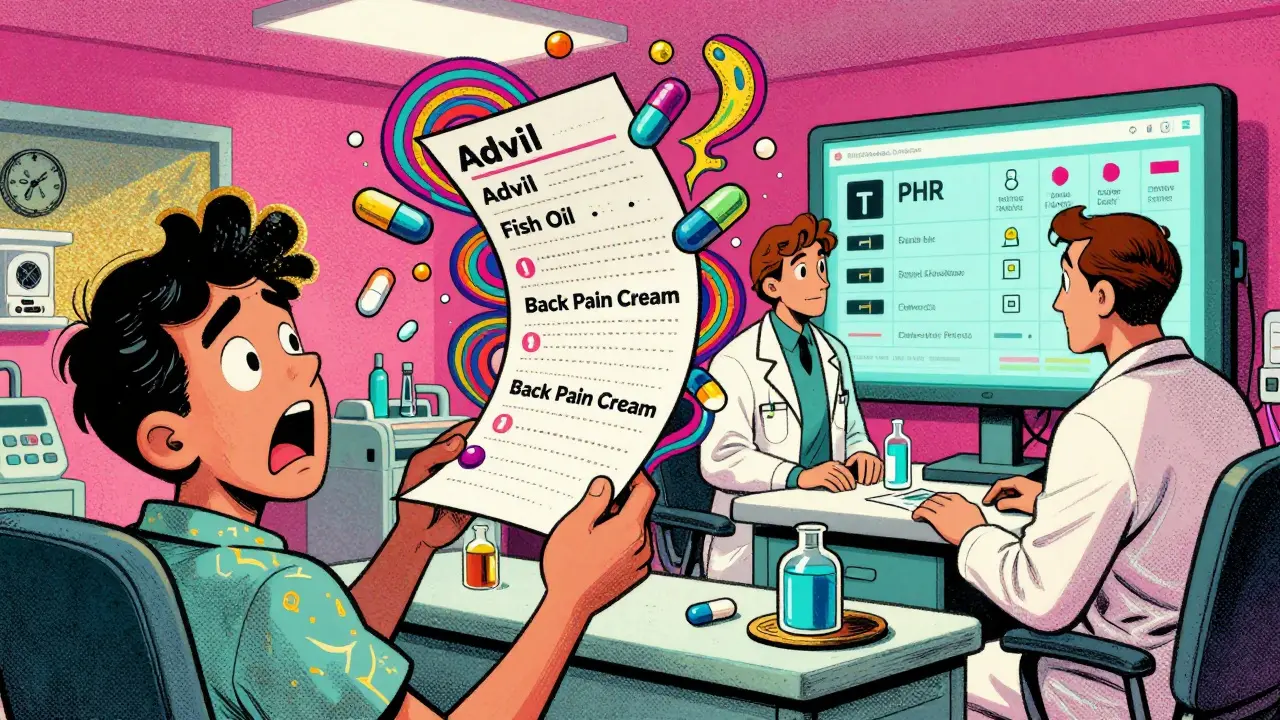
Imagine this: you’re at the emergency room after a fall. You can’t remember all the pills you take. The doctor asks for your meds. You list five. But you’re actually on nine - including that herbal supplement you started last month and the over-the-counter painkiller you grab when your back flares up. The ER team doesn’t know about those last four. That’s not rare. It happens every day. And it’s dangerous.
Personal health records (PHRs) are meant to fix that. They’re your own digital file - not controlled by a hospital or pharmacy - that pulls together every medication you’ve taken, no matter where you filled it. Whether it’s your local drugstore, an online pharmacy, or even a cash purchase at a corner store, your PHR should show it all. But in practice? It’s messy.
What a PHR Actually Tracks (And What It Misses)
A good PHR doesn’t just show prescriptions. It includes over-the-counter drugs, vitamins, supplements, and even topical creams. The goal is a complete picture. But here’s the problem: only 37% of PHR systems capture OTC medications reliably. Why? Because most don’t have a way to classify them. Ibuprofen isn’t coded the same way as a prescription painkiller. So if you type in “Advil,” the system might ignore it. Or worse - it might mislabel it as something else.
Even when systems do capture OTCs, patients often don’t enter them. A 2023 study found that 61% of patient-entered medication lists contain dosage errors. Someone writes “10 mg” when it’s really “100 mg.” Or they forget to update it after switching brands. That’s not just a mistake - it’s a risk.
And refill patterns don’t tell the full story. Just because you picked up your blood pressure pill last week doesn’t mean you took it. PHRs track dispensing, not consumption. So if you’re skipping doses because the cost is too high or you’re feeling better, the system won’t know. That creates a false sense of security for doctors.
How PHRs Get Data - And Where They Fall Short
Most PHRs pull data from three places: pharmacy claims (through your insurance), direct pharmacy feeds, and what you manually enter. The biggest source? Pharmacy benefit managers (PBMs). They handle 92% of prescription fills. So if you use insurance to fill a script, chances are it shows up.
But what about the cash-paying patient? Or the one who uses a different pharmacy every time? That’s where things break. Smaller pharmacies, especially in rural areas, often use outdated software that doesn’t talk to PHR systems. A 2023 analysis found that 22% of rural pharmacies can’t share data properly. That means if you fill your diabetes meds at a small town pharmacy, your PHR might never see it.
Even big networks like Surescripts - which processes 22 billion transactions a year - aren’t perfect. Their system matches patients with 99.2% accuracy using name, birthdate, and address. But if your name is spelled slightly wrong on one record? Or if you moved and didn’t update your address everywhere? You could end up with a mix of your records and someone else’s. That’s not theoretical. Surescripts reports 8.7% of medication history requests have patient ID errors.
Apple Health vs. Surescripts: Which One Works Better?
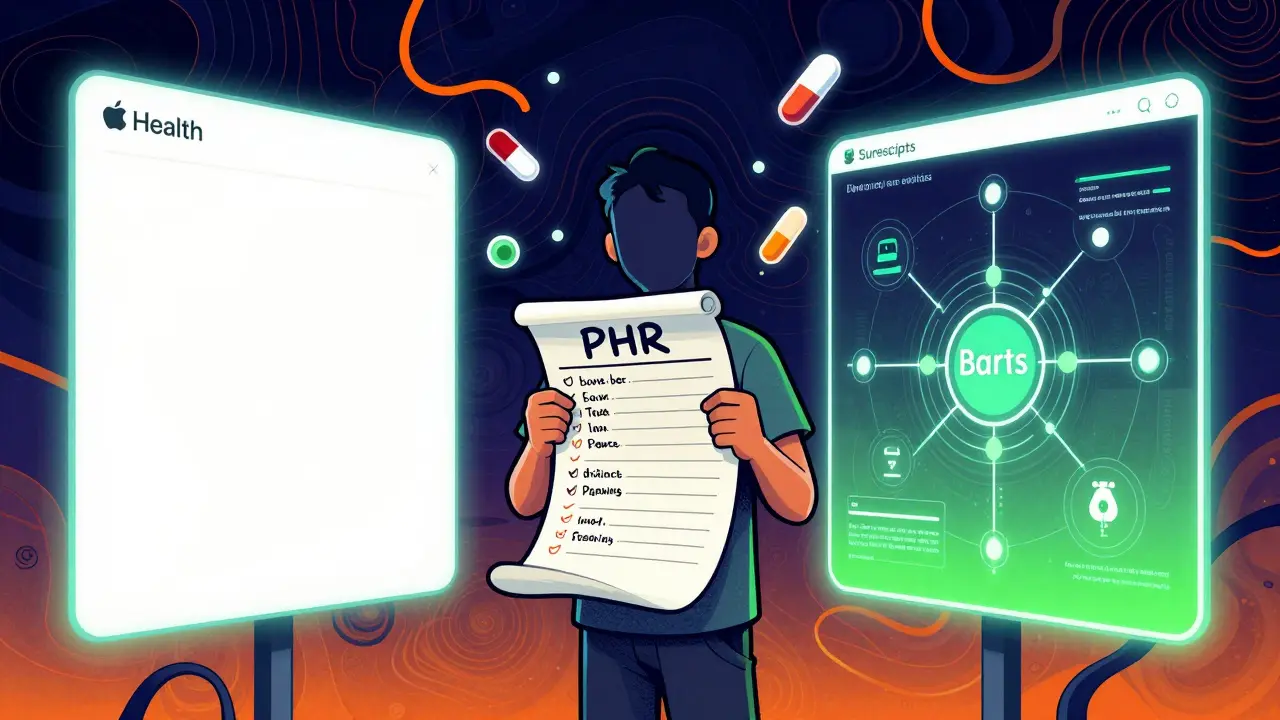
Apple Health Records is the most visible PHR out there. It’s on 200 million iPhones. Easy to use. Looks clean. But here’s the catch: it only captures 68% of your medication history. Why? Because it depends on what your doctor’s system sends over. If your doctor uses an old EHR that doesn’t share with Apple, your meds won’t show up.
Surescripts, on the other hand, gets data directly from pharmacies and PBMs. It’s got 92% completeness. But you can’t open it like an app. You need a pharmacy or hospital to pull it up. So if you’re trying to manage your meds on your own, Apple looks better. But if you’re a pharmacist or doctor trying to avoid a dangerous interaction? Surescripts is the tool they rely on.
Neither is enough alone. The best outcome comes when both are used together - and you keep your own list updated.
Why Pharmacists Are Both the Solution and the Problem
Pharmacists are the frontline in medication safety. They’re the ones who spot duplicates, interactions, and wrong dosages. And they’re the ones who actually use PHRs the most.
A 2022 study found that pharmacists using EHR-integrated medication histories spend 35% less time on reconciliation. That’s 7.2 extra hours a week they can spend counseling patients instead of digging through paper charts.
But here’s the twist: 79% of pharmacists say they spend extra time fixing patient-entered errors. One pharmacist in a Reddit thread said they had to manually enter 30% of OTC meds because the system didn’t pick them up. Another reported spending 8.3 minutes per patient just correcting inaccuracies.
And then there’s the workflow problem. In Australia, where nearly everyone is enrolled in My Health Record, only 57% of community pharmacists regularly update the system. Why? Because it slows them down. Filling a prescription is already fast. Adding a data entry step? That’s a friction point. Many just skip it.
What You Can Do Right Now
You don’t need to wait for the system to fix itself. Here’s what actually works:
- Make your own list. Use a notebook, a notes app, or a printable template. Write down every pill, patch, cream, and supplement. Include the name, dose, how often, and why you take it. Don’t rely on memory.
- Update it after every pharmacy visit. Even if you didn’t pick up anything, write down what you were given. Did the pharmacist say, “This replaces your old one”? Note it.
- Bring it to every appointment. Not your phone. A printed copy. Doctors and nurses are more likely to look at paper than a digital record they didn’t create.
- Ask your pharmacy to send updates. If you use a chain like CVS or Walgreens, ask if they contribute to your PHR. If they don’t, ask why. Push them.
- Check your PHR monthly. Log in. Does everything match your list? If not, fix it. Delete duplicates. Add missing items. Flag anything you’re not sure about.
This isn’t glamorous. But it’s the only way to close the gaps the system leaves open.
The Future: AI, Regulations, and What’s Coming
Change is coming - fast. Starting in July 2024, Medicare and private insurers will be required to share 45 days of your medication history with your PHR if you give permission. That’s expected to boost completeness by 27%.
Google Health is testing AI that predicts medication errors using PHR data. Early results show 92% accuracy. But it’s still a prototype. Widespread use? At least 3-5 years away.
Meanwhile, the Pharmacist eCare Plan (PeCP) is gaining traction. It’s a framework that lets pharmacists send real-time updates directly to your doctor’s inbox. Kroger Health already uses it - and reports 33% fewer phone calls between prescribers and pharmacies.
But here’s the hard truth: technology won’t fix this unless people use it. And patients need to be active participants. A 2023 survey found that only 44% of chronic disease patients update their PHR between visits. That’s not enough.
The system is getting better. But it still has blind spots. Your list - the one you keep, update, and bring with you - is still the most reliable tool you have.
Why This Matters More Than You Think
Medication errors cost the U.S. healthcare system $528 per patient every year. That’s $100 billion total. And half of those errors happen during transitions - when you move from hospital to home, or from one pharmacy to another.
PHRs can cut those errors by 43%, according to experts. But only if they’re accurate. And only if you’re the one keeping them that way.
This isn’t about tech. It’s about control. You’re the only one who knows what you actually take. No system can replace that. But when your PHR matches your reality? That’s when it becomes powerful.
Don’t wait for the perfect system. Build your own. Keep it current. And don’t be afraid to ask your pharmacist, “Is this in my record?”
Can I trust my PHR to show all my medications?
No, not fully. PHRs often miss over-the-counter drugs, supplements, and medications from small or cash-based pharmacies. Even major systems like Apple Health only capture about 68% of your meds. Always cross-check with your own list.
Do online pharmacies update my PHR?
Some do, but not all. Major chains like CVS or Walgreens usually connect to networks like Surescripts. Smaller or international online pharmacies often don’t. Always ask the pharmacy if they contribute to your PHR - and verify the update yourself.
What’s the difference between a PHR and an EHR?
An EHR is controlled by your doctor or hospital. A PHR is controlled by you. EHRs show what your provider knows. PHRs can show what you know - including things your doctor hasn’t documented, like supplements or home remedies.
Why do my PHR and pharmacy list sometimes disagree?
Because PHRs pull from multiple sources - some automated, some manual. If you added a medication yourself and later filled it at a different pharmacy, the system might not match them. Or your pharmacy might not have sent the update yet. Always reconcile your personal list with what you see in the PHR.
Is my medication data safe in a PHR?
Yes, if it’s a certified system. Most use AES-256 encryption and follow HIPAA or NIST standards. You control who sees it. But remember: if you share your login with someone else, that protection goes away. Never give out your password.
Should I use Apple Health or My Health Record (Australia)?
Use both if you can. Apple Health is great for personal access and iPhone users. My Health Record (Australia) has broader pharmacy integration and is mandatory for most providers. If you’re in Australia, use My Health Record as your primary source. If you’re elsewhere, Apple Health is a solid start - but always supplement it with your own list.
How often should I update my PHR?
After every pharmacy visit, every time you start or stop a medication, and at least once a month. Even if nothing changed, review it. Missing a single drug - like a blood thinner or insulin - can have life-or-death consequences.
If you’re managing multiple medications across pharmacies, your personal list is your most powerful tool. No app, no system, no doctor can replace your own awareness. Keep it updated. Keep it visible. And don’t let technology make you complacent.
Glenda Marínez Granados
January 20, 2026 AT 10:07So let me get this straight - we’re trusting our lives to a system that can’t tell the difference between Advil and ibuprofen? 😅 And we wonder why people die in ERs? I keep my meds in a notebook, a sticky note, and a voice memo titled ‘DON’T DIE’. The app? It’s for decoration. 📱💀
Yuri Hyuga
January 20, 2026 AT 11:14This is one of those rare posts that doesn’t just highlight a problem - it gives you the tools to fight back. 💪 Let’s be clear: your health isn’t a data point. It’s your life. Start today. Grab a pen. Write down every pill, every drop, every herbal tea that’s ‘harmless’. Then print it. Bring it. Make them look at it. You’re not being difficult - you’re being smart. And if they roll their eyes? Smile. They’ll thank you later. 🌱❤️
MARILYN ONEILL
January 22, 2026 AT 06:06Ugh. Another ‘you should keep a list’ post. Like I don’t already know that. My cousin died because her PHR didn’t show her fish oil. So yeah, I keep a list. On paper. In triplicate. In three different colors. And I laminated it. Because apparently, we’re all just one missed supplement away from a coffin. 🤦♀️
Coral Bosley
January 23, 2026 AT 09:47I used to think my PHR was reliable. Then I missed a dose of metoprolol because the system said I was ‘up to date’ - but I’d stopped taking it two months ago because my insurance raised the copay. I cried in the pharmacy aisle. No one asked. No one saw. Just me, a bottle of pills, and a screen that lied. Now I print it. Every. Single. Month. And I scream at the pharmacist. They’re used to it.
Steve Hesketh
January 24, 2026 AT 20:19Bro, this is why we need community. I’m from a small town in Nigeria - we don’t have fancy apps. But we have neighbors. Auntie Bisi knows everyone’s meds. She writes them down on a chalkboard outside her shop. If you forget your pills? She remembers. If you’re too broke to refill? She gives you a little from her stash. Technology? Cool. But human memory? That’s the real PHR. We don’t need AI. We need each other. 🙏🌍
shubham rathee
January 25, 2026 AT 03:28Kevin Narvaes
January 26, 2026 AT 02:18So like… we’re supposed to be the ones fixing the system? What about the people who can’t read? Or who are blind? Or who are 80 and have three different meds that all look like Skittles? This post sounds like it was written by a tech bro who thinks everyone has an iPhone and a 9-to-5 with health insurance. Reality check: most people are just trying to survive. Not update their PHR.
Alex Carletti Gouvea
January 26, 2026 AT 18:37Look, I get it. But this is why America needs to stop outsourcing everything to China and start making real medical tech here. Surescripts? Apple? Foreign junk. We need a U.S.-built PHR. Made by Americans. For Americans. No foreign data centers. No weird algorithms. Just good ol’ American medicine - with a paper list, because that’s what our granddads used. And they lived longer.
Ben McKibbin
January 27, 2026 AT 23:09I love how this post doesn’t just point fingers - it gives us a roadmap. But let’s not pretend the system is broken because of lazy patients. It’s broken because we’ve treated healthcare like a transaction, not a relationship. Pharmacists aren’t data clerks. They’re lifesavers. And if we make them jump through hoops to update records, we’re not just wasting time - we’re risking lives. Let’s pay them to do the right thing. Not just the fast thing.
Rod Wheatley
January 29, 2026 AT 12:12PLEASE - if you’re reading this, DO THIS NOW. Open your Notes app. Type: ‘My Medications’. Then list EVERYTHING: name, dose, frequency, reason, pharmacy, date started. Do it today. Right now. I’m not asking. I’m begging. I’ve seen people die because they thought ‘I’ll update it later’. Later never comes. Your life isn’t a to-do list. It’s a legacy. And your meds? They’re part of it. 🙏💊
Malvina Tomja
January 29, 2026 AT 14:04Oh, so now we’re blaming patients for the healthcare system’s failure? How convenient. Let’s not forget that 79% of pharmacists say they fix patient errors - which means the system is designed to be broken, and patients are the ones who get punished for it. And yet, here we are, lecturing people to ‘bring a printed list’. Like that’s the solution. It’s not. It’s a Band-Aid on a hemorrhage. The real problem? A system that treats human beings like data entry errors. And we’re still surprised when people die?