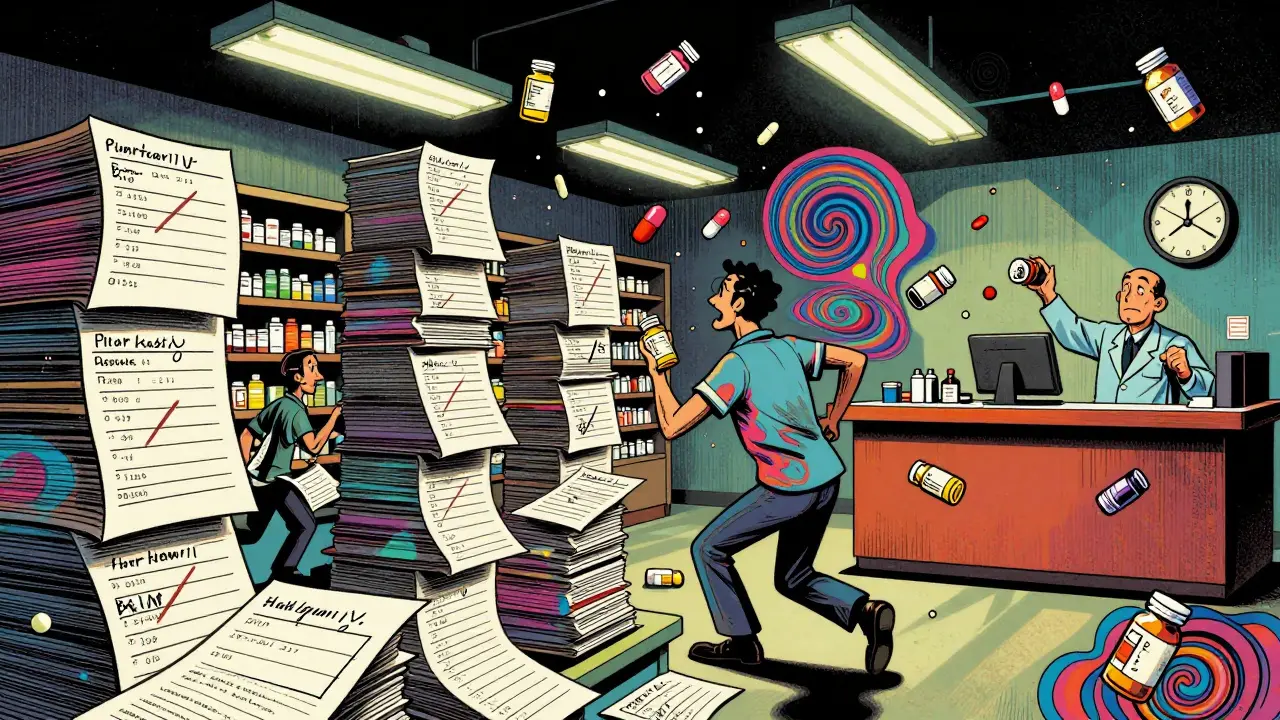
Every year, tens of thousands of patients in the U.S. are harmed or killed by medication errors. Many of these mistakes happen not because pharmacists are careless, but because the system they work in is overloaded, outdated, and full of manual steps. A single misplaced decimal, a misread label, or a missed drug interaction can turn a life-saving prescription into a life-ending mistake. That’s where modern pharmacy workflow and error prevention systems come in - not as fancy gadgets, but as essential safety nets.
How Pharmacy Workflows Used to Work (And Why They Failed)
Ten years ago, a pharmacist’s day looked like this: stacks of paper prescriptions, handwritten notes, manual inventory checks, and a rush to fill dozens of orders before lunch. Each step had a chance for error. A technician might grab the wrong bottle. A pharmacist might miss a drug allergy because the patient’s record wasn’t updated. A label could be printed with the wrong dosage. These weren’t big, dramatic mistakes - they were small, quiet ones. And they added up. The Institute of Medicine’s 1999 report To Err is Human shocked the healthcare world. It found that between 44,000 and 98,000 people died each year in U.S. hospitals from preventable medical errors - and medication errors were a huge part of that. Pharmacies, especially hospital IV compounding units, were ground zero. One wrong mix of IV fluids could kill a patient in minutes. The system wasn’t broken because people were bad - it was broken because it relied on humans doing the same repetitive, high-stakes tasks for hours on end.What Modern Pharmacy Workflow Systems Do
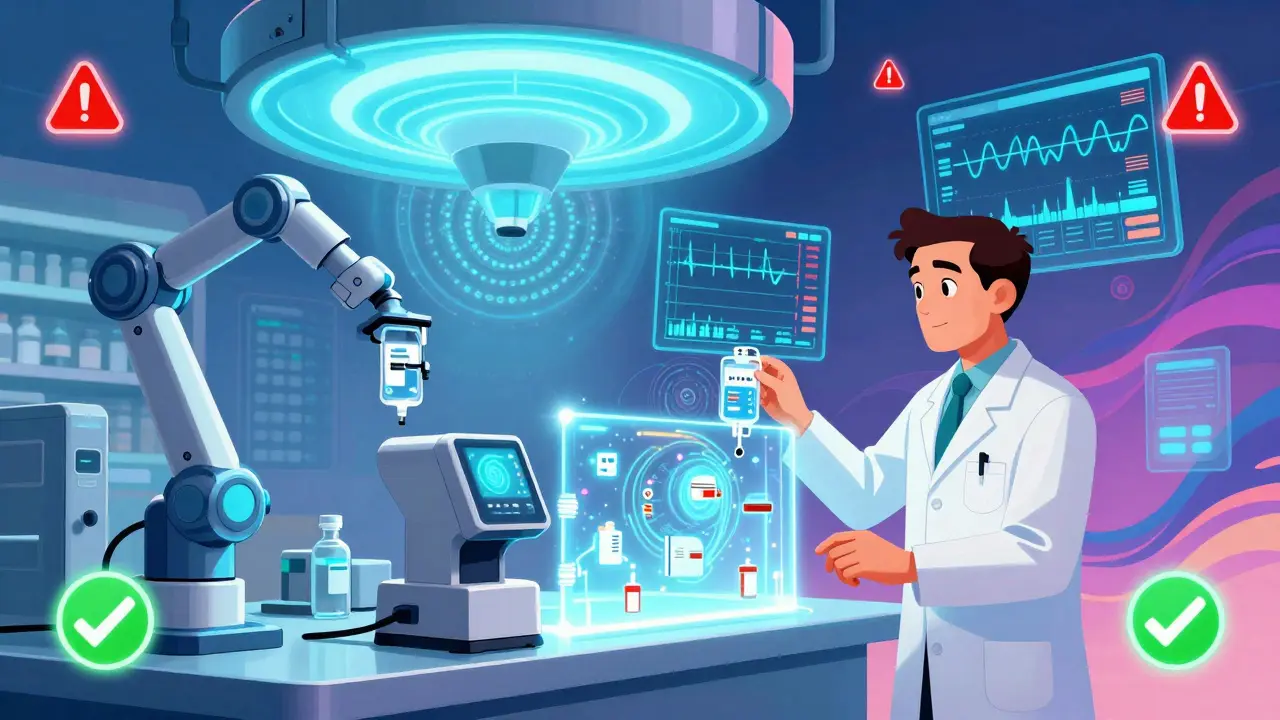
Today’s pharmacy workflow systems are built around one idea: automate the routine, protect the human. These systems combine hardware, software, and smart design to create a closed-loop process. Here’s how it works:- An electronic prescription comes in from a doctor’s system - no handwritten notes, no fax machines.
- The system checks the patient’s history: allergies, current meds, kidney function, age, weight. If something doesn’t add up, it flags it before a single pill is touched.
- Barcodes on every bottle and vial are scanned at every step - from receiving to dispensing. If the wrong drug is picked up, the system stops the process.
- For IV medications, robotic arms measure exact doses down to the microliter. No more guessing with syringes.
- Inventory updates in real time. If a drug is running low or expired, the system alerts the pharmacist before it’s even used.
- All actions are logged. If something goes wrong, you can trace it back to the exact person, time, and step.
This isn’t science fiction. Systems like BD Pyxis™, Wolters Kluwer’s Simplifi+ IV, and Cflow are already in use in hospitals across New Zealand, the U.S., and Europe. One study found that technology-assisted workflows detect 14 times more errors than manual checks. That’s not a small improvement - it’s a revolution.
Key Components of a Reliable System
Not all pharmacy workflow tools are the same. A good system has five core parts:- Barcode Scanning - Every medication, every container, every patient wristband has a unique code. Scanning at each step prevents mix-ups. No exceptions.
- Electronic Health Record (EHR) Integration - The system pulls real-time data from the patient’s chart. If a patient is on warfarin and the doctor prescribes an antibiotic that interacts with it, the system warns the pharmacist immediately.
- Automated Drug Interaction Checks - Built-in databases flag dangerous combinations. Not just the obvious ones, but the rare ones too - like St. John’s Wort reducing the effect of birth control pills.
- Inventory Management - Tracks expiration dates, stock levels, and reorder points. No more running out of insulin on a Friday night.
- Workflow Automation - Assigns tasks, tracks progress, and lets pharmacists see what’s queued, what’s done, and what’s stuck. No more shouting across the pharmacy floor.
These systems also run on secure, HIPAA-compliant platforms with 99.9% uptime. If the system goes down, the pharmacy shuts down - because safety can’t wait.
Types of Systems Used Today
There are three main categories of pharmacy workflow tools, each serving different needs:| Type | Best For | Key Features | Examples |
|---|---|---|---|
| Comprehensive Pharmacy Management | Hospitals and large chains | Full EHR integration, inventory, billing, reporting | Epic, Cerner |
| IV Compounding Specialized | Hospital IV labs, infusion centers | Robotic compounding, sterile environment controls, USP <797> compliance | Wolters Kluwer Simplifi+, BD Pyxis™ |
| Workflow Optimization Tools | Independent pharmacies, small clinics | Task tracking, digital checklists, reporting | Cflow, KanBo, Kissflow |
For example, Simplifi+ IV is designed specifically for hospitals that prepare IV bags. It ensures every step follows USP <797> and <800> standards for sterile compounding and hazardous drug handling. Meanwhile, Cflow gives small pharmacies a way to digitize their refill process without needing a full hospital-grade system.
Why These Systems Reduce Errors - The Real Numbers
It’s easy to say “technology reduces errors.” But what does that actually mean on the ground? At a 340B hospital in the Midwest, pharmacists used to spend 45 minutes a day just tracking down missing documentation for compounded IVs. The HL7 interface with their EHR fixed that. Now, all the data is there - automatically. Error rates dropped by 68% in six months. Another study in a busy outpatient clinic found that before automation, 1 in every 120 prescriptions had a preventable error. After installing barcode scanning and automated checks, that number fell to 1 in 1,800. That’s a 94% reduction. And it’s not just about mistakes. Pharmacists report feeling less stressed. They’re not rushing. They’re not double-checking the same thing three times. They have time to talk to patients, answer questions, and catch subtle issues a machine might miss.
The Hidden Costs - Training, Transition, and Resistance
These systems aren’t plug-and-play. They cost between $50,000 and $250,000 a year, depending on size and features. But the real cost isn’t the price tag - it’s the change. Most pharmacies take 3 to 6 months to fully adopt a new system. Staff need training. Old habits die hard. A pharmacy lead technician might resist scanning every vial because “I’ve done this for 20 years.” But that’s exactly why the scan matters - because even the best pharmacist makes mistakes. The American Society of Health-System Pharmacists (ASHP) says it clearly: “Technology alone doesn’t prevent errors. Workflow redesign does.” That means you can’t just install the software and call it done. You have to retrain staff, update policies, and change how tasks are handed off. Many pharmacies fail because they treat it like buying a new printer. It’s not. It’s like changing the engine of a plane while it’s flying.What’s Next? AI, Predictive Analytics, and Telehealth
The next wave of pharmacy automation isn’t just about doing things faster - it’s about doing things smarter. Some systems are starting to use AI to predict inventory needs. If a flu shot clinic is coming up, the system might automatically order extra vaccines before the request even comes in. Others are linking with telehealth platforms so a remote doctor can send a prescription, and the pharmacy can verify it before the patient even leaves the virtual visit. Robotics are getting smarter too. New machines can now prepare complex IV mixes with multiple drugs, in the exact order needed, without human intervention. And they do it in a sterile environment that meets USP standards every single time. The goal isn’t to replace pharmacists. It’s to free them from the boring, dangerous, repetitive parts of their job so they can focus on what only a human can do - talk to patients, spot subtle signs of misuse, and make judgment calls that no algorithm can.Is This Right for Your Pharmacy?
If you’re running a small independent pharmacy, you don’t need a $200,000 hospital system. But you do need something. Even a basic digital checklist tool like Kissflow or Cflow can cut down on refill errors and save hours a week. If you’re in a hospital or compounding center, skipping automation isn’t an option anymore. Regulators are watching. Patients are demanding safer care. And the cost of one error - in money, reputation, or lives - far outweighs the cost of the system. The question isn’t whether you can afford to implement a workflow system. It’s whether you can afford not to.How do pharmacy workflow systems prevent medication errors?
They use barcode scanning, automated drug interaction checks, real-time EHR integration, and robotic compounding to catch mistakes before they reach the patient. Every step is logged and verified, so if a wrong drug is picked or a dosage is off, the system stops the process and alerts the pharmacist.
What’s the difference between IV workflow systems and general pharmacy software?
IV workflow systems are built specifically for sterile compounding and handle complex, multi-drug infusions. They include robotics, environmental controls, and compliance tracking for USP <797> and <800>. General pharmacy software focuses on dispensing oral meds, inventory, and billing - not sterile preparation.
Do these systems replace pharmacists?
No. They replace repetitive, high-risk tasks so pharmacists can focus on patient care. The system flags a potential interaction - the pharmacist decides what to do. Machines don’t make clinical judgments. Humans do.
How long does it take to implement a pharmacy workflow system?
Most pharmacies need 3 to 6 months. This includes staff training, workflow redesign, system testing, and integration with existing EHRs. Rushing the process leads to errors and resistance. Slow, steady adoption works best.
Are pharmacy workflow systems expensive?
Enterprise systems cost $50,000 to $250,000 per year. Smaller pharmacies can use cloud-based tools like Cflow or Kissflow for under $10,000 annually. But the real cost of not using them is far higher - in patient harm, lawsuits, regulatory fines, and lost trust.
What regulations do these systems need to follow?
They must comply with HIPAA for patient privacy, USP <797> for sterile compounding, and USP <800> for hazardous drugs. They also need to meet state pharmacy board rules and FDA guidelines for electronic prescribing.
Can small pharmacies benefit from these systems?
Absolutely. Even basic digital checklists and barcode scanning can reduce refill errors by over 50%. You don’t need robotics - just structure, automation, and verification. Tools like Cflow and Kissflow are designed for smaller settings.
What happens if the system goes down?
Most systems have backup protocols. Pharmacies should have a paper-based contingency plan. But because these systems are cloud-based with 99.9% uptime, outages are rare. When they do happen, the priority is patient safety - not system uptime.
How do you measure success after implementation?
Track key metrics: prescription fill time, error rates, inventory turnover, patient wait times, and staff satisfaction. A good system should reduce errors by at least 50% and cut fill times by 20-30% within six months.
What’s the biggest mistake pharmacies make when adopting these systems?
Thinking it’s just a software purchase. The real work is changing how people work. If you don’t retrain staff, redesign workflows, and get buy-in from everyone - even the most advanced system will fail.
Doreen Pachificus
January 4, 2026 AT 05:04Been working in a hospital pharmacy for 12 years. Used to spend half my shift chasing down missing allergy info or double-checking doses because someone missed a fax. Now? The system flags it before I even touch the bottle. Feels like I finally have time to talk to patients instead of just filling scripts.
Still weird seeing a robot arm mix my IVs though. Kinda miss the human touch, but I’ll take safety over nostalgia.
Charlotte N
January 5, 2026 AT 22:25so like… barcodes everywhere right? but what if the scanner glitches? or the barcode smudges? or the tech just scans it without looking? i’ve seen it happen. the system thinks it’s fine but it’s not. it’s not magic. it’s just… faster mistakes.
also why is everyone acting like this is new? we had barcode systems in 2010. it’s just more common now. not a revolution. just a rollout.
Catherine HARDY
January 7, 2026 AT 04:11Let me guess… the same companies that made the EHRs that broke healthcare are now selling us ‘safety systems’? Of course they are. You think they want fewer errors? No. They want you dependent on their software. What happens when the vendor goes bankrupt? Or gets hacked? Or the FDA ‘recommends’ a change that costs $80k to implement?
They don’t care about patient safety. They care about recurring revenue. And the ‘mandatory’ training? That’s just lock-in. You’re not safer. You’re trapped.
Siobhan Goggin
January 7, 2026 AT 08:28This is exactly the kind of progress we need. It’s not about replacing people-it’s about giving them the tools to do their jobs right. I’ve seen pharmacists cry because they missed a drug interaction that cost a patient their life. Technology doesn’t erase that pain, but it gives them a fighting chance. Keep pushing for this everywhere.
Shanna Sung
January 8, 2026 AT 19:57They’re not fixing the system they’re just making it look fancy while the real problem stays the same-pharmacists are still overworked and underpaid. The machine scans the bottle but the person still has to work 12-hour shifts on 3 hours of sleep. You think a barcode stops burnout? Nah. They just put a shiny coat on a sinking ship.
josh plum
January 9, 2026 AT 12:03People still don’t get it. This isn’t about tech-it’s about accountability. Before, if you messed up, you could blame ‘human error.’ Now? The system logs every single click. If you scan the wrong thing, you get flagged. No more hiding behind ‘I was tired.’ That’s what really cuts errors-not the robot, but the fact that nobody wants to be the one who got caught.
And yes, I know it costs money. But how much does a wrongful death lawsuit cost? You do the math.
John Ross
January 10, 2026 AT 10:33From a systems engineering perspective, the real innovation is the closed-loop integration-EHR to eRx to barcode verification to inventory sync to audit trail. That’s a true systems-level intervention. Most legacy workflows are siloed and asynchronous. This architecture enforces atomicity at every transaction point, reducing the error surface exponentially.
And yes, USP 797 compliance is non-negotiable for IV compounding. Any system that doesn’t enforce environmental monitoring and sterility validation is not just inadequate-it’s negligent.
Clint Moser
January 11, 2026 AT 11:11lol i read this whole thing and still dont get why we need all this. my cousin works at a small pharmacy and they just use a tablet and a printer. they scan stuff sometimes. its fine. why do we need robots and $200k systems? its all just corporate greed. also i think the system is tracking us. why else would it always know what drugs i take?
also i think the barcode thing is a scam. i saw a guy scan the same bottle twice and the system didnt care. so its not perfect. just expensive.
Ashley Viñas
January 12, 2026 AT 10:07It’s not just about technology-it’s about culture. The fact that you’re even asking if these systems are worth it shows you haven’t been in a pharmacy where someone died because a handwritten ‘5’ looked like a ‘9’. This isn’t a luxury. It’s a moral imperative. If you’re still using paper logs in 2025, you’re not just outdated-you’re dangerous.
And don’t even get me started on the ‘small pharmacies don’t need this’ crowd. You think your grandma’s blood pressure med is less important than someone else’s? Please.
Brendan F. Cochran
January 14, 2026 AT 02:35Look, I get it. Tech is great. But let’s be real-this is just another way for Big Pharma and their tech partners to make more money. You think they care about your grandma? Nah. They care about contracts. They care about data. They care about who owns the patient record.
And don’t tell me it’s ‘HIPAA compliant’-I’ve seen the loopholes. The system logs everything… except the part where your doctor prescribed 10x the dose and no one noticed because the alert was ‘muted’ for ‘low risk’. That’s not safety. That’s theater.
jigisha Patel
January 15, 2026 AT 11:04While the quantitative reduction in medication errors is statistically significant (p < 0.001), the qualitative impact on pharmacist burnout remains underreported in the literature. The assumption that automation reduces cognitive load is flawed-instead, it redistributes it into system monitoring and override justification. Furthermore, the reliance on proprietary platforms introduces vendor lock-in, which violates the principle of interoperability in healthcare informatics. A longitudinal study is required to assess whether error reduction is sustained beyond the honeymoon period of implementation.