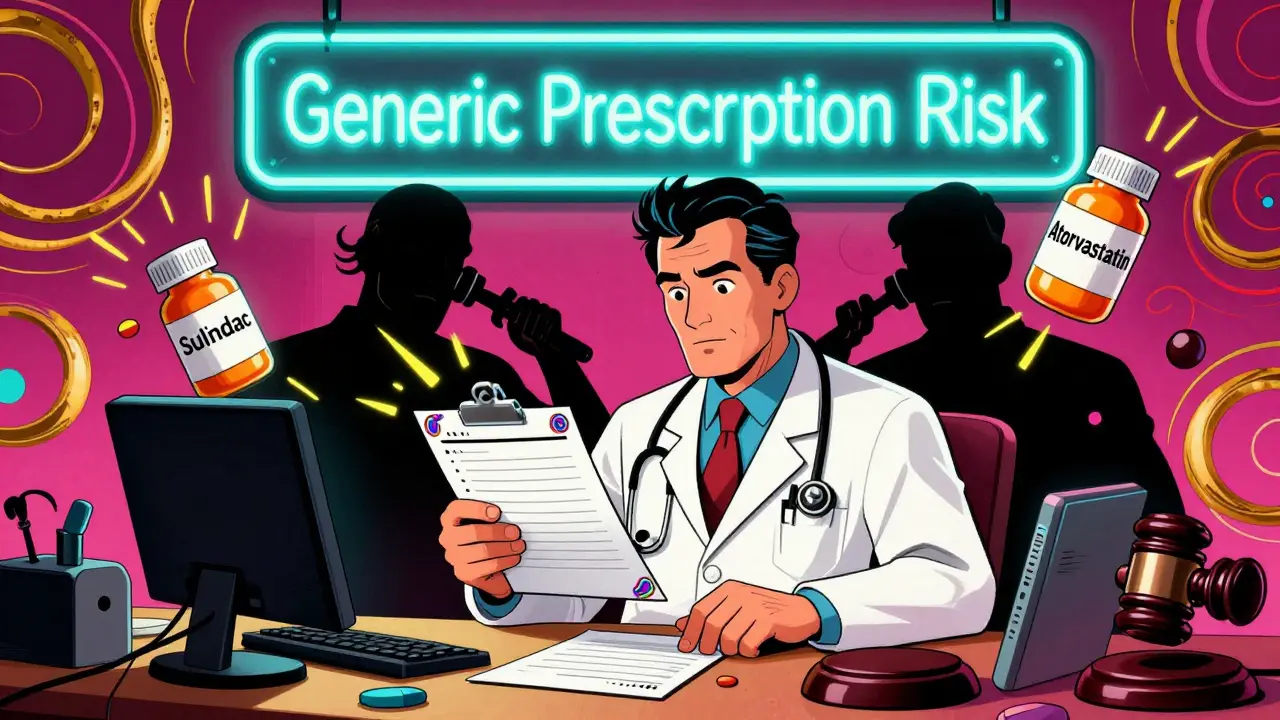
When you prescribe a generic medication, you might think you’re doing the right thing-saving the patient money, following guidelines, keeping costs down. But in today’s legal landscape, that simple choice could put your license, your practice, and your finances at risk. Since the Supreme Court’s 2011 and 2013 rulings, physician liability for generic drug injuries has shifted dramatically. Patients can no longer sue the makers of generic drugs for failing to update warning labels. That means the blame, and the lawsuit, often lands squarely on you-the prescribing doctor.
Why Generic Prescriptions Are Now Riskier Than Ever
Before 2011, if someone got hurt by a generic drug, they could sue the manufacturer. But in PLIVA v. Mensing and later Mutual Pharmaceutical v. Bartlett, the Supreme Court ruled that generic drug companies can’t be held liable for inadequate warnings. Why? Because federal law forces them to copy the brand-name label exactly. They can’t change it, even if new safety data emerges. So if a patient develops toxic epidermal necrolysis from a generic version of Sulindac-like Karen Bartlett did, losing 65% of her skin-the manufacturer is legally protected. That leaves patients with only one realistic target: the doctor who wrote the prescription. This isn’t theoretical. Between 2014 and 2019, lawsuits targeting physicians over generic drug injuries rose by 37%, according to the American Bar Association. In 2022, a Reddit user shared how their patient developed Stevens-Johnson syndrome after a generic substitution. The manufacturer couldn’t be sued. The doctor is now facing legal action-even though they followed standard prescribing practices.What the Law Actually Requires
To prove medical malpractice, a plaintiff must show three things: duty, dereliction, and direct cause. That’s been true since the 1800s. But now, the bar for proving dereliction has changed. If you prescribe a drug known to cause drowsiness and don’t warn the patient not to drive, and they crash, you’re liable-that’s been established in cases like Coombes v. Florio. But now, the same logic applies even if you didn’t know about a newly discovered side effect. Why? Because the generic manufacturer can’t update the label, and the FDA doesn’t require them to notify prescribers. In 49 states, pharmacists are allowed to swap brand-name drugs for generics unless you write “dispense as written” on the prescription. That means you might prescribe Lipitor, but the patient walks out with atorvastatin. If they have a bad reaction, and the label didn’t warn about it, the manufacturer is off the hook. You’re left holding the bag.The Patchwork of State Laws
Not every state treats this the same. In Illinois, courts have ruled that generic manufacturers do have a duty to stop selling dangerous drugs if the label is inadequate-something called the “change the formula, change the label, or stop selling” rule. That’s from the Guvenoz v. Target Corp. case in 2016. But in most other states, federal preemption wins. That means if you’re practicing in Texas, Florida, or Georgia, you’re operating under the strict Mensing/Bartlett rule. No liability for manufacturers. Full liability for prescribers. And here’s the twist: in 2014, Alabama briefly allowed lawsuits against brand-name manufacturers for injuries caused by generics. But the state legislature shut that down in 2015 with SB80. Now, even the brand-name maker is protected. You’re the only one left who can be sued.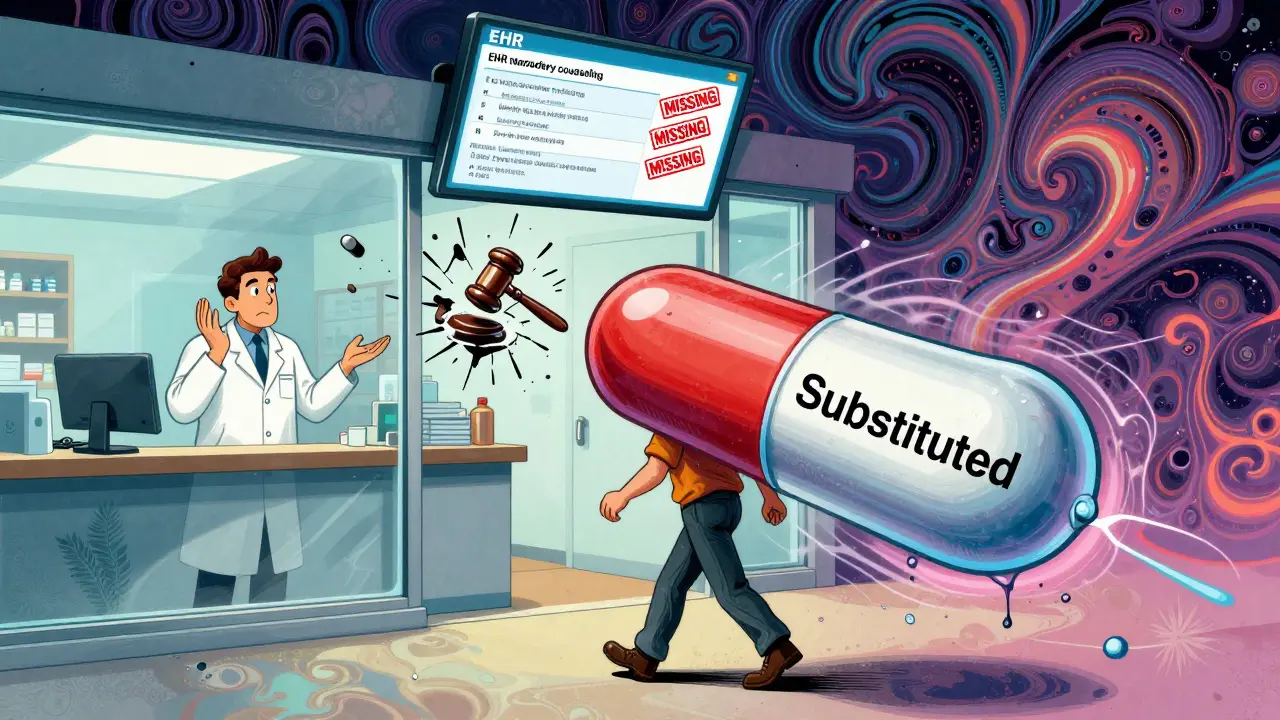
What Doctors Are Actually Doing
A 2022 AMA survey of 1,200 physicians found that 68% feel more anxious about prescribing generics. Forty-two percent admit they sometimes prescribe the more expensive brand-name drug-just to avoid liability. On physician forums like Sermo, doctors are sharing stories. One from Massachusetts General Hospital said he now adds 15 to 20 minutes to every visit to document side effects in writing. “I don’t just say ‘medication discussed,’” he wrote. “I list each risk, each warning, and have the patient initial it.” The American College of Physicians documented 47 malpractice claims tied to generic drugs between 2016 and 2021. Twelve of those led to settlements averaging $327,500. That’s not a small number. That’s enough to wipe out a decade of savings.How to Protect Yourself
There are three proven ways to reduce your risk. 1. Use “dispense as written” for high-risk drugs. This includes warfarin, levothyroxine, carbamazepine, and other drugs with narrow therapeutic indices. In 32 states, this blocks substitution entirely. Even if your state doesn’t require it, write it anyway. It’s your best legal shield. 2. Document everything-specifically. Generic notes like “medication discussed” won’t hold up. You need specifics. The Physicians’ Legal Handbook recommends this language: “I have discussed potential side effects of [medication], including [specific side effects], and advised you to avoid [specific activities] while taking this medication.” Epic Systems, the most common EHR platform, now has mandatory fields for generic substitution counseling. If you skip it, the system won’t let you close the note. That’s not a bug-it’s a legal safeguard. 3. Know your insurer’s rules. Professional liability insurers now charge a 7.3% surcharge on premiums for physicians who authorize substitutions without documented counseling. That’s $1,460 extra a year on a $20,000 policy. Pay the time now to document properly-or pay more later in premiums and lawsuits.
Janelle Moore
December 19, 2025 AT 05:48They’re lying to us. The FDA and Big Pharma are in bed together. Generics are just cheap knockoffs with fake ingredients. I know a guy whose cousin got cancer after taking generic metformin-turns out it had rat poison in it. They don’t want you to know this, but the pills are made in China by guys who don’t even wash their hands. You think your doctor cares? Nah. They get kickbacks. I’ve seen the spreadsheets.
Andrew Kelly
December 20, 2025 AT 10:43Let’s be clear: if you’re prescribing generics without documenting every possible side effect in triplicate, you’re not a doctor-you’re a liability waiting to happen. The law doesn’t care about your intent. It cares about your paper trail. If you didn’t write it down, it didn’t happen. And if it didn’t happen, you’re guilty by default. This isn’t malpractice-it’s negligence dressed in a white coat.
Isabel Rábago
December 21, 2025 AT 15:15It’s not about the pills. It’s about control. They took away the manufacturers’ responsibility so they could force doctors into becoming insurance agents. You’re not healing people anymore-you’re signing legal waivers with every scrip. And the worst part? Patients think you’re saving them money. Meanwhile, you’re the one getting sued when something goes wrong. It’s a trap. And we walked right into it.
Mike Rengifo
December 22, 2025 AT 09:04I just use the EHR prompts now. It’s annoying, but it’s easier than getting sued. I don’t even argue with the system anymore. If it won’t let me close the note without checking ‘discussed side effects,’ then I check it. I write ‘risk of Stevens-Johnson, avoid driving, report rash immediately.’ Done. Move on. It’s not perfect, but it’s enough to sleep at night.
Ashley Bliss
December 23, 2025 AT 13:35They turned healing into a courtroom drama. We used to trust science. Now we’re drowning in forms. Every prescription is a potential funeral. Every patient is a plaintiff waiting to happen. This isn’t medicine-it’s a horror movie where the monster is bureaucracy, and we’re the ones holding the scalpel. I miss the days when a ‘thank you’ was the only reward.
Kelly Mulder
December 24, 2025 AT 09:22One must interrogate the epistemological foundations of pharmaceutical liability in the post-Mensing paradigm. The ontological shift from manufacturer accountability to prescriber culpability constitutes a profound rupture in the bioethical contract between clinician and patient. One is compelled to ask: Is the physician now the de facto guarantor of pharmacological safety in a regulatory vacuum? The answer, regrettably, is affirmative-and it is both legally and morally indefensible.
Emily P
December 25, 2025 AT 16:30Wait, so if the label doesn’t get updated, and the doctor doesn’t know about the new risk, how is that their fault? Isn’t that on the FDA? Or the manufacturer? Or the pharmacist who swapped it? Why is the doctor always the one getting blamed? I feel like the whole system is broken.
Vicki Belcher
December 27, 2025 AT 05:37Y’all are stressing too much 😔 I’ve been doing this for 20 years and I just talk to my patients like humans. I say, ‘Hey, this is generic, it’s cheaper, but here’s what to watch for.’ I write it in the note. I have them sign. I use the EHR. I sleep fine. You’re not a robot. You’re a doctor. Be a good one. 💪❤️
Jedidiah Massey
December 27, 2025 AT 12:56Let’s not conflate risk mitigation with malpractice avoidance. The 7.3% premium surcharge is a market signal-proof that insurers recognize the asymmetry in liability exposure. The real issue is the absence of a federal indemnity framework for prescribers operating under preemption doctrine. Until Congress enacts a safe harbor for documented generic counseling, we’re just rearranging deck chairs on the Titanic.
Lynsey Tyson
December 28, 2025 AT 04:28I get why people are scared. But I also get why generics exist. They save lives. They save money. The system’s broken, sure-but we can’t just stop prescribing them. Maybe we just need better communication. Maybe we need pharmacists to call us when they swap. Maybe we need to stop blaming the doctor and fix the law. But we can’t go back to $500 pills just because we’re scared.
Edington Renwick
December 28, 2025 AT 16:49They warned us. The AMA, the ACP, the legal journals-everybody said this was coming. And yet, here we are. Still writing ‘medication discussed.’ Still skipping the EHR prompts. Still pretending the system works. You can’t blame the courts. You can’t blame the manufacturers. You can only blame yourself for not adapting. And now? Now you pay the price.
Kitt Eliz
December 30, 2025 AT 12:32As a pharmacist in Toronto, I see this daily. We swap generics because the system forces us to. But we also have a duty to flag high-risk meds to prescribers. I’ve sent 147 emails to docs this year saying ‘WATCH THIS PATIENT ON CARBAMAZEPINE.’ Some reply. Most don’t. The system’s broken-but we can fix it one note at a time. 📞💊 #PharmacistPower
anthony funes gomez
January 1, 2026 AT 07:26Liability is not a moral category. It is a legal construct. The Supreme Court did not create this outcome-it merely interpreted statutory preemption. The fault lies not with the judiciary, but with Congress, which failed to update the Hatch-Waxman Act to reflect modern pharmacovigilance needs. The doctor is not the villain. The legislature is. And until we hold them accountable, we are all just collateral damage in a broken machine.
Laura Hamill
January 2, 2026 AT 13:10They’re letting China control our medicine. And now they want US doctors to go to jail for it? I’m not taking some foreign-made pill that could kill me just to save 20 bucks. If the FDA can’t make sure generics are safe, then ban them. We don’t need Chinese pills. We need American doctors to be able to prescribe American drugs. This is a national security issue. #AmericaFirst #NoMoreGenericPoison