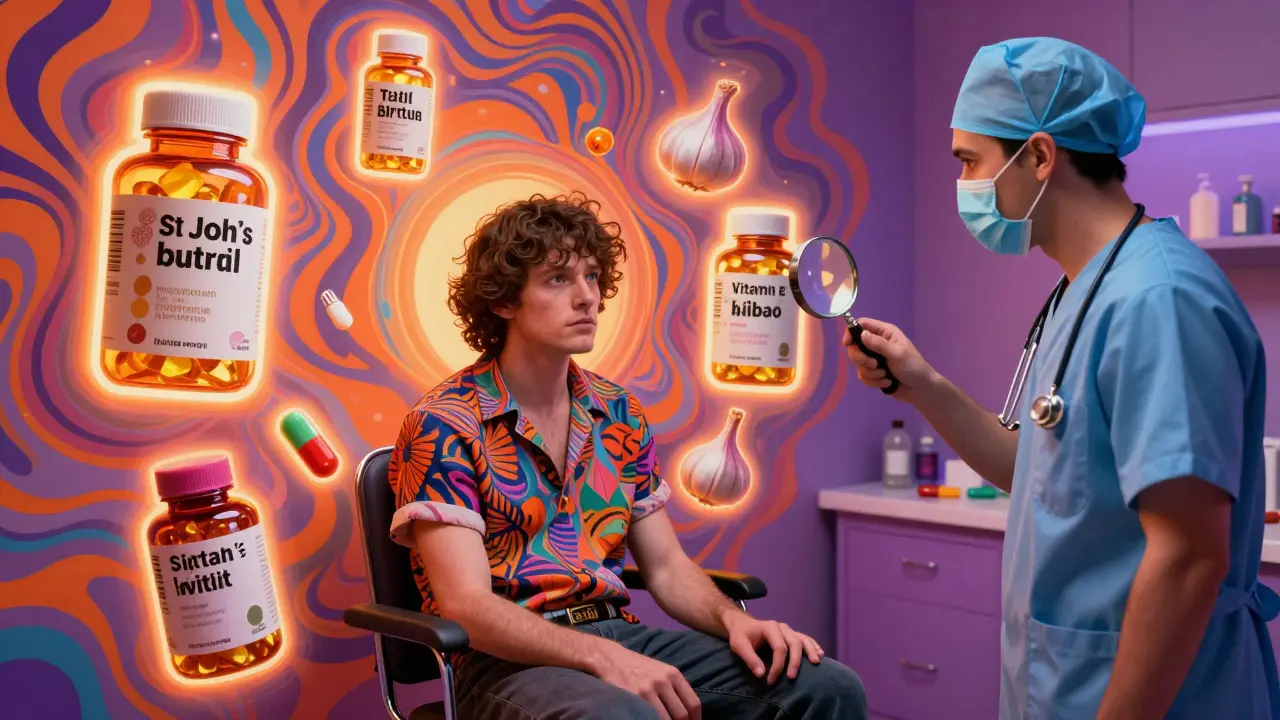
When a patient walks into the pre-op room, they might say they're taking nothing but their prescription meds. But what they don't mention-often because they don't think it counts-is the fish oil capsule they swallow every morning, the garlic supplement for their immune system, or the multivitamin from the drugstore shelf. These aren't harmless. In fact, they're quietly putting patients at risk during surgery. Surgeons need to know exactly what's in the body before cutting into it-not because they're being overly cautious, but because the science is clear: unreported supplements cause real, preventable complications.
Why Supplements Are a Silent Threat in the OR
It's not just about bleeding. Though that's the biggest concern, supplements can mess with anesthesia, blood pressure, heart rhythm, and even how the body heals after surgery. A 2018 study in JMIR Research Protocols found that 15-25% of adverse events during surgery were linked to unreported supplement use. That's not a small number. It's one in every five or six cases where something went wrong that could've been avoided. Take Vitamin E. A standard dose of 400 IU can thin the blood enough to double blood loss during surgery. Fish oil? One capsule usually contains 180mg EPA and 120mg DHA-enough to interfere with clotting. Garlic, ginkgo biloba, and ginseng? All known to increase bleeding risk by 30-50%. And then there's St. John’s Wort. This one's especially dangerous. It triggers liver enzymes that break down anesthesia faster. Studies show it can reduce the effectiveness of anesthetic drugs by 30-40%. Patients don’t think of it as a drug. They think it's a natural remedy. But in the operating room, it behaves like a potent pharmaceutical.What Surgeons Must Ask-And How to Ask It
Asking “Are you taking any supplements?” is useless. Only 35% of patients volunteer the truth when asked that way. The University of Michigan found a 22% error rate in patient self-reports because most don’t consider vitamins or herbs as “medications.” The right approach? Ask specific, structured questions. The Hospital for Special Surgery (HSS) 2023 guidelines recommend five direct questions:- Which supplements should I stop before surgery?
- How many days or weeks before should I discontinue them?
- Could any of my vitamins or herbals cause bleeding or interfere with anesthesia?
- Can I take my usual medications on the day of surgery?
- When can I safely resume my supplements after surgery?
When to Stop-And When to Keep Taking Them
Not all supplements need to be stopped. Blanket rules don’t work. The key is knowing which ones are dangerous and which ones are safe-or even helpful. Stop 14 days before surgery:- Vitamin E (d-alpha-tocopherol)
- Fish oil (any dose above 1g daily)
- Garlic supplements
- Ginkgo biloba
- Ginseng
- St. John’s Wort
- Green tea extract (high-dose)
- Evening primrose oil
- Calcium (1200mg daily) - especially for orthopedic patients
- Vitamin D (1000-2000 IU daily) - HSS now permits this right up to surgery day for bone healing
- Iron (if prescribed for anemia) - avoid high doses unless necessary

How Different Surgeries Change the Rules
A one-size-fits-all approach fails. Plastic surgery demands the strictest rules. Bleeding in a facelift or breast augmentation can ruin the outcome. That’s why the American Society of Plastic Surgeons has required 14-day discontinuation of all herbal supplements since 2007. Orthopedic surgery? Different. Bone healing needs vitamin D and calcium. HSS updated their guidelines in December 2023 to allow these supplements through surgery day. Their 2022 study showed 21% faster bone fusion when vitamin D wasn’t interrupted. Bariatric surgery? Here, protein matters more than anything. Hospital Mid-Doctor’s 2022 protocol requires patients to take 60-80g of protein daily for two weeks before surgery. Supplements like Fortisip Compact (250 mL daily) are used to meet this goal. This isn’t about avoiding risk-it’s about preparing the body to survive major metabolic stress. And don’t forget GLP-1 agonists. Drugs like Ozempic (semaglutide) are now common. They slow stomach emptying. That’s fine for weight loss-but during anesthesia, it raises the risk of vomiting and aspiration. HSS now recommends stopping these 2-4 weeks before surgery.The Real Problem: Patient Confusion and Compliance
Only 58-67% of patients follow discontinuation instructions. Why? Because they’re confused. A Mayo Clinic study found 32% of patients thought fish oil was a “food,” not a supplement. Another 28% didn’t know their multivitamin had vitamin E in it. The solution? Written instructions. Phoenix Lipo’s 2022 audit showed that giving patients a printed list of what to stop-and when-boosted compliance from 47% to 83%. Simple. Direct. No jargon. Documentation matters too. A 2018 study showed that when surgeons wrote down the exact supplement name, dose, and stop date, intraoperative complications dropped by 18%. Generic notes like “supplements discontinued” aren’t enough. You need details.
What’s Changing Now-and What’s Next
The landscape is shifting fast. In October 2023, the FDA released draft guidance pushing for clearer labeling on supplements with surgical risks. That’s a start, but it’s not enough. The STAR (Supplement Transparency and Reporting) guidelines, published in Annals of Surgery, now give surgeons a 10-point checklist to standardize disclosure across hospitals. Thirty-seven major surgical associations have adopted it. Technology is catching up too. Epic’s “Supplement Safety Checker” is now in 62% of academic medical centers. It auto-flags dangerous interactions when a patient’s meds are entered into the system. And the American Society of Anesthesiologists just launched a mobile app in early 2024 that gives real-time risk alerts for over 50 supplements. The future? Personalized protocols. Mayo Clinic started a pilot in January 2024 using CYP450 genetic testing to see how a patient’s liver processes drugs. Some people break down St. John’s Wort faster. Others barely touch it. In five years, we may not be telling everyone to stop the same supplements. We’ll be telling each patient what’s dangerous for them.Why This Isn’t Optional
CMS is watching. Starting in 2025, Medicare will reduce hospital reimbursements by 1.5% if supplement screening isn’t documented. That’s not a fine. That’s real money. But beyond money, it’s about safety. You can’t operate on someone and say, “I didn’t know.” You have to know. This isn’t about scaring patients. It’s about giving them the best chance to heal. A 2017 trial in Clinical Nutrition showed that when supplement use was properly managed, post-op complications dropped by 22%. That’s not a small win. That’s life-changing. Surgeons aren’t pharmacists. But they don’t need to be. They just need to ask the right questions, listen to the answers, and act on the science. The tools are here. The data is clear. The time to ignore this is over.Do all supplements need to be stopped before surgery?
No. Only high-risk supplements like fish oil, Vitamin E, garlic, ginkgo, and St. John’s Wort need to be stopped 14 days before surgery. Calcium, iron, and vitamin D are often safe to continue-even right up to surgery day-especially for orthopedic or bariatric patients. The key is knowing which ones are risky and which ones are helpful.
Why don’t patients report their supplements?
Most patients don’t consider vitamins, herbs, or fish oil as "medications." They think of them as "natural" or "food." A Mayo Clinic study found 32% of people didn’t even classify fish oil as a supplement. Also, many assume their doctor already knows, or they forget because it’s not a prescription.
Can I take my multivitamin before surgery?
It depends. Many multivitamins contain high-dose Vitamin E (over 400 IU) or Vitamin K (over 100mcg), both of which interfere with clotting. Unless you know the exact ingredients, it’s safest to stop it 14 days before surgery. Bring the bottle to your pre-op visit so your surgeon can check the label.
What about protein supplements before bariatric surgery?
They’re encouraged. Bariatric patients need 60-80g of protein daily for two weeks before surgery to support healing and reduce complications. Products like Fortisip Compact (250 mL daily) are commonly used. Unlike high-risk herbs, these supplements improve outcomes and are part of the standard protocol.
Is there a tool that helps surgeons check supplement interactions?
Yes. Epic’s "Supplement Safety Checker" is used in 62% of academic hospitals. The American Society of Anesthesiologists also launched a mobile app in early 2024 that gives real-time alerts for over 50 supplements. These tools flag interactions with anesthesia, bleeding risks, and metabolic effects.
Nerina Devi
February 23, 2026 AT 15:33As someone who’s seen too many patients come in with their supplement cabinets full of mystery pills, I can’t stress this enough: the problem isn’t just what they take-it’s that they don’t realize it’s medicine. I had a patient last month who swore she took ‘nothing’-until I asked her about the green powder in her gym bag. Turned out it was ‘natural energy boost’ with 500mg of ginseng. She was scheduled for a knee arthroscopy. We had to delay it. No one’s trying to scare you. We’re just trying to keep you alive.
Surgeons aren’t being overcautious. We’re being responsible. And if your multivitamin has vitamin E or K in it? It’s not ‘just a vitamin.’ It’s a pharmacological agent in this context. Period.
Dinesh Dawn
February 24, 2026 AT 04:56Man, I love how this post breaks it down. I’m a med student in Bangalore and we’re taught to ask about meds, but never about supplements. This is eye-opening. I’ll definitely start asking for bottles now. Also, the part about St. John’s Wort and anesthesia? That’s wild. I had a cousin who took it for ‘anxiety’ and passed out during a dental procedure. No one connected the dots. Thanks for the clarity.
Vanessa Drummond
February 25, 2026 AT 12:58Ugh. I hate how lazy healthcare is. I had a surgeon tell me ‘just stop everything’ before my tummy tuck. No specifics. No reasoning. Just ‘stop it all.’ That’s not care-that’s laziness. This article? Finally someone who gets it. I brought my whole cabinet. They found 3 hidden sources of vitamin E. One was in my ‘hair, skin, nails’ gummy. I didn’t even know it had vitamin E. That’s the problem. We need labels that scream DANGER, not whisper ‘natural.’
Nick Hamby
February 26, 2026 AT 20:30There is a profound epistemological shift occurring in perioperative care-one that moves from paternalistic blanket prohibitions to evidence-based, individualized risk stratification. The data presented here is not merely clinical; it is a moral imperative. To dismiss supplement disclosure as ‘boilerplate’ is to ignore the fundamental principle of non-maleficence.
Consider the CYP450 genetic variability data. We are no longer in an era where ‘one size fits all’ is ethically defensible. The future lies in pharmacogenomic-guided preoperative protocols, where supplementation is not eradicated but calibrated. This is not just surgery-it is precision medicine in its most literal form. The institutions adopting STAR guidelines are not following trends-they are pioneering a new paradigm of patient autonomy and scientific rigor.
kirti juneja
February 27, 2026 AT 22:35OMG this is so real. I’m a nurse in Mumbai and I’ve seen patients bring in 10+ bottles like they’re showing off their ‘wellness routine.’ One guy had a ‘detox tea’ with senna, cascara, and licorice root. He didn’t think it was a ‘drug’ because it was ‘herbal.’ We had to cancel his colonoscopy because his BP dropped to 85/50. The real tragedy? He said, ‘But I’ve been taking it for years!’
Here’s the thing-we need to stop talking like doctors and start talking like humans. ‘Hey, what’s in that jar?’ ‘Can I see the label?’ ‘Did your auntie give you this?’ That’s how you get the truth. Not forms. Not checkboxes. Real conversation.
Haley Gumm
March 1, 2026 AT 02:58Let’s be real-this whole ‘supplement danger’ thing is just Big Pharma’s way of making you dependent on their drugs. Fish oil? Natural anti-inflammatory. Garlic? Immune booster. You’re telling me a 400 IU vitamin E capsule is more dangerous than five hours of general anesthesia? Come on. The real risk here is overmedicalizing natural health. Patients are being scared into compliance so hospitals can bill more. This isn’t safety-it’s profit-driven fearmongering.
Gabrielle Conroy
March 2, 2026 AT 20:22YES YES YES!!! This is the most important thing I’ve read all year!!! 🙌🙌🙌 I’m a nurse anesthetist and I’ve been screaming about this for years!!! The supplement checklist? The bottle rule? The 14-day stop? YES!!! I had a patient last week who brought her whole medicine cabinet-turns out her ‘all-natural energy blend’ had 200mg of caffeine AND 300mg of ginkgo!!! We stopped the surgery, delayed it 2 weeks, and she came back with a perfect recovery!!! I’m sending this to every single one of my colleagues!!! 💪🩺❤️ Also, the pre-op carb drink? GAME CHANGER!!! My patients are recovering 2 days faster!!! We need this in every hospital!!!
Spenser Bickett
March 4, 2026 AT 10:11so like… you’re telling me that if i take a fish oil capsule every day, im basically doing a slow-mo overdose on blood thinner? wow. mind blown. 🤯
and like… the hospital actually makes you bring the bottles? like… what next? do they want me to show them my tea bag receipts? ‘sorry doc, this chamomile has a trace of valerian root’? come on.
also, st. john’s wort messes with anesthesia? wow. so if i take it for my ‘mild sadness’ and then go under, i’m basically doing a drug combo that’s like… 3am netflix and a 2am energy drink? lol. we’re all gonna die from gummies, aren’t we? 🤡