
Probiotic-Antibiotic Effectiveness Calculator
Find the right probiotic for your antibiotic treatment
Recommended Probiotic
42-66% reduction in diarrhea risk when taken correctly
Timing: Take 2 hours after antibiotic dose
Duration: Continue for at least 7 days after antibiotics
Important: Only use USP Verified products with exact strain names. Avoid multi-strain formulas and unverified brands.
When you’re on antibiotics, you’re not just fighting an infection-you’re also shaking up your gut. Antibiotics don’t discriminate. They kill the bad bacteria causing your illness, but they also wipe out the good ones that keep your digestion running smoothly. The result? Diarrhea, bloating, cramps, and in serious cases, a dangerous Clostridioides difficile infection. That’s where probiotics come in. Taking probiotics alongside antibiotics isn’t just a trendy health hack-it’s backed by solid science. But not all probiotics work the same. And not everyone should take them. Here’s what actually helps, what doesn’t, and how to do it right.
Why Antibiotics Mess With Your Gut
Antibiotics like amoxicillin, ciprofloxacin, or clindamycin are powerful. They enter your bloodstream and travel through your digestive tract, killing bacteria along the way. The problem? Your gut holds trillions of bacteria-more than 10 times the number of human cells in your body. These microbes help digest food, make vitamins, train your immune system, and keep harmful bugs in check. When antibiotics wipe out large chunks of this community, it creates chaos. Opportunistic pathogens like C. diff move in fast. Studies show that up to 30% of people on antibiotics develop diarrhea. In older adults or those with weakened immune systems, that number climbs higher.What Probiotics Actually Do
Probiotics are live microorganisms that, when taken in the right amounts, give you health benefits. They’re not magic pills. They don’t “rebuild” your gut overnight. But they can act like temporary reinforcements. Think of them as friendly troops sent in to hold the line while your own gut bacteria recover. The strongest evidence shows they reduce the risk of antibiotic-associated diarrhea (AAD) by 42% to 66%. That’s not small. It means for every 10 people taking probiotics with antibiotics, 4 to 6 fewer will get diarrhea. They also cut the risk of C. diff infection by about two-thirds in high-risk patients.Which Probiotic Strains Actually Work?
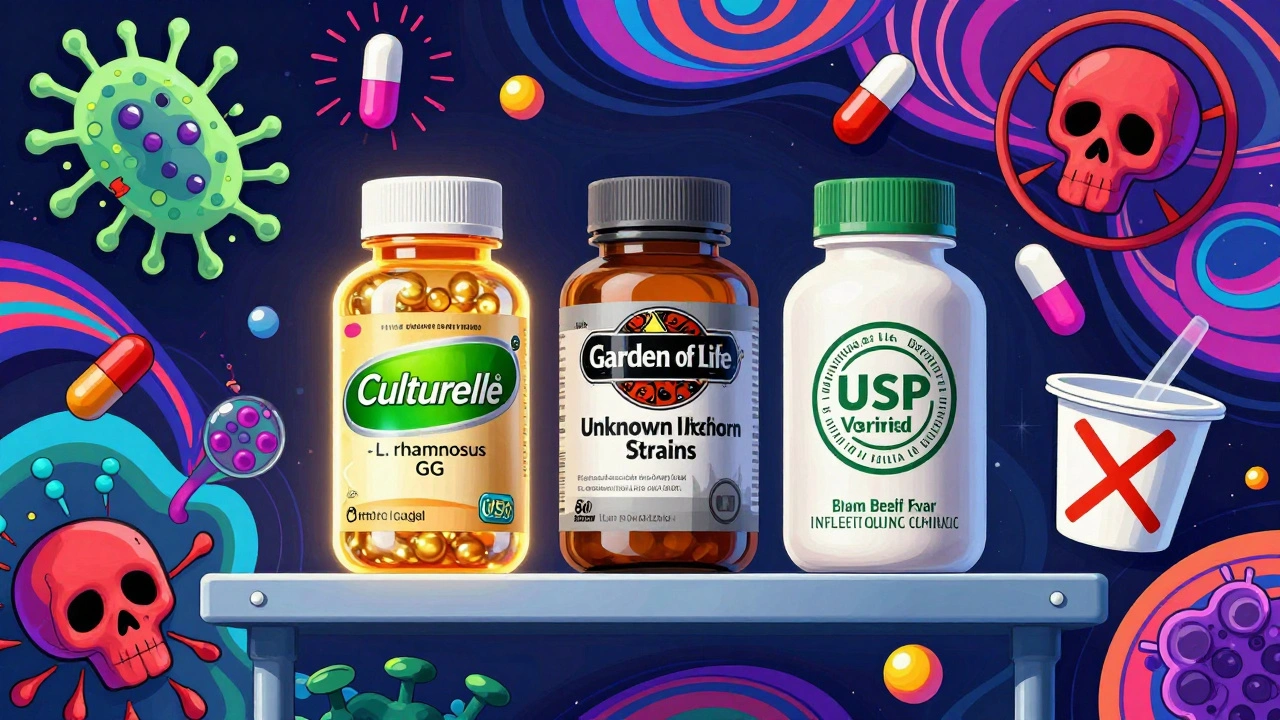
Not all probiotics are created equal. The label might say “10 billion CFUs,” but if the strain doesn’t match the problem, it’s useless. Two strains have the most solid proof:- Lactobacillus rhamnosus GG - Proven in over 20 clinical trials to prevent diarrhea. Found in Culturelle and other popular brands.
- Saccharomyces boulardii CNCM I-745 - A yeast, not a bacteria. Works even when taken with antibiotics that kill bacteria. Shown to reduce C. diff recurrence.
When and How to Take Them
Timing matters. If you take your probiotic at the same time as your antibiotic, the antibiotic might kill the probiotic before it can do anything. The best practice? Take your probiotic 2 hours after your antibiotic dose. This gives the antibiotic time to do its job without wiping out the probiotic. Studies show protection starts after 48 hours, so don’t wait until day 3 to start. Begin on day one. Dosage? Most effective doses fall between 10 billion and 50 billion CFUs per day. That’s usually one capsule, taken once or twice daily. Continue taking the probiotic for at least a week after finishing your antibiotics. For people at high risk of C. diff-like those over 65, on broad-spectrum antibiotics, or with prior infections-extend it to two weeks.What Doesn’t Work (and Why)
Many people buy probiotics because they heard they help. But they don’t pick the right ones. Here’s what often goes wrong:- Using a cheap, shelf-stable probiotic with no strain listed. Many of these have dead bacteria by the time you open the bottle.
- Choosing a multi-strain formula with 10+ strains. More isn’t better. The strains that work are few and well-studied.
- Waiting until diarrhea starts. Probiotics work best as prevention, not treatment.
- Using yogurt or kefir as a substitute. The bacteria in yogurt are often not the right strains, and the dose is too low to matter.
Who Should Avoid Them
Probiotics are generally safe. But they’re not for everyone. People with weakened immune systems should avoid them. That includes:- Those on chemotherapy
- People with central lines or catheters
- Anyone with severe pancreatitis
- Patients with short bowel syndrome
Product Quality Is a Wild West
The probiotic market is huge-$56 billion in 2022-and poorly regulated. A 2021 test by ConsumerLab found that 23% to 45% of products didn’t contain the strains or CFUs listed on the label. Some had no live bacteria at all. Refrigerated products tend to have higher viability (78% in testing), while shelf-stable ones often lose potency. Look for products with the USP Verified mark. That means an independent lab checked the label claims. It costs a bit more, but you know you’re getting what you paid for.Cost and Accessibility
Good probiotics cost between $20 and $45 a month. Most insurance plans don’t cover them. But compared to the cost of treating severe diarrhea or a C. diff infection-which can run into thousands of dollars-it’s a bargain. You can buy them at pharmacies, grocery stores, or online. No prescription needed. That’s why 62% of U.S. primary care doctors recommend them for patients on antibiotics. But only 28% do it routinely. Why? Lack of clear guidelines and concerns about product quality.What Experts Say
The Infectious Diseases Society of America (IDSA) conditionally recommends specific probiotics for high-risk patients. The American Gastroenterological Association (AGA) is more cautious, citing inconsistent product quality. Dr. Elisa Marroquin, who led a 2022 review of 29 studies, says: “When participants take antibiotics, we see several consistent changes in bacterial species. But when treatment was combined with probiotics, the majority of those changes were less pronounced and some changes were completely prevented.” In other words, probiotics don’t fix everything. But they blunt the damage.
The New Risk: Antibiotic Resistance in Probiotics
Here’s something you won’t hear from most supplement ads. A 2025 study in mSphere found that 38% of commercial probiotics carry genes that make bacteria resistant to antibiotics-including tetracycline, macrolides, and vancomycin. That’s alarming. If those genes jump to harmful bacteria in your gut, they could make future infections harder to treat. The FDA is now requiring new probiotic products to be screened for these resistance genes. If you’re buying now, stick to brands with verified labels and avoid anything with unknown strains.Real People, Real Results
On Reddit and Amazon, users report mixed results. One user wrote: “Took Culturelle with my 10-day amoxicillin course. No diarrhea-unlike last time.” Another said: “Spent $35 on Garden of Life. Still got C. diff after clindamycin.” The difference? Strain selection and timing. The first person used a proven strain, taken correctly. The second used an unverified product, possibly with dead bacteria or the wrong strains.What to Do Next
If you’re about to start antibiotics:- Ask your doctor if probiotics are right for you.
- If yes, ask which strain: Lactobacillus rhamnosus GG or Saccharomyces boulardii CNCM I-745.
- Buy a USP Verified product with that exact strain listed.
- Take it 2 hours after your antibiotic, once or twice daily.
- Keep taking it for at least a week after your antibiotic ends.
Future of Probiotics
The next generation of probiotics is coming. Companies are developing precision formulations like VE303, a defined mix of 8 bacterial strains. In early trials, it cut C. diff infections by 76%. These aren’t available yet, but they’re in clinical trials. In 5 years, we may see probiotics prescribed like medications-with specific strains, doses, and clear indications. Until then, stick with what’s proven.Antibiotics save lives. But they come with a cost. Probiotics aren’t a cure-all. But when used right, they’re one of the few tools we have to protect your gut while you heal. Don’t skip them. Just make sure you’re using them correctly.
Maria Elisha
December 9, 2025 AT 14:01I took probiotics with my last round of antibiotics and still got the runs. Maybe it’s just my gut being a drama queen. 🤷♀️
Angela R. Cartes
December 11, 2025 AT 00:35Oh wow, another ‘probiotics are magic’ article. Did you even read the 2018 Cell study? Or are you just repeating what your wellness influencer told you over oat milk lattes? 😒
Also, ‘USP Verified’? Please. That’s just a fancy sticker on a bottle of expired yogurt cultures. Most of these brands don’t even survive the trip from warehouse to shelf.
Courtney Black
December 11, 2025 AT 17:55There’s a deeper truth here, and it’s not about strains or CFUs. It’s about the illusion of control. We take antibiotics because we fear infection, then we take probiotics because we fear the consequences of the cure. We’re trying to engineer our microbiome like it’s a damn spreadsheet.
But the gut isn’t a machine. It’s a living ecosystem shaped by centuries of evolution, not by a capsule bought on Amazon at 2 a.m. after scrolling through ‘gut health hacks.’
Maybe the real solution isn’t more bacteria-but less intervention. Let the body heal. Let the microbiome find its own balance. We don’t need to fix everything. Sometimes, just waiting is the most radical act of trust.
Raja Herbal
December 13, 2025 AT 11:25Lmao, so now we’re supposed to believe some Indian guy in a yoga studio selling ‘immune boosters’ is the answer? Nah. I’ve seen this shit before. Antibiotics kill bacteria. Probiotics are just… more bacteria. So what’s the difference? Why not just eat yogurt like your grandma did?
Also, 50 billion CFUs? That’s like throwing a whole damn zoo into your colon and hoping one of them survives. 😅
Rich Paul
December 13, 2025 AT 17:21bro i took culturelle with my amox and it was lit no diarrea but also i think i just got lucky bc i also drank kombucha and ate kimchi and did a 3 day fast after. probiotics are just hype but if u wanna spend 40 bucks on a pill that might help then go for it. also the strain thing is real tho-l. rhamnosus gg is the only one that actually has data. everything else is just marketing bs. and yeah, take it 2 hrs after the abx or it’s useless. i learned that the hard way. also, dont trust shelf stable shit. refrigerated or gtfo.
Delaine Kiara
December 14, 2025 AT 13:11Okay, but what if I told you… the real villain isn’t the antibiotic… it’s the corporate probiotic industrial complex? 🤯
Think about it. Big Pharma makes billions off antibiotics. Then they fund ‘research’ on probiotics so you’ll buy the ‘solution’-but the real solution is just… don’t take antibiotics unless you absolutely have to. Which no doctor will ever tell you because they’re paid by the pill companies.
And don’t even get me started on ‘Saccharomyces boulardii’-it’s a yeast. A FUCKING YEAST. We’re treating our guts like a science fair project now. 🤦♀️
I’m not saying don’t take them. I’m saying… why are we so desperate to fix something that might fix itself if we just… stopped meddling?
Ruth Witte
December 16, 2025 AT 10:44YESSSSSSS this is the info I needed!! 🙌 I just finished my 10-day clindamycin and I was terrified I’d get C. diff again 😭 I bought the Culturelle with LGG and took it 2 hours after my dose like you said-NO DIARRHEA!! I’m crying happy tears!! 🥹💖
Also, I started eating sauerkraut daily and drinking bone broth. My gut feels like a cozy little hammock now 😌✨
Thank you for writing this. So many people need to read this!!
Katherine Rodgers
December 16, 2025 AT 17:29Wow. So you’re telling me that after 15 years of doctors telling me to ‘just take probiotics’ and me spending $200/month on supplements… I was doing it wrong the whole time?
And now you’re telling me the probiotics I’ve been taking for years might’ve been carrying antibiotic resistance genes? 🤡
So let me get this straight: I paid for dead bacteria, wrong strains, and possibly superbugs-all because I trusted a label that said ‘10 billion CFUs.’
Thanks for the psychological trauma. I’ll be in therapy for this. 💀
Lauren Dare
December 17, 2025 AT 01:42Let’s be clear: the AGA’s caution isn’t about probiotics-it’s about the lack of regulatory oversight. The FDA treats these like food, not medicine. That’s a problem. If you’re prescribing a biological agent that alters microbial ecology, it should be held to pharmaceutical standards.
And yes, the 2025 mSphere paper on resistance genes is terrifying. We’re not just talking about ‘ineffective supplements’ here. We’re talking about potential horizontal gene transfer in the gut microbiome. That’s not ‘wellness’-that’s public health risk.
So yes, use L. rhamnosus GG. But don’t treat this like a vitamin. Treat it like a targeted therapy. Because that’s what it is.
Gilbert Lacasandile
December 17, 2025 AT 04:47I’ve been taking probiotics with antibiotics for years now, and honestly, I don’t know if it helped or if I just got lucky. But I’ve never had C. diff, and I’m 62, so maybe it did something?
I use the USP Verified one with LGG, take it after my antibiotic, and keep going for two weeks after. I don’t have all the science, but it feels right. And I’ve told three friends to do the same. If it helps even a little, why not?
Lola Bchoudi
December 18, 2025 AT 04:59Okay, let’s get tactical. If you’re on antibiotics and you want to protect your gut, here’s your action plan:
1. Ask your prescriber for L. rhamnosus GG or S. boulardii CNCM I-745 - don’t accept ‘any probiotic.’
2. Buy only USP Verified products. Check the label for the exact strain name. No abbreviations.
3. Set a phone reminder: take probiotic 2 hours after your antibiotic. Every day.
4. Continue for 7–14 days post-antibiotic. Don’t quit early.
5. Avoid dairy-based probiotics unless you’re sure they contain the right strains in therapeutic doses.
This isn’t ‘supplement advice.’ This is clinical protocol. And if your doctor doesn’t know this, educate them. Your gut will thank you.