Stopping statins isn’t as simple as just skipping a pill. For millions of people, these drugs have been part of daily life for years-often without ever questioning if they still need them. But here’s the truth: statin discontinuation isn’t always dangerous. In fact, for some, it’s the safest choice. The key isn’t whether to stop, but when and how.
Why Do People Stop Statins?
One in five people who take statins stop them for at least a year, according to a 2013 study that tracked over 3 million patient-months. That’s not just a few outliers-it’s a pattern. And most of the time, it’s not because they forgot. It’s because they felt something off.
Muscle pain is the number one reason. Not always severe, but persistent enough to make people wonder: "Is this worth it?" Other concerns include fear of diabetes, fatigue, or just feeling like they’re taking too many pills. Many patients feel trapped-like they’re on a lifelong medication with no exit plan. And when they talk to their doctor, they often get a shrug: "You should keep taking it."
But here’s what no one tells you: statins aren’t magic bullets. They work best for people with existing heart disease. For others-especially older adults with multiple health issues-the benefits shrink, and the risks grow.
Who Should Consider Stopping?
Not everyone who takes statins needs to keep taking them forever. The guidelines are clearer than most people realize.
For people with heart disease (secondary prevention): If you’ve had a heart attack, stroke, or stent, stopping statins is risky. A 2021 study found that for every 77 people who quit, one more had a major heart event each year. That’s not a small number. For these patients, the benefit is real and lasting.
For people without heart disease (primary prevention): This is where things get blurry. If you’re over 75, have diabetes, high cholesterol, and no history of heart trouble, the data is less clear. A 2024 review of studies in older adults found no increase in death risk after stopping statins-especially if life expectancy is under two years.
That last part matters. If someone is in hospice, has advanced cancer, or is in late-stage dementia, continuing statins adds no meaningful benefit. Instead, it adds pill burden, cost, and potential side effects. The American Geriatrics Society now recommends considering deprescribing statins in older adults with poor health or limited life expectancy.
The Real Risks of Stopping
Let’s be honest: stopping statins isn’t risk-free. But the risk isn’t the same for everyone.
For someone with stable heart disease, stopping could mean a heart attack within months. For someone who’s 88, has COPD, kidney disease, and hasn’t left their house in a year? The risk of a heart attack is already low. The bigger risk is falling because of muscle weakness, or feeling worse because of too many meds.
Studies show that 42% of people who stop statins eventually restart them-often because they felt better after a break and then got scared. But that doesn’t mean everyone should stay on forever. It means decisions need to be personal.
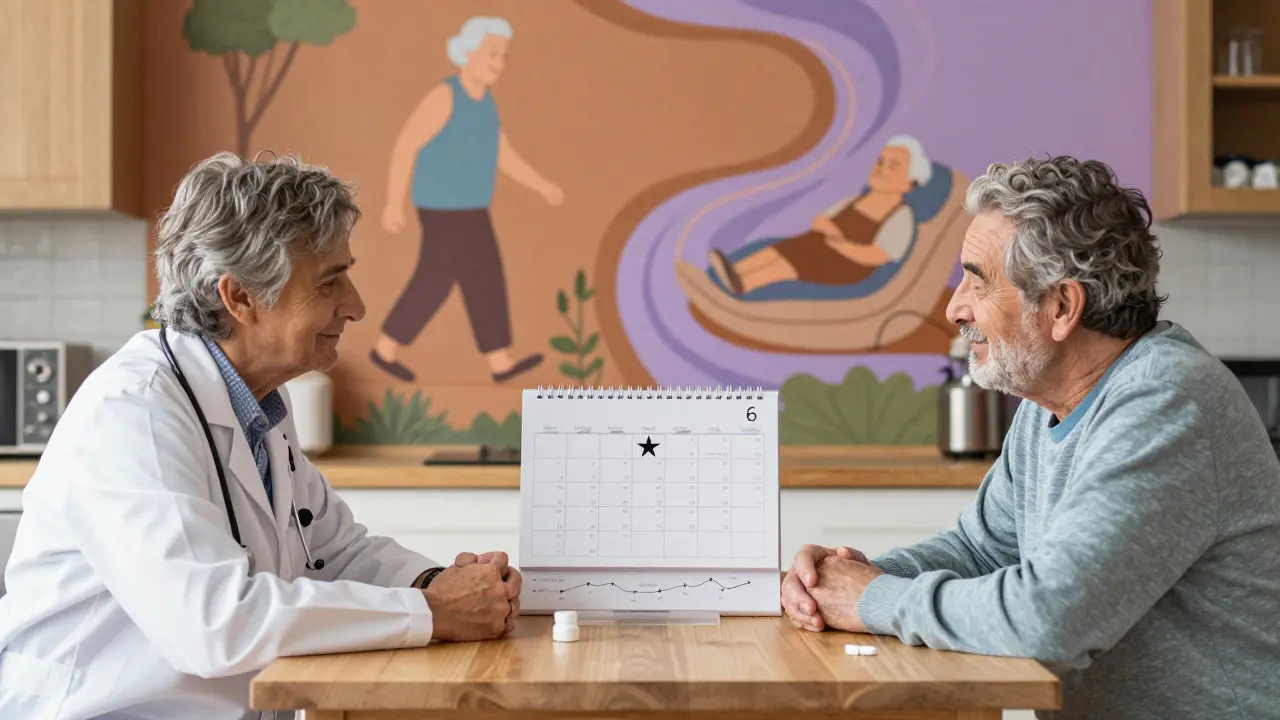
How to Stop Safely
You don’t just quit cold turkey. Here’s how to do it right.
- Talk first. Don’t decide alone. Bring up the topic with your doctor. Say: "I’m feeling tired, my muscles ache, and I’m not sure I still need this. Can we review?"
- Check your risk. If you have no history of heart disease, are over 75, and have other serious conditions, stopping is often safe. If you’ve had a heart event, keep going unless your doctor says otherwise.
- Try a trial stop. For some, reducing the dose or skipping doses for 4-6 weeks helps. If muscle pain goes away and you feel better, that’s useful data. If you feel fine after a month, you might not need to restart.
- Monitor symptoms. Keep an eye out for chest pain, unusual fatigue, or shortness of breath. If they show up, contact your provider. Don’t wait.
- Document why. If you stop, make sure your chart says why. Too often, records just say "no longer necessary." That hides the real reason-side effects, quality of life, or personal choice.
What If You Have Side Effects?
Not everyone who has muscle pain should quit statins. Sometimes, switching helps.
Try a different statin. Rosuvastatin and pravastatin are less likely to cause muscle issues than simvastatin or atorvastatin. Lower the dose. Go from daily to every other day. Some people do fine on 10 mg every other day. It’s not as effective, but it’s better than quitting entirely.
If you still can’t tolerate statins, there are non-statin options. Ezetimibe reduces cholesterol absorption and works well with low-dose statins. PCSK9 inhibitors are powerful but expensive. Fibrates and omega-3s help with triglycerides but don’t lower LDL like statins do. None are perfect. But they’re options.
The Bigger Picture: Deprescribing Is Medicine Too
We’ve spent decades telling people to take more pills. Now, we’re learning that sometimes, taking fewer is better.
One study found that patients who stopped statins in their 80s reported better sleep, more energy, and less confusion. No increase in heart attacks. No rise in death. Just… better days.
Deprescribing isn’t giving up. It’s choosing quality over quantity. It’s recognizing that medicine isn’t just about extending life-it’s about making the life you have worth living.
The ongoing "Discontinuing Statins in Multimorbid Older Adults" trial in Europe is tracking 1,800 people over two years. It’s not just looking at heart attacks-it’s looking at falls, muscle strength, mental clarity, and daily function. That’s the future of care: not just survival, but well-being.
What About Cost and Access?
Statins are cheap. Most are generic. But that doesn’t mean they’re free. The cost isn’t just financial-it’s time, mental energy, and physical comfort. For someone managing 10 pills a day, adding one more just because "it’s always been there" isn’t smart.
Some insurance plans now reward doctors for deprescribing. That’s a sign things are changing. But it’s still rare. Most patients still get pushed toward continuing, not questioning.
Final Thoughts
Statin discontinuation isn’t a failure. It’s a decision. A thoughtful one.
If you’re young and had a heart attack, keep taking yours. If you’re older, frail, and on multiple meds, talk to your doctor. Ask: "Is this still helping?" If the answer isn’t clear, a short break might be the best thing you can do.
Medicine doesn’t have to be forever. Sometimes, less is more. And sometimes, the bravest thing you can do is stop.
Can I stop statins cold turkey?
Most people can stop statins without withdrawal symptoms. But sudden stopping isn’t always the best approach. If you’re at high risk for heart events, your doctor may suggest a gradual reduction. For low-risk patients, stopping outright is usually fine. The key is to monitor how you feel afterward and report any new symptoms.
Do statins cause muscle damage?
Statins can cause muscle aches in about 5-10% of users, but true muscle damage (rhabdomyolysis) is extremely rare-less than 1 in 10,000. Most muscle pain isn’t caused by statins. Other factors like vitamin D deficiency, thyroid issues, or overexertion play a bigger role. Still, if you feel new or worsening pain, talk to your doctor before assuming it’s the statin.
Are there natural alternatives to statins?
Diet, exercise, and weight loss can lower cholesterol, but they rarely match statin effectiveness. Supplements like red yeast rice contain a natural statin and carry similar risks. Plant sterols and soluble fiber help a little. But if you need strong LDL lowering, nothing beats statins-or their non-statin alternatives like ezetimibe or PCSK9 inhibitors. Don’t rely on supplements alone if you’re high risk.
What if I stop statins and have a heart attack?
It’s possible. If you’re at high risk and stop without medical guidance, your chance of a heart event increases. But if you’re older, frail, or have limited life expectancy, the risk of stopping is often lower than the risk of side effects. The goal isn’t to avoid all risk-it’s to balance risks. A shared decision with your doctor makes the difference.
Can I restart statins later if I change my mind?
Yes. Many people stop statins, feel better, and later restart them after a heart event or new diagnosis. Restarting is safe and common. The key is to document your reasons for stopping and restarting. That way, your care team can make smarter decisions later.
What’s Next?
If you’re thinking about stopping statins, start here:
- Write down why you’re considering it-side effects? fatigue? cost? confusion?
- Review your medical history: Have you had a heart attack, stroke, or stent?
- Check your age and overall health: Are you over 75? Do you have cancer, dementia, or kidney failure?
- Ask your doctor: "Based on my situation, is this drug still helping?"
- Request a trial period: "Can we try stopping for 6 weeks and see how I feel?"
There’s no one-size-fits-all answer. But there is a better way: not just taking pills, but choosing them. And that starts with asking the right question.
Alex Brad
March 3, 2026 AT 05:56Stopping statins isn't about fear. It's about context. For someone over 75 with kidney disease and no heart history, the math doesn't work. More pills don't mean more life. Just more side effects.
Callum Duffy
March 4, 2026 AT 08:31This is one of the clearest, most balanced takes I've seen on deprescribing. Too often, we treat guidelines like commandments rather than tools. The real question isn't whether to stop-it's whether the drug still serves the person, not the protocol.
John Smith
March 4, 2026 AT 21:17Statins are Big Pharma's golden goose and everyone's too scared to say it out loud. I stopped mine after 12 years-muscle pain was killing me. Docs acted like I was trying to burn down the hospital. Funny how they never ask if the pill is helping or just keeping the revenue stream flowing.
Renee Jackson
March 6, 2026 AT 09:25I appreciate how this article centers patient autonomy without dismissing clinical evidence. Medicine should empower, not enforce. The five-step safe discontinuation protocol is practical, compassionate, and desperately needed in primary care.
Levi Viloria
March 7, 2026 AT 23:25My dad stopped statins at 82 after a six-week trial. Said he slept better, walked without groaning, and didn’t feel like a pharmacy. No heart events. Two years later, still fine. We didn’t just ‘take the risk’-we made a decision with data, not dogma.
Raman Kapri
March 8, 2026 AT 05:25While the article presents a compelling case, it overlooks the broader epidemiological evidence. Statin discontinuation in primary prevention cohorts consistently shows a 15-20% increase in cardiovascular events over five years. Quality of life metrics are subjective. Clinical outcomes are not. The data does not support widespread discontinuation.
John Cyrus
March 9, 2026 AT 01:02People stop statins because they're lazy and want to avoid responsibility. You think your muscles hurt because of the pill? Try looking in the mirror. You're overweight. You sit all day. You eat crap. The statin isn't the problem. Your life is.
Jane Ryan Ryder
March 9, 2026 AT 18:16So now we're told to quit meds because we're old? Next they'll say don't take insulin for diabetes because you're too tired to walk to the fridge. This is how you kill grandmas. I'm 62 and I take my statin. I'm not ready to die quietly so someone can save a buck.
Helen Brown
March 11, 2026 AT 03:52I know what this is. This is how they get you to stop taking your meds so they can put something in the water. You think the doctors really care? They get paid by the pill. I read this article and I'm not touching my statin ever again. I'm going raw vegan and taking garlic pills. That's the real science.