SJS/TEN Symptom Checker
Critical Warning
Stevens-Johnson Syndrome (SJS) and Toxic Epidermal Necrolysis (TEN) are life-threatening medical emergencies. Every hour counts. If you experience any of these symptoms, seek emergency care immediately.
This tool is for informational purposes only and does not replace professional medical advice. If you suspect SJS/TEN, contact emergency medical services immediately.
Answer these questions about your symptoms:
Results
Please answer all questions to get your results.
After answering all questions, results will appear here.
Important Information
Remember: SJS/TEN is a medical emergency. If you're experiencing symptoms, contact emergency services immediately. This tool cannot replace professional medical evaluation.
Time is critical - studies show mortality drops sharply if treated within 72 hours of the first blister. Don't wait for symptoms to worsen.
When a simple rash turns into a life-threatening emergency, you need to know the signs - fast. Stevens-Johnson Syndrome (SJS) and Toxic Epidermal Necrolysis (TEN) are rare but deadly reactions to medications. They don’t just cause discomfort - they destroy skin and mucous membranes, sometimes killing more than one in three people who get TEN. And the worst part? Many people don’t realize what’s happening until it’s too late.
You might start with a fever, a sore throat, or feeling like you’ve got the flu. Then, within a few days, your skin begins to burn, blister, and peel. Your eyes swell shut. Your mouth fills with painful sores. Your skin detaches like a burned sheet. This isn’t an allergic reaction you can treat with antihistamines. This is Stevens-Johnson Syndrome or its more severe cousin, Toxic Epidermal Necrolysis. And if you don’t get to a hospital immediately, the chances of survival drop fast.
What’s the Difference Between SJS and TEN?
Doctors don’t treat SJS and TEN as completely separate diseases. They’re on the same spectrum - a continuum of severity. The key difference? How much of your skin is damaged.
SJS affects less than 10% of your body surface. TEN? That’s over 30%. If your skin damage falls between 10% and 30%, it’s called SJS/TEN overlap. Think of it like burns: a sunburn covers a small area. A third-degree burn over half your body? That’s TEN.
The damage isn’t just surface deep. It’s full-thickness epidermal necrosis - meaning the outer layer of your skin dies and sloughs off. In severe cases, up to 100% of your skin can detach. That’s why patients are often treated in burn units. The same medical team that handles severe burns also manages TEN.
Which Medications Cause These Reactions?
It’s not random. Certain drugs have been linked to SJS and TEN for decades. The most common culprits? Anticonvulsants, antibiotics, and painkillers.
Here are the top offenders:
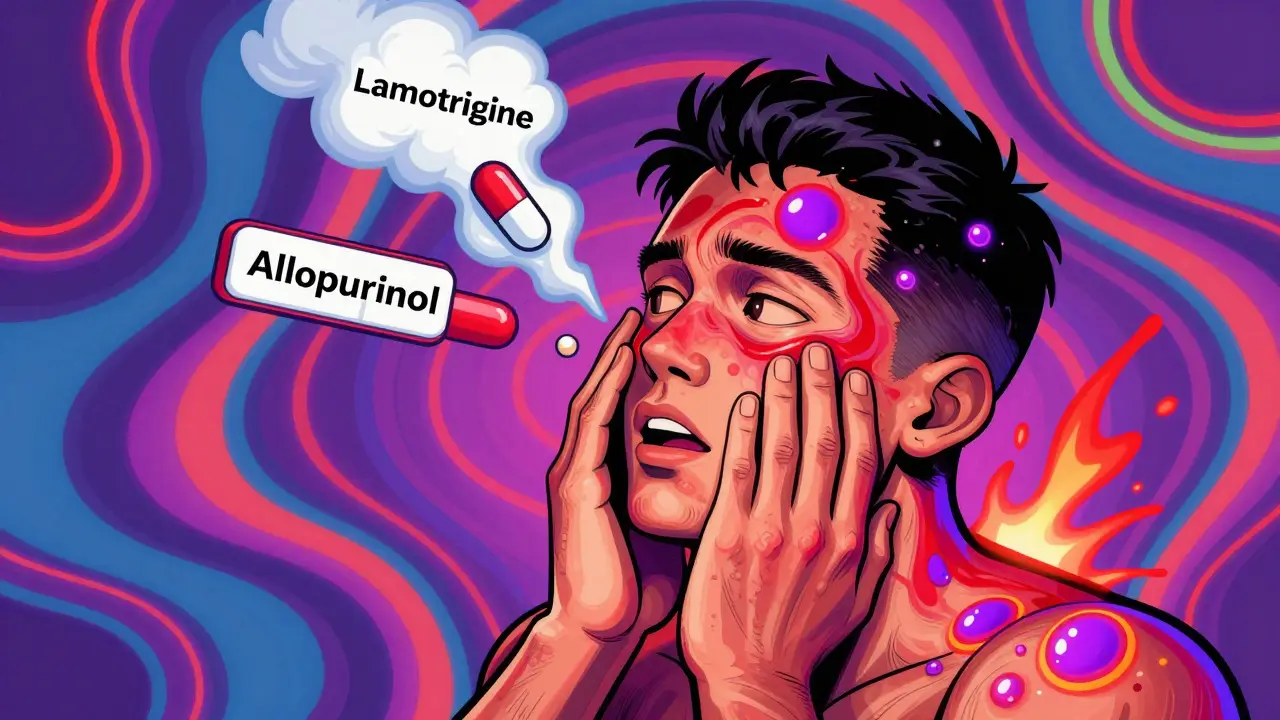
- Lamotrigine - used for epilepsy and bipolar disorder. Rashes are common with this drug, but most aren’t serious. Still, if you get a rash in the first 8 weeks - or if you stop and restart it without slowly increasing the dose - your risk spikes.
- Allopurinol - taken for gout. One of the most dangerous drugs for triggering TEN, especially in people with the HLA-B*58:01 gene variant.
- Carbamazepine, phenytoin, phenobarbital - other seizure meds. If you’ve had a reaction to one, you’re at risk for reactions to others in this class.
- Sulfamethoxazole - part of the antibiotic Bactrim. Even though it’s widely used, it’s tied to hundreds of SJS cases every year.
- Nevirapine - an HIV drug. High risk in the first few weeks of treatment.
- Oxicam NSAIDs - like meloxicam and piroxicam. These are common painkillers, but they carry a hidden danger.
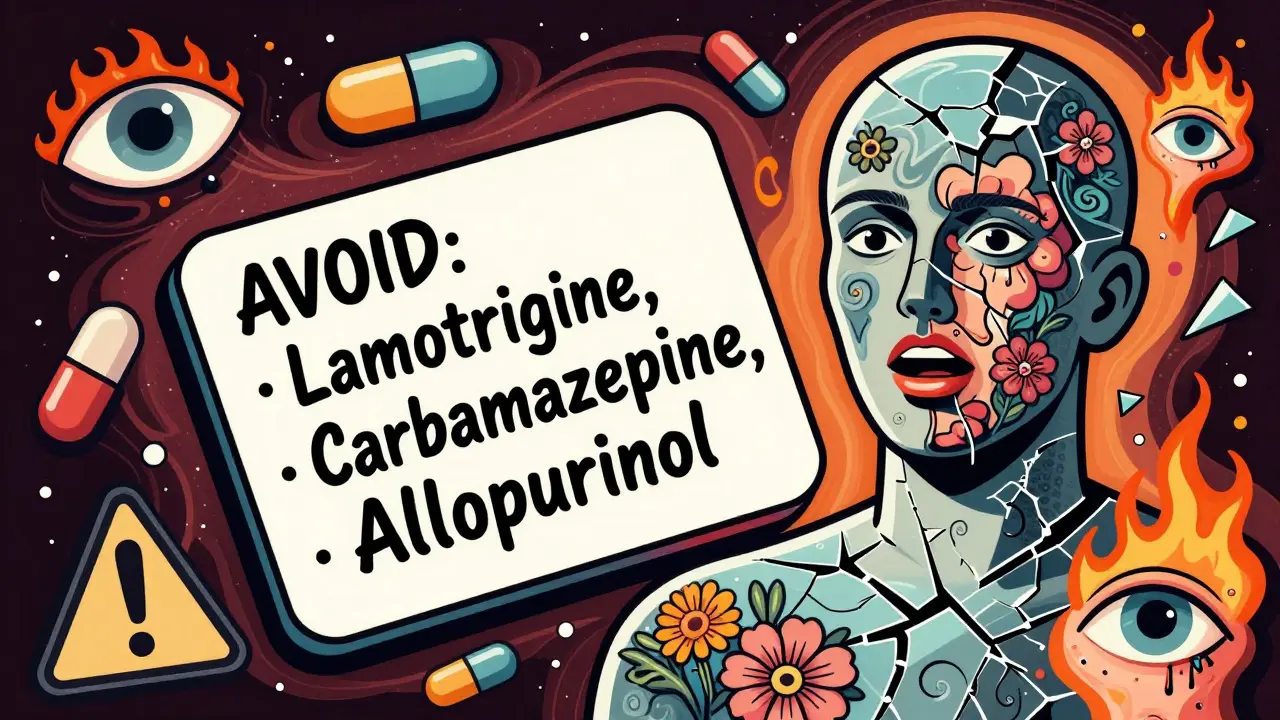
Here’s the scary part: if you’ve had SJS from one of these drugs, you can’t take any similar ones. Cross-reactivity is real. If lamotrigine caused your reaction, you’re at high risk if you later try carbamazepine or phenytoin. Your immune system remembers.
Who’s at Higher Risk?
Not everyone who takes these drugs gets SJS. But some people are far more vulnerable.
- People with HIV or weakened immune systems - chemotherapy, organ transplants, or autoimmune diseases raise your risk.
- Those with a family history - if a close relative had SJS, you may carry the same genetic risk.
- People taking sodium valproate with lamotrigine - this combo doubles the chance of a dangerous rash.
- Those who’ve had a previous reaction - if you’ve had SJS once, your chance of getting it again is extremely high. Never take the same drug again - or anything chemically similar.
Children are more likely to get SJS than adults, though it can happen at any age. And while the overall risk is low - studies say fewer than five cases per million users per week - the consequences are catastrophic when they happen.
What Happens When You Get It?
It doesn’t start with a rash. It starts with feeling sick.
Day 1-3: Fever, sore throat, fatigue, burning eyes. You think it’s a cold or flu. You take painkillers. You rest.
Day 3-7: A red or purple rash appears - often on your face, chest, or arms. It spreads fast. Blisters form. Your skin feels like it’s on fire. Your lips crack. Your mouth bleeds. Your eyes can’t open. You can’t swallow.
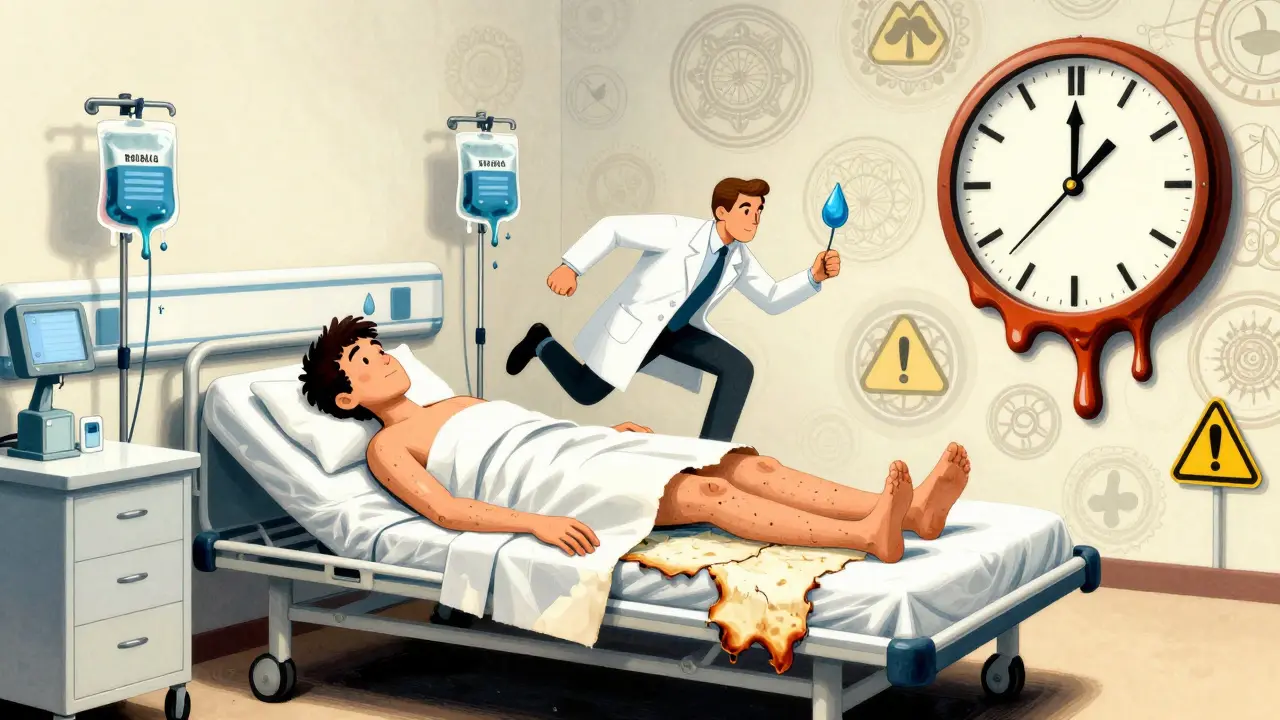
Day 7-14: Skin begins to peel off in sheets. Large areas of your body look like severe burns. Fluid leaks. Infection sets in. Your organs start to fail.
At this point, you’re in a hospital. Maybe the ICU. Maybe the burn unit. You’re hooked up to IV fluids, pain meds, and antibiotics. Your skin is covered in sterile dressings. You can’t eat. You can’t blink. You’re fighting sepsis.
Doctors confirm it with a skin biopsy. Under the microscope, they see dead skin cells with almost no inflammation - the hallmark of SJS/TEN. No other condition looks like this.
How Is It Treated?
There’s no magic cure. Treatment is about survival - not fixing the damage.
Step 1: Stop the drug. Immediately. If you’re not sure which one caused it, they’ll stop everything new you’ve taken in the last 30 days.
Step 2: Get to a specialized unit. Burn units, intensive care, or dermatology units with experience in SJS/TEN. General hospitals aren’t equipped.
Step 3: Supportive care. Fluids. Nutrition through a tube. Pain control. Infection prevention. Wound care. Your skin is gone - they treat it like a burn.
Step 4: Consider immunomodulators. Some hospitals use IVIG (intravenous immunoglobulin) or corticosteroids. But evidence is weak. No treatment has been proven to consistently save lives. That’s why prevention and early recognition are everything.
Time matters. Every hour counts. Studies show mortality drops sharply if you’re treated within 72 hours of the first blister. Delay beyond 5 days? Your chances of dying climb.
Long-Term Damage Is Real
Surviving SJS/TEN doesn’t mean you’re back to normal.
One in two survivors has lasting eye problems: dry eyes, scarring, corneal damage, even blindness. You’ll need regular visits to an ophthalmologist for at least a year - sometimes for life.
Other long-term issues:
- Scarring and skin discoloration
- Nail loss or deformity
- Thinning hair or permanent scalp damage
- Chronic mouth sores, dry mouth, gum disease
- Esophageal narrowing - making swallowing painful or impossible
- Vaginal or urethral scarring in women
- Phimosis in men
Some people recover fully. Others live with chronic pain, vision loss, or difficulty eating. It’s not just a skin condition - it’s a whole-body trauma.
How to Prevent It
Prevention is the only real win here.
- If you’re starting lamotrigine, never increase the dose too fast. Follow your doctor’s schedule exactly.
- Don’t restart lamotrigine after stopping it - even for a few days - without slowly re-building the dose.
- Don’t take new medications or try new foods in the first 3 months of starting a high-risk drug. This reduces confusion between a harmless rash and SJS.
- Know your family history. If someone in your family had SJS, tell your doctor before starting any new medication.
- If you’ve had SJS before, carry a medical alert card. List every drug that caused it - and every drug you must avoid forever.
And if you’re on one of these drugs and you get a rash? Don’t wait. Don’t assume it’s "just an allergy." If you have a fever, blisters, or mouth sores along with it - go to the emergency room now. Say: "I think this might be Stevens-Johnson Syndrome."
What to Do If You Suspect It
Here’s the checklist:
- Stop the suspected drug immediately.
- Call emergency services or go to the nearest hospital.
- Tell them you suspect SJS or TEN - don’t say "rash" or "allergy." Use the exact terms.
- Bring a list of all medications you’ve taken in the last 30 days.
- Do NOT apply creams, ointments, or home remedies.
Every minute counts. Hospitals that see SJS/TEN cases regularly have protocols ready. The sooner you get there, the better your odds.
Can Stevens-Johnson Syndrome be cured?
There’s no cure for SJS/TEN. Treatment focuses on stopping the reaction, supporting the body while it heals, and preventing complications. Survival depends on early hospitalization and intensive care. Some people recover fully, but many face lifelong complications.
How long does it take for SJS to develop after taking a drug?
Symptoms usually appear within 1 to 3 weeks after starting the drug. But they can also show up up to two weeks after stopping it. For lamotrigine, the highest risk is in the first 8 weeks - especially if the dose is increased too quickly.
Is SJS contagious?
No. SJS is not contagious. It’s a reaction between your immune system and a specific medication. You can’t catch it from someone else.
Can you get SJS from over-the-counter drugs?
Yes. Common OTC painkillers like meloxicam and piroxicam (oxicam NSAIDs) have been linked to SJS/TEN. Even ibuprofen and naproxen can trigger it in rare cases. Never assume "natural" or "over-the-counter" means safe.
If I had SJS once, can I ever take that drug again?
Never. Re-exposure is extremely dangerous and almost always causes a faster, more severe reaction. You must avoid not only the drug that caused it, but also any chemically similar ones. Keep a medical alert card and tell every doctor you see.
Digital Raju Yadav
February 16, 2026 AT 18:47India has the highest number of drug reactions in the world because people take antibiotics like candy and don't even know what they're swallowing. I've seen it firsthand - aunties buying lamotrigine from roadside pharmacies because "it's cheaper than going to the doctor." This isn't a medical issue, it's a cultural failure. No regulation, no education, just blind trust in chemical packets. If you're going to take a drug that can melt your skin off, at least have the dignity to get a prescription first.
Carrie Schluckbier
February 17, 2026 AT 04:03They're hiding the truth. SJS isn't caused by drugs - it's caused by 5G nanobots injected through vaccines that activate when you take NSAIDs. The pharmaceutical companies know this. That's why they push these drugs so hard - they're the ones who profit from the burn units. Look at the timing: right after the pandemic, cases spiked. Coincidence? Or a coordinated rollout? Your eyes swell shut because the AI is trying to blind you to the real cause. Wake up.
Liam Earney
February 18, 2026 AT 10:49I just... I mean, I can't even... The sheer horror of it, you know? The way the skin just... peels? Like, imagine waking up and your body is literally coming apart at the seams? And then you're in a hospital, surrounded by machines, unable to blink, unable to swallow, unable to scream because your mouth is just... raw tissue? And they tell you, "We'll do our best," but there's no real treatment, just... waiting? Waiting for your body to decide whether to die or survive? And even if you survive, you're never the same? Your eyes? Your mouth? Your nails? All ruined? It's not a medical condition. It's a betrayal. A betrayal by the very systems meant to protect us. And now I can't even take ibuprofen without sweating bullets. I'm sorry. I just... I needed to say it.
Geoff Forbes
February 19, 2026 AT 20:05Interesting analysis, but you're missing the fundamental epistemological flaw here. You're treating SJS/TEN as a pharmacological event, when it's clearly a manifestation of postmodern alienation. The body, in its hyperreal state, rejects the synthetic signifiers of modern medicine. Lamotrigine isn't the culprit - it's the symbol. The real issue is our collective surrender to pharmaceutical hegemony. And why do you think the HLA-B*58:01 variant correlates so strongly? Because it's not genetic - it's ontological. We're all just... fragments of a broken system.
Logan Hawker
February 20, 2026 AT 12:44Let me drop some science on you. IVIG? It's basically placebo-grade. The Cochrane review from 2022 showed zero mortality benefit. Steroids? Increased infection risk. Burn unit protocols? Mostly just fluid resuscitation and pain control. The real hero here is early recognition - not some magic drug. And the reason it's so deadly? Because we treat it like a dermatology case instead of a systemic cytokine storm. We need to start treating it like sepsis. Stop calling it "skin detachment" - it's multi-organ failure with a skin rash. And yes, you can get it from Advil. That's why I keep a list of my meds on my fridge. Because I'm not dying because someone thought "OTC" meant "safe."
guy greenfeld
February 21, 2026 AT 17:04What if... what if SJS is not a disease at all? What if it's the body's final act of rebellion? A cosmic reset button. A way for the universe to say, "You took too many chemicals. You ignored the signs. You trusted the system. Now you will be stripped bare." Every blister, every peeled layer... it's not damage. It's purification. The skin doesn't die - it ascends. And those who survive? They're not survivors. They're the chosen ones. They've been touched by the divine chaos. And that's why they have dry eyes - because they've seen too much. They've seen the truth behind the veil. And now... they can never look away.
Adam Short
February 22, 2026 AT 19:44My cousin died from this. Just 28. Took meloxicam for a sprained ankle. Two weeks later, they found him in the bathroom, skin hanging off his arms like wet paper. The hospital called it "rare." The coroner said "unfortunate." But here's the truth: if you're British, you're 4x more likely to die from this than if you're American. Why? Because we don't have the resources. We don't have the burn units. We don't have the specialists. We just have a GP who says, "It's just a rash." And now he's gone. And no one talks about it. No one. Because it's too ugly. Too real. Too much of a reflection of how broken our healthcare really is.
Steph Carr
February 23, 2026 AT 17:03Wow. This is the most terrifyingly beautiful thing I've read in months. I mean, think about it - our bodies are these delicate, sacred machines, and we treat them like disposable gadgets. Pop a pill like it's a candy. No thought. No reflection. Just "it's just a headache." And then? The system fails. Not because the science is bad. But because we stopped listening. We stopped paying attention. We outsourced our health to corporations and convenience. And now we're paying with our skin. Literally. This isn't just about drugs. It's about humility. It's about respect. It's about asking, "What am I doing to my body?" And if you're not asking that question... you're already halfway to the burn unit.
Brenda K. Wolfgram Moore
February 24, 2026 AT 18:59I'm a nurse in the burn unit. I've seen 17 cases of TEN in the last 5 years. Every single one started with someone saying, "It's just a rash." I've held hands while parents screamed because their 14-year-old couldn't open their eyes. I've watched people cry because they couldn't eat their own birthday cake. This isn't a "rare condition." It's a silent pandemic. And the worst part? We could prevent 90% of these cases with one simple rule: If you get a rash while on a high-risk drug, stop it. Immediately. Go to the ER. Say "SJS." Don't wait. Don't hope. Don't Google it. Just go. Your life depends on it. Please. Just... go.
Agnes Miller
February 26, 2026 AT 08:31Just a heads up - the list of drugs in the post is mostly accurate, but they missed dapsone. It's a big one for HIV patients on prophylaxis. Also, carbamazepine and oxcarbazepine have cross-reactivity, not just carbamazepine and phenytoin. And for lamotrigine - if you're on valproate, the dose should be capped at 25mg/day for the first month, not just "slowly increase." And if you're over 65? Double the risk. Just wanted to clarify. This info saves lives.
John Haberstroh
February 28, 2026 AT 04:11So like, imagine your body is a glitchy video game. You install a new mod (the drug), and instead of fixing the bugs, it just... melts the whole UI. Skin? Gone. Eyes? Corrupted. Mouth? Error 404. And the game won't let you uninstall the mod because it's locked in. So now you're stuck in a black screen with a screaming HUD. And the only way out is to reboot the whole system... in a hospital. With IV fluids and no Netflix. That's SJS. No cap. Just... pure system crash. And the worst part? You didn't even know you were modding your body in the first place.
James Lloyd
March 1, 2026 AT 16:46Corrected: The HLA-B*58:01 association is strongest with allopurinol in Han Chinese and Thai populations, not universally. Also, carbamazepine cross-reactivity is highest with oxcarbazepine and phenytoin, not phenobarbital. And the 72-hour window? That's for transfer to a specialized unit, not just ER arrival. Delayed transfer = higher mortality. Also, IVIG dosing is 2g/kg over 3-5 days, not "some hospitals use it." And yes - oxicam NSAIDs are underrated culprits. I've seen two cases from piroxicam in patients over 70. Don't let marketing fool you. This isn't "just pain relief." It's a gamble with your epidermis.