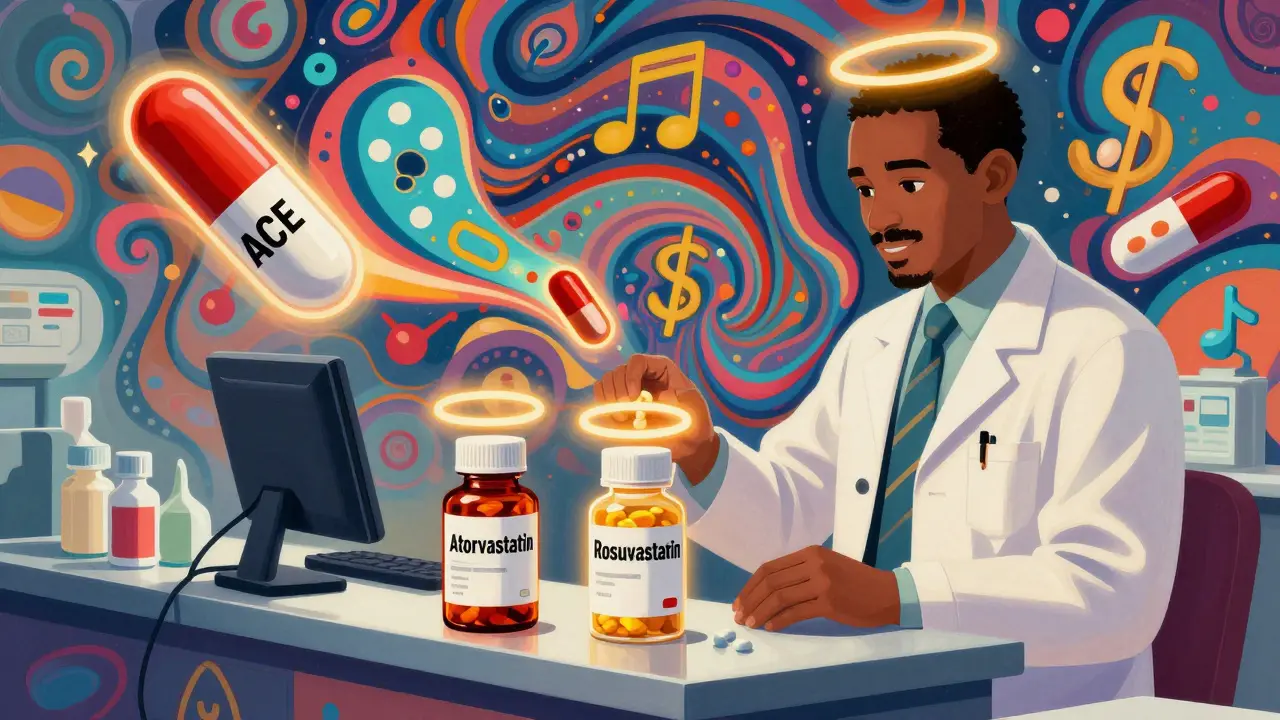
When a doctor switches your blood pressure medication from one brand to another, it might feel like a random change. But more often than not, it’s not random at all. It’s therapeutic interchange-a deliberate, evidence-based move to swap one drug for another in the same class that works just as well, but costs less. And yes, this happens every day in hospitals, nursing homes, and clinics across the U.S. and New Zealand. But here’s the thing most people don’t realize: therapeutic interchange does not mean switching between different drug classes. If your provider swaps lisinopril for amlodipine, that’s not therapeutic interchange. That’s a new prescription. Therapeutic interchange only happens when you go from one ACE inhibitor to another, or one statin to another-not across therapeutic categories.
What Therapeutic Interchange Actually Is
Therapeutic interchange is a formal process where a pharmacist, under a pre-approved policy, swaps a prescribed medication for another drug in the same therapeutic class that has been proven to deliver similar clinical results. Think of it like swapping one brand of running shoe for another that has the same cushioning, support, and durability-just cheaper. The American College of Clinical Pharmacy defines it clearly: it’s replacing a prescribed drug with a chemically different one that’s therapeutically equivalent. Not similar. Not close. Equivalent.
This isn’t guesswork. It’s built on years of clinical data. For example, if you’re prescribed atorvastatin for high cholesterol, a pharmacist might substitute it with rosuvastatin because both are HMG-CoA reductase inhibitors (statins), both lower LDL cholesterol by 40-50%, and both have similar side effect profiles. But if they swapped atorvastatin for metformin? That’s not interchange. That’s a mistake. Or worse, a dangerous change.
By 2002, over 80% of U.S. hospitals had formal therapeutic interchange programs. Today, they’re even more common in long-term care facilities. Why? Because drug costs keep rising. In 2018, drug prices jumped 8% nationally. For a skilled nursing home with 150 residents on multiple medications, that’s tens of thousands of dollars in extra costs every month. Therapeutic interchange helps cut that without cutting care.
How It Works Behind the Scenes
It doesn’t happen because a pharmacist sees a cheaper option and decides on their own. There’s a system. A Pharmacy and Therapeutics (P&T) Committee-a group of doctors, pharmacists, nurses, and sometimes even patients-meets regularly to review medications. They look at clinical studies, real-world outcomes, and cost data. Then they build a formulary: a list of approved drugs for each condition.
Let’s say the committee decides that for treating hypertension, they’ll prefer hydrochlorothiazide over chlorthalidone because it’s cheaper and has the same effectiveness in most patients. Once that’s approved, any time a doctor writes a prescription for chlorthalidone, the pharmacist can automatically fill it with hydrochlorothiazide-unless the doctor specifically says no.
But here’s where it gets tricky: not every state allows this. In some places, the pharmacist must call the prescriber every single time. In others, if the prescriber signs a one-time “therapeutic interchange letter,” the pharmacy can swap automatically for that patient forever. In New Zealand, the system leans heavily on centralized formularies through the Pharmaceutical Management Agency (PHARMAC), which makes therapeutic interchange more seamless than in the U.S., where rules vary wildly from state to state.
Why It’s Not Just About Saving Money
People assume therapeutic interchange is just about cutting costs. It’s not. It’s about standardizing care. When every hospital in a system uses the same 3 beta-blockers instead of 12, it reduces confusion. Nurses know what to expect. Pharmacists spot interactions faster. Patients are less likely to get the wrong drug because the options are fewer and better understood.
Take heart failure patients. If they’re on carvedilol, metoprolol, or bisoprolol-all beta-blockers approved for heart failure-switching between them based on cost or availability doesn’t hurt outcomes. In fact, a 2016 study in the Journal of the American College of Cardiology found no difference in hospital readmissions or survival rates when patients were switched within this class.
But if you switch a beta-blocker for a calcium channel blocker like diltiazem? That’s not therapeutic interchange. That’s changing the treatment goal. Beta-blockers slow the heart and reduce oxygen demand. Calcium channel blockers relax blood vessels. Different mechanisms. Different risks. Different uses. Mixing those up is not interchange-it’s error.

Where It Fails: Community Pharmacies and Prescriber Resistance
Therapeutic interchange thrives in hospitals and nursing homes. It barely exists in your local pharmacy. Why? Because community pharmacists don’t have the same authority. In most states, they can’t swap a brand-name drug for another brand-name drug in the same class unless the prescriber says so. Even then, they usually have to call the doctor, explain why, and wait for approval. That’s a time sink.
One pharmacist in Wellington told me about a patient on omeprazole who got switched to pantoprazole by the hospital. When the patient came to the community pharmacy with the same prescription, the pharmacist had to call the doctor’s office three times before they understood why the swap was okay. “They didn’t even know therapeutic interchange was a thing,” the pharmacist said. “They thought we were trying to give them a generic.”
That’s the problem. Many prescribers aren’t trained on this. They think interchange means “any cheaper drug,” not “same class, same effect.” So they resist. They write “Do Not Substitute” on prescriptions. They don’t sign TI letters. And patients get stuck paying more.
The Rules That Keep It Safe
Therapeutic interchange isn’t a free-for-all. There are hard rules:
- Only happens within the same therapeutic class
- Must be based on published clinical evidence
- Requires approval from a multidisciplinary P&T committee
- Needs documentation: either a signed TI letter or a pre-approved formulary
- Must allow for exceptions-for patients with allergies, intolerance, or unique needs
And here’s the biggest one: it’s not for every drug. Drugs with narrow therapeutic windows-like warfarin, lithium, or digoxin-almost never get swapped. The margin for error is too small. A 10% difference in blood level could mean a stroke or a seizure. So even if one drug costs half as much, it stays off the interchange list.
What Patients Should Know
If your medication changes and you didn’t ask for it, don’t panic. Ask: “Is this the same kind of drug?” If the answer is yes, and it’s from the same class, it’s probably therapeutic interchange. Ask if there’s a reason-maybe it’s cheaper, or your insurance covers it better.
If you’re on a medication that’s been switched and you feel different-worse sleep, new side effects, less energy-tell your provider. That doesn’t mean the swap was wrong. It just means your body might respond differently to the new one. That’s why exceptions exist.
And if your pharmacist says they can’t fill your prescription because they need to call your doctor? That’s probably because your doctor hasn’t signed a therapeutic interchange agreement. It’s not a glitch. It’s policy.
The Future of Therapeutic Interchange
It’s not going away. With drug prices still climbing and healthcare systems under pressure, therapeutic interchange is one of the few tools that saves money without sacrificing outcomes. The real challenge now is education.
Prescribers need to understand it’s not a cost-cutting gimmick-it’s a clinical strategy. Pharmacists need better tools to communicate it. Patients need to know it’s safe when done right.
And most of all, we need to stop calling it “switching classes.” That’s not interchange. That’s a different treatment plan. And if you’re getting that without being told? That’s a red flag.
Is therapeutic interchange the same as generic substitution?
No. Generic substitution is when you swap a brand-name drug for its exact chemical copy-like switching from Lipitor to atorvastatin. Therapeutic interchange is swapping one drug for another that’s chemically different but works the same way, like switching from atorvastatin to rosuvastatin. Generics are identical in structure. Interchange drugs are similar in effect but different in chemistry.
Can my pharmacist switch my medication without asking me?
In institutional settings like hospitals or nursing homes, yes-if the change is pre-approved by the Pharmacy and Therapeutics Committee and your prescriber has signed off. In community pharmacies, usually no. Most states require the pharmacist to contact the prescriber first. If your medication was changed without your knowledge, ask your pharmacy or provider for the reason.
Why do some drugs never get switched through therapeutic interchange?
Drugs with narrow therapeutic windows-like warfarin, lithium, digoxin, and some seizure medications-are too risky to swap. Even small differences in how the body processes them can lead to serious side effects. These drugs are kept out of interchange programs for safety reasons, no matter how much cheaper an alternative might be.
Does therapeutic interchange affect how well my medication works?
When done correctly, no. Therapeutic interchange only happens between drugs proven to have substantially equivalent clinical outcomes. Studies show no difference in hospital readmissions, symptom control, or survival rates when switching within the same class-for example, between different statins or ACE inhibitors. But if you feel different after a switch, speak up. Individual responses vary.
Can I request a therapeutic interchange to save money?
You can ask. But the decision isn’t yours alone. It has to be approved by the Pharmacy and Therapeutics Committee and your prescriber. If your current drug is expensive and there’s a cheaper, equally effective alternative in the same class, your pharmacist or doctor might agree. But if it’s a different class, they won’t-because that’s not therapeutic interchange.
Camille Hall
February 10, 2026 AT 21:57As someone who’s been on three different statins over the last decade, I can tell you-therapeutic interchange saved me hundreds a month. My doc didn’t even ask; the pharmacy just swapped me from atorvastatin to rosuvastatin. I was nervous at first, but my labs stayed perfect. No weird side effects. Just cheaper meds. Turns out, my insurance had a better tier for rosuvastatin. Funny how the system works when you’re not paying out of pocket.
And honestly? I wish more people knew this was a thing. Not a scam. Not a cut. Just smart pharmacology.
Ritteka Goyal
February 12, 2026 AT 00:07OMG this is so trueeeeee!! I live in India and we dont have this system but in US it makes so much sense!! Like why pay 200$ for one pill when another one does the same thing?? I mean its not like they are giving you sugar pills right?? Like if two drugs are both ACE inhibitors and both lower BP, why not pick the cheaper one?? I think people are scared because they dont understand science!! Its not magic!! Its chemistry!! And if the docs and pharmacists say its safe, then trust them!! We need more of this!!
Frank Baumann
February 12, 2026 AT 18:43Ohhhh this is the most important thing no one talks about. I work in a nursing home. We used to have 17 different antihypertensives on formulary. Seventeen. Every time a new resident came in, we had to check their med history, call their old doc, hope they didn’t have a weird reaction to something obscure… it was chaos.
After we standardized to three ACE inhibitors and two ARBs? Life changed. Nurses stopped mixing up meds. Pharmacists caught interactions before they happened. And we saved over $40k a year. Not because we cut corners. Because we cut the noise.
And yeah, some docs still write ‘Do Not Substitute’ like it’s a personal insult. But guess what? We’ve started training them. One by one. And now? They get it.
Ken Cooper
February 14, 2026 AT 01:53Wait wait wait-so if I’m on lisinopril and they switch me to enalapril, that’s fine? But if they switch me to losartan? That’s a whole new ballgame? So… it’s not about the class? It’s about the subclass? I’m confused. Are ACE inhibitors and ARBs considered the same ‘class’? Because they both treat HTN… but they’re totally different mechanisms…
And if the P&T committee says ‘swap’ but my body hates the new one? Do I get to go back? Or am I stuck? I had a bad reaction to one statin and they just kept trying others. Felt like a lab rat.
MANI V
February 15, 2026 AT 07:58This is why America is broken. You let pharmacists make medical decisions? That’s socialism. That’s corporate control. Who gave them the right to decide what works for you? Your body is not a spreadsheet. Your health is not a cost center.
And don’t even get me started on ‘evidence-based.’ Evidence is manipulated. Studies are funded by Big Pharma. They want you on the cheapest drug so you stay dependent. They don’t care if you feel worse. They care about margins.
My uncle was switched from a brand-name beta-blocker to a generic. He had chest pain for months. No one listened. Because ‘it’s the same thing.’
It’s not the same thing. It’s manipulation.
Random Guy
February 15, 2026 AT 15:19So let me get this straight… if I’m on omeprazole and they swap me for pantoprazole, that’s cool? But if they swap me for famotidine? That’s a felony?
Bro. I don’t care. I just want my heartburn to stop. Why are we having a PhD-level debate about two proton pump inhibitors that both work 90% of the time?
Also-why does this feel like a corporate trick to make us feel like we’re being ‘saved’ while they quietly lower their liability? I’m not mad. I’m just… suspicious.
Ryan Vargas
February 17, 2026 AT 15:14Let’s not pretend this is about ‘clinical equivalence.’ That’s the language of control. The real reason therapeutic interchange exists is to consolidate pharmaceutical power. The P&T committees? They’re not made of saints. They’re made of consultants paid by drug manufacturers.
Every ‘equivalent’ drug on the formulary? It’s the one the hospital has a rebate deal on. The one the rep brought donuts for at the quarterly meeting.
And don’t tell me about ‘evidence.’ The studies are funded by the same companies that profit from the swap. It’s a closed loop. A manufactured consensus.
Patients aren’t being saved. They’re being standardized. And standardization is the first step toward control.
Wake up.
Tasha Lake
February 19, 2026 AT 14:40As a clinical pharmacist, I’ll say this: therapeutic interchange is one of the most underappreciated tools in pharmacotherapy. We’re not just swapping for cost-we’re optimizing for adherence, polypharmacy risk, and drug-drug interactions.
For example: switching from a twice-daily ACE inhibitor to a once-daily one? That’s interchange. And it reduces non-adherence by 30%. That’s not ‘saving money.’ That’s preventing hospitalizations.
And yes-P&T committees are rigorous. We review RCTs, real-world data, formulary alignment, even pharmacy automation compatibility. It’s not a free-for-all. It’s precision medicine with budget constraints.
Also: if your doc doesn’t know what it is? That’s a training gap. Not a system failure.
Sam Dickison
February 20, 2026 AT 00:25Y’all are overthinking this. I’m a nurse. I’ve seen this play out a hundred times. Patient comes in, confused because their pill looks different. We explain: ‘Same class. Same effect. Cheaper. No change in your labs.’ They breathe a sigh of relief. ‘Oh. Okay. So I’m not getting ripped off?’
Yeah. You’re not.
And honestly? The system works better in nursing homes than in outpatient clinics. Why? Because in the hospital, we have the team. We have the communication. In the community? No one talks. Pharmacist doesn’t know the doc’s intent. Doc doesn’t know the med was swapped. Patient gets stuck in the middle.
Solution? Better EHR integration. And less ‘Do Not Substitute’ scribbles.
Brett Pouser
February 21, 2026 AT 13:26I’m from Canada and we do this all the time. Like, automatically. No drama. No calls. No ‘do not substitute.’ It’s just… how things work. You get the best drug for the price, based on what the national formulary says.
And guess what? People are healthier. Adherence is higher. Costs are lower. No one’s screaming about ‘corporate takeover’ because it’s just… normal.
Here’s the thing: if you trust your doctor to prescribe, why wouldn’t you trust your pharmacist to swap within the same class? They’re the medication experts. Not the sales reps.
Maybe we just need to stop treating pharmacists like order-fillers and start treating them like clinicians.
Tom Forwood
February 22, 2026 AT 16:41My grandma got switched from furosemide to hydrochlorothiazide and thought she was being poisoned. She called 911. She was convinced they were ‘trying to kill her with cheap water pills.’
Turns out? Her BP dropped 10 points. Her edema improved. Her kidney numbers stayed stable.
She still won’t take the new pill. Says it ‘looks wrong.’
So yeah. This isn’t a policy problem. It’s a trust problem. And we’re not fixing that with formularies. We’re fixing that with conversations. One grandma at a time.
John McDonald
February 23, 2026 AT 01:50This is the kind of thing that should be taught in med school. Like, right after ‘how to write a prescription.’ Why are we still acting like pharmacists are just the people who hand out pills? They’re the ones who catch errors before they happen.
And let’s be real-most prescribers have zero training in formulary logistics. They’re trained to diagnose. Not to navigate insurance formularies. So they write ‘do not substitute’ out of fear… not knowledge.
We need mandatory CE on therapeutic interchange for every prescriber. Like, every year. It’s not optional. It’s patient safety.
Chelsea Cook
February 24, 2026 AT 23:28So… if I’m on a $300/month brand-name drug and they swap me for a $3 generic in the same class… is that therapeutic interchange? Or is that just ‘we’re trying to make you take the cheap one’?
Because honestly? I don’t care if it’s ‘evidence-based.’ If I feel like crap after the switch, I want my original back. No questions. No forms. No committee.
And if the system says ‘no’? Then the system is broken.
Also-why is no one talking about how this disproportionately affects elderly patients? They don’t have the energy to fight. So they just… take the new pill. And hope.
Jacob den Hollander
February 26, 2026 AT 09:40I’m a retired pharmacist. Worked in a hospital for 37 years. I’ve seen this evolve from ‘weird idea’ to ‘standard practice.’ And I’ll tell you-when it’s done right? It’s beautiful.
But you know what breaks my heart? When a patient comes in, confused, because their doctor didn’t explain it. Or worse-when the doctor says, ‘I don’t know what you’re talking about.’
Therapeutic interchange isn’t magic. It’s science. But science needs communication. And right now? We’re failing at that.
Teach patients. Train prescribers. Trust pharmacists.
It’s not complicated.
Joseph Charles Colin
February 26, 2026 AT 11:51Let’s clarify terminology: therapeutic interchange ≠ generic substitution. Generic substitution = same active ingredient, same dosage form, same bioavailability. Therapeutic interchange = different molecule, same therapeutic class, same clinical outcome profile.
Example: lisinopril → enalapril = therapeutic interchange.
Lisinopril → atorvastatin = therapeutic error.
And yes-warfarin, lithium, digoxin are absolute no-gos. Narrow therapeutic index drugs require individualized dosing. Even a 15% difference in Cmax can be lethal.
Also: New Zealand’s PHARMAC model works because it’s centralized. No state-by-state chaos. No prescriber resistance. Just evidence + cost + safety.
We should be studying it. Not mocking it.