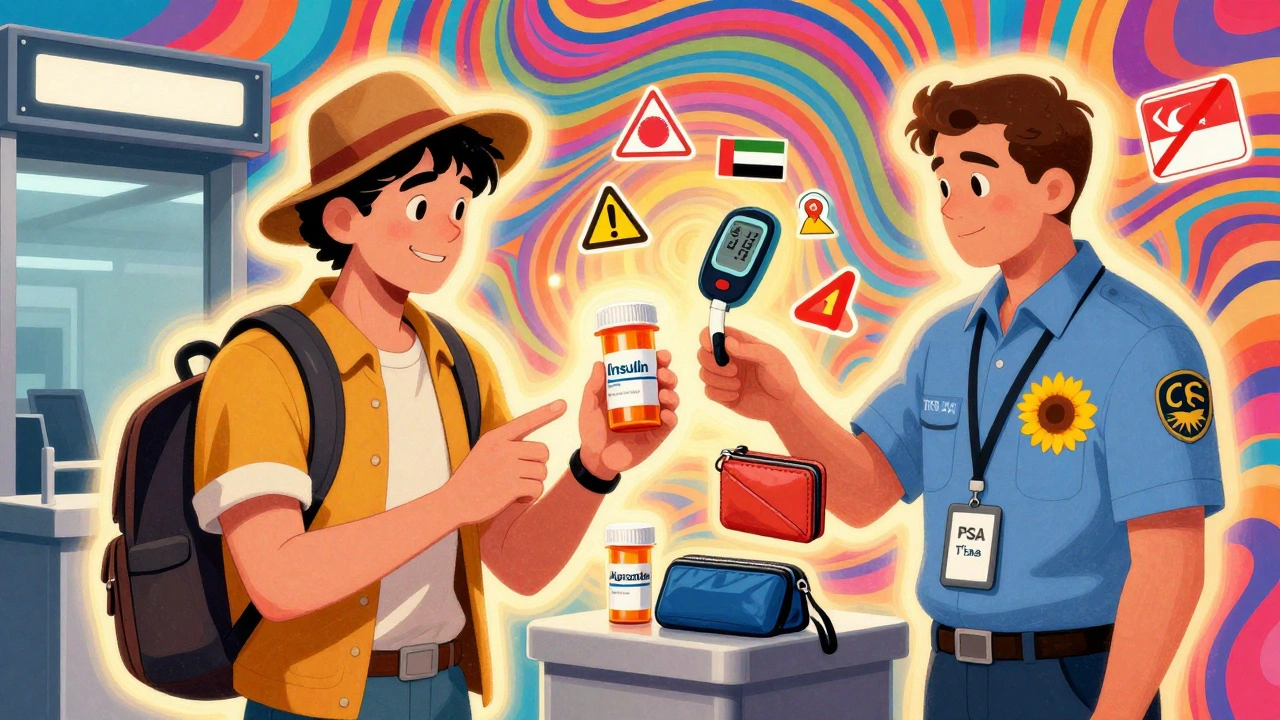
Every year, over 14 million air travelers carry prescription medications across borders. For many, it’s not a choice-it’s a lifeline. But what happens when your insulin, antidepressant, or painkiller gets flagged at security? Or worse, confiscated because you didn’t know your ADHD medication is illegal in Japan? Traveling with medications isn’t just about packing a pillbox. It’s about understanding security, mastering storage, and planning for refills before you even leave home.
Know What’s Allowed-Before You Fly
The biggest mistake travelers make? Assuming U.S. rules apply everywhere. They don’t. The U.S. may let you bring Adderall or Xanax in your carry-on, but France, Sweden, and Singapore ban them entirely. Thailand requires prior approval for benzodiazepines. The UAE doesn’t allow any opioids-not even oxycodone for chronic pain. Even common decongestants like pseudoephedrine are banned in 22 countries because they can be used to make methamphetamine. The CDC’s 2025 Yellow Book lists five high-risk medications that trigger international restrictions: hydrocodone, oxycodone, alprazolam, diazepam, and zolpidem. Nearly 3 out of 10 countries restrict at least one of these. If you’re taking any of them, check the International Narcotics Control Board (INCB) country database. Don’t rely on Google. Don’t ask your pharmacist. Contact the embassy of your destination country directly. They’re the only ones who can give you legally binding info.Security Screening: What TSA Actually Allows in 2025
TSA officers aren’t out to hassle you. They’re trained to spot threats-not treat you like a drug dealer. But they need clear information to do their job. Here’s how to make it easy:- Keep all medications in their original pharmacy containers with your name and prescription details clearly visible. This cuts inspection time by 63%.
- Liquid medications over 3.4 oz (100ml) are allowed if they’re medically necessary. You don’t need a doctor’s note, but having one helps. Declare them at the checkpoint.
- Solids-pills, capsules, patches-have no quantity limits. No need to declare them unless asked.
- Insulin pumps, glucose monitors, and other electronic medical devices must stay in your carry-on. Their lithium batteries can’t exceed 100 watt-hours without airline approval.
Storage That Keeps Your Meds Safe-Even in 100°F Heat
Medications aren’t like snacks. Heat, cold, and moisture can ruin them. Insulin? It degrades fast above 86°F (30°C). Biologics like rheumatoid arthritis drugs? They need steady 2°C-8°C (36°F-46°F). A hot car or checked luggage in the cargo hold can turn your treatment into useless sludge. Use a pharmaceutical-grade cooling wallet. These are designed to maintain safe temperatures for up to 72 hours-even in 40°C (104°F) ambient heat. Brands like Frio and MedAngel have been tested by diabetes travelers and approved by clinics. 73% of insulin users who used these during tropical trips reported zero spoilage. For short trips, a small insulated bag with a reusable ice pack works. Just make sure the pack doesn’t leak. Never put meds in checked baggage. Always carry them with you.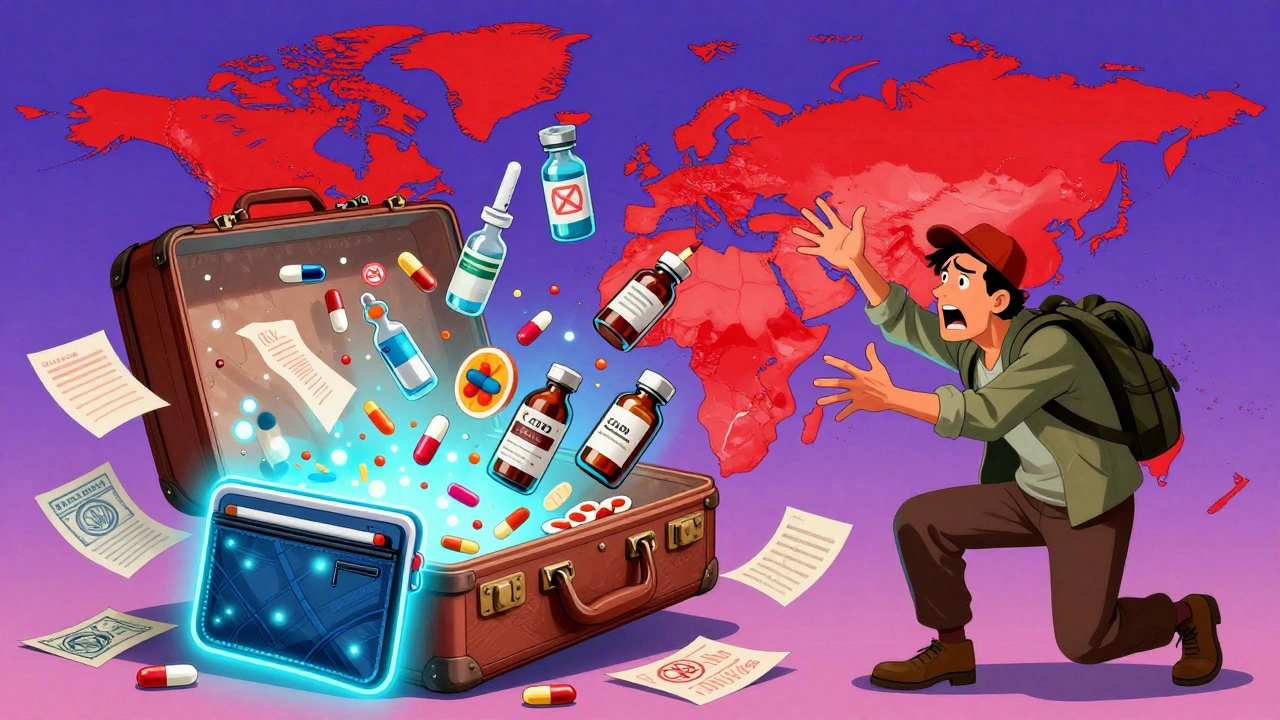
Refills Abroad: How to Avoid Running Out
If you’re staying longer than 90 days, you can’t just wing it. The FDA allows foreign nationals to bring in a 90-day supply for personal use. But after that? You need to arrange mail delivery. To send more medication abroad:- Get a signed letter from your doctor explaining your condition and medication needs.
- Include a copy of your prescription in English.
- Attach a copy of your passport and visa.
- Ship through a licensed international pharmacy or your U.S. pharmacy’s overseas service.
Special Cases: CBD, Cannabis, and Controlled Substances
CBD is a mess. TSA allows CBD products with less than 0.3% THC on domestic flights. But 29 countries-including Dubai, Singapore, and Japan-ban all CBD, no exceptions. Even if it’s legal in the U.S., it’s not legal everywhere. Medical marijuana? Only 12 countries allow it to be transported internationally, and only under strict conditions. Most require special permits, and even then, airlines can refuse to carry it. Don’t risk it. If you’re unsure, leave it at home. The consequences aren’t worth it: detention, fines, deportation, or worse.
Pro Tips That Save Lives
- Distribute your meds across two carry-ons. If one bag gets lost, you still have half your supply.
- Carry a printed copy of your prescription and a doctor’s letter-even if you don’t think you need it. Translation matters. If you’re going to a non-English-speaking country, get the letter translated.
- Use a pill organizer only for short-term use. Never rely on it for international travel. Customs agents need to see the original label.
- Take photos of your prescriptions and medication bottles. Save them on your phone and email them to a trusted contact. If something goes wrong, you’ll have proof.
- Know your medication’s generic name. Brand names vary by country. Your “Lipitor” might be called “Atorvastatin” overseas.
What Happens If You Get Caught With the Wrong Meds?
It’s rare-but it happens. In 2024, 12.7% of international travelers reported having medication confiscated. Most of those cases were avoidable. The average delay? 47 minutes. In 3.2% of cases, travelers were denied entry. In 0.8% of severe cases, people were arrested. The good news? Most TSA agents are reasonable. If you’re honest, calm, and prepared, they’ll help you. But if you hide pills in your shoe or lie about what you’re carrying, you’re playing with fire.What’s Changing in 2025?
More countries are moving toward digital systems. 31 now accept electronic prescriptions. 19 have online portals where you can apply for medication pre-approval before you fly. The World Health Organization is pushing for global standardization, aiming to cut medication-related travel incidents by 25% by 2027. Meanwhile, TSA has added “medication-friendly” screening lanes at 37 major U.S. airports. These lanes have staff trained specifically to handle medical items without delays. The message is clear: preparation pays off. The more you plan ahead, the smoother your trip.Can I bring my insulin on a plane?
Yes. Insulin is considered a medically necessary liquid and is exempt from the 3.4 oz (100ml) limit. Keep it in its original packaging and declare it at security. Always carry it in your carry-on. Never check it. Use a cooling wallet if traveling in hot climates.
Do I need a doctor’s note for my medications?
TSA doesn’t require one for domestic flights, but it’s strongly recommended for international travel. A letter from your doctor stating your condition, medication name, dosage, and necessity helps avoid delays and confiscation. For countries with strict drug laws, it’s often mandatory.
Can I refill my prescription overseas?
It’s risky. Many countries don’t recognize U.S. prescriptions, and counterfeit drugs are common. If you’re staying longer than 90 days, arrange for mail delivery from your U.S. pharmacy. You’ll need your doctor’s letter, English prescription, passport copy, and visa copy. Never buy meds from local pharmacies unless absolutely necessary.
Is CBD allowed on international flights?
TSA allows CBD with under 0.3% THC on U.S. flights. But 29 countries, including Singapore, Dubai, and Japan, ban all CBD products-no exceptions. Even if it’s legal in your destination, airlines may refuse to carry it. Leave it at home unless you have written permission from the country’s health authority.
What if my medication is banned in my destination country?
Don’t bring it. If you’re caught, you risk confiscation, fines, detention, or deportation. Talk to your doctor before you travel. They may be able to prescribe an alternative that’s legal in your destination. If not, consider rescheduling your trip or finding another treatment plan.
Grant Hurley
December 1, 2025 AT 07:02Just brought my insulin through LAX last week and used the sunflower lanyard-total game changer. Agent even gave me a high-five. TSA ain’t the enemy if you come prepared.
Matt Dean
December 1, 2025 AT 22:53Wow. So you’re telling me I can’t just throw my Xanax in my suitcase like I always have? Newsflash: not everyone’s a paranoid medical nerd. I’ve been flying for 20 years and never got flagged. Probably because I don’t make a big deal out of it.
Walker Alvey
December 2, 2025 AT 13:48Oh good. Another 12-page essay on how to not get arrested abroad. Next up: How to breathe without getting deported. Seriously, do people actually think the world cares about your Adderall? Maybe stop being a walking pharmacy and get a life.
Louise Girvan
December 3, 2025 AT 23:28Wait-so the government is tracking your meds? And now they’re pushing digital prescriptions? This is how they start controlling us. Next they’ll implant chips in your pills. I’ve seen the reports. They’re already linking pharmacy data to immigration databases. Don’t trust this. Don’t. Trust. This.
James Steele
December 5, 2025 AT 08:38Let’s deconstruct the epistemological framework of pharmaceutical sovereignty in transnational mobility. The pharmacopoeic hegemony of the FDA, coupled with the neocolonialist regulatory apparatus of the INCB, creates a bio-political asymmetry wherein the global south is pathologized for its pharmacological autonomy. Meanwhile, the TSA’s ‘sunflower lanyard’ is performative allyship-marketed as empowerment, but structurally reinforcing the medical-industrial complex’s gatekeeping. Also, Frio wallets are overpriced. I use a Yeti cup with wet paper towels. Works fine.
Dennis Jesuyon Balogun
December 6, 2025 AT 18:57Bro, I’m from Nigeria and I’ve had my antiretrovirals confiscated twice in Europe because they didn’t recognize the brand name. You think this is about rules? It’s about who gets to be seen as human. If your life depends on this pill and they treat you like a criminal-you’re not the problem. The system is. Always carry the doctor’s letter. Always. And if you’re lucky, find a local HIV org-they’ll help you navigate the mess.
Nnaemeka Kingsley
December 7, 2025 AT 14:59Man, this post is gold. I’m in India now and my blood pressure med is called something totally different here. Took me 3 weeks to find it. Learned the hard way-always get the generic name. Also, never trust a pharmacy that doesn’t have a real address. I saw one that looked like a grocery store but sold fake pills. Scary stuff.
Courtney Co
December 9, 2025 AT 06:16Wait, so if I’m on antidepressants and I get caught with them in Japan, do they just throw me in jail?? Like, for life?? I’m so scared now. I didn’t even know this was a thing. What if I forget my letter? What if my phone dies? What if I’m on a red-eye and I’m crying and they think I’m high?? I can’t even sleep now.
Jaswinder Singh
December 9, 2025 AT 17:59Bro, you think you’re safe because you’re American? I got pulled over in Dubai for having tramadol-legal in India, banned there. They held me for 3 days. No lawyer. No phone. No meds. You think this is about rules? It’s about power. Carry your papers. Don’t be dumb. And if you’re lucky, pray.