
Most Antibiotics Don’t Ruin Your Birth Control
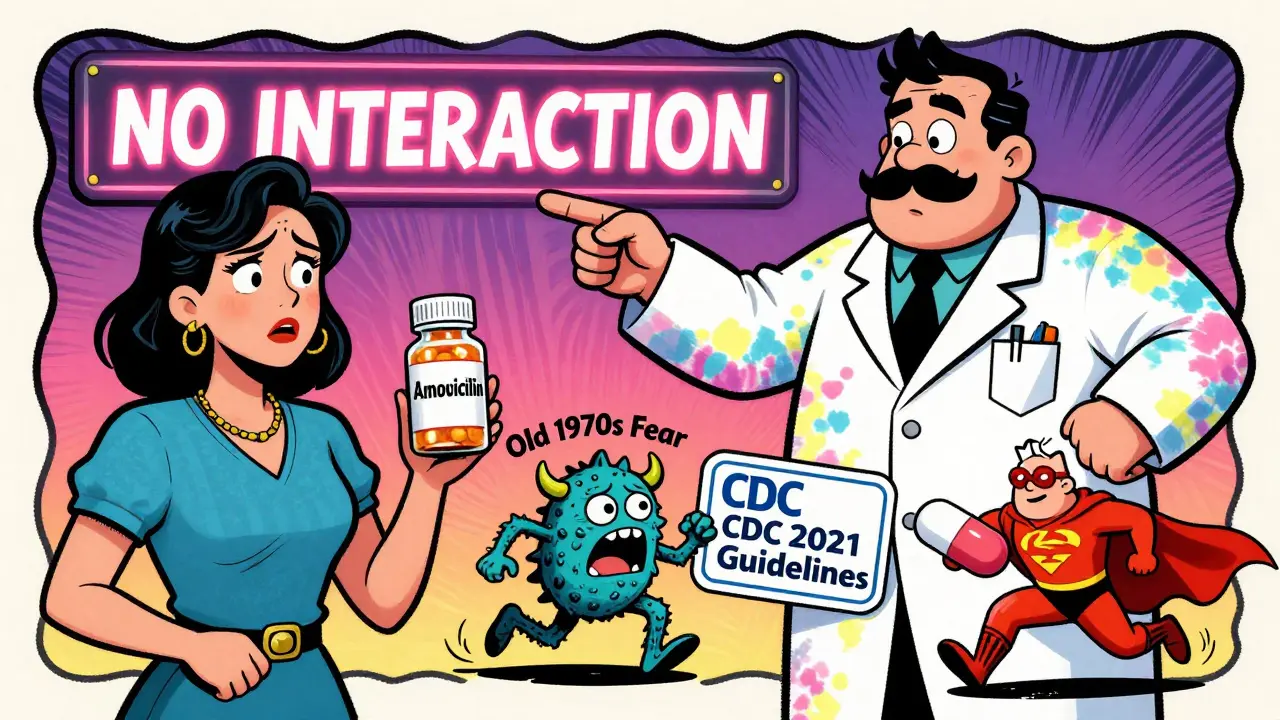
You’ve probably heard it a dozen times: antibiotics can make your birth control stop working. Your pharmacist says it. Your friend swears by it. Even your doctor might have mentioned it, just to be safe. But here’s the truth: for almost every antibiotic you’ll ever take, that’s not true.
The idea that common antibiotics like amoxicillin, azithromycin, or doxycycline interfere with hormonal birth control comes from old case reports in the 1970s. Back then, researchers didn’t have the tools to prove cause and effect. They saw a few pregnancies in women taking both antibiotics and the pill, and assumed the two were linked. Decades of rigorous studies since then have shown otherwise.
According to the CDC’s 2021 guidelines, and backed up by the American College of Obstetricians and Gynecologists (ACOG), there is no evidence that amoxicillin, ciprofloxacin, metronidazole, or any other common antibiotic reduces hormone levels enough to cause pregnancy. A 2011 review in the journal Contraception analyzed 14 studies and found zero clinically meaningful drop in estrogen or progestin levels when women took these antibiotics alongside their pill. Serum estradiol stayed between 200-400 pg/mL - the normal, effective range.
The One Antibiotic That Actually Does Interfere
There’s one big exception: rifampin (also called rifampicin). It’s not a common drug - you’ll only get it if you’re being treated for tuberculosis or certain rare infections. Rifampin is an enzyme inducer, meaning it cranks up the liver’s ability to break down hormones. Studies show it can slash ethinyl estradiol (the estrogen in most birth control pills) by 25-50%, and progestin by up to 37%. That’s not a small drop - it’s enough to leave you unprotected.
Rifabutin, a close cousin of rifampin, has the same effect. Both are classified as Category 3 interactions by the CDC - meaning the risks of using them with birth control outweigh the benefits. If you’re prescribed either of these, you need backup contraception for 28 days after your last dose. That means condoms, a diaphragm, or even a copper IUD. Don’t rely on timing or withdrawal. Those don’t cut it.
And yes - it’s confusing. You might hear about rifaximin, a drug used for traveler’s diarrhea. It sounds like rifampin, but it doesn’t get absorbed into your bloodstream the same way. The FDA confirmed in 2022 that rifaximin does not affect birth control. If your doctor prescribes something with “rif-” in the name, always double-check which one it is.
Griseofulvin Is Also a Problem - But It’s Not an Antibiotic
Griseofulvin is often grouped with antibiotics in patient conversations, but it’s actually an antifungal. You might get it for stubborn nail or scalp fungus. And yes - it also boosts liver enzymes that break down birth control hormones. The CDC and WebMD both recommend using backup contraception for a full month after finishing griseofulvin.
It’s rare. Most people will never take it. But if you’re on it, don’t assume your pill is still working. The same 28-day backup rule applies.
What About Other Medications?
Antibiotics aren’t the only drugs that can mess with birth control. Several others are known to interfere:
- Lamotrigine (used for epilepsy and bipolar disorder) - at doses above 300 mg/day, it lowers estrogen levels.
- Topiramate (for seizures and migraines) - doses over 200 mg/day can reduce contraceptive effectiveness.
- Efavirenz and nevirapine (HIV medications) - these are strong enzyme inducers, similar to rifampin.
- St. John’s wort - this herbal supplement, often taken for mild depression, can cut estrogen levels by up to 57%, according to a 2017 study in Clinical Pharmacology & Therapeutics.
If you’re taking any of these, talk to your provider. Don’t assume your pill is still safe. You might need to switch to a non-hormonal method like an IUD or implant, or add a backup.
Why Does the Myth Still Exist?
Even though science has cleared up this issue, the myth won’t die. Why?
First, it’s easy to remember. “Take antibiotics, don’t trust your pill” is a simple rule. The real answer - “only rifampin and griseofulvin” - is harder to explain. Second, some pharmacists still tell patients to use backup contraception out of caution. A 2022 study in the Journal of the American Pharmacists Association found 35% of pharmacists still advise it for all antibiotics, even though guidelines haven’t supported that since 2016.
Third, real-life stories stick. Someone gets pregnant while on amoxicillin and blames the antibiotic. But pregnancy can happen for lots of reasons: missed pills, vomiting, diarrhea, or even interactions with other meds. Blaming the antibiotic is simpler than untangling the real cause.
Dr. Jen Gunter, an OB/GYN and author of The Menopause Manifesto, puts it bluntly: “There is zero evidence that common antibiotics like amoxicillin affect birth control.” Yet she still gets messages every day from women terrified they’re pregnant because they took an antibiotic for a sinus infection.
What Should You Do?
Here’s your clear, simple action plan:
- If you’re prescribed rifampin or rifabutin - use backup contraception for 28 days after your last dose.
- If you’re prescribed griseofulvin - use backup contraception for 28 days after your last dose.
- If you’re prescribed any other antibiotic - your birth control is still working. No backup needed.
- If you’re on lamotrigine, topiramate, HIV meds, or St. John’s wort - talk to your doctor about your birth control options.
- If you’re unsure - ask for the generic name of the drug. Then look it up. Or ask your pharmacist: “Is this an enzyme inducer?” If they say no, you’re fine.
And if you’re worried about vomiting or diarrhea while on antibiotics? That’s a separate issue. If you throw up within two hours of taking your pill, or have severe diarrhea for more than 24 hours, treat it like a missed pill. Follow the instructions on your pill packet. That’s about absorption, not interaction.
What About the Pill, Patch, or Ring?
It doesn’t matter how you take your hormones. If you’re using the pill, the patch, or the vaginal ring - the same rules apply. Rifampin affects them all. So does griseofulvin. Other antibiotics? Still safe.
Even if you’re on a low-dose pill (like 20 mcg of estrogen), the data still holds. A 2020 CDC analysis of 35 clinical trials showed that even with low hormone levels, non-rifamycin antibiotics didn’t push concentrations below the 50 pg/mL threshold where effectiveness drops.
What’s Changing in 2026?
The FDA updated birth control labels in January 2023 to reflect the current science. Now, every package insert for hormonal contraceptives clearly lists: “Rifampin, rifabutin, and griseofulvin may reduce effectiveness.” And right after that, it says: “Other antibiotics do not affect effectiveness.” That’s a huge step. It means the message is now official, printed on the box.
But the real challenge isn’t the science - it’s the noise. Social media is full of fear. Reddit threads, Facebook groups, and Instagram posts still push the myth. A 2022 Planned Parenthood survey found 62% of patients still believe antibiotics reduce birth control effectiveness. That’s not just misinformation - it’s a public health issue. Women are using condoms unnecessarily, skipping doses out of fear, or even switching to less effective methods.
Healthcare providers need better training. Patients need clearer messages. And the truth? It’s simple: unless your antibiotic is rifampin, rifabutin, or griseofulvin - your birth control is still working just fine.
Bob Cohen
February 2, 2026 AT 10:18Nidhi Rajpara
February 3, 2026 AT 06:17Jamie Allan Brown
February 5, 2026 AT 04:25Lisa Rodriguez
February 5, 2026 AT 22:57Nicki Aries
February 6, 2026 AT 13:40Lilliana Lowe
February 7, 2026 AT 20:15vivian papadatu
February 9, 2026 AT 02:15Deep Rank
February 10, 2026 AT 05:28Chris & Kara Cutler
February 11, 2026 AT 06:57Rachel Liew
February 13, 2026 AT 04:49Naomi Walsh
February 15, 2026 AT 04:32