
Quick Summary
- Asthma is a chronic condition defined by inflamed airways that make breathing difficult.
- Major types include allergic, exercise-induced, and occupational asthma, each triggered differently.
- Inhalers deliver medication directly to lungs with fewer side effects than oral pills.
- Oral corticosteroids are effective but carry risks like weight gain and bone density loss.
- Modern biologic therapies offer targeted relief for severe asthma without heavy systemic side effects.
Imagine walking into a room and suddenly realizing you cannot pull enough air into your lungs. That panic describes an asthma attack perfectly. It feels like a vice tightening around your chest while wheezing fills the background noise of your breathing. You are not alone; roughly 300 million people globally deal with this condition. Many struggle not just with the breathlessness itself, but with understanding the maze of medications available to them. Should you reach for the inhaler? Is the doctor's prescription for daily pills necessary? Understanding the mechanics behind your diagnosis helps significantly when making these choices.
This guide breaks down exactly what asthma is, the different flavors it can take, and the crucial differences between puffing a mist into your mouth versus swallowing a tablet. By the time you finish reading, you will have a clear roadmap for managing your respiratory health.
What Exactly Is Asthma?
Asthma is a chronic inflammatory disorder of the airways characterized by recurrent episodes of wheezing, breathlessness, chest tightness, and coughing. The term comes from the Greek word "aazein," meaning "to pant." While the sensation has existed for millennia, modern science views it through an immunological lens.At its core, asthma is about inflammation. Your airways swell up and narrow. Muscles around these tubes tighten, restricting airflow. When you breathe normally, your air passages are open pipes. During an asthmatic reaction, those pipes crumble inward. This constriction blocks oxygen from entering efficiently. The swelling is caused by immune cells fighting perceived threats, leading to the production of mucus which further clogs the system.
Medical experts classify asthma using frameworks established by organizations like the Global Initiative for Asthma (GINA) and the National Institutes of Health. They look at severity-how bad symptoms are-and control-how often the patient can function normally. A major shift in recent years focuses less on just "severity" and more on maintaining strict "control." This means aiming for zero nighttime symptoms and no missed work or school days. When asthma is truly controlled, the body functions almost like someone without the condition.
Different Types of Asthma
Your specific experience depends heavily on your underlying type. Doctors don't just see one uniform disease; they see distinct subtypes. Recognizing your specific variety helps identify triggers and select the right therapy.
- 1. Allergic Asthma
- This is the most common form. It reacts to environmental allergens like pollen, dust mites, pet dander, or mold. It often begins in childhood and runs in families. If you sneeze at certain seasons and then wheeze, this is likely your culprit.
- 2. Exercise-Induced Asthma
- Physical activity cools and dries the airway lining, causing them to spasm temporarily. This isn't just about running marathons; even brisk walking in cold air can trigger it.
- 3. Occupational Asthma
- This develops after exposure to irritants at work. Chemists, farmers, and bakers face higher risks due to chemicals, grains, or flour dusts respectively.
- 4. Cough-Variant Asthma
- The hallmark here is a persistent dry cough rather than classic wheezing. It can linger for months, mimicking bronchitis or a never-ending cold.
- 5. Severe Asthma
- About 1 in 25 adults fall here. Standard high-dose inhalers don't fully stop the symptoms. These patients often need complex regimens involving biologics.
There are also biological pathways, known as endotypes. For example, Eosinophilic Asthma involves high counts of white blood cells called eosinophils driving the inflammation. Knowing this helps doctors pick specific advanced medicines later on.
Identifying Your Triggers
Understanding types is step one. Step two is spotting the enemy. Triggers vary wildly from person to person. Some react to cat hair; others explode with symptoms during a rainstorm.
- Household Allergens: Dust mites thrive in bedding. Pet dander sticks to clothes. Mold loves damp basements. Reducing these sources can lower medication needs.
- Weather Changes: Cold, dry air acts as an irritant. Sudden temperature drops can cause immediate tightening.
- Viral Infections: The common cold remains the number one trigger for flare-ups in both children and adults.
- Tobacco Smoke: Secondhand smoke is toxic to asthmatics. Firsthand smoking damages lung architecture permanently.
The American Lung Association notes that avoiding triggers is vital, yet impossible to achieve completely. Even with a pristine home, pollen will eventually blow in. That reliance on avoidance makes medication essential for safety.
Inhalers vs. Oral Medications: The Great Debate
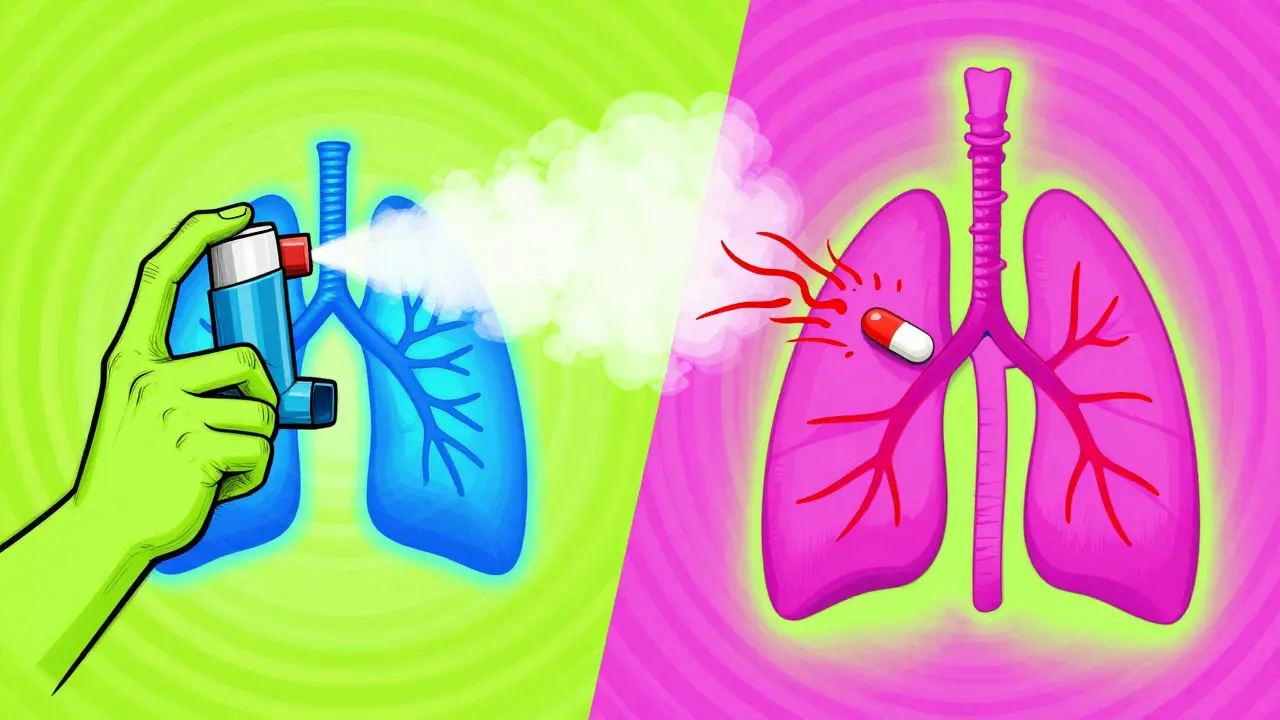
This is where most confusion lies. Patients often wonder if a pill works just as well as an inhaler. The truth is complicated, but the science leans heavily toward specific tools for specific jobs. Let's break down Inhaler vs oral meds.
| Feature | Inhalers (ICS/LABA) | Oral Medications (Prednisone/Pills) |
|---|---|---|
| Targeting | Delivers drug directly to airways | Enters bloodstream, circulates everywhere |
| Speed | Fast onset (minutes for rescue) | Slower absorption via stomach |
| Side Effects | Low risk (hoarseness, thrush) | High risk (weight gain, bone loss) |
| Best Used For | Daily maintenance and acute attacks | Severe flares or resistant cases |
The Case for Inhalers
Inhaled Corticosteroids (ICS) remain the gold standard. When you use an inhaler, about 70% of the steroid goes straight to the throat and lungs. Very little enters your blood system. This localization minimizes damage to other organs. Short-acting beta-agonists (SABAs), like albuterol, relax muscle spasms quickly. Long-acting versions (LABAs) keep the muscles relaxed for 12 hours. Studies published in journals like the Journal of Allergy and Clinical Immunology confirm that regular ICS use reduces exacerbations significantly compared to using rescue inhalers alone.
Technique matters immensely. Roughly 60-80% of users make critical errors, reducing drug delivery by half. Using a spacer-a plastic chamber connecting the canister to your mouth-fixes this issue and ensures the mist reaches deep into the lungs.
The Reality of Oral Medications
Oral steroids, such as Prednisone, are powerful but come with baggage. Because they travel through your whole body, they disrupt metabolism. Long-term use carries risks like osteoporosis (bone thinning), diabetes onset, and mood changes. About 68% of long-term users report weight gain. Doctors reserve these for severe crises where an inhaler isn't doing enough, typically for a short course of 3-7 days to kickstart healing.
Leukotriene modifiers (pills like montelukast) are another option. They block chemical messengers in the lungs. While convenient for people who hate inhalers, they are generally considered secondary to inhaled options for controlling inflammation.

New Frontiers: Biologics
For severe cases where standard inhalers fail, we now have biologic injections. These drugs target specific immune cells, like eosinophils, without poisoning the whole body. Drugs like Mepolizumab (Nucala) have shown to reduce severe attacks by over 50%. This represents a massive leap forward because it allows many patients to drop their oral steroid usage entirely, sparing them from the dangerous side effects.
Making the Right Choice
Your ideal plan usually starts with a daily maintenance inhaler. Adding a rescue inhaler covers acute moments. Oral steroids should rarely be the baseline. If you find yourself needing frequent bursts of oral pills, your doctor needs to reassess your maintenance plan or consider biologics.
Frequently Asked Questions
Can I switch from pills to an inhaler?
Yes, many patients transition successfully. Doctors typically taper off the oral steroid slowly while introducing high-dose inhaled steroids to prevent withdrawal spikes.
Are there side effects of rescue inhalers?
Using rescue inhalers too often (>2 times a week) indicates uncontrolled asthma. Mild side effects include shaky hands or a racing heart, but these are rare at normal doses.
Does cold weather trigger asthma?
Cold, dry air is a known physical trigger. Covering your nose and mouth with a scarf can warm the air before it hits your sensitive airways.
Why do doctors prefer inhalers over pills?
Inhalers minimize systemic toxicity. Oral steroids affect the entire body, whereas inhalers target the lung lining directly, offering a better safety profile for long-term use.
What is the cost difference between methods?
Brand name inhalers can be expensive ($300-$400/month), though generics help. Oral meds are cheaper ($10-$30) but the hidden costs of treating side effects can add up significantly over time.
Austin Oguche
March 29, 2026 AT 00:25Greetings to all who visit this page today. The differentiation between allergen induced and non allergic asthma pathways is fundamental for treatment efficacy. Patients require clarity on occupational exposures specifically. Many workplace environments contain particulate matter that compromises lung architecture permanently. It remains vital to document symptoms relative to specific locations. We must prioritize control metrics over subjective symptom reporting alone.
Eva Maes
March 29, 2026 AT 10:06The prevailing narrative regarding oral corticosteroids glosses over the subtle metabolic devastation that occurs beneath the surface. While inhalers offer targeted relief the industry pushes pills because systemic toxicity generates repeat billing cycles effortlessly. Asthma is weaponized as a chronic revenue stream by entities profiting from perpetual inflammation states. The distinction between maintenance and rescue agents is deliberately blurred to increase dependency. True liberation involves eliminating the trigger source not merely masking the wheeze.
Sophie Hallam
March 29, 2026 AT 21:31While strong opinions exist regarding pharmaceutical motives the clinical guidelines remain rooted in patient safety outcomes. Systemic steroids have undeniable utility during acute crises where airway obstruction threatens life. We must balance skepticism with respect for established medical protocols. Dismissing oral options entirely could endanger someone needing rapid systemic anti-inflammatory intervention.
Monique Ball
March 30, 2026 AT 22:26I am so glad that this information is finally shared with the community today!! It really helps people understand why the doctors push inhalers so much more than the pills!!!! You cannot ignore the side effects of prednisone anymore when there is a better way!!!! Many people do not realize how much their bone density decreases when taking steroids for too long!!!! The biologic therapies mentioned are truly revolutionary for those severe cases that struggle daily!!!!! We should all encourage our friends to stop smoking around anyone with respiratory issues!!!!! It is tragic that we wait until an attack happens before we seek better solutions!!!! Please try using the spacers correctly because technique really does change the outcome completely!!!!! If you feel anxious about the process remember that your body is designed to handle challenges!!!! The research cited in the article aligns perfectly with what my cousin experienced during her diagnosis!!!! Everyone deserves access to proper maintenance tools without feeling guilty about the medication choices!!!!! We must prioritize safety over convenience when managing chronic health conditions!!!!!
Devon Riley
April 1, 2026 AT 10:28It is wonderful to see such comprehensive support material being discussed openly😊. You are doing amazing work by educating others on these nuances🌟. Remember that consistency with your prescribed inhaler routine builds resilience over time💪. Your commitment to learning about your own health is truly inspiring👏. Never forget that progress often comes from small consistent actions rather than perfection⭐.
Tommy Nguyen
April 1, 2026 AT 21:45Great resource for understanding the mechanical differences between delivery systems.
Kameron Hacker
April 2, 2026 AT 20:23The economic implications of transitioning from oral steroids to biologics remain prohibitively expensive for the average insured citizen. Insurance formularies systematically gatekeep access to these advanced therapies due to rebate structures favoring older cheaper drugs. Patients are forced into suboptimal maintenance regimens that perpetuate hospital admissions unnecessarily. Healthcare systems benefit financially from failure rather than successful disease modification strategies.
Poppy Jackson
April 3, 2026 AT 16:55Absolutely devastating reality check indeed. It leaves us trembling in the face of corporate greed quite frankly. The sheer cost of living with a chronic condition is simply overwhelming sometimes. We stand together in defiance of this unfair system.
Jeannette Kwiatkowski Kwiatkowski
April 4, 2026 AT 13:51Most people posting here clearly haven't navigated the insurance labyrinth themselves. You act like education solves coverage denial when prior authorization is the real bottleneck. Stop talking about science and acknowledge the administrative nightmare patients actually face daily.
Monique Louise Hill
April 6, 2026 AT 05:02It's honestly frustrating to see people ignoring lifestyle factors while chasing magic bullets 🙄. Cleaning your home reduces allergen load significantly 💅. Why spend thousands on shots when you won't remove the carpet 🤷♀️. Discipline matters more than pharmaceuticals sometimes 💯.
Sarah Klingenberg
April 6, 2026 AT 06:31Everyone brings up valid points about environment versus medication balance :) . We all want better outcomes for ourselves and loved ones 👋. Let's keep supporting each other through these tricky medical decisions 🙂.
Shawn Sauve
April 8, 2026 AT 02:09Your inclusive approach fosters a supportive atmosphere for difficult discussions :-). Environmental mitigation does not replace pharmacotherapy in severe phenotypes though :-).
walker texaxsranger
April 8, 2026 AT 09:13Big pharma controls airflow mechanics through patent law extensions preventing generic alternatives effectively. They maintain dependency on proprietary devices requiring subscription refills constantly. Real cure involves detoxification not symptom suppression forever.
Debra Brigman
April 9, 2026 AT 20:56Perhaps the truest medicine lies in acknowledging the fragility inherent in human physiology itself. Breathing is a profound gift often taken until it is suddenly threatened. We navigate these storms seeking stability amidst the chaotic winds of biology.