
When you buy a generic version of a pill like ibuprofen, you know exactly what you’re getting - the same active ingredient, same effect, same price drop. But what if the drug isn’t a pill at all? What if it’s an injection for rheumatoid arthritis, cancer, or Crohn’s disease? That’s where biosimilars come in. They’re the closest thing to generics for complex biologic drugs - and they work in ways most people don’t understand.
What Exactly Are Biosimilars?
Biosimilars aren’t exact copies like traditional generics. You can’t just recreate a biologic drug the same way you copy a chemical compound. Biologics are made from living cells - yeast, bacteria, or animal cells - and even tiny changes in how they’re grown can affect how they work. That’s why the FDA doesn’t call them "generics." They call them highly similar. The FDA requires biosimilars to prove they match the original biologic - called the reference product - in structure, how they behave in the body, and how safe and effective they are. No clinically meaningful differences. That means if you’re getting a biosimilar for psoriasis or diabetes, you’re getting the same outcome as the brand-name drug. The science behind it isn’t guesswork. It’s hundreds of lab tests, clinical trials, and real-world data reviewed over years.How Are Biosimilars Different From Authorized Generics?
Authorized generics are simple: same active ingredient, same manufacturer, same pill. A company that makes brand-name Lipitor might also sell a generic version under a different label - identical in every way. That’s possible because small molecule drugs have a fixed chemical structure. Biologics? Not so simple. A biologic like Humira (adalimumab) is made of proteins with complex 3D shapes. Two batches from the same company can vary slightly. That’s normal. So when a biosimilar maker tries to copy it, they’re not aiming for perfect chemical identity - they’re aiming for functional identity. Does it bind to the same target? Does it trigger the same immune response? Does it last the same amount of time in your bloodstream? If yes, it passes. The result? Biosimilars cost less, but not as much as traditional generics. While generics can cut prices by 80-85%, biosimilars typically save 10-50%. That’s still huge when you’re talking about drugs that cost $20,000 a year.Interchangeable Biosimilars: The Real Game-Changer
Not all biosimilars are created equal. There’s a special subset called interchangeable biosimilars. These are the ones that can be swapped at the pharmacy without asking your doctor. That’s the same rule that applies to generic pills. To get this status, manufacturers must prove you can switch back and forth between the biosimilar and the original without any increase in risk or loss of effectiveness. It’s not just one switch - it’s multiple switches. The FDA requires data showing no difference in safety or immune response after repeated substitutions. In 2023, the FDA approved the first interchangeable biosimilar for Humira - Amjevita. That was a turning point. Before that, pharmacists couldn’t substitute without a doctor’s OK, even if the biosimilar was approved. Now, in states with substitution laws, you might walk in for your Humira refill and walk out with Amjevita - no new prescription needed.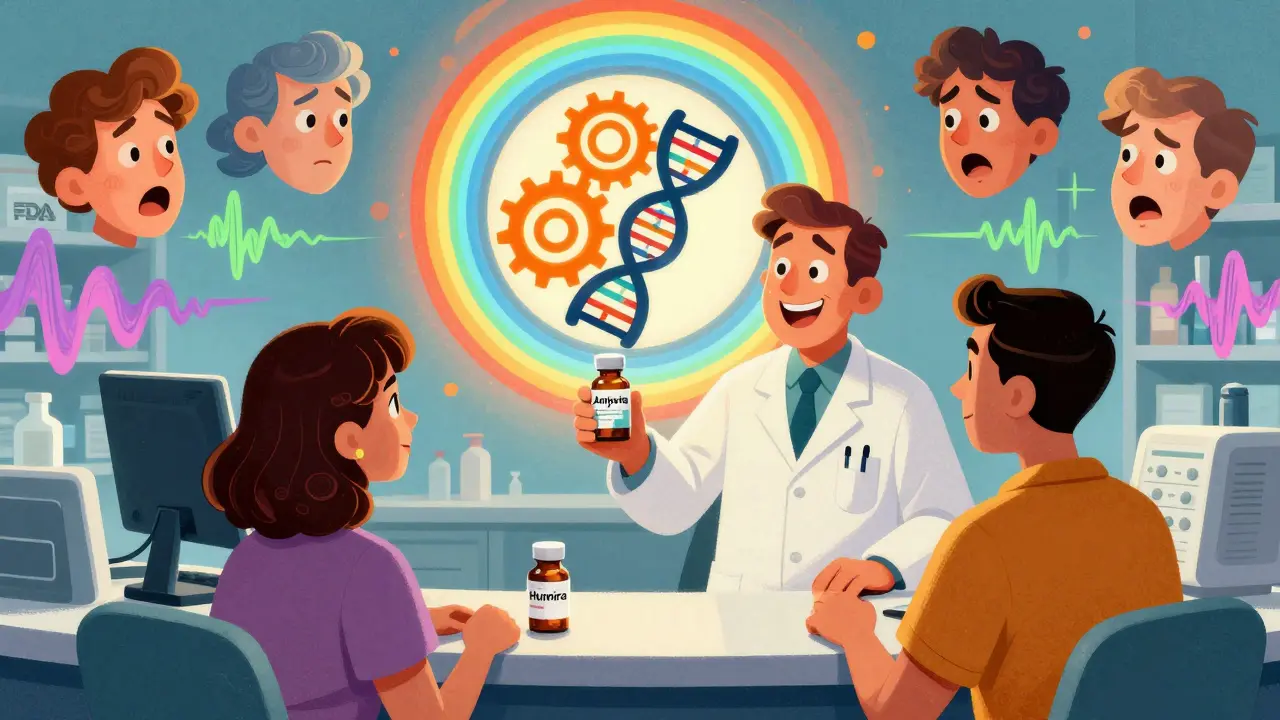
Why Aren’t More People Using Them?
Despite 76 biosimilars approved by the FDA as of late 2023, they make up less than 20% of biologic prescriptions in the U.S. Why? Three big reasons:- Doctors are cautious. Many haven’t been trained on biosimilars. A 2022 survey found it takes 6-8 hours of continuing education for rheumatologists to feel confident prescribing them.
- Patient fear is real. One patient on a cancer forum said her out-of-pocket cost dropped from $1,200 to $450 after switching to a biosimilar - and she had zero side effects. But another Reddit user reported new injection reactions after being switched three times between different biosimilars. Even if the science says it’s safe, stories like that stick.
- Insurance plays hardball. Some plans force patients to switch to biosimilars to save money. A 2022 Arthritis Foundation survey found 37% of patients had their treatment disrupted by an insurance-mandated switch. Only 12% reported worse symptoms - but the disruption itself caused stress, missed doses, and confusion.
Who’s Making Them, and Where Are They Available?
Big pharma companies are investing heavily. Amgen has 12 approved biosimilars. Sandoz and Pfizer each have 8. Most are for autoimmune diseases - rheumatoid arthritis, psoriasis, inflammatory bowel disease - and cancer drugs like Herceptin and Avastin. The market is growing fast. The global biosimilar market was worth $10.1 billion in 2022 and is projected to hit $58.6 billion by 2030. In the U.S., usage jumped from 5% of biologic prescriptions in 2019 to 18% in 2022. But availability varies by state. Forty-nine states have laws about biosimilar substitution, but only 32 let pharmacists substitute interchangeable biosimilars without telling the doctor. California, New York, and Texas are among them. In other states, you might need a new prescription even if the drug is interchangeable.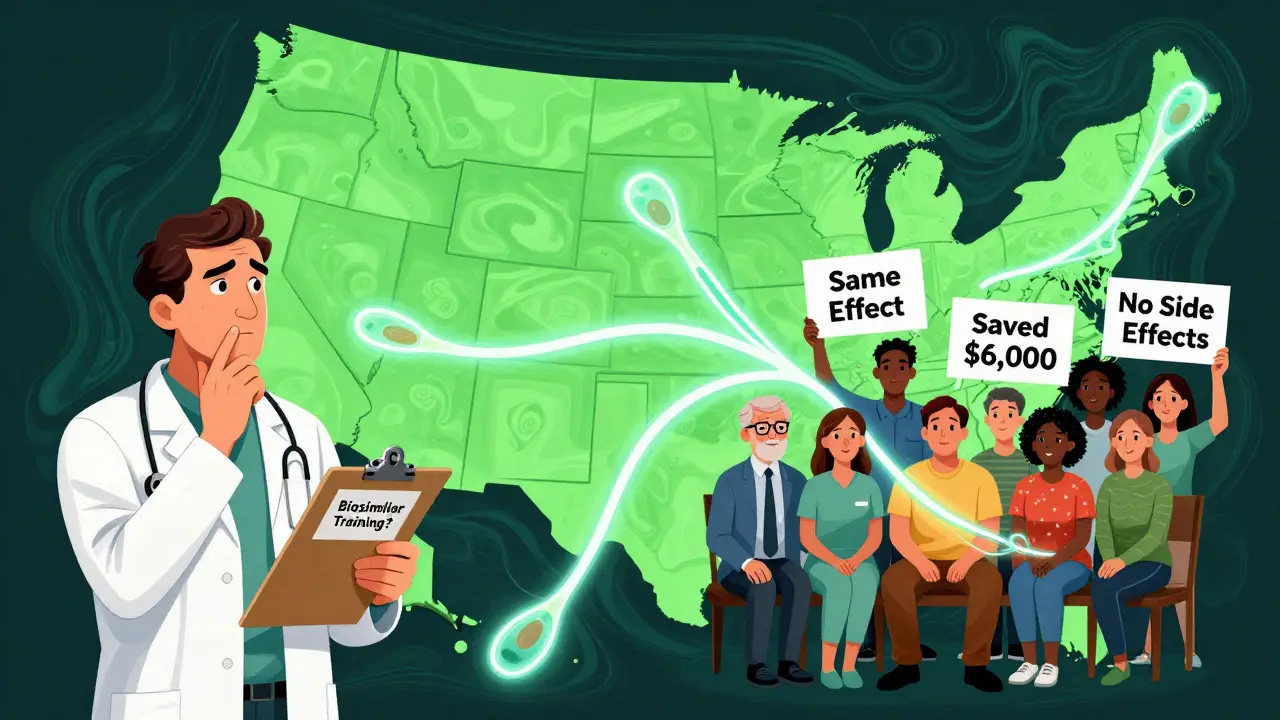
What’s Changing in 2025?
The FDA is pushing harder. In May 2023, they released new guidance to make it easier for companies to prove interchangeability. They’re aiming to approve 15-20 new biosimilars every year by 2025. Why? Because the clock is ticking on patents. Over $115 billion in biologic sales will face biosimilar competition by 2028. The Congressional Budget Office estimates biosimilars could save Medicare $53 billion between 2024 and 2033. Hospitals are already ahead of the curve - 87% have formal biosimilar adoption policies. The real question isn’t whether biosimilars work - it’s whether the system will let them be used the way they’re meant to.What This Means for You
If you’re on a biologic drug and paying high out-of-pocket costs, ask your doctor: Is there a biosimilar option? Is it approved as interchangeable? Does my insurance cover it at the same tier? Don’t assume your doctor knows all the options. Many don’t. Bring up the topic. Ask for data. Check if your drug has a biosimilar on the FDA’s list. And if you’re switched to a biosimilar? Keep track. Note any new side effects. Tell your doctor. But don’t assume it’s the biosimilar’s fault - most changes are coincidental. The science is solid. The savings are real. The barriers are mostly cultural, not clinical.What’s Next for Biosimilars?
The next wave will hit in oncology, diabetes, and rare diseases. Drugs like insulin, rituximab, and infliximab are next in line for biosimilar competition. As more become interchangeable, pharmacy substitution will become routine - just like with aspirin or metformin. The goal isn’t to replace the original. It’s to give patients more choices, lower costs, and better access. And that’s exactly what happened with generics. The difference now? We’re doing it for the most complex drugs in medicine.Are biosimilars safe?
Yes. The FDA requires biosimilars to show no clinically meaningful differences in safety, purity, or effectiveness compared to the original biologic. They undergo the same rigorous testing as new drugs, including clinical trials and real-world monitoring. Over 10 years of global use - especially in Europe - show biosimilars are as safe as the originals.
Can I be switched to a biosimilar without my doctor’s permission?
Only if the biosimilar is designated as "interchangeable" and your state allows pharmacist substitution. As of 2025, 32 U.S. states permit this, including California, New York, and Texas. In other states, your doctor must approve the switch. Always check your state’s laws and ask your pharmacist if substitution is allowed.
Do biosimilars cost less than the original biologic?
Yes, but not always by a lot. Biosimilars typically cost 10% to 50% less than the brand-name drug. That’s far less than traditional generics, which can cut prices by 80-85%. The higher cost is due to the complexity of manufacturing biologics. Still, even a 30% savings on a $20,000 drug means $6,000 saved per year.
Why aren’t more biosimilars on the market?
Patent litigation is the biggest barrier. Brand-name manufacturers file an average of 14.7 patent challenges per biosimilar to delay competition. Regulatory hurdles, provider hesitation, and insurance restrictions also slow adoption. But with major biologics losing patent protection through 2028, the number of biosimilars is expected to grow rapidly.
Can I switch back to the original biologic if I don’t like the biosimilar?
Yes. If you experience side effects or feel the biosimilar isn’t working as well, talk to your doctor. You can switch back. The FDA doesn’t require you to stay on a biosimilar. However, insurance may require you to try the biosimilar first before covering the brand-name drug again. Always document any changes in symptoms when switching.
matthew martin
January 29, 2026 AT 10:27Man, I remember when I first heard about biosimilars - thought they were just cheap knockoffs. Turned out my rheumatoid arthritis doc slipped me one as a test run. Cost me $80 instead of $900. No side effects, no drama. Now I’m basically a biosimilar evangelist. If your insurance tries to force you into one, don’t freak out - ask for data, not fear.
These aren’t aspirin, sure. But they’re not magic either. The science’s been rock solid overseas for over a decade. We’re just late to the party.
Also, props to the FDA for not letting Big Pharma bury this with 147 patents. That’s the real win here.
Jeffrey Carroll
January 30, 2026 AT 01:59The regulatory rigor applied to biosimilars is, in many respects, more stringent than that applied to traditional generics. The analytical characterization, pharmacokinetic profiling, and immunogenicity assessments required represent a significant scientific and logistical undertaking. It is therefore misleading to equate biosimilars with generic small-molecule drugs, as their development pathway is fundamentally distinct in complexity and scope.
That said, the clinical outcomes data, when aggregated across multiple jurisdictions, consistently demonstrate non-inferiority. The economic implications are profound, particularly for chronic autoimmune conditions requiring lifelong therapy.
doug b
January 30, 2026 AT 17:52Look - if your drug costs $20K a year and there’s a version that works just as well for $10K, why wouldn’t you take it? Doctors get nervous because they didn’t learn this in med school. Patients freak out because they saw a scary Reddit post. But the data doesn’t lie.
I switched my mom to a biosimilar for her Crohn’s. She’s been fine for two years. No rashes, no flares. Just cheaper. That’s all you need to know.
Rose Palmer
January 31, 2026 AT 08:52It is imperative to recognize that the designation of interchangeability is not merely a regulatory formality, but a clinical safeguard requiring extensive evidence of multiple switches without immunogenic consequences. The FDA’s guidance issued in May 2023 represents a critical step toward streamlining this process, yet implementation remains fragmented across state lines.
Pharmacists must be empowered, but only when the biosimilar’s data package meets the highest evidentiary standard. Patient safety must remain paramount, even as cost containment becomes urgent.
Timothy Davis
January 31, 2026 AT 10:30Let’s be real - most of these biosimilars are just rebranded versions of the same manufacturing process with minor tweaks. The FDA’s definition of ‘no clinically meaningful difference’ is laughably loose. I’ve seen patients develop antibodies after switching, then get blamed for ‘non-compliance.’
And don’t get me started on the ‘interchangeable’ label. It’s a marketing ploy dressed up as science. The real savings? Mostly going to insurers, not patients. Big Pharma’s just playing 4D chess with patents and state laws.
Also, if you think 10-50% savings is good, you’ve never seen what happens when a drug loses exclusivity in Europe. Prices drop 80%. Here? We’re stuck in a lobbying swamp.
John Rose
January 31, 2026 AT 12:20One thing people don’t talk about enough: the quiet revolution happening in oncology. Biosimilars for Herceptin and Avastin are changing how cancer care is delivered - especially in community clinics that can’t afford the brand-name drugs.
I work in a rural hospital. We switched three patients to a biosimilar last year. One had a minor infusion reaction, but it was manageable. The other two? Same results, half the bill.
It’s not perfect, but it’s progress. And honestly? If we can make cancer treatment less financially toxic, we’re doing something right.
Amber Daugs
February 2, 2026 AT 04:35People who switch to biosimilars are basically gambling with their health. You think your insurance cares about you? They care about their quarterly profits. And you just hand over your life to a company that can’t even replicate a protein perfectly?
My cousin got switched to a biosimilar for psoriasis. Now she has rashes everywhere. The doctor said it was ‘stress.’ Bullshit. It’s the drug.
Don’t be a lab rat. If it ain’t broke, don’t fix it. And if your doctor pushes it? Find a new one.
Ambrose Curtis
February 2, 2026 AT 18:32yo so i got switched to a biosimilar for my infliximab last year and honestly? no big deal. my doc was like ‘it’s the same thing but cheaper’ and i was like ‘but what if it doesn’t work?’
turns out it did. saved me like 6k a year. no new side effects. no weird reactions.
but then my buddy got switched three times in a row - different biosimilars each time - and he started having chills. turns out he’s just super sensitive to the fillers, not the actual drug. so it’s not always the biosimilar’s fault.
point is: talk to your doc. track your symptoms. don’t panic. this shit’s legit. we’re just scared of new stuff.
also, why do we still need a doctor’s note to swap a drug? that’s 2005 logic. we’re in 2025. let pharmacists do their job.
Robert Cardoso
February 3, 2026 AT 20:17The entire biosimilar paradigm is a systemic failure of regulatory capture. The FDA’s ‘no clinically meaningful difference’ standard is a semantic loophole designed to appease pharmaceutical conglomerates while maintaining the illusion of competition.
Biologics are inherently variable - even within the same manufacturer’s batches. To claim that a third-party product can match this variability without measurable immunogenic risk is not science - it’s statistical theater.
And let’s not forget: the real cost savings are never passed to the patient. They’re absorbed by PBMs and insurers, while the brand-name manufacturer simply restructures its pricing tiers to maintain revenue.
This isn’t innovation. It’s financial engineering dressed in lab coats.
jonathan soba
February 4, 2026 AT 14:43Interesting how the U.S. lags behind Europe by over a decade in biosimilar adoption. The EMA approved its first biosimilar in 2006. The FDA didn’t approve one until 2015. Why? Because American healthcare is less about science and more about litigation.
Patent thickets, pay-for-delay agreements, and state-level substitution laws are not regulatory barriers - they’re profit shields.
And yet, the public still believes the FDA is protecting them. The truth? They’re just trying to keep up.
Katie Mccreary
February 5, 2026 AT 20:17You’re all so naive. My sister got switched to a biosimilar and now she’s in the hospital with a weird rash and fever. The doctor said it was ‘probably’ the drug. Probably? That’s not good enough.
And now my insurance won’t cover the original anymore. So I’m stuck paying $1,200 out of pocket to get the real one.
This isn’t saving money. It’s trapping people. And you guys are just happy because you got a discount. You’re the problem.