Every year, 60,000 children end up in emergency rooms because they got into medicine they weren’t supposed to. Most of these accidents happen in the home-when a grandparent leaves a pill bottle on the counter, or a babysitter forgets to lock the cabinet. It’s not about being careless. It’s about not having a system. A safe medication routine isn’t just for seniors or people with chronic conditions. It’s for every family, no matter the age of the kids or the number of prescriptions. The goal is simple: keep the right medicine in the right place, at the right time, and out of the hands of curious little ones.
Stop Guessing. Start Tracking.
Before you can manage medication safely, you need to know what’s in your house. That means writing it all down. Not just prescriptions. Include vitamins, herbal supplements, over-the-counter pain relievers, cough syrups, and even topical creams. A 2023 study from the American Pharmacists Association found that 78% of households with multiple medications had at least one duplicate or interaction that wasn’t caught because no one had a complete list.
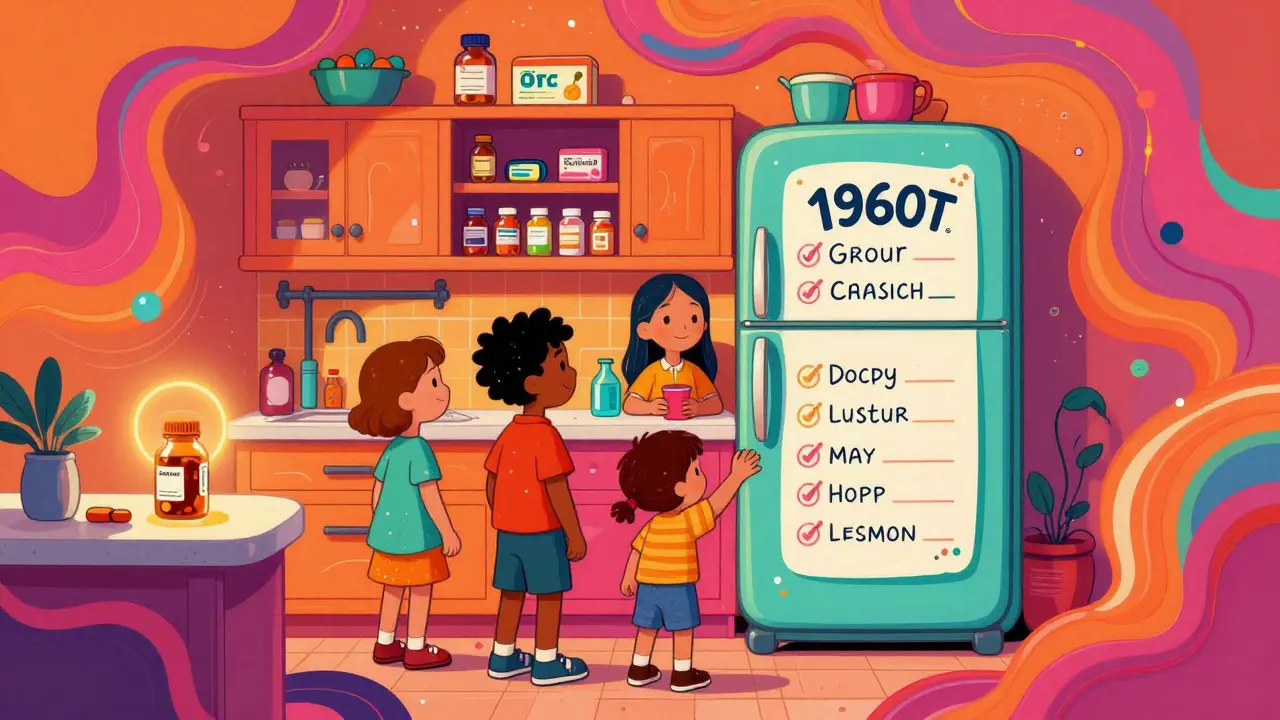
Start with a master list. Use a notebook or a simple digital doc. For each medication, write:
- Full name (brand and generic, like "ibuprofen" and "Advil")
- Dosage (e.g., 200 mg)
- How often it’s taken (e.g., "twice daily after meals")
- Purpose (e.g., "for high blood pressure" or "for occasional headaches")
- Start date
- Any side effects noted
Keep this list in a spot everyone can see-like taped to the fridge or stuck inside the medicine cabinet door. Update it every time you fill a new prescription or stop one. A 2022 CDC survey showed that households with a visible, updated list had 41% fewer medication errors.
Storage Isn’t Just About Height-It’s About Locks
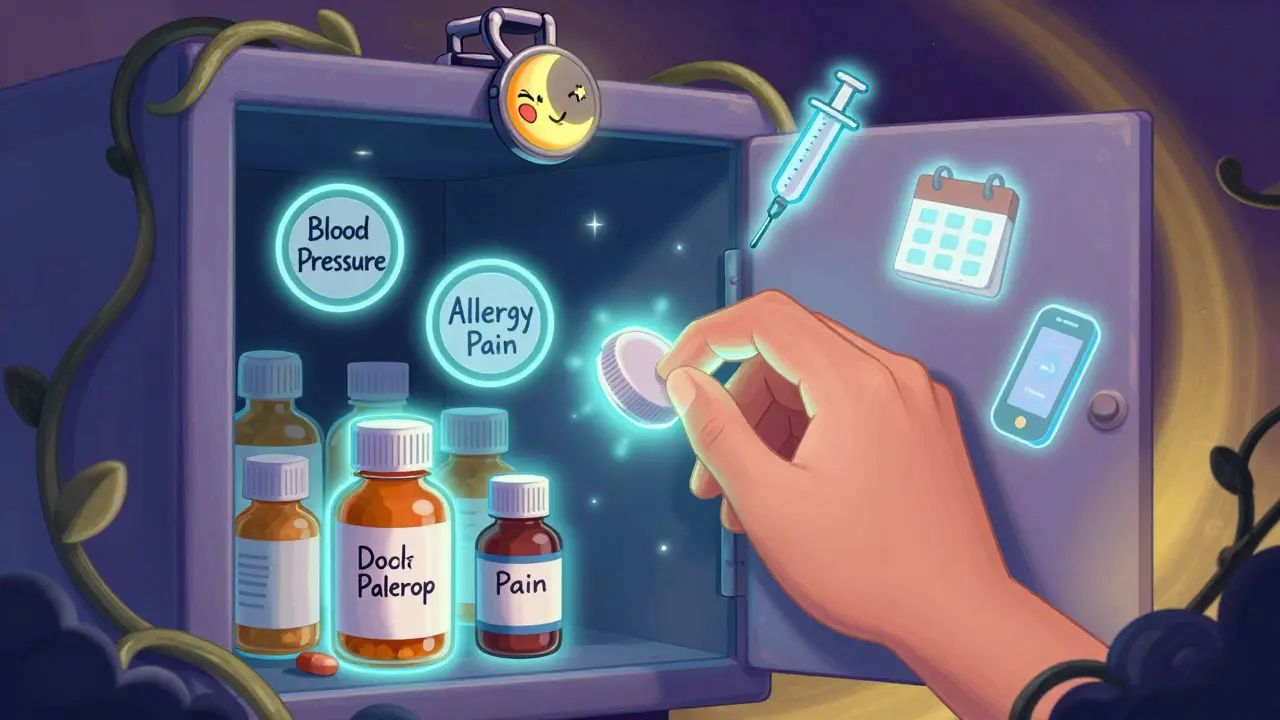
You’ve heard "keep it up and away." But that’s not enough. Kids climb. They pull open drawers. They find purses on chairs. A 2023 report from Children’s Hospital Los Angeles found that 25% of accidental ingestions happened because medicine was left in a bag or on a nightstand. The solution? Locked storage.
Install a lock on your medicine cabinet. Use a small combination lock or a childproof latch. Store all medications-even ones you take once a week-in the same locked space. Don’t put them in the bathroom. Humidity from showers can make pills lose potency. Don’t leave them in the kitchen near the sink. Moisture and heat ruin many medications.
Keep medicines in their original containers. Those child-resistant caps? They work-but only if you actually snap them shut. The CDC found only 55% of parents consistently reseal child-resistant packaging. Make it a habit: after every use, twist the cap until it clicks. If you’re using a pill organizer, keep the original bottles locked away. Never transfer pills to unlabeled containers.
And if someone in your home takes opioids-like oxycodone or hydrocodone-keep naloxone (Narcan) on hand. It’s not just for addicts. It’s for families. Opioid overdoses in children under 5 spiked by 37% between 2020 and 2023, mostly from accidental ingestion. Naloxone can reverse an overdose in minutes. Ask your pharmacist for a prescription. It’s free in many places under public health programs.
The Five Rights: Never Skip Them
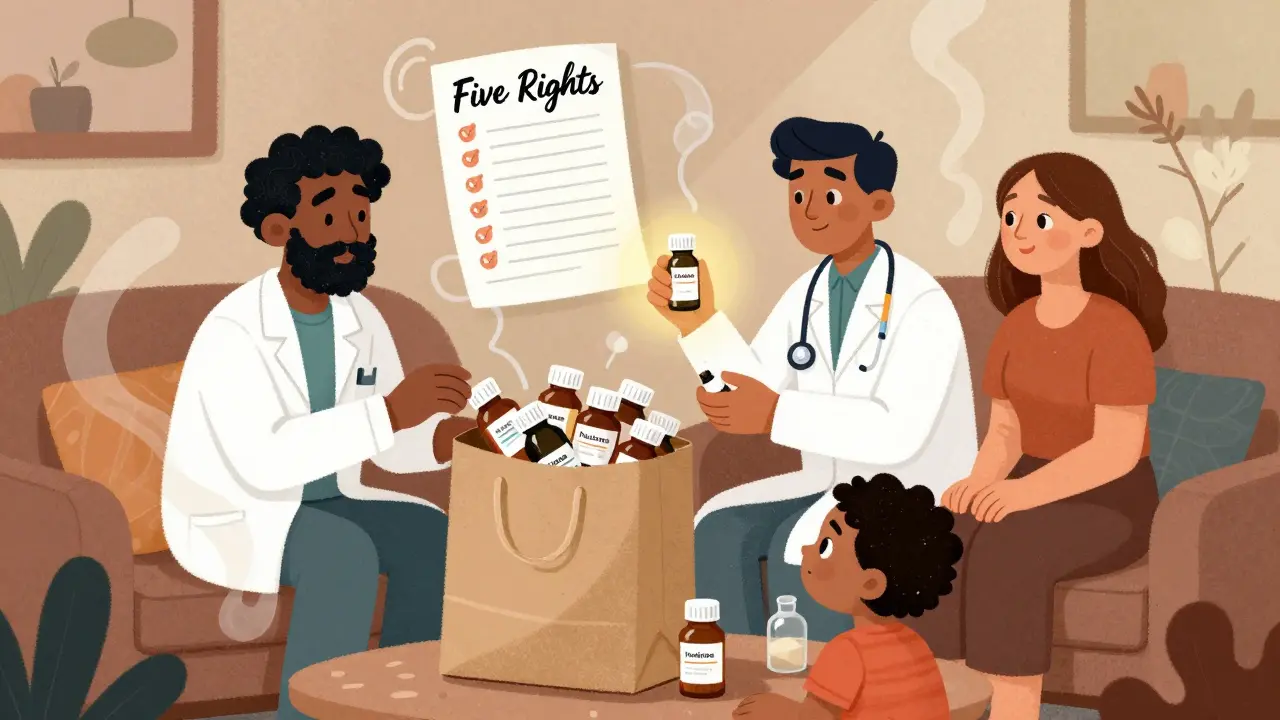
When giving medicine to a child-or an older adult-ask yourself five questions. This is called the "Five Rights," and it’s used in hospitals for a reason:
- Right child - Is this medicine for the person you’re giving it to? Don’t assume. Double-check the name on the bottle.
- Right medication - Is this the one you meant to give? Many pills look alike. Use a flashlight to read tiny print.
- Right dose - Are you using the right tool? A kitchen spoon? That’s risky. Use the syringe or measuring cup that came with the bottle. Liquid medicines should never be given with a regular spoon. Studies show syringes reduce dosing errors by 47%.
- Right route - Is it meant to be swallowed, applied to skin, or sprayed in the nose? Don’t guess.
- Right time - Is it time for this dose? A missed dose can be dangerous. A double dose can be deadly.
Make this a ritual. Say the five rights out loud every time you give medicine. It takes 10 seconds. But it stops mistakes before they happen.
Pill Organizers and Digital Help
If your family takes more than two daily medications, a 7-day pill organizer is a game-changer. Choose one with compartments for morning, afternoon, evening, and night. Fill it once a week. Do it on Sunday after your pharmacy visit. Label each section with tape or a marker if the organizer doesn’t have clear labels.
Some families color-code with painter’s tape: red for blood pressure, blue for asthma, green for pain. A Reddit user in Ohio shared that after color-coding, their household went from 3 errors a month to zero. It’s cheap, simple, and works.
For tech-savvy families, apps like Medisafe or MyTherapy send phone alerts. But don’t rely on them alone. A 2023 AARP survey found that 27% of older adults gave up on digital reminders within three months. They didn’t understand the app, or the phone was too loud, or they forgot to charge it. Use tech as a backup, not the main system.
Regular Reviews Save Lives
Medications change. New ones are added. Old ones are stopped. But no one tells the whole family. That’s why every six months, do a "brown bag" review. Empty every pill bottle, supplement jar, and OTC box into a brown paper bag. Bring it to your pharmacist or doctor. They’ll check for duplicates, interactions, and drugs that are no longer needed.
For seniors, this is critical. The American Geriatrics Society found that 1 in 3 older adults take at least one medication that increases fall risk. Many of those are anticholinergics-drugs for allergies, bladder issues, or sleep-that are outdated and dangerous for people over 65. A 2023 study showed that regular reviews cut hospital admissions from medication problems by 31%.
Don’t wait for a crisis. Schedule a 15-minute appointment just to talk about meds. Pharmacists are trained for this. And they’re free under Medicare’s new 2024 telehealth program.
What to Do When You Miss a Dose
Everyone forgets sometimes. The key is knowing what to do next. Never double up. That’s how overdoses happen.
Here’s the rule: If you realize you missed a dose, give it as soon as you remember. Then wait until the next scheduled time to give the next one. For example, if you usually give a pill at 8 a.m. and 8 p.m., and you forget the morning dose but remember at 11 a.m., give it then. Don’t give the next one until 8 p.m.
Some meds have special rules. Antibiotics? You need to keep the full course. Blood pressure pills? Missing one can cause spikes. Always check the label or call your pharmacist if you’re unsure. Don’t guess.
Dispose of Unused Meds the Right Way
Don’t flush pills down the toilet. Don’t throw them in the trash where a kid or pet can find them. The CDC says over 50% of unused medications sit in home cabinets for years. That’s a ticking time bomb.
Use a drug take-back program. Most pharmacies, police stations, and hospitals have drop boxes. In New Zealand, pharmacies like Countdown and Pharmacy2U offer free disposal. If you can’t get there, mix pills with coffee grounds or cat litter in a sealed container before tossing. It makes them unappealing and unrecognizable.
Get rid of old meds every time you do your six-month review. Empty bottles? Remove labels and recycle.
Emergency Plan: Know the Number
One in three households doesn’t know the Poison Control number. That’s 1-800-222-1222 in the U.S. In New Zealand, it’s 0800 764 766 (Poison Centre). Save it in your phone. Write it on the fridge. Tell your kids where it is.
Have a small emergency kit ready: the master medication list, a list of allergies, your pharmacy’s phone number, and the Poison Control number. Keep it in your wallet or near the phone. If something happens, you won’t have to scramble.
And if you suspect an overdose-slowed breathing, drowsiness, unresponsiveness-call emergency services immediately. Don’t wait. Don’t try to make them vomit. Just call.
It Takes Time. But It’s Worth It
Setting up a safe medication routine isn’t a one-day task. It takes 2 to 3 weeks to build the habits. Spend one weekend gathering all meds. Write the list. Lock the cabinet. Fill the organizer. Teach the family the five rights. Schedule your first review.
After that, it becomes second nature. You won’t panic when a grandchild finds a pill. You’ll know exactly where it should be. You won’t worry about mixing up your husband’s blood pressure pill with your daughter’s allergy medicine. You’ll have a system.
Medication safety isn’t about perfection. It’s about reducing risk. Every locked cabinet, every updated list, every clear label cuts the chance of disaster. And in a home, that’s not just smart-it’s essential.
What’s the most common mistake families make with medications?
The most common mistake is storing medications in easy-to-reach places like bathroom cabinets, kitchen counters, or purses. Even if you think your child is too young to climb or open bottles, most accidental ingestions happen with kids under 2 who pull things down or crawl into bags. The CDC reports 80% of these incidents occur when a caregiver-like a grandparent or babysitter-is watching the child. The fix? Locked storage, out of sight and reach.
Can I use a pill organizer for all my family’s meds?
Yes-but only if the pills are stable and don’t need special storage. Some meds, like insulin or eye drops, must stay in their original bottles and refrigerated. Pill organizers work best for stable, room-temperature pills taken daily. Always check with your pharmacist first. Never transfer controlled substances like opioids into organizers. Keep those locked in their original containers.
How do I know if a medication is expired?
Check the expiration date on the bottle or box. For most pills, they’re safe to use for 1-2 years past that date, but potency drops. Liquids, eye drops, and insulin should be thrown out on the expiration date. If a pill is cracked, discolored, or smells strange, toss it. Don’t risk it. The American Pharmacists Association says expired meds can lose up to 50% of their strength, which means they won’t work-and could cause harm if you think they’re doing their job.
Is it safe to give my child adult medicine if I cut the dose?
No. Never. Children’s bodies process medicine differently. A pill cut in half isn’t the same as a child’s dose. The concentration, fillers, and release mechanisms aren’t designed for kids. Even small amounts of adult ibuprofen or acetaminophen can cause liver damage or seizures in children. Always use medicine labeled for children. If you’re out of it, call your pharmacist or doctor. Don’t improvise.
What should I do if my child swallows medicine by accident?
Call Poison Control immediately: 1-800-222-1222 in the U.S., or 0800 764 766 in New Zealand. Don’t wait for symptoms. Don’t try to make them vomit. Have the medicine container ready-tell them what it is, how much was taken, and when. Keep the child calm. If they’re unconscious, having trouble breathing, or having seizures, call emergency services right away. Every second counts.
Sanjana Rajan
March 17, 2026 AT 22:02Ugh, I hate how people act like this is some revolutionary idea. My grandma’s had her meds locked in a cabinet since the 90s. Meanwhile, my neighbor leaves her oxycodone on the coffee table like it’s a bag of chips. It’s not rocket science. Just lock it. Stop being lazy. And no, ‘I’m just keeping it handy’ isn’t an excuse. You’re not a pharmacist, you’re a potential liability.
Kyle Young
March 18, 2026 AT 11:58It’s fascinating how we’ve outsourced personal responsibility to systems and labels. The Five Rights are essentially a formalized version of mindfulness-something we’ve lost touch with in the age of automation. We rely on apps, organizers, and locks because we’ve stopped internalizing the gravity of what we’re handling. A pill isn’t candy. It’s a bioactive compound with consequences. The real question isn’t ‘how do we store it?’ but ‘how do we re-educate ourselves to treat it with reverence?’
Aileen Nasywa Shabira
March 19, 2026 AT 20:00Oh wow, a 78% statistic about duplicate meds? Shocking. Next you’ll tell me water is wet and gravity exists. And let me guess-the solution is ‘lock it’ and ‘write it down.’ Genius. Why didn’t we think of that before the CDC published a 41% reduction stat? I’m sure the 22% of households that still mess up are just too busy scrolling TikTok to read a sticky note. Also, Naloxone? Sure, let’s arm every household with a drug reversal kit like we’re in a post-apocalyptic zombie movie. Next up: mandatory CPR certification just to open a medicine cabinet.
Kendrick Heyward
March 21, 2026 AT 15:37My mom forgot to lock the cabinet and my little cousin got into my dad’s blood pressure pills. He’s fine now, but I still have nightmares. 😔 This post? 10/10. Lock it. List it. Review it. Don’t wait until it’s too late. My family didn’t. We fixed it. And now? No more panic. Just peace. 💙
Lauren Volpi
March 21, 2026 AT 16:58Let’s be real-this is just another American overreaction. We’re so scared of liability we turn every household into a pharmaceutical bunker. In India, my cousins just keep meds in the kitchen cabinet. No locks, no lists. Kids grow up knowing not to touch ‘papa’s pills.’ Maybe instead of building a whole system, we should just teach kids respect? Also, why is everyone so obsessed with ‘child-resistant caps’? My 3-year-old nephew opened one like it was a Ziploc. Those things are a joke.
Michelle Jackson
March 21, 2026 AT 20:01soooooo many people just leave their meds out and then act shocked when their kid finds them? like. wow. you didn’t think this might happen? i mean, we all know kids are little explorers. if you’re gonna keep pills in the house, treat them like grenades. not snacks. also, color-coding? that’s cute. but if you’re using a pill organizer for anything other than daily meds, you’re playing russian roulette. and yes, i’ve seen it go wrong. trust me. don’t be that person.
Suchi G.
March 23, 2026 AT 05:11When I was growing up in Mumbai, my grandmother would keep all her medicines in a small wooden box on the windowsill. No locks, no apps, no lists. She’d say, ‘If you don’t know what it is, don’t touch.’ And we didn’t. We learned early. But now? Everyone’s so anxious they turn their homes into pharmacies with alarms and digital trackers. It’s not safer-it’s more stressful. The real issue isn’t storage. It’s education. Teach kids what medicine is. Not as a mystery, not as a toy, but as something powerful. That’s what really protects them. Not a combination lock. A conversation. And maybe, just maybe, less fear, more trust.
becca roberts
March 24, 2026 AT 03:25Oh honey, you think you’re the first person to write this? This is basically the ‘don’t leave your keys in the car’ of parenting. But hey, at least you included the part about naloxone-that’s actually genius. I’ve been carrying Narcan in my purse since my neighbor’s grandkid overdosed on his grandpa’s fentanyl patch. So… yeah. Lock it. List it. But also? Don’t be a hero. If you’re scared, just call Poison Control. They’re literally free, trained, and ready. I wish I’d known that 10 years ago. 🙏
Paul Ratliff
March 24, 2026 AT 19:54lock it. list it. review it. that’s it. no app needed. no color code. just do it. my sister’s kid got into a bottle last year. she didn’t even know she had two kinds of ibuprofen. now? locked cabinet. fridge list. every 6 months. simple. works. no drama. no stress. just smart.
SNEHA GUPTA
March 24, 2026 AT 20:16There’s a quiet dignity in the ritual of medication management-not just for safety, but for dignity. When we take the time to write down what we’re taking, when we pause before handing a pill to someone we love, we’re not just preventing errors. We’re honoring the humanity of care. In a world that rushes us through every interaction, this slow, deliberate act becomes an act of resistance. It says: I see you. I know you. I won’t let you be forgotten. And maybe that’s the most powerful medicine of all.