
Ezetimibe GI Symptom Checker
Symptom Assessment
Enter your current gastrointestinal symptoms and when they started to determine if they're likely related to ezetimibe.
When you're managing high cholesterol, every pill matters - especially if you've had bad reactions to statins. That's where ezetimibe is a cholesterol-lowering medication that blocks absorption of dietary cholesterol in the small intestine. Also known by its brand name Zetia, it's been used since 2002 and is often prescribed when statins cause muscle pain or when LDL levels still won't budge.
Many people worry about side effects, especially stomach issues. The truth? Ezetimibe doesn’t hit your muscles like statins do. But it can stir up your gut. Not everyone. Not always. But enough that you should know what to expect.
What GI Symptoms Are Most Common?
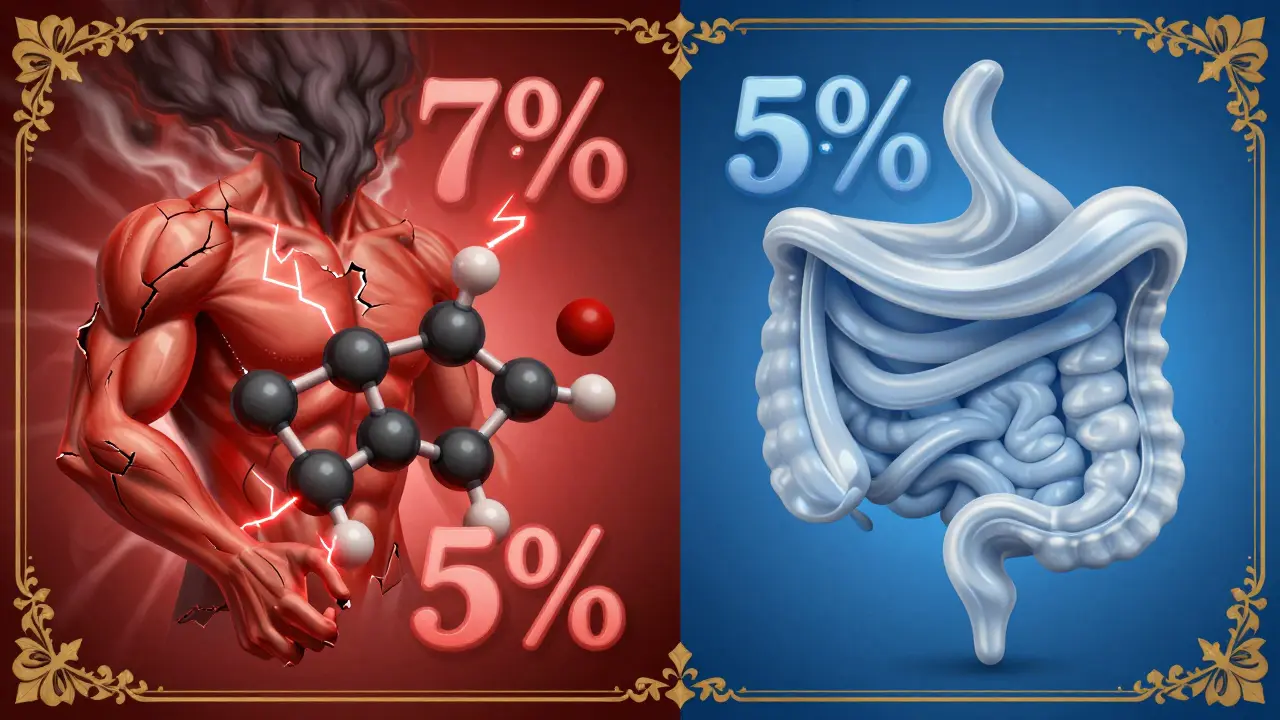
Diarrhea is the big one. Around 7 out of 100 people taking ezetimibe will notice looser stools. That’s only slightly higher than the placebo group - about 6.8%. So, it’s not dramatic. But if you’re already prone to digestive sensitivity, it can be noticeable.
Abdominal pain shows up in about 5% of users. Not the sharp, emergency-room kind. More like a dull ache or cramp that comes and goes. Flatulence - gas - affects roughly 4% of people. Nausea? About 3%. Vomiting? Less than 2%. These numbers come from pooled data across seven major clinical trials and post-marketing reports from the FDA and EMA.
Compare that to statins. Muscle pain? Up to 10% of users. Liver enzyme spikes? More common than you think. Ezetimibe doesn’t touch your muscles or liver much at all. Its job is simple: stop cholesterol from being absorbed in your gut. That’s why its side effect profile is so different.
When Do Symptoms Start - and Do They Last?
If you’re going to have GI trouble, it usually starts within the first 2 to 4 weeks. Most people don’t get worse after that. In fact, 78% of those who experience diarrhea or stomach upset find it fades completely within 2 to 4 weeks. No dose change. No switch. Just time.
A 2022 study tracked 1,247 patients on ezetimibe. Of those who had GI symptoms, 83% didn’t need to stop the drug. That’s huge. It means your body adapts. Your gut adjusts to the change in cholesterol flow.
One patient on Reddit said: "Zetia caused mild diarrhea for about 10 days when I started, but it completely resolved without changing anything - my doctor said it was my gut adjusting to lower cholesterol absorption." That’s the norm, not the exception.
How Does Ezetimibe Compare to Other Cholesterol Drugs?
Let’s put this in perspective. If you tried cholestyramine (a bile acid sequestrant), you’d likely deal with constipation, nausea, and bloating. Up to half of users quit because of it. Fenofibrate? Around 14% get stomach pain. Atorvastatin? Muscle pain, liver issues, and yes - GI symptoms too.
But ezetimibe? It’s quieter. A 2023 study compared ezetimibe monotherapy to moderate-dose atorvastatin (20 mg). Results: ezetimibe had 17.4% total side effects versus 26.8% for atorvastatin. GI-related dropouts? Just 0.8% for ezetimibe. For atorvastatin? 2.1%. That’s more than double.
Even when combined with simvastatin (as Vytorin), diarrhea rises to 8.3% - still lower than many statin side effect rates. And unlike statins, ezetimibe doesn’t mess with your gut microbiome. A 2021 study in Gut Microbes found statins shift bacterial ratios by 15-20%. Ezetimibe? No change. That’s likely why it’s gentler on digestion.
PCSK9 inhibitors like evolocumab? They’re even better tolerated - only 1.2-2.5% report GI issues. But they cost over $5,800 a year. Ezetimibe? Less than $40 a year as a generic. You get a lot of bang for your buck.

Real Patient Experiences
Drugs.com has over 1,200 reviews. 78% say they had no significant side effects. 14% mentioned mild diarrhea that went away in weeks. Only 4% reported ongoing problems.
One 68-year-old woman on WebMD said she had diarrhea for three months straight and had to switch. That’s rare. Most people don’t end up there.
On average, ezetimibe scores 4.2 out of 5 for GI tolerability. Atorvastatin? 3.1. That gap isn’t small. It’s meaningful.
How to Manage GI Side Effects
You don’t have to suffer. There are simple, proven ways to reduce discomfort.
- Take it with food. This cuts GI upset by 35%, according to Mayo Clinic data from 2,145 patients. Eat a light meal - not greasy, not huge. Just something.
- Avoid gas-producing foods. Beans, lentils, onions, broccoli, carbonated drinks. They’ll make gas worse if you’re already sensitive.
- Drink plenty of water. At least 2 liters daily if you’re having diarrhea. Dehydration makes everything worse.
- Try probiotics. A 2024 study in the Journal of Clinical Gastroenterology found Lactobacillus rhamnosus GG (10 billion CFU daily) helped 62% of patients with ezetimibe-related diarrhea. Look for refrigerated brands like Culturelle or VSL#3.
- Don’t panic if it’s mild. The American College of Gastroenterology says only 0.7% of cases ever require stopping the drug. Your gut is probably just adjusting.
NHS England and the American Heart Association both recommend eating smaller, more frequent meals. Heat packs on your abdomen can also help with cramping. No magic bullet - just smart habits.
Who Should Avoid Ezetimibe?
Most people can take it safely. But there are exceptions.
- If you’ve had a severe allergic reaction to ezetimibe before - don’t restart.
- If you have severe liver disease, talk to your doctor. While ezetimibe doesn’t cause liver damage, your body may process it differently.
- If you’re pregnant or breastfeeding, it’s not recommended. Not because it’s dangerous - but because there isn’t enough data.
It’s not a drug for everyone. But for those who can’t take statins - or need extra help lowering LDL - it’s one of the best options out there.
The Bigger Picture: Why Tolerability Matters
Cholesterol meds only work if you take them. Every year, 7.4% of statin users quit because of side effects. That’s hundreds of thousands of people. And many of them end up with higher heart attack risk.
Ezetimibe changes that. It’s the go-to for patients who can’t tolerate statins. In fact, 63% of those who stop statins due to side effects are successfully switched to ezetimibe. And only 8.2% of them report serious GI issues.
For people with diabetes? Even better. The Endocrine Society found ezetimibe caused 40% fewer GI side effects than statins in that group. That’s huge. Diabetics often have slower digestion and are more sensitive to gut changes.
And here’s the kicker: ezetimibe has been on the market for over 20 years. The FDA’s 2024 safety update said: "No new gastrointestinal safety concerns have been identified." The data is solid. The track record is long. The side effects are mild. The benefits? Proven.
The IMPROVE-IT trial - which followed 18,144 people for 6 years - showed adding ezetimibe to simvastatin cut heart attacks and strokes by 6.4%. That’s not a small win. And it happened without the muscle pain, liver flags, or high cost of newer drugs.
What’s Next?
The ENHANCE-2 trial is now complete. It compared ezetimibe to bempedoic acid (Nexletol) in 3,500 statin-intolerant patients. Results are due in mid-2026. We’ll see if the new kid on the block can beat ezetimibe’s tolerability.
For now? Ezetimibe remains the quiet workhorse. It doesn’t scream for attention. But it gets the job done - with fewer complaints than almost anything else.
Does ezetimibe cause weight gain?
No, ezetimibe is not linked to weight gain. Clinical trials and long-term observational studies show no significant change in body weight among users. Unlike some diabetes or blood pressure medications, it doesn’t affect appetite, metabolism, or fluid retention. Any weight changes while on ezetimibe are likely due to diet, activity, or other medications.
Can I take ezetimibe with statins?
Yes, and it’s very common. In fact, the combination of ezetimibe and simvastatin (sold as Vytorin) is FDA-approved and widely used. It lowers LDL more than either drug alone. While diarrhea rates go up slightly (to 8.3% vs 6.1% for ezetimibe alone), most patients tolerate it well. The added benefit in reducing heart risk often outweighs the mild GI side effects.
How long does it take for ezetimibe to work?
You’ll start seeing LDL reductions within 1 to 2 weeks. Maximum effect usually happens around 2 weeks after starting. Unlike statins, which need several weeks to build up in the liver, ezetimibe works directly in the gut - so it kicks in faster. Your doctor will typically check your cholesterol levels after 4 to 6 weeks to see how well it’s working.
Is ezetimibe safe for long-term use?
Yes. The IMPROVE-IT trial followed patients for a median of 6 years, and the Z-TOOL study extended monitoring to 5 years. No new safety signals emerged. Long-term use is associated with stable liver enzymes, no increase in muscle damage, and no rise in cancer risk. The FDA and EMA both confirm its safety profile remains unchanged after 20+ years on the market.
What should I do if I have diarrhea for more than a month?
If diarrhea lasts longer than 4-6 weeks, talk to your doctor. It could be ezetimibe, but it might also be another cause - like a food intolerance, infection, or irritable bowel syndrome. Your doctor may suggest a stool test, dietary review, or trial of probiotics. Permanent discontinuation is rare (under 1%), but if symptoms are severe or persistent, switching to another non-statin option like bempedoic acid or a PCSK9 inhibitor may be considered.
Ian Kiplagat
March 8, 2026 AT 06:01Probiotics helped. Culturelle was my savior. No regrets.
Tim Hnatko
March 10, 2026 AT 00:10Also, no weight gain. Surprised me.
Aaron Pace
March 10, 2026 AT 02:30It’s just a cholesterol sponge. Your gut’s gonna notice. Stop acting shocked.
And yeah, probiotics help. Duh.
Joey Pearson
March 11, 2026 AT 15:04Diarrhea for a couple weeks? Totally normal. Your body’s recalibrating.
Drink water. Eat bananas. You’re not broken. You’re adapting.
Roland Silber
March 13, 2026 AT 06:35Also, the fact that ezetimibe doesn’t alter the microbiome like statins do? Huge. That’s why tolerability is better. It’s not just luck - it’s mechanism.
Patrick Jackson
March 15, 2026 AT 04:11What if the real problem isn’t the drug… but our expectation that our bodies should handle synthetic molecules without complaint? 🤔
Ezetimibe doesn’t force change - it gently redirects. Maybe that’s why it’s so well-tolerated. We’re not fighting our biology. We’re whispering to it.
And yet… we still panic at a loose stool. We’ve forgotten how to trust our own systems.
Maybe the real side effect is fear.
Pranay Roy
March 16, 2026 AT 10:07Meanwhile, the real LDL killer? Diet. Exercise. Fasting. But you can’t patent kale. 😏
Joe Prism
March 17, 2026 AT 10:19Diarrhea = drug working. Not broken. Just… redirecting.
Also, the fact that it doesn’t touch the microbiome? That’s the quiet revolution. We’re finally seeing drugs that don’t nuke our innards.
Bridget Verwey
March 17, 2026 AT 17:15It’s like asking if coffee gives you the runs. Yes. So what? You don’t quit coffee. You don’t quit Zetia. You take it with food. You drink water. You live.
And if you’re still whining after 4 weeks? Maybe try not being a drama queen.