Ever feel like the paperwork that comes with your prescription is written for a rocket scientist instead of a patient? While most of us just toss the leaflets into a drawer, there is one specific document you absolutely cannot ignore: the Medication Guide is an FDA-mandated patient information document designed to communicate critical risk information and monitoring requirements for medications with serious safety concerns . These aren't just generic brochures; they are legal requirements for drugs where a patient's understanding can literally prevent a severe adverse reaction.
The reality is that reading these guides can feel like a chore, but the payoff is huge. Data from an FDA effectiveness study shows that patients who actually follow the monitoring instructions in these guides saw 32% fewer adverse events. Whether you're starting a new blood thinner or a mood stabilizer, knowing how to spot the "red flags" in these documents is a vital part of your healthcare.
Quick Guide to Medication Risk Monitoring
If you're short on time, here is the fastest way to get the most value out of your guide:
- Start at the top: Look for the "Most Important Information" section first.
- Scan for action words: Look for "blood test," "monitor," or "call your doctor immediately."
- Map your timeline: Note if risks are higher in the first few weeks of treatment.
- Create a schedule: Put monitoring dates (like monthly blood work) directly into your calendar.
Decoding the Seven-Section Structure
The FDA requires these guides to be written at a 6th to 8th-grade reading level so they're accessible. They almost always follow a standard layout. To master your medication risk monitoring, you need to know exactly where the high-value data is hidden.
The most critical section is "What is the most important information I should know?" This is where you'll find the plain-language version of "black box" warnings. Instead of medical jargon, you'll see direct warnings like "can cause serious liver damage." If you see this, it's your signal to pay extra attention to the rest of the document.
Next, look at "What should I tell my healthcare provider before taking this drug?" This section lists contraindications-essentially the "do not take if" list. It's where you'll find risk factors that might make the drug dangerous for your specific health history. Finally, the "Possible serious side effects" section isn't just a list of symptoms; it's your manual for monitoring. For example, if you're taking a JAK inhibitor like Tofacitinib, the guide will tell you specifically to get regular blood tests to check your cell counts.
Spotting Monitoring Red Flags
Not every sentence in a medication guide is equally important. To avoid the "wall of text" feeling, look for specific "red flag" phrases that signal a required action. The Agency for Healthcare Research and Quality (AHRQ) identifies several key triggers that mean you need to be proactive.
| Phrase Found in Guide | What it Actually Means for You | Action Required |
|---|---|---|
| "Get blood tests regularly" | The drug affects internal organ function or blood chemistry. | Schedule lab appointments before starting. |
| "Call your doctor immediately if..." | This is a sign of a potentially life-threatening reaction. | Memorize the symptom; have a doctor's number ready. |
| "Do not stop taking without talking to your doctor" | Stopping abruptly could cause withdrawal or a rebound effect. | Never skip doses or quit "cold turkey." |
| "Avoid sunlight exposure" | The medication makes your skin hypersensitive (photosensitivity). | Use SPF and wear protective clothing. |
Be especially careful with time-sensitive instructions. A common mistake is interpreting "monitor monthly" as "check if I feel symptoms once a month." In reality, it means you need a scheduled clinical check regardless of how you feel. This is common with blood thinners like Warfarin, where you need an INR (International Normalized Ratio) test at least monthly to ensure your blood isn't too thick or too thin.
Pro Strategies for Risk Assessment
Reading the guide is one thing; implementing the advice is another. Many patients struggle with the volume of information. To combat this, try the "3-2-1 Method" recommended by the FDA: spend 3 minutes reading the guide before your first dose, 2 minutes reviewing it before every refill, and 1 minute checking for updates during your treatment.
If you're dealing with a high-risk medication, use a physical marking system. The American Medical Association suggests a color-coded approach to make the data digestible:
- Yellow Highlight: Any mention of "test," "monitor," "check," or "measure."
- Circle in Blue: All time references, such as "weekly," "every 3 months," or "first 6 weeks."
- Underline in Red: Symptoms that require emergency care (e.g., "unusual bruising" or "shortness of breath").
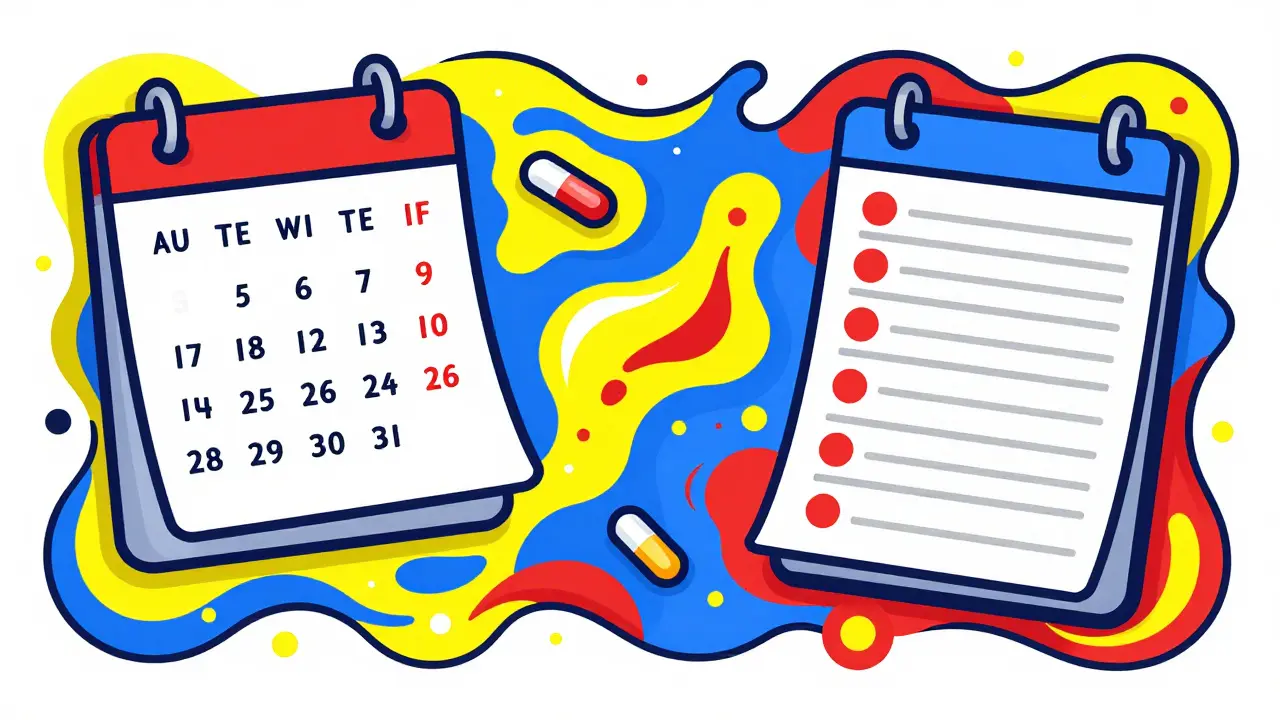
For those taking medications that require frequent labs, a monitoring calendar is a lifesaver. Instead of relying on memory, mark the exact date for your next blood draw based on the guide's requirements. For example, if you're on Clozapine, you'll need weekly blood tests for the first six months to monitor for agranulocytosis. Putting these on a calendar ensures you don't miss a critical safety window.
Common Pitfalls and How to Avoid Them
One of the biggest hurdles is that not every pharmacy consistently hands out these guides. Despite federal regulations, some patients never receive them. If you don't have a physical copy, don't guess. You can find the most current versions on DailyMed, the NIH's official medication portal. This is especially important because the FDA requires manufacturers to update these guides within 30 days of any significant safety change.
Another pitfall is the "vague term trap." Some guides might say a drug "may cause dizziness," while others are more specific, stating it "causes dizziness in 25% of patients." The specific numbers are much more helpful for setting realistic expectations. If your guide is too vague, ask your pharmacist: "What is the actual percentage of people who experience this side effect?"
Finally, don't mistake a Medication Guide for a Patient Package Insert (PPI). While both provide information, Medication Guides are specifically reserved for drugs with serious, preventable risks. If you have a Medication Guide, it means the FDA has determined that your active participation in monitoring is a key part of the treatment's safety.
How is a Medication Guide different from a regular drug leaflet?
Regular leaflets or package inserts provide a broad overview of the drug. Medication Guides are specifically mandated by the FDA only for medications that have serious safety concerns where patient understanding can prevent or reduce the severity of adverse effects. They are written in simpler language and focus heavily on risk and monitoring.
What should I do if I can't find my Medication Guide?
You can request one from your pharmacist, as they are required to provide it when the drug is dispensed. Alternatively, you can download the latest version from DailyMed, the NIH's official database, which ensures you have the most up-to-date safety information.
Why do some guides require blood tests every few weeks?
Some medications can cause significant changes in blood cell counts or organ function (like the liver or kidneys) that you cannot feel. Regular tests allow your doctor to catch these changes early and adjust your dose or stop the medication before a serious health crisis occurs.
What does "black box warning" mean in a Medication Guide?
A black box warning is the FDA's most serious alert. In a Medication Guide, this is translated into the "Most Important Information" section. It highlights risks that could lead to permanent injury or death if not managed correctly.
How often are these guides updated?
Manufacturers are required to update Medication Guides within 30 days of any significant change in safety information. Because safety data evolves, it's a good habit to check for updates during your annual medication review with your doctor.
Brittney Prince
April 26, 2026 AT 04:49Right because we're supposed to trust the FDA just because they wrote it at a 6th grade level lol. They probably hide the real nasty stuff in the fine print and just give us the "simplified" version so we don't panic while they experiment on us. Totally typical corporate cover-up vibes here.
Anand Mehra
April 27, 2026 AT 18:47reading guides is just a coping mechanism for the illusion of control in a chaotic system anyway
Nila Sawyer
April 28, 2026 AT 05:20Oh my goodness this is such a wonderful and empowering way to take charge of our own health journeys! 🌟 I absolutely love how this guide breaks everything down into such manageable steps because sometimes the medical world feels so overwhelming but we can totally do this together! 💖 If we all just take a few minutes to be proactive and mindful about our medications we can truly live our best and healthiest lives possible! ✨ keep shining everyone!
Jaclyn Vo
April 28, 2026 AT 10:58Ummm hello? Did anyone else notice that the "3-2-1 method" is literally the most basic advice ever? Like obviously I already know how to read a calendar and use a highlighter, thanks for the groundbreaking discovery :P But yeah, it's cute that people actually need a guide to tell them to call a doctor when they're dying lol <3
James Harrison
April 28, 2026 AT 22:39It's an interesting intersection of trust and autonomy. We delegate our health to experts, yet the responsibility for monitoring the fallout remains with the individual. It's a strange balance to maintain in modern medicine.
Michael Deane
April 29, 2026 AT 16:03I don't care what these guides say as long as we're making the best meds right here in the USA and not importing some garbage from overseas that's gonna mess with our systems! We gotta keep our standards high and our pharmaceutical industry leading the world because once we lose that edge we're just handing the keys to the kingdom over to people who don't care about our freedom or our health!
sachin singh
April 30, 2026 AT 17:54The detailed explanation regarding the International Normalized Ratio for Warfarin is most helpful. It provides a concrete example of why clinical monitoring is indispensable regardless of the patient's subjective feeling of wellness.