
Picture this: You’ve just spent twenty minutes explaining a complex treatment plan. The patient nods, understanding the importance of staying on top of their health. Then you hand them the prescription, and they look at the label. Their face falls. "I don't want the generic," they say firmly. "The brand name works better for me."
This moment is where many providers stumble. It’s not about chemistry or pharmacology anymore; it’s about trust. If you can’t bridge that gap between clinical evidence and patient perception, you lose more than just a sale-you risk their health outcomes. Generic medications are the backbone of modern medicine, accounting for roughly 90% of all prescriptions filled in the United States today. Yet, despite saving the healthcare system an estimated $373 billion annually, skepticism remains high.
The challenge isn't the drug itself. The challenge is the conversation. How do you explain that a pill looking completely different from the one they used to take is actually identical in strength and effect? This guide breaks down exactly how to have that talk, turning hesitation into acceptance without damaging your professional relationship with the patient.
Why Patients Resist Generics (And What They're Really Afraid Of)
To fix the problem, you first need to understand the root cause. When a patient refuses a generic, they aren't usually rejecting science. They are reacting to visual cues and past experiences. Research from the Journal of General Internal Medicine shows that nearly 28% of patients express concern when switching from brand to generic, and about 17% report reduced adherence afterward.
So, what are they worried about?
- Appearance: This is the biggest hurdle. A red oval pill suddenly becoming a white circle feels like a downgrade. Inactive ingredients-fillers, binders, and dyes-can differ between manufacturers, leading to changes in color, shape, and size. To a layperson, if it doesn't look the same, it doesn't work the same.
- Efficacy Doubts: Many patients believe "you get what you pay for." Since generics are often 80-85% cheaper, some assume corners were cut in quality. They fear the medication won't be strong enough to manage their condition.
- Past Negative Experiences: Some patients may have switched manufacturers before and felt side effects change. While rare, variations in inactive ingredients can occasionally affect absorption rates in sensitive individuals, fueling the myth that generics are unreliable.
Understanding these fears allows you to address them directly rather than dismissing them as ignorance. Acknowledging their concern validates their feelings and opens the door for education.
The Science of Bioequivalence: Explaining It Simply
You don't need to recite the Hatch-Waxman Act of 1984 to convince a patient, but you do need to know the facts cold. The core concept here is bioequivalence. According to FDA standards, a generic drug must deliver the same amount of active ingredient into a patient's bloodstream in the same amount of time as the brand-name drug.
Think of it like two different brands of coffee. One might come in a fancy ceramic mug (the brand), and the other in a simple paper cup (the generic). The container looks different, but the liquid inside-the caffeine-is identical in strength and effect.
Here are the key points to share with patients, stripped of jargon:
- Same Active Ingredient: The chemical that treats the disease is exactly the same molecule. If the brand has 10mg of atorvastatin, the generic has 10mg of atorvastatin.
- Same Strength and Dosage Form: Whether it’s a tablet, capsule, or injection, the delivery method and potency match the original.
- Rigorous Testing: Generics undergo strict FDA inspections. Manufacturers must prove through bioequivalence studies that the drug performs within a narrow margin (80-125% confidence interval) of the brand-name reference product.
A systematic review of 47 studies involving over 9,000 participants found no clinically significant differences in effectiveness between generic and brand-name cardiovascular drugs. That’s solid data to back up your words.
The TELL Framework: A Step-by-Step Conversation Guide
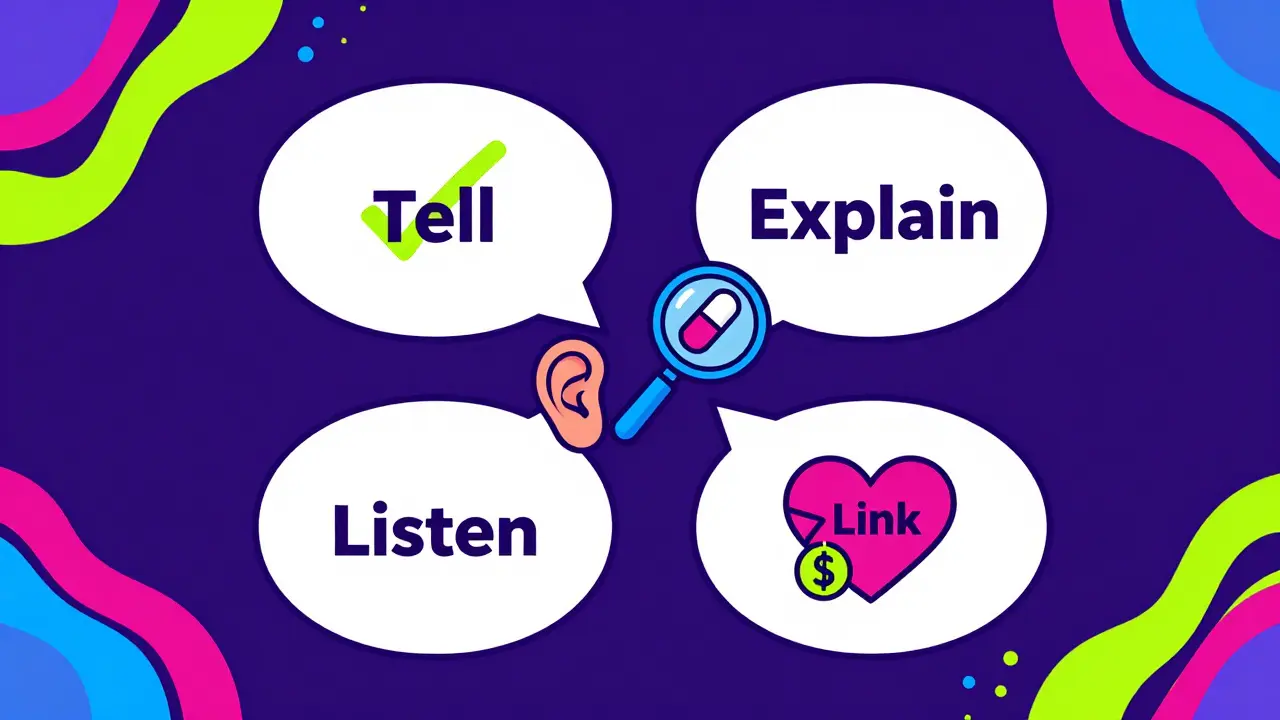
When you’re standing at the counter or sitting across from a patient, structure helps. The American Pharmacists Association recommends the TELL framework, which provides a clear roadmap for these discussions.
| Step | Action | What to Say (Example) |
|---|---|---|
| Tell | State the fact clearly. | "This generic contains the exact same active ingredient as the brand name you were taking before." |
| Explain | Address the appearance. | "It looks different because trademark laws prevent us from copying the brand's design, but the medicine inside is identical." |
| Listen | Ask for concerns. | "Have you had any issues with generics in the past? I want to make sure you feel comfortable with this switch." |
| Link | Connect to goals. | "By using this generic, you'll save $50 a month, which means you can stay on this life-saving medication long-term without financial stress." |
This framework moves the conversation from confrontation to collaboration. By linking the generic option to their personal health goals-like affordability or consistency-you make the choice feel empowering rather than forced.

Handling Narrow Therapeutic Index Drugs
There is a nuance here that every provider must respect. Not all generics are created equal in terms of patient comfort, especially when dealing with Narrow Therapeutic Index (NTI) drugs. These are medications where a small change in blood concentration can lead to toxicity or lack of efficacy. Examples include levothyroxine (for thyroid conditions), warfarin (blood thinner), and phenytoin (seizure control).
While the FDA requires stricter scrutiny for NTI generics, switching between different generic manufacturers can sometimes require closer monitoring. If a patient is stable on a specific generic manufacturer of levothyroxine, changing to a new manufacturer might necessitate a follow-up lab test.
How do you handle this?
- Be Transparent: Admit that while the drug is equivalent, individual bodies can react differently to fillers.
- Monitor Closely: For NTI drugs, suggest a follow-up appointment sooner than usual after a switch.
- Stay Consistent: If a patient finds a specific generic manufacturer that works well for them, try to keep them on that same manufacturer whenever possible to avoid unnecessary fluctuations.
This honesty builds immense trust. It shows you care about their specific physiology, not just the bottom line.
The Financial Argument: Making Savings Tangible
For many patients, money talks louder than chemistry. Insurance formularies increasingly favor generics, placing them in the lowest cost-sharing tiers. In 2023, 84% of health plans put generics in the cheapest tier compared to only 12% for brand names.
Don't just say "it's cheaper." Give them the math. If a brand-name statin costs $200 a month and the generic costs $15, that’s $2,100 saved annually. Frame it as a win for their wallet and their health. A GoodRx survey found that 78% of patients who received a detailed explanation about generics reported high satisfaction, largely driven by understanding the financial benefit.
Use real-world examples. Mention Medicare Part D beneficiaries saving an average of $1,269 per year through generic use. Make the savings concrete and relatable.
Pro Tips for Difficult Conversations
Sometimes, despite your best efforts, a patient remains resistant. Here are some advanced tactics to help close the loop:
- Use the Teach-Back Method: Ask the patient to repeat back what they understood about the generic. "Just to make sure I explained it clearly, can you tell me why this pill looks different?" This increases retention by 40% according to AHRQ studies.
- Offer Authorized Generics: Some brand-name companies produce their own generic versions. These are chemically identical to the brand and made by the same company. If a patient is terrified of unknown manufacturers, this can be a perfect middle ground.
- Document Everything: Note in the patient profile that you counseled them on the generic, their concerns, and the outcome. This protects you legally and helps future providers understand the context.
- Visual Aids Help: Show them the packaging. Point out the National Drug Code (NDC) and explain that it tracks the manufacturer. Transparency reduces anxiety.
Remember, your goal isn't to force a generic on someone who absolutely cannot tolerate it. Your goal is to ensure they are making an informed decision based on facts, not fear. Most of the time, once the mystery is removed, the resistance fades.
Looking Ahead: Biosimilars and the Future
The landscape is evolving. As biologic drugs become more common, we are seeing the rise of biosimilars. These are similar to generics but for complex biological products derived from living cells. The FDA has approved dozens of biosimilars, and they offer similar cost savings.
Communicating about biosimilars will require even more nuanced conversations because they are not identical copies but highly similar versions. Preparing now with strong communication skills around traditional generics positions you perfectly for this next wave. The principles remain the same: listen, explain, link to benefits, and build trust.
Are generic medications really as effective as brand-name drugs?
Yes. The FDA requires generic drugs to be bioequivalent to their brand-name counterparts. This means they must contain the same active ingredients, strength, dosage form, and route of administration. Extensive research, including a systematic review of over 9,000 participants, has shown no clinically significant difference in effectiveness for most chronic conditions, particularly cardiovascular drugs.
Why do generic pills look different from brand-name pills?
Generic pills often differ in color, shape, and size due to variations in inactive ingredients like fillers, binders, and dyes. Additionally, trademark laws prevent generic manufacturers from copying the exact appearance of the brand-name drug to avoid consumer confusion. However, these physical differences do not affect the therapeutic performance of the medication.
Should I worry about switching generic manufacturers?
For most medications, switching manufacturers is safe and seamless. However, for Narrow Therapeutic Index (NTI) drugs like levothyroxine or warfarin, small variations in absorption can matter. If you are on an NTI drug, inform your provider if you notice a change in the manufacturer, as they may recommend closer monitoring or lab tests to ensure your dosage remains optimal.
How much money can I save by taking generics?
Generics typically cost 80-85% less than brand-name equivalents. On average, Medicare Part D beneficiaries save about $1,269 per year by using generics. For individual patients, savings can range from tens to hundreds of dollars monthly, depending on the specific medication and insurance plan.
What should I do if my patient refuses a generic?
Start by listening to their specific concerns without judgment. Use the TELL framework: Tell them the active ingredient is the same, Explain why the appearance differs, Listen to their fears, and Link the generic to their health goals (like cost savings). If they remain hesitant, consider offering an authorized generic or documenting the refusal and discussing alternative options that fit their budget.