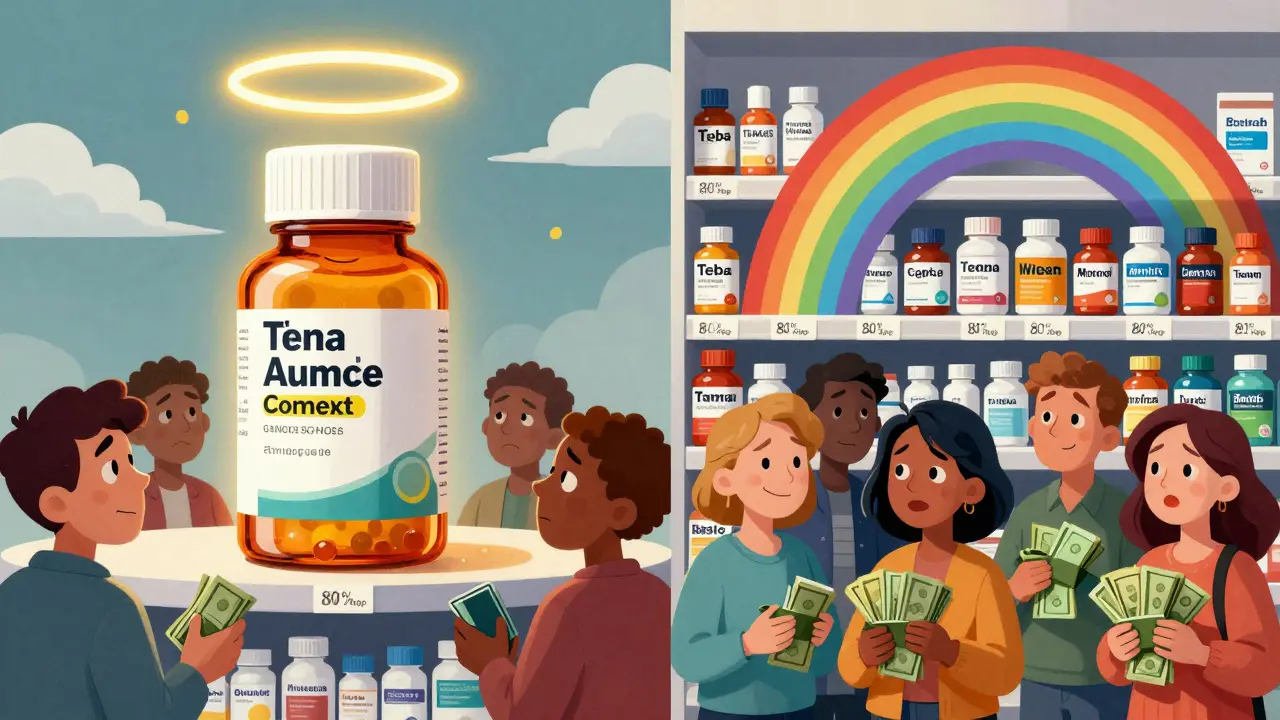
When you pick up a prescription, you might not realize there are two very different kinds of drugs on the shelf. One is made by just one company. The other? Dozens of companies make it - and they all sell it for way less. Understanding the difference between single-source and multi-source drugs can save you hundreds a month - and help you avoid nasty surprises at the pharmacy.
What Exactly Is a Single-Source Drug?
A single-source drug is the original brand-name medicine with no generic versions available. Think of it like the first iPhone: only Apple made it. For drugs, that means one company holds the patent or exclusivity, and no one else is legally allowed to copy it yet. These are often newer medications for conditions like cancer, rare diseases, or autoimmune disorders. Examples include Humira (before 2023), Enbrel, and many specialty injectables.
Because there’s no competition, manufacturers have full control over pricing. The list price can climb dramatically - sometimes over $1,000 a month. But here’s the twist: what you pay at the pharmacy isn’t always the list price. Insurers and pharmacy benefit managers (PBMs) negotiate rebates behind the scenes. The problem? Those savings rarely reach you. A 2018 study from the USC Schaeffer Center found that for single-source drugs, every $1 increase in rebates leads to a $1 increase in list price. That means the sticker price keeps going up - but your out-of-pocket cost stays high.
What Makes a Drug Multi-Source?
Multi-source drugs are the opposite. They’re the ones you see in bulk bins at your pharmacy - the generic versions. These are FDA-approved copies of brand-name drugs that contain the exact same active ingredient, strength, dosage form, and route of administration. The catch? They must also prove they work the same way in your body. That’s called bioequivalence. The FDA requires generics to deliver between 80% and 125% of the brand’s effect - meaning they’re not just similar; they’re medically interchangeable.
Multi-source drugs come from multiple manufacturers. One month you might get a pill from Teva, the next from Mylan, then from Sandoz. All of them meet the same FDA standards. In fact, about 90% of prescriptions filled in the U.S. are for multi-source drugs. Yet they make up only 23% of total drug spending. That’s because generics cost 80% less on average than their brand-name counterparts.
Why the Price Difference Is So Huge
Let’s break it down with real numbers. In 2022, the average monthly cost for a single-source drug was $587. For a multi-source drug? Just $132. That’s a $455 difference - every month. Multiply that by 12 months, and you’re talking over $5,000 a year saved.
Why does this gap exist? It’s simple math. When multiple companies make the same drug, they compete. Lower prices win. But with single-source drugs, there’s no competition. The manufacturer can raise prices, and insurers just adjust rebates - not your co-pay. Even worse, some insurers won’t cover the brand-name version at all unless you first try (and fail) the generic. This is called step therapy. It’s common with single-source drugs.
And here’s something most patients don’t know: sometimes, a brand-name company will release its own generic version. It’s called an “authorized generic.” It’s made by the same company, under the same roof, but sold under a different name. You’d think this would lower prices - but often, it doesn’t. The company still controls distribution and pricing. A 2022 Truveris analysis showed these “single-source generics” cost nearly as much as the original brand.
Are Generics Really the Same?
Yes - and no.
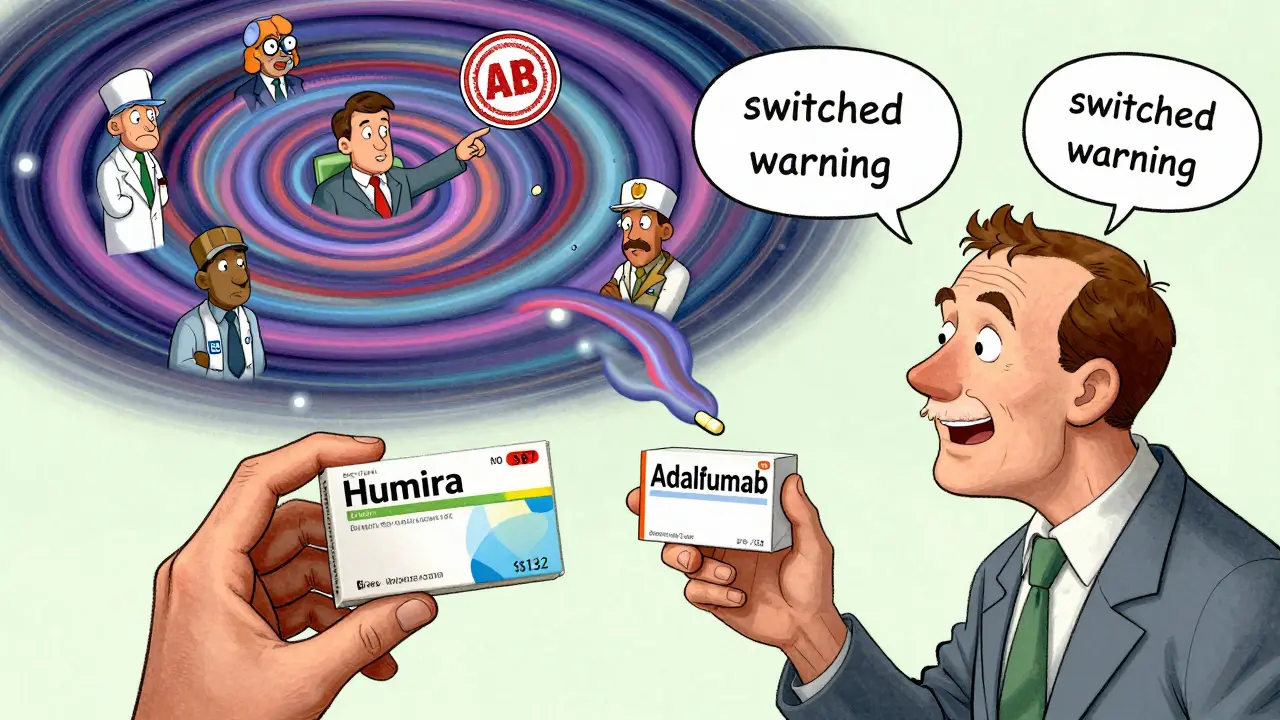
The FDA says all approved generics are therapeutically equivalent. That’s true. They must pass strict bioequivalence tests. But patients report differences. On Drugs.com, 68% of negative reviews for multi-source drugs mention “inconsistent effectiveness” or “strange side effects” after switching manufacturers.
Why? Because while the active ingredient is identical, the inactive ingredients - like fillers, dyes, and coatings - can vary. For most people, this doesn’t matter. But for those with allergies, sensitivities, or conditions like epilepsy or thyroid disease, even tiny changes can cause problems. A 2022 3 Axis Advisors report found that 63% of patients on multi-source drugs had their generic switched without warning. Some reported feeling “off” after the switch. Others noticed their blood pressure or cholesterol numbers changed.
The FDA acknowledges this. Their Orange Book includes a two-letter code system. An “A” rating means the drug is considered fully equivalent. But if a drug has an “AB” or “BX” code, it means there are formulation differences that could affect performance. Ask your pharmacist to check this. Don’t assume all generics are created equal.
What You Should Do at the Pharmacy
Here’s what to ask every time you refill a prescription:
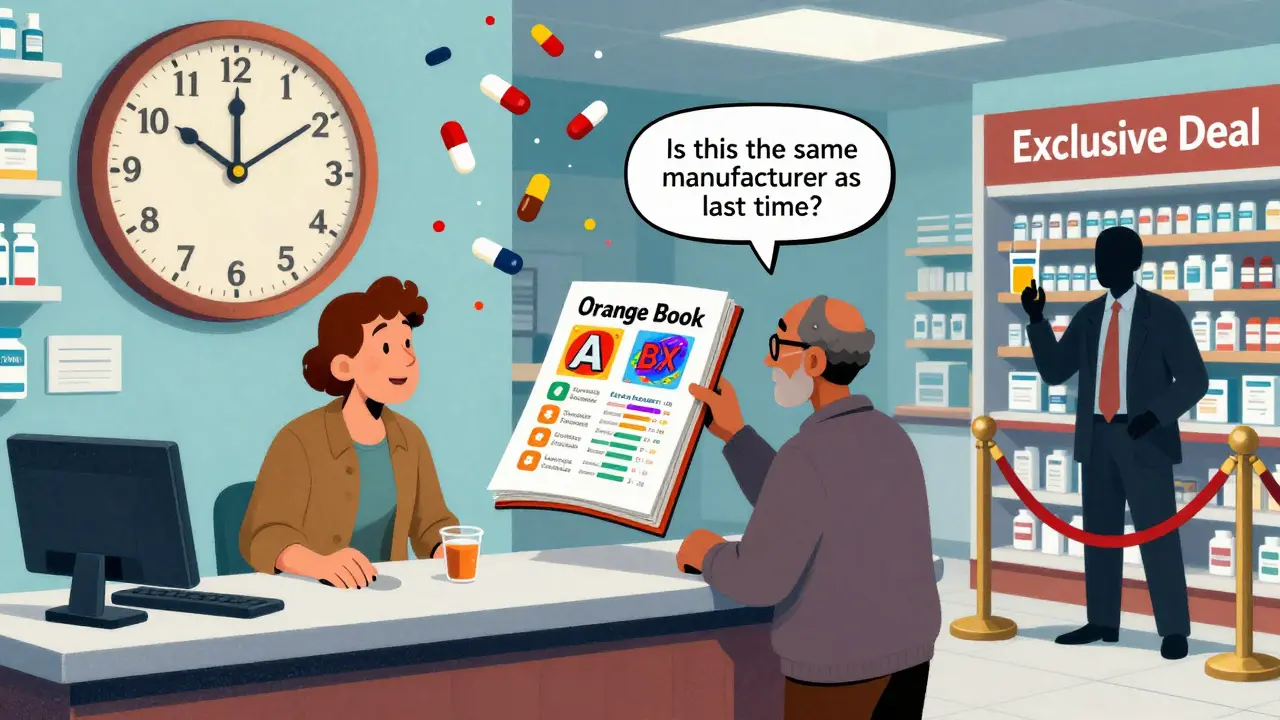
- “Is this the same manufacturer as last time?” If it’s changed, ask if it’s safe to switch.
- “Is this a generic or brand?” If it’s generic, find out which company made it.
- “Can I stick with the same brand or generic?” Some pharmacies will let you request a specific version - especially if you’ve had issues before.
- “What’s my out-of-pocket cost if I switch?” Sometimes, the brand is cheaper than the generic due to insurance discounts.
Also, check your insurance formulary. Many plans put single-source drugs on higher tiers - meaning higher co-pays or even full coverage denial unless you get prior authorization. Multi-source drugs are usually on Tier 1 or 2. That’s why your plan pushes you toward them.
What’s Changing in 2026?
The FDA’s Generic Drug User Fee Amendments (GDUFA III), implemented in 2023, are speeding up approval times for generics. By 2025, the goal is to approve new generics in just 10 months. That means more single-source drugs will become multi-source - faster than ever.
Take Humira. For 14 years, it was a single-source drug. In 2023, 10 different generic versions hit the market. The price dropped by over 70% almost overnight. That’s the power of competition.
But the system still has holes. PBMs sometimes lock in exclusive deals with one generic manufacturer, creating a “fake single-source” scenario. You think you’re getting a generic - but you’re only getting one brand of generic. And if that company raises prices, you’re stuck.
Bottom Line: Know Your Drug, Know Your Cost
You don’t need to be a pharmacist to understand this. If your drug has no generic version, you’re paying more. If it does, you’re likely paying less - but you might get a different pill every time. That’s normal. But if you feel different after a switch - talk to your doctor and pharmacist. Your body matters more than the label.
The FDA says generics work the same. And for most people, they do. But real-world experience shows that for some, the difference is real. Don’t assume. Ask. Verify. Advocate.
Over the last decade, generic drugs saved U.S. patients $1.7 trillion. That’s real money. But you won’t see those savings unless you know how the system works - and how to use it.
Are generic drugs as effective as brand-name drugs?
Yes - for the vast majority of patients. The FDA requires generics to have the same active ingredient, strength, dosage form, and route of administration as the brand. They must also prove bioequivalence, meaning they deliver the same amount of medicine into your bloodstream at the same rate. Studies show they work just as well. But a small percentage of people - especially those with conditions like epilepsy, thyroid disease, or blood thinners - may notice differences due to inactive ingredients. Always tell your pharmacist if you feel something changed after a switch.
Why does my generic drug look different every time I refill?
Because different manufacturers make the same generic drug. A pill from Teva might be oval and white; one from Mylan might be round and blue. The active ingredient is identical, but the shape, color, and fillers can vary. This is normal and approved by the FDA. If you’re concerned, ask your pharmacist to confirm it’s the same generic. You can also request a specific manufacturer if you’ve had issues before.
Can my insurance force me to switch from a brand to a generic?
Yes - and they often do. Insurance plans use step therapy to control costs. That means you must try the cheaper generic first before they’ll cover the brand. If you have a medical reason not to switch - like an allergic reaction or documented side effect - your doctor can file a prior authorization. Always ask your pharmacist or insurer about your plan’s rules before switching.
Why are some generics more expensive than others?
It’s usually because of how your insurance or PBM negotiates deals. Some generics are priced higher because they’re part of an exclusive contract - meaning only one manufacturer is covered. This is called a “single-source generic.” Even though it’s technically a generic, it’s the only one your plan allows. Always check your formulary or call your insurer to see if another generic is cheaper.
What’s the difference between single-source and authorized generics?
An authorized generic is made by the original brand-name company - but sold under a different name as a generic. It’s chemically identical, but because the brand still controls distribution, it often doesn’t drop in price like regular generics. In fact, authorized generics sometimes cost almost as much as the brand. Don’t assume it’s cheaper just because it says “generic.” Always compare prices.
How do I know if my drug is single-source or multi-source?
Ask your pharmacist or check your insurance formulary. You can also look up your drug in the FDA’s Orange Book (available online). If it has an “A” rating and multiple manufacturers listed, it’s multi-source. If only one manufacturer is listed and no generics are approved, it’s single-source. If you’re unsure, call your insurer - they can tell you what’s covered and at what cost.
Melissa Stansbury
March 16, 2026 AT 03:44I got switched from my brand-name thyroid med to a generic last year and ended up in the ER with a racing heart. The pharmacist didn't even tell me they changed manufacturers. Now I refuse to take anything unless I see the same logo on the bottle. It's not paranoia-it's survival.
My doctor says it's 'bioequivalent.' Yeah, right. My body doesn't care about FDA charts. It cares about how I feel when I wake up. And I don't feel like myself anymore.
I've started keeping a log: date, manufacturer, symptoms. It's wild how consistent the bad reactions are with certain batches. Teva? Fine. Mylan? Panic attacks. Sandoz? Fatigue so bad I napped through my kid's recital.
Why isn't this tracked? Why aren't pharmacies required to notify us? This isn't about cost-it's about trust. And the system is breaking it.
cara s
March 18, 2026 AT 00:07It is, quite frankly, astonishing how little most patients are informed about the intricacies of pharmaceutical manufacturing and regulatory oversight, particularly in the context of generic drug substitution. While the FDA does indeed mandate bioequivalence, it is crucial to understand that the permissible range of 80% to 125% of the reference drug's pharmacokinetic profile is, in fact, a 45% window-meaning a generic could theoretically deliver nearly half again as much or half as much active ingredient as the brand, and still be deemed ‘equivalent.’
This is not hyperbole. This is the regulatory reality. And while the majority of patients may not perceive a difference, those with narrow therapeutic index medications-such as warfarin, levothyroxine, or phenytoin-are at demonstrable risk. The literature is replete with case studies of therapeutic failure or toxicity following generic switches.
Moreover, the variability in inactive ingredients-dyes, binders, fillers-can trigger immune responses in susceptible individuals. A recent study in the Journal of Clinical Pharmacy and Therapeutics documented 17% of patients with celiac disease experiencing adverse reactions due to corn-derived fillers in generics.
So yes, for most, it’s fine. But for those of us who are not ‘most,’ the system is dangerously opaque.
Amadi Kenneth
March 19, 2026 AT 15:57And the real kicker? The same company that makes Humira? They own 7 of the 10 'generic' versions that came out in 2023. They didn't lose the monopoly-they just rebranded it. You think you're getting competition? Nah. You're getting a monopoly with a new name.
They're playing 4D chess with your health. And they're winning. Always have been. Always will be.
Shameer Ahammad
March 19, 2026 AT 17:09Let me be unequivocally clear: the notion that patients should be responsible for tracking their generic manufacturers is not only absurd-it is a grotesque abdication of medical and ethical responsibility. The burden of vigilance should not fall on the sick, the elderly, or the financially strained. It should lie squarely with the institutions that profit from this system.
Furthermore, the FDA’s Orange Book is a labyrinth of codes and jargon designed to confuse, not inform. The ‘AB’ and ‘BX’ designations are not consumer-friendly-they are bureaucratic obfuscation. And when insurers enforce ‘step therapy’ without disclosing that the ‘generic’ they’re pushing is, in fact, an authorized generic manufactured by the same company that charges $12,000 a year for the brand-this is not healthcare. This is extortion dressed in a lab coat.
There is no transparency. There is no accountability. And until the government forces full disclosure of ownership chains, manufacturing origins, and PBM rebates-this entire system remains a predatory racket.
Alexander Pitt
March 21, 2026 AT 13:09There's a lot of fear-mongering here, but the data doesn't lie. Over 90% of generics are bioequivalent without issue. The FDA’s testing is rigorous, and post-market surveillance is extensive. If you're having problems, it's likely a rare case-maybe an allergy to a filler, or a miscommunication with your pharmacist.
Don't confuse anecdote with evidence. Millions of people switch generics daily without incident. The cost savings are real, and they prevent people from skipping doses or going without treatment.
If you're one of the small percentage who reacts, talk to your doctor. Get a prescription for a specific manufacturer. Most pharmacies can accommodate that. But don't let one bad experience invalidate the entire system that saves billions annually.
Manish Singh
March 23, 2026 AT 10:51As someone from India, where generics are the backbone of healthcare access, I’ve seen this play out differently. In rural clinics, patients rely on generics because there’s no other option. And yes-there are bad batches. But the system here has a built-in resilience: community pharmacists know their patients. They remember who reacted to which batch. They keep logs. They swap pills manually if needed.
Here in the U.S., the system is so corporatized that your pharmacist is a cog in a machine. No one has time to ask you how you felt last month. No one tracks. No one remembers.
The answer isn’t to abandon generics-it’s to humanize the system. Train pharmacists to be advocates. Reward pharmacies that track outcomes. Let patients choose their manufacturer. This isn’t about drugs. It’s about dignity.
Nilesh Khedekar
March 23, 2026 AT 14:45they dont care if you die. they just want you to keep buying. and if you ask questions? they call you a conspiracy nut. lololol. you think this is about health? no. its about profit. always has been.
Robin Hall
March 25, 2026 AT 02:57It is imperative to recognize that the pharmaceutical supply chain is not a transparent system but rather a highly regulated oligopoly, wherein the Food and Drug Administration, Pharmacy Benefit Managers, and patent-holding corporations operate in a symbiotic relationship designed to maximize profit under the veneer of public health.
The so-called 'competition' in multi-source markets is frequently illusory. Exclusive contracts, known as 'formulary exclusivity,' effectively create monopolies under the guise of generics. Furthermore, the FDA's Orange Book does not mandate disclosure of corporate ownership-meaning a 'generic' may be produced by the very same entity that manufactures the branded product, thereby eliminating true price competition.
The narrative of 'generic savings' is thus a public relations construct. The true cost is externalized onto patients through adverse events, inconsistent therapeutic outcomes, and the psychological toll of unpredictable medication changes. Regulatory capture is not a theory-it is documented policy.
Suchi G.
March 26, 2026 AT 03:42I’ve been on the same medication for 12 years. 12 years. And every time I refill, I hold my breath. Will I feel okay? Will I feel like me? Or will I be crawling into bed at 3 p.m., crying for no reason, like last month?
My pharmacist says, ‘It’s the same thing.’ But my body doesn’t think so. My body remembers. It remembers the blue pill. It remembers the white one. It remembers the one that made my hands shake and my heart race.
I’m not a statistic. I’m not a data point. I’m a person who’s been told to ‘just adapt.’ But you don’t adapt to feeling like you’re slowly disappearing.
I’ve cried in parking lots. I’ve called my doctor in tears. I’ve begged them to let me stay on the brand-even though it costs $800 a month. And they say, ‘We can’t.’
So now I save. I work extra shifts. I skip meals. Because I’d rather be hungry than feel like I’m losing my mind.
This isn’t about money. It’s about being seen. And no one sees me.