
You have a flare-up of eczema or a chronic inflammatory skin condition characterized by itchy, red, and dry patches, your doctor prescribes a tube of cream, and you feel relieved. But then you hear the whispers: "Steroids make your skin paper-thin." "They cause stretch marks." "You get addicted to them." Suddenly, that relief feels like a trap. You hesitate to apply the medication, fearing that fixing one problem will create another.
This fear is real, but it is also largely based on misuse rather than the medicine itself. Topical corticosteroids are medications applied directly to the skin to reduce inflammation and treat various dermatological conditions including psoriasis and dermatitis are among the most effective tools in modern dermatology. When used correctly, they are safe. The risk of skin atrophy is the thinning of the skin caused by prolonged use of potent topical medications, leading to visible blood vessels and easy bruising (thinning) usually comes from using the wrong strength, applying too much, or staying on treatment too long without medical supervision.
Understanding Potency: Not All Steroids Are Created Equal
The biggest mistake patients make is treating all steroid creams as if they were the same. They are not. Doctors classify these medications into seven classes based on potency. Class I is super-potent, while Class VII is low-potency. Using a Class I steroid on your face is like using a sledgehammer to crack a nut-it works, but it causes unnecessary damage. Using a Class VII steroid on thick, scaly psoriasis on your elbows is like trying to stop a freight train with a feather; nothing happens, so you keep applying more, which doesn't help either.
| Class | Potency Level | Typical Body Areas | Duration Limit |
|---|---|---|---|
| Class I | Super-potent | Thick skin (palms, soles), severe psoriasis | Max 2 weeks |
| Class II-IV | Moderate to High | Trunk, limbs for acute flares | 2-4 weeks total |
| Class V-VII | Low to Mild | Face, groin, underarms, eyelids | As directed, often longer term |
The American Academy of Family Physicians is a professional organization representing family physicians in the United States, providing clinical guidelines and patient care resources (AAFP) emphasizes that vehicle type matters just as much as the drug itself. Ointments are greasy and occlusive, making them the most potent because they trap moisture and drive the medication deeper. Creams are better for moist or weeping lesions. Gels and foams work well on hairy areas like the scalp. If you have dry, cracked skin on your hands, an ointment might be necessary, but if you put that same ointment on your face, you increase the absorption rate significantly, raising the risk of side effects.
The Fingertip Unit: Measuring Success Without Waste
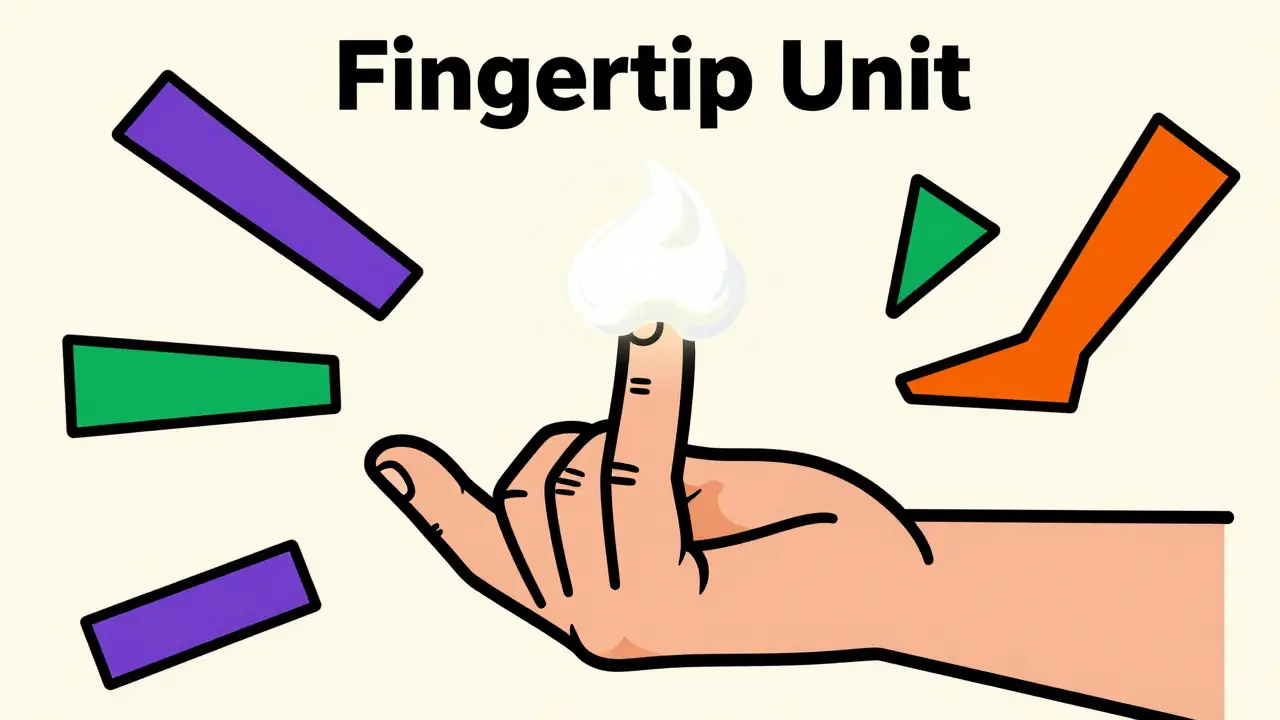
How much do you actually need? Most people guess, and most guesses are wrong. Under-applying prolongs the inflammation, forcing you to treat for longer periods, which ironically increases the risk of side effects over time. Over-applying wastes money and spikes systemic absorption risks. The solution is the Fingertip Unit (FTU) is a standardized measurement for topical medication application, defined as the amount of cream squeezed from the tip of an adult's index finger to the first crease.
An FTU is the amount of ointment or cream squeezed out from a standard tube onto the tip of an adult’s index finger to the first crease. It covers an area roughly equal to two adult handprints. Here is how to calculate what you need:
- One arm: 3 FTUs
- One hand (front and back): 1 FTU
- One leg: 6 FTUs
- One foot: 2 FTUs
If you have a small patch of eczema on your knee, you likely only need half an FTU. Rubbing it in gently until absorbed is key. A little goes a long way. The goal is a thin layer, not a thick mask. If you can still see white cream after rubbing, you’ve used too much.
Skin Thinning: Separating Fact from Fear
Let’s address the elephant in the room: Skin atrophy is the thinning of the epidermis and dermis layers due to collagen breakdown, often resulting from prolonged exposure to high-potency topical corticosteroids. Does it happen? Yes. Is it inevitable? No. Atrophy occurs when the steroid suppresses fibroblast activity-the cells that produce collagen-in the skin. This leads to thinner skin, visible blood vessels (telangiectasia), easy bruising, and striae (stretch marks).
This risk is highest when:
- You use high-potency steroids (Class I-III) on thin-skinned areas like the face, groin, or underarms.
- You apply the medication continuously for more than two weeks without a break.
- You cover the treated area with tight bandages or plastic wrap (occlusion) without specific medical instruction.
The National Institute of Health is a U.S. government agency within the Department of Health and Human Services responsible for biomedical and public health research (NIH) notes that high-potency steroids should not be administered for longer than two weeks and must be tapered. For mild steroids on sensitive areas, the risk is negligible. In fact, leaving severe inflammation untreated can sometimes cause more tissue damage than the steroid itself would. Inflammation releases enzymes that break down skin structure; stopping that process quickly preserves skin integrity.
The Step-Down Strategy: Smart Management
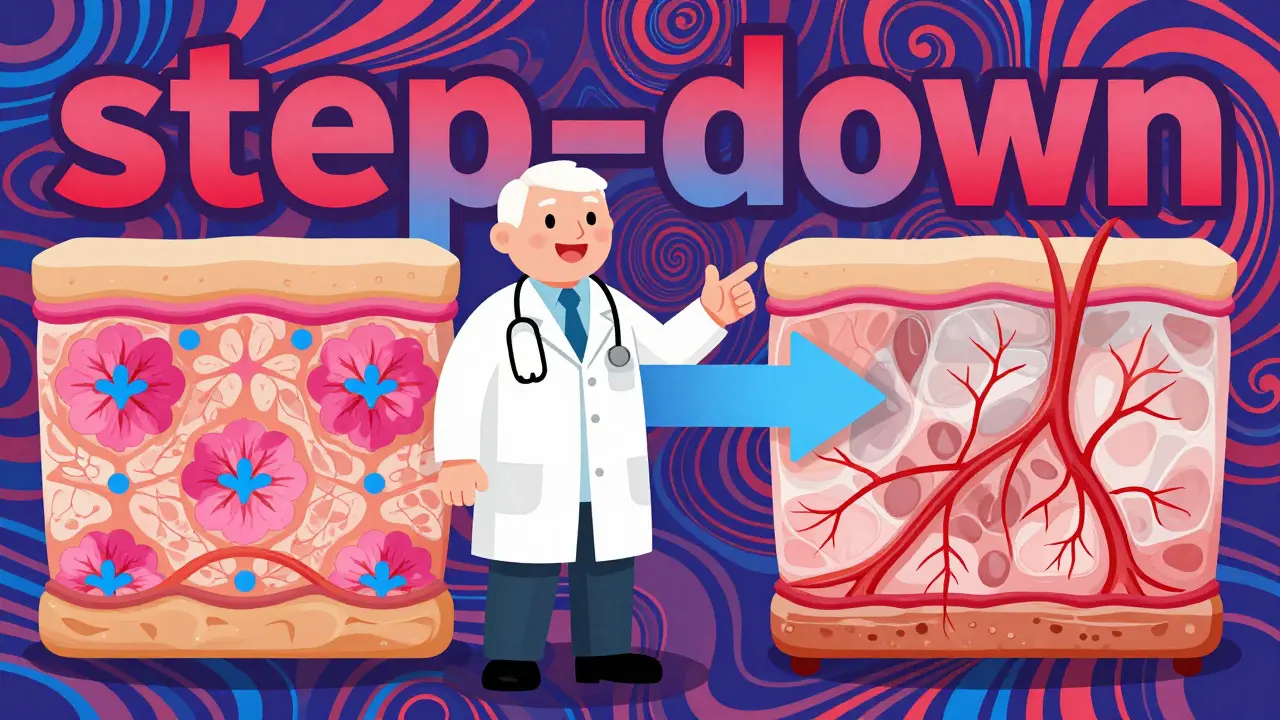
The secret to long-term control without side effects is the "step-down" approach. Dr. Jonathan Silverberg, a leading dermatologist referenced by the National Eczema Society is a non-profit organization dedicated to supporting individuals with eczema through education, advocacy, and community resources, recommends starting with a stronger steroid to knock out the acute flare. Once the redness and itching subside-usually within 7 to 10 days-you switch to a lower-potency steroid or a non-steroidal alternative like tacrolimus is a topical immunomodulator used to treat atopic dermatitis by suppressing local immune responses without causing skin thinning or crisaborole is a non-steroidal phosphodiesterase 4 inhibitor approved for the treatment of mild to moderate atopic dermatitis.
This method keeps the skin calm while minimizing cumulative steroid exposure. Many patients stay on the strong stuff for months because they’re afraid to stop. That’s where the trouble starts. Tapering isn’t weakness; it’s strategy. It allows your skin to recover its natural barrier function while maintaining control over the disease.
Application Timing: The Moisturizer Mistake
Here’s a common error that ruins effectiveness: applying your moisturizer and steroid at the exact same time. Emollients dilute the steroid. If you mix them or apply one immediately after the other, you reduce the concentration reaching the inflamed tissue. The rule is simple: wait 20 to 30 minutes between applications. Apply the steroid first to clean, dry skin. Let it absorb. Then, later, apply your moisturizer to lock in hydration. Some doctors recommend the opposite order depending on the formulation, so always follow your specific prescription instructions, but never mix them in your palm.
When to Seek Help
If you notice signs of skin thinning-transparency, purple lines, or bruises appearing from minor bumps-stop the medication and contact your provider. Also, watch for perioral dermatitis is a rash resembling acne that develops around the mouth, often triggered by improper use of topical steroids on the face, a red, bumpy rash around the mouth that can occur from facial steroid misuse. These are signals that your current regimen needs adjustment, not abandonment. Your doctor can switch you to a safer alternative or adjust the frequency.
Remember, the goal isn’t to avoid steroids entirely. It’s to use them wisely. With proper potency selection, precise dosing via fingertip units, and strategic step-down therapy, you can manage your skin condition effectively while keeping your skin healthy and intact.
Can topical steroids cause permanent skin damage?
Permanent damage is rare when used correctly. However, prolonged use of high-potency steroids on thin skin can lead to lasting changes like visible blood vessels or stretch marks. Mild to moderate atrophy often reverses after stopping the medication and allowing the skin to heal over several months.
How long can I safely use a topical steroid?
For high-potency steroids, limit continuous use to no more than two weeks. For low-potency steroids on sensitive areas, duration depends on your doctor’s advice, but regular breaks are recommended. Never use any topical steroid continuously for months without medical supervision.
What is the difference between a cream and an ointment?
Ointments are oil-based, greasy, and more potent because they seal in moisture and enhance drug absorption. Creams are water-based, less greasy, and suitable for moist or weeping skin. Choose the vehicle based on your skin type and the location of the rash.
Are there non-steroid alternatives for eczema?
Yes. Calcineurin inhibitors like tacrolimus and pimecrolimus, and PDE4 inhibitors like crisaborole, are effective non-steroidal options. They do not cause skin thinning and are ideal for sensitive areas like the face and neck, though they may be more expensive.
Why does my skin burn when I apply the steroid?
A mild stinging sensation can occur on broken or severely inflamed skin. If the burning is intense or persistent, it may indicate irritation or an allergic reaction to the vehicle (base) of the cream. Consult your doctor to switch formulations if this happens.
Jamie Rogers
July 21, 2026 AT 23:57Oh my gosh, this is such a relief to read!
I have been so terrified of using my hydrocortisone cream because my aunt told me it would make my face look like paper. Reading about the fingertip unit method makes so much sense now. It’s crazy how we just guess with these things. I’m definitely going to try waiting those 20 minutes before putting on my moisturizer. Thanks for breaking this down so clearly!
Angie Lara
July 23, 2026 AT 03:37i totally agree with the part abt the fingertip unit its soo helpful
i always used way too much thinking more is better but now i see why that was wrong
also the step down strategy sounds smart i will ask my doc about it
Ed Ostrego
July 25, 2026 AT 00:41Let's get after it folks!
Your skin is resilient and you've got this! Don't let fear stop you from treating your condition. Use the right tool for the job and stick to the plan. You are stronger than a little eczema flare-up. Keep pushing forward and take care of yourself!
Ambarish Pal
July 26, 2026 AT 18:41Bah! This is all nonsense propaganda pushed by big pharma to keep us dependent on their products.
Skin thinning is real and permanent if you use ANY steroid. They don't tell you that. Natural remedies are the only way. Aloe vera, coconut oil, forget this chemical sludge. The doctors are lying to you to sell more tubes. Wake up sheeple!
Andrew Donovan
July 28, 2026 AT 02:44The tapestry of our epidermis is indeed delicate, woven with threads of collagen that can be frayed by the heavy hand of improper treatment. Yet, to abandon the loom entirely due to fear of a snagged thread is folly. The key lies in the rhythm of application, a dance between potency and patience. One must respect the vehicle as much as the agent, for an ointment on the face is akin to wearing armor in a ballroom. Let us tread lightly, with knowledge as our guide, lest we unravel the very fabric we seek to mend.
Patrick Meyer
July 29, 2026 AT 19:48Look, most people here dont even know what theyre talking about. Its obvious that if you cant afford a derm you should just stick to the cheap stuff but dont blame the meds when you mess up. Real experts know that class 1 steroids are basically poison for the face unless you want to look like a vampire. Stop whining and read the label properly.
Prashant Shishodia
July 30, 2026 AT 00:04Simple rule. Use less. Wait longer. If it burns, stop. Do not mix creams. Ask doctor if unsure. Easy steps work best. No need for complex theories. Just follow instructions carefully.
Autumn LW
July 30, 2026 AT 19:03Obviously, anyone reading this already knows that steroids are dangerous if misused, but let us pretend otherwise for the sake of argument. The average person lacks the cognitive discipline to measure a fingertip unit accurately. They smear it on like butter. And then they complain about atrophy. It is pathetic really. Only those with proper medical training should even touch these medications. Leave it to the professionals.
Scott Colter
July 31, 2026 AT 02:33In the grand scheme of existence, our skin is merely a boundary between the self and the void. To treat it with harsh chemicals is to invite chaos into order. Yet, sometimes chaos is necessary to restore balance. Perhaps the true steroid addiction is not to the drug, but to the illusion of control we believe we hold over our own biology. Interesting thoughts to ponder while applying that cream.
Paul Lyons
August 1, 2026 AT 16:12This is typical American healthcare confusion. In other countries, they regulate this better. But here, everyone just buys whatever they want. It's a disaster waiting to happen. My neighbor used a strong steroid on his face and now he looks terrible. Blame the system, not the patient. We need stricter laws on who can prescribe these things. Freedom has its price, apparently.
Deva Vidya
August 2, 2026 AT 19:33Great information here! I found the section on timing very useful. It makes sense to separate the applications so they don't interfere with each other. I will definitely try the step-down approach next time I have a flare. Thanks for sharing this positive perspective on managing skin conditions effectively.