mRNA Side Effect Probability & Symptom Checker
Your Profile
Estimation Results
Common Reactions (Expected)
Likelihood of experiencing these temporary symptoms within 72 hours.
Rare Risks (Monitor)
Statistical incidence rates for serious but uncommon events.
When you hear about mRNA therapeutics, a class of medical treatments that use messenger RNA to instruct cells to produce specific proteins for therapeutic purposes, the first thing on your mind might be the rapid rollout during the pandemic. But what happens after the shots are given? The real story isn't just in the clinical trials; it’s in the years of watching how these treatments behave in millions of people. As we move into 2026, the landscape has shifted from emergency authorization to a robust framework of post-approval monitoring. This shift reveals a lot about safety, rare side effects, and how regulators keep track of long-term health outcomes.
Understanding the Basics: How mRNA Works and Why It Matters
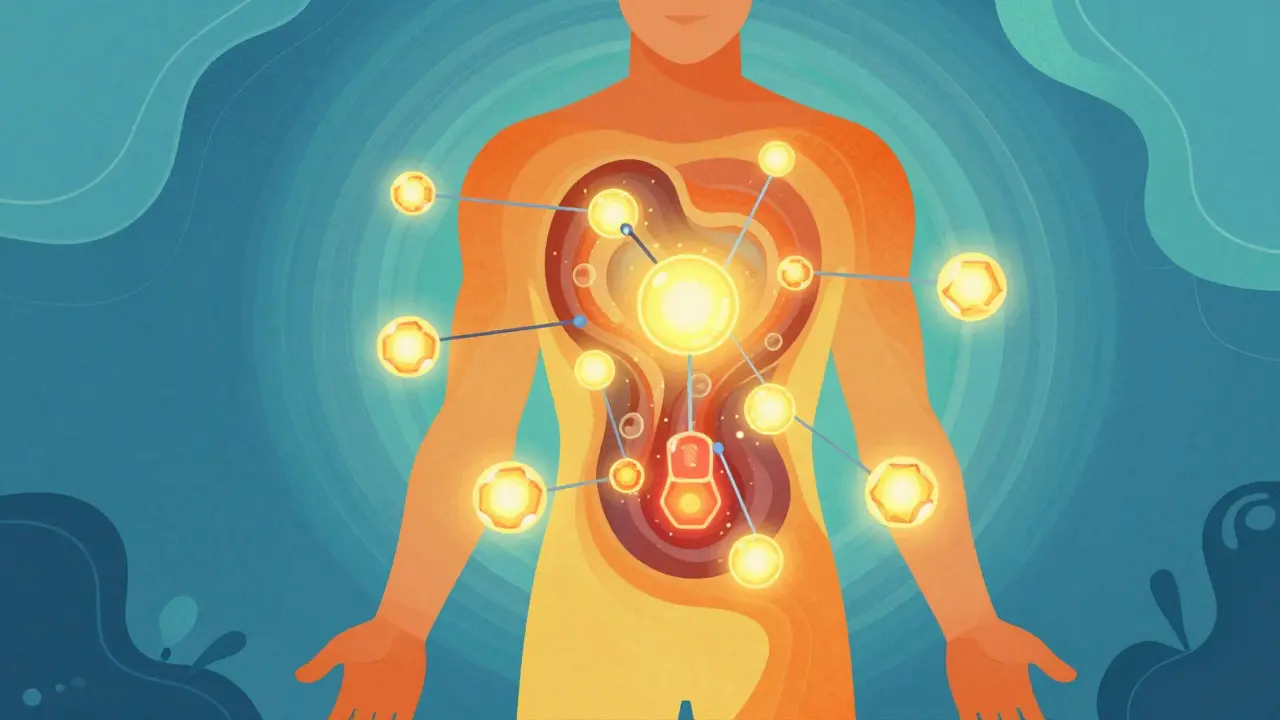
To get why side effects happen, you have to look at how the technology works. Unlike traditional vaccines that inject weakened or dead parts of a virus, mRNA therapeutics deliver instructions. Your cells read these instructions and temporarily make a protein-usually a spike protein-that triggers an immune response. The key players here are lipid nanoparticles (LNPs). These tiny spheres protect the fragile mRNA inside and help it enter your cells. Without LNPs, the mRNA would break down before it could do any good.
The beauty of this platform is its speed and flexibility. Pfizer-BioNTech’s Comirnaty went from sequence selection to clinical batch production in just 27 days. Moderna’s Spikevax followed a similar path. But this speed came with questions. How does the body react to these synthetic components over time? Does the immune system remember too much, or not enough? These questions drive the current research and monitoring efforts.
Common Side Effects: What Most People Experience
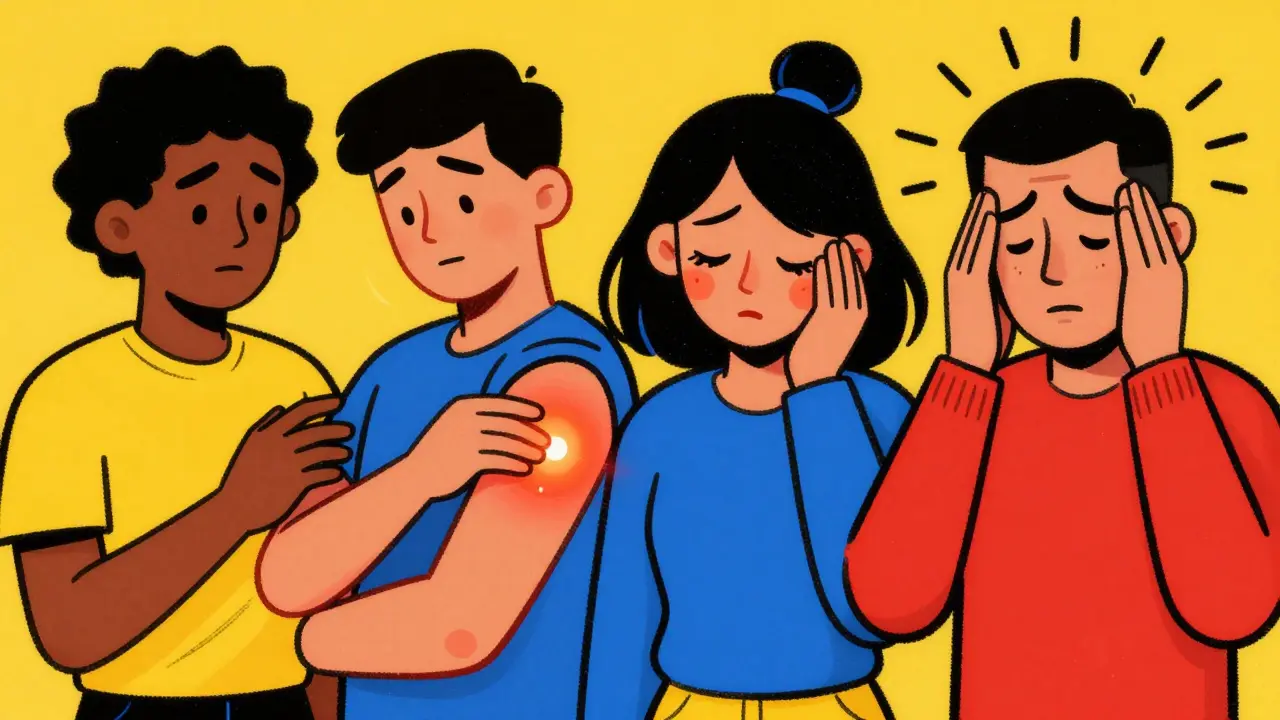
Let’s be clear: most side effects are mild and temporary. They’re actually a sign that your immune system is working. Data from the Vaccine Adverse Event Reporting System (VAERS) through September 2025 shows that out of nearly 1.25 million reports for COVID-19 mRNA vaccines, the vast majority involved common symptoms. Pain at the injection site was the top complaint, affecting 58.3% of reporters. Headaches (26.7%) and fatigue (24.1%) were also frequent.
Clinical trial data backs this up. For Comirnaty, injection site pain occurred in 76.7% of people after the first dose and 69.4% after the second. Compare that to placebo groups, where only about 10% reported pain. Fatigue affected roughly 25-27% of vaccine recipients versus 11-15% in placebo groups. These numbers tell us that mRNA vaccines are more "reactogenic" than older technologies. That means they provoke a stronger immediate reaction. But crucially, these symptoms usually resolve within 72 hours.
| Symptom | mRNA Vaccine Recipients (%) | Placebo Group (%) | Typical Duration |
|---|---|---|---|
| Injection Site Pain | 69-77% | 8-10% | 1-2 days |
| Fatigue | 25-28% | 11-16% | 1-3 days |
| Headache | 20-27% | 10-15% | 1-2 days |
| Myalgia (Muscle Pain) | 20-25% | 5-10% | 1-2 days |
Rare but Serious Concerns: Myocarditis and Beyond
While most reactions are minor, some are serious. The biggest headline-grabber has been myocarditis-inflammation of the heart muscle. The risk is low, but it’s real. CDC estimates suggest about 1 case per 50,000 second doses in adolescent males. In males aged 12-29, the incidence was 40.6 cases per million second doses for Comirnaty. To put that in perspective, viral vector vaccines like AstraZeneca’s Vaxzevria had a lower rate (3.8 per million), but they carried a different risk: blood clots.
Here’s the good news: almost all cases of vaccine-associated myocarditis resolved quickly. A study found that 98.7% of patients recovered their symptoms within 30 days. Most didn’t even need hospitalization. Still, doctors watch for chest pain, shortness of breath, or palpitations closely after vaccination. If you feel something off, don’t ignore it. Early detection makes a huge difference.
Another area of interest is menstrual changes. Social media buzzed with reports of cycle shifts. A large study published in Clinical Infectious Diseases (August 2024) looked at 6.2 million women. They found transient menstrual changes in 3.7% of women aged 18-45. Importantly, these changes resolved within two cycles without medical intervention. There’s no evidence that mRNA vaccines cause long-term fertility issues or permanent hormonal disruption. The immune activation might temporarily stress the body, leading to short-term fluctuations, but the effect fades.
The Role of Lipid Nanoparticles in Safety Profiles
You can’t talk about mRNA side effects without talking about delivery. The lipid nanoparticles (LNPs) aren’t just packaging; they’re active participants. Typical LNPs contain ionizable cationic lipids (38-50%), phospholipids (10-15%), cholesterol (35-45%), and PEGylated lipids (1-2%). Each component has a job. Ionizable lipids help the mRNA escape the endosome (the cell’s recycling bin). Cholesterol stabilizes the structure. PEGylated lipids prevent the particles from clumping together.
But LNPs can also trigger immune responses. Some people develop allergies to PEG or polysorbate, ingredients found in many cosmetics and foods. While true allergic reactions are rare, they’re monitored closely. Researchers are working on next-generation lipids that target specific tissues, potentially reducing systemic reactogenicity by up to 80% within five years, according to Nobel Laureate Dr. Drew Weissman. This could mean fewer flu-like symptoms and less inflammation for future therapies.
Post-Approval Monitoring: How Regulators Keep Watch
Clinical trials involve thousands of people. Real-world usage involves billions. That’s where post-approval monitoring comes in. The FDA uses several tools to track safety signals:
- VAERS (Vaccine Adverse Event Reporting System): A passive surveillance system where anyone can report a problem. Healthcare providers must report serious events within 15 days. It’s great for spotting new patterns but doesn’t prove causation.
- VSD (Vaccine Safety Datalink): An active surveillance network linked to electronic health records of over 30 million people. It allows researchers to run controlled studies quickly.
- v-safe: A smartphone-based program that enrolled 6.3 million participants. Users received text messages asking about their health after vaccination. About 87.4% completed at least seven days of follow-up.
- Sentinel Initiative: Monitors 300 million patient records across 11 data partners. It uses advanced algorithms to detect unusual clusters of adverse events.
In May 2025, the FDA approved the first AI-powered pharmacovigilance system called Vigi4mRNA. It analyzes 1.2 million social media posts daily alongside traditional data. This helps catch emerging concerns faster than ever before. However, AI isn’t perfect. It needs human experts-immunologists, pharmacovigilance specialists, and biostatisticians-to interpret the signals. Disproportionality analysis methods like Bayesian Confidence Propagation Neural Network (BCPNN) help distinguish noise from real risks.

Beyond Vaccines: Oncology and Chronic Diseases
mRNA isn’t just for infectious diseases. Oncology is the hottest area right now, representing 38.2% of the pipeline. Cancer vaccines teach the immune system to recognize tumor-specific antigens. Merck’s acquisition of OncoCytos for $2.4 billion in May 2024 highlights the industry’s confidence. Their candidate, mRNA-4157/V940, showed a 49% reduction in melanoma recurrence when combined with pembrolizumab in the Phase IIb KEYNOTE-942 trial.
Safety profiles in cancer patients differ slightly. Dr. Ugur Sahin noted that in combination with checkpoint inhibitors, mRNA vaccines caused Grade 3+ adverse events in only 8.3% of patients, compared to 15.2% with checkpoint inhibitors alone. This suggests mRNA adds minimal toxicity while boosting efficacy. Patients in forums like Smart Patients report mostly mild flu-like symptoms, with 12% experiencing Grade 2 fever requiring acetaminophen. No major red flags have emerged yet, but long-term data is still accumulating.
Challenges and Future Directions
Despite the progress, challenges remain. One big issue is diversity. Pre-approval studies often lacked representation. Only 9.8% of participants were Hispanic and 3.2% Black. This limits our ability to generalize safety findings across all populations. The EMA now requires pregnancy registries tracking 5,000+ exposed pregnancies to fill these gaps.
Temperature sensitivity is another hurdle. Comirnaty needs ultra-cold storage (-70°C), while Spikevax requires -20°C. Room temperature stability is poor, with half-lives under six hours. New formulations aim to improve this. Self-amplifying mRNA (saRNA) platforms, currently in Phase I trials, require 10-fold lower doses (1-10 μg). Lower doses might mean fewer side effects. We’ll see how that plays out over the next few years.
Finally, there’s the question of repeated dosing. Dr. Robert Wittes cautioned that the long-term safety database remains limited for chronic administration scenarios. Will annual boosters cause cumulative immune exhaustion? Or will they maintain protection safely? Time will tell. For now, the data looks promising, but vigilance is key.
Are mRNA vaccines safe for pregnant women?
Current data suggests mRNA vaccines are safe during pregnancy. Large-scale monitoring has not shown increased risks of miscarriage or preterm birth. In fact, vaccinated pregnant women had better outcomes against severe illness. However, dedicated pregnancy registries are ongoing to gather more comprehensive long-term data.
Can mRNA change my DNA?
No. mRNA operates in the cytoplasm of the cell, never entering the nucleus where DNA resides. It degrades quickly after delivering its instructions. Unlike some gene therapies, mRNA does not integrate into your genome. This is a fundamental safety feature of the technology.
Why do I feel so tired after getting an mRNA shot?
Fatigue is a common immune response. Your body is ramping up defenses, producing cytokines and activating T-cells. This process takes energy. Most people feel better within 1-3 days. Staying hydrated and resting can help manage symptoms.
What is myocarditis, and should I worry?
Myocarditis is inflammation of the heart muscle. It’s rare, occurring in about 1 in 50,000 adolescent males after the second dose. Symptoms include chest pain and shortness of breath. Most cases resolve fully within a month. If you experience these symptoms, seek medical attention immediately.
How long does mRNA stay in my body?
mRNA is very unstable. It typically lasts only 24-72 hours before breaking down. Your cells use the instructions to make proteins for a few weeks, then the mRNA is gone. It does not accumulate or persist long-term.