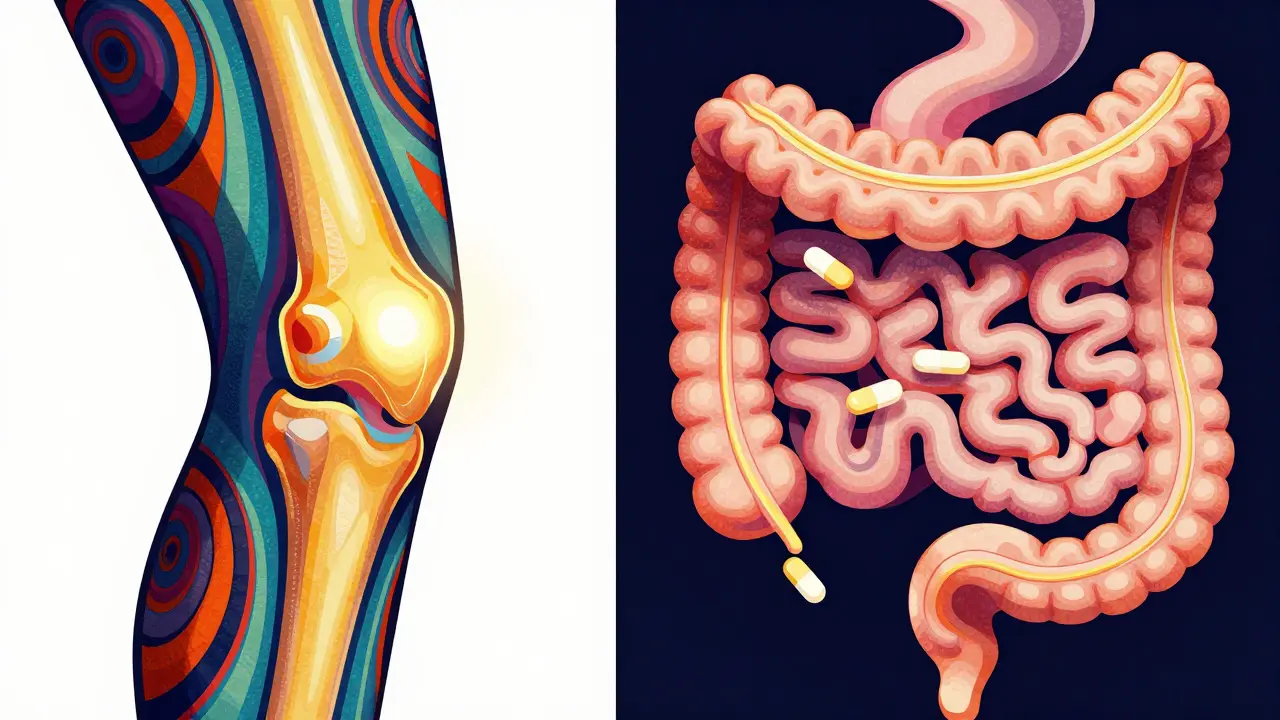
Imagine you have a painful knee. You can swallow a pill that travels through your entire body to get there, or you can rub a gel directly on the skin above it. Which one sounds safer? For millions of people, especially older adults, the answer is shifting toward the gel. But why? It’s not just about convenience; it’s about how your body processes medicine.
We often assume that if a drug stays on the skin, it doesn’t enter the bloodstream. That’s a dangerous myth. The truth is more nuanced. Both topical medications are drugs applied directly to the skin or mucous membranes for localized effect and oral medications are drugs ingested and absorbed through the gastrointestinal tract into systemic circulation interact with your body in complex ways. Understanding the difference in systemic absorption is the process by which a drug enters the bloodstream from its site of administration is key to making safer health choices.
How Your Body Handles Pills vs. Creams
When you take an oral pill, like ibuprofen for joint pain, it goes on a long journey. It hits your stomach, where acid tries to break it down. Then it moves to the small intestine, where enzymes do more work. Finally, it travels to your liver. This is called first-pass metabolism is the metabolic process that reduces the bioavailability of a drug before it reaches systemic circulation. According to data from StatPearls (2023), this liver processing cuts the effectiveness of many drugs by an average of 58.7%. Some drugs lose up to 95% of their potency before they even start working.
Topical meds skip most of this trip. They sit on the skin. The goal is for them to stay local. However, some of the drug always gets through. Standard topical NSAIDs (non-steroidal anti-inflammatory drugs) usually have a bioavailability of less than 5%. Compare that to oral NSAIDs, which often hit 70-90% bioavailability. That means with the cream, only a tiny fraction enters your blood. With the pill, almost all of it does.
This matters because your heart, kidneys, and stomach don’t need that high concentration of drug if the problem is just in your knee. By keeping the drug local, you spare the rest of your body from unnecessary exposure.
The Safety Gap: Why Side Effects Differ
The biggest selling point for topical meds isn’t just comfort; it’s safety. Let’s look at the numbers. A study published in PubMed found that gastrointestinal adverse events happen in 15% of people taking oral NSAIDs. For those using topical versions, that number drops to less than 1%.
Why such a huge difference? Oral NSAIDs irritate the lining of your stomach and intestines as they pass through. Topical NSAIDs bypass the gut entirely. Dr. Sarah S. O'Mahony from Johns Hopkins University noted in a 2022 JAMA Dermatology editorial that topical analgesics reduce serious adverse events by 63% compared to oral NSAIDs in patients over 65. That’s a massive drop in risk.
| Feature | Oral Medications | Topical Medications |
|---|---|---|
| Bioavailability | 70-90% | <5% |
| Gastrointestinal Risk | High (15% incidence) | Very Low (<1% incidence) |
| Common Side Effect | Stomach bleeding, ulcers | Skin irritation, dryness |
| Hospitalization Rate (per 10k prescriptions) | 14.7 | 1.2 |
However, topical isn’t risk-free. About 10-15% of users experience skin reactions like redness or itching at the application site. These are usually mild and go away quickly. But here’s the catch: if you apply too much, or if your skin is damaged, more drug can get into your blood. Dr. Michael R. Johnson from Mayo Clinic warned that assuming zero systemic absorption is dangerous. In cases where patients covered large areas with diclofenac gel, plasma levels rose enough to cause systemic effects.
Do Topical Meds Actually Work?
You might wonder if skipping the bloodstream means skipping the results. For localized pain, the answer is yes-they work. Clinical studies show efficacy rates ranging from 18% to 92%, depending on the formulation and the condition. The American College of Rheumatology now recommends topical NSAIDs as the first-line treatment for knee osteoarthritis. Why? Because they offer comparable pain relief to pills but with far fewer risks.
A 2023 survey by the Arthritis Foundation asked 2,417 participants about their experiences. While 72.1% said oral meds gave "good to excellent" relief, 68.3% said the same for topicals. The gap is small. But when asked about preference, 89.7% chose topicals. Their reason? "Fewer stomach problems."
It’s important to note that topical meds aren’t magic bullets for everything. They struggle with deep tissue penetration. Hydrogels typically reach 0.5-1.0 mm into the skin. Liposomal formulations can go deeper, reaching 2.0-3.0 mm. If your pain is deep inside the hip joint, a cream on the surface might not reach it effectively. In those cases, oral meds or injections might be necessary.
Real-World Usage: What Patients Say
Data tells one story, but patient experience tells another. On Reddit’s r/ChronicPain community, users frequently praise topical gels for eliminating acid reflux and stomach upset. One common theme was "no more acid reflux," mentioned in hundreds of posts. But there were complaints too. Many users found the application messy. Others noted that absorption seemed slower in cold weather, likely because cooler skin temperatures reduce blood flow and drug uptake.
Adherence is also a factor. A 2023 study in the Annals of Internal Medicine found that elderly patients had 37% higher adherence rates with topical formulations. Swallowing multiple pills a day is hard. Rubbing a gel on a sore spot feels more targeted and manageable. However, incorrect application is a major issue. A pharmacist survey found that 41% of topical medication failures were due to under-dosing or applying it too infrequently. You need to use enough product-usually a 4-6 inch ribbon-to see results.
When to Choose Which
So, how do you decide? Here is a simple guide based on current medical consensus:
- Choose Topical If: You have localized pain (knees, hands, elbows). You are over 65. You have a history of stomach ulcers, GERD, or kidney issues. You are taking other medications that might interact with oral NSAIDs.
- Choose Oral If: You have widespread pain (fibromyalgia, multiple joints). The pain is deep-seated and unresponsive to creams. You need rapid, high-level systemic relief for acute injury. You have sensitive skin prone to allergic reactions.
Also, consider the type of drug. Not every medication comes in both forms. Only about 12% of the 200 most commonly prescribed drugs are available topically. Molecular size matters. Large molecules can’t penetrate the skin barrier easily. This is why antibiotics for internal infections must be taken orally, while antibiotic creams work fine for surface cuts.
The Future of Skin-Based Delivery
The market is moving fast. The global topical drug delivery market was valued at $52.3 billion in 2023, growing faster than the oral drug market. Companies are investing heavily in new technologies. Microneedle patches, currently in Phase III trials, promise to bridge the gap. These tiny needles create micro-channels in the skin, allowing larger molecules to enter without hitting the liver. Early data shows they could deliver osteoporosis meds with 45% bioavailability, rivaling oral options but with better safety.
By 2030, analysts predict 35% of new pain medications will use topical or transdermal delivery. The trend is clear: doctors want to avoid the systemic risks of oral meds whenever possible. As Dr. O’Mahony said, it’s a paradigm shift. We’re learning that we don’t need to flood the whole body with medicine to treat a specific part.
Can topical medications cause systemic side effects?
Yes, although rare. While standard topical NSAIDs have less than 5% bioavailability, applying them to large surface areas or broken skin can increase absorption. In extreme cases, plasma concentrations can rise enough to cause systemic effects like dizziness or increased bleeding risk. Always follow dosage instructions carefully.
Are topical NSAIDs safe for elderly patients?
They are generally safer than oral NSAIDs for seniors. The American Geriatrics Society recommends topical NSAIDs for elderly patients due to an 82% lower risk of gastrointestinal bleeding. However, caution is still needed regarding skin integrity and potential interactions with other medications.
Why do some topical creams feel sticky or messy?
The base ingredients in creams and gels are designed to keep the active drug on the skin long enough for absorption. Hydrogels and liposomal formulations use different carriers that can feel tacky. Applying the correct amount (a 4-6 inch ribbon) helps minimize waste and mess while ensuring effective coverage.
Does cold weather affect topical medication absorption?
Yes. Absorption is optimized at skin temperatures above 32°C (89.6°F). Cold weather constricts blood vessels in the skin, which can slow down the rate at which the drug penetrates. Warming the area gently before application may help, but avoid heat sources that could damage the skin.
When should I switch from oral to topical pain relief?
Consider switching if you experience stomach upset, heartburn, or if you are over 65 with localized joint pain. The American College of Rheumatology suggests trying topical NSAIDs first for knee osteoarthritis. If pain persists after 2-4 weeks of proper topical use, consult your doctor about alternative treatments.