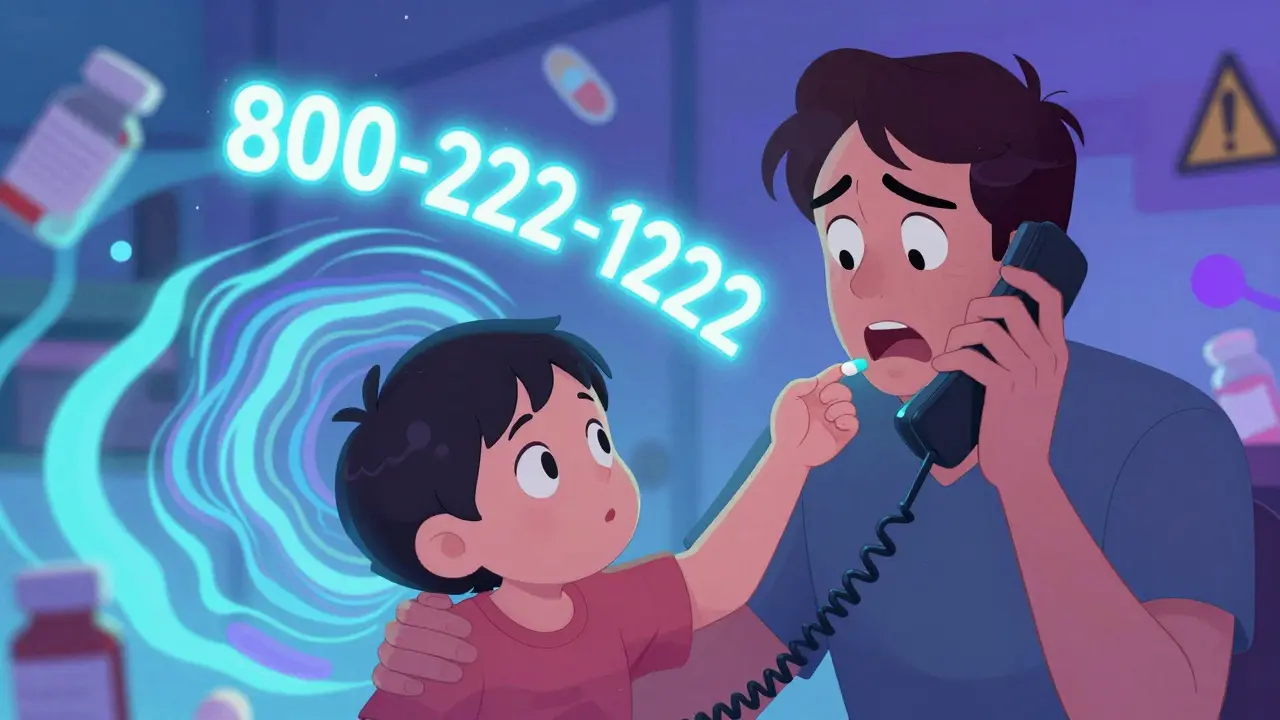
When a child swallows the wrong medication, time isn’t just a factor-it’s the difference between life and death. Every second counts. You won’t have time to panic, search online, or call a friend. You need to act, and act fast. This isn’t about guessing or hoping things get better. It’s about following a clear, proven protocol that has saved thousands of children. According to the CDC, medication poisoning is the second most common cause of poisoning in kids under 6. In 2022 alone, over 1.9 million poisoning exposures were reported in the U.S., and nearly 4 out of 10 of those involved children 5 and under. Painkillers, especially those containing acetaminophen, cause over 30% of fatal pediatric poisoning cases. Heart medications, antidepressants, and even common vitamins can trigger seizures, coma, or cardiac arrest in minutes. But here’s the good news: you don’t need to be a doctor to make a life-saving difference. The most critical step is simple, fast, and free.
Step 1: Call Poison Control Immediately
Forget calling 911 first. Forget rushing to the hospital. The single most important thing you can do is call Poison Control at 800-222-1222. This number is available 24/7, free, and staffed by trained toxicology nurses and pharmacists who know exactly what to do. They don’t just give generic advice. They ask for details: the medication name, how much was swallowed, when it happened, and the child’s age and weight. Then they give you step-by-step instructions tailored to that exact situation. Studies show that calling Poison Control reduces hospitalization rates by 43%. One parent in Ohio called after her 3-year-old swallowed three chewable antihistamines. The specialist told her to watch for drowsiness and check breathing every 15 minutes. Her child never went to the ER. Don’t waste time looking for the bottle. Don’t try to figure it out yourself. Call first. Even if you’re not sure. Even if you think it’s “just a pill.” The Poison Control line exists because it works.Step 2: Remove Any Remaining Medication
While you’re on the phone with Poison Control, or immediately after, check the child’s mouth. If there’s any leftover pill, liquid, or patch, gently remove it with your fingers. Don’t use tools. Don’t force anything. Just scoop it out. If it’s a medicated patch-like fentanyl or nicotine-check the child’s skin and even the roof of their mouth. Patches can stick there after being sucked on. Peel it off carefully, wash your hands afterward, and keep the patch in a sealed bag to show medical staff. Do NOT try to make the child vomit. Not even a little. Not with syrup of ipecac. Not with salt water. Not with your fingers down their throat. Since 2004, every major medical organization-including the American Academy of Pediatrics and the American College of Medical Toxicology-has banned this practice. Why? Because vomiting doesn’t help in most cases, and it can cause choking, lung damage, or even push the poison deeper into the body. Over 78% of parents still believe vomiting is a good idea. They’re wrong.Step 3: Watch for These Warning Signs
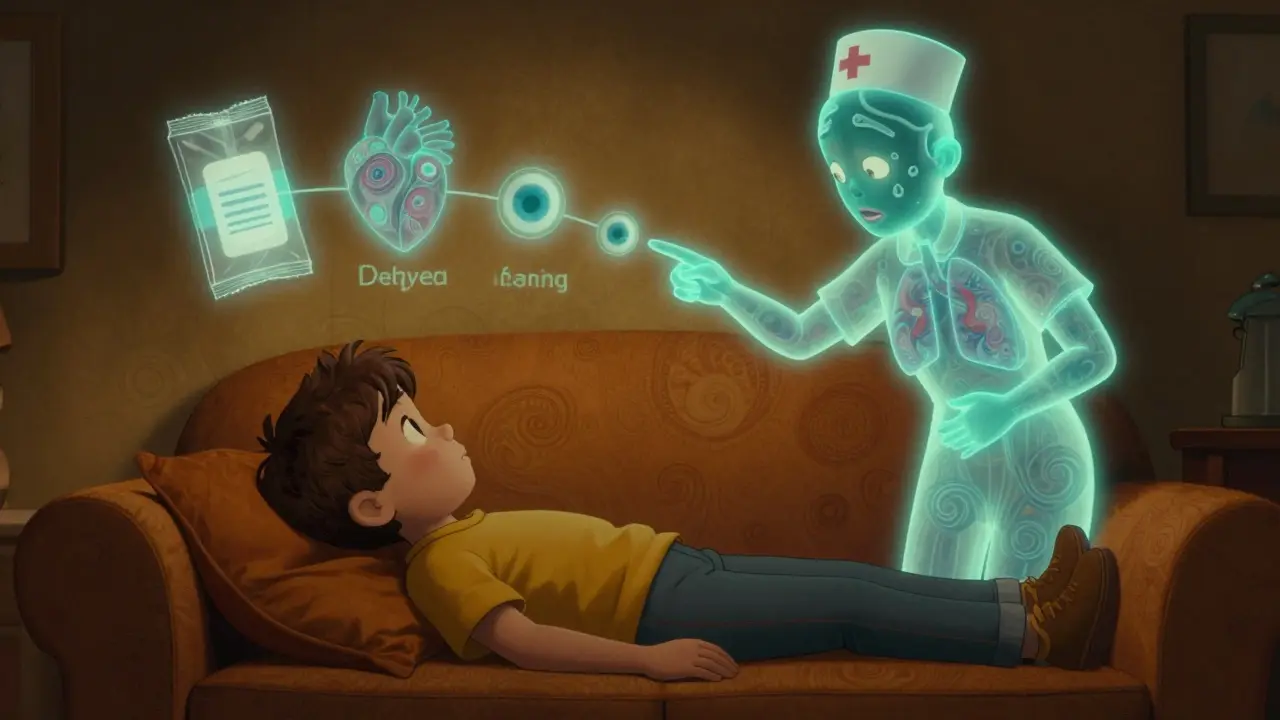
While you wait for help-or after following Poison Control’s instructions-watch closely for these red flags:- Difficulty breathing or stopped breathing
- Loss of consciousness or extreme drowsiness
- Seizures or uncontrolled shaking
- Abnormal pupils-very large or very small
- Excessive drooling or foaming at the mouth
- Persistent vomiting or nausea lasting more than 20 minutes
- Unusual lethargy-child won’t wake up, respond, or move
Step 4: Prepare for the Hospital
If you’re told to go to the ER, bring these things:- The medication container-even if it’s empty
- The pill bottle or packaging
- A list of all medications the child takes
- Any vomit or stool samples (if possible)
- Your phone with the Poison Control call log
What Hospitals Do After the Emergency
Treatment isn’t one-size-fits-all. It depends on what was swallowed.- Opioids (like oxycodone): Naloxone is given. It works fast-often within minutes. Dose is 0.1 mg/kg, max 2 mg per dose.
- Sulfonylureas (diabetes pills): Blood sugar is monitored hourly. Octreotide is given to stop insulin release.
- Tricyclic antidepressants: Sodium bicarbonate IV to stabilize heart rhythm.
- Acetaminophen: N-acetylcysteine is given to prevent liver failure.
What Not to Do
Here are the top three mistakes parents make-and why they’re dangerous:- Waiting to see if the child gets sick - Many poisons don’t cause symptoms right away. Waiting gives the poison time to spread.
- Using home remedies - Milk, charcoal, salt, honey, or syrup of ipecac have no proven benefit. Some, like ipecac, are actively harmful.
- Assuming it’s “not a big deal” - A single aspirin can be deadly for a baby. A half-pill of a blood pressure drug can stop a child’s heart.
How to Prevent This From Happening Again
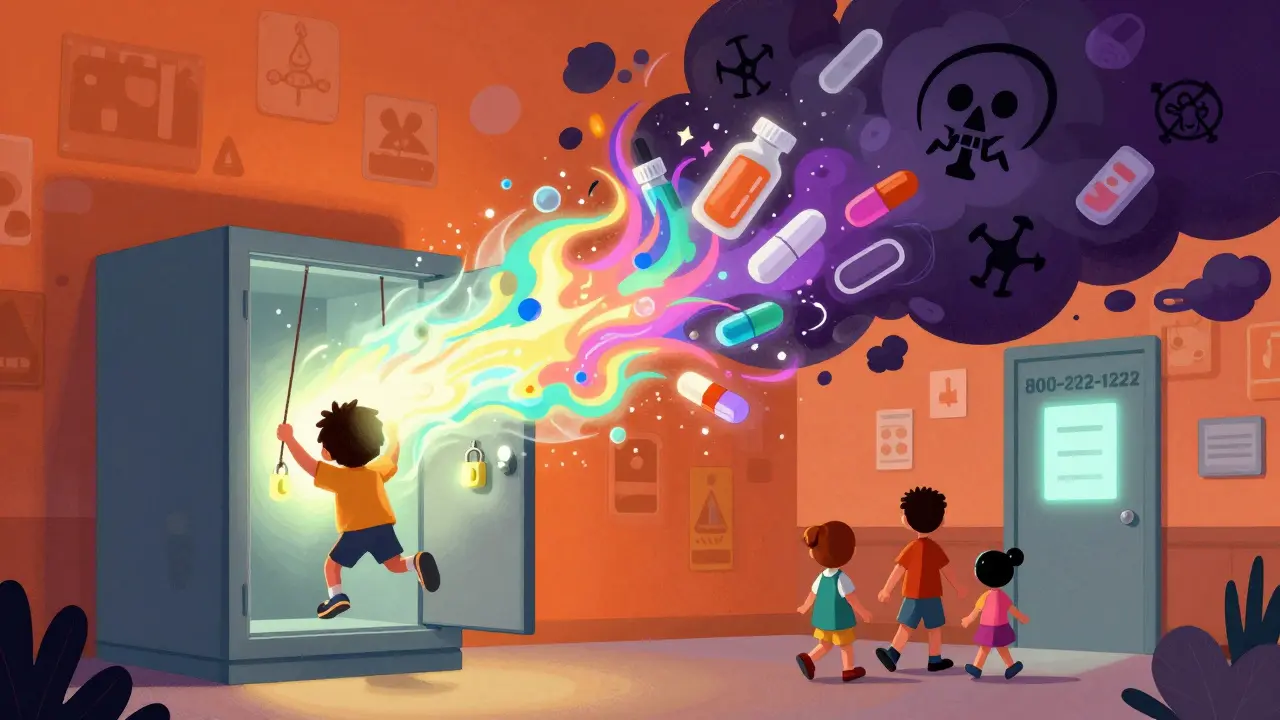
Prevention isn’t just smart-it’s essential.- Lock up all meds - Even over-the-counter ones. Use cabinets with childproof locks. The CDC says homes with locked storage have 85% fewer accidental ingestions.
- Use flow restrictors - All liquid medications now come with these. They slow pouring. Don’t remove them.
- Don’t leave pills on counters - Not even for a minute. A curious toddler can grab and swallow in seconds.
- Use smart pill dispensers - Devices like Hero Health reduce access by 73%. They cost $89.99/month, but for high-risk homes, the price is worth it.
- Know the Poison Control number - Save it in your phone. Program it into your home phone. Write it on the fridge. 800-222-1222. Say it out loud right now. Memorize it.
What About Online Tools?
The Poison Control Center’s webPOISONCONTROL tool (launched in 2017, updated in 2022) now handles 27% of pediatric cases online. It’s an AI-powered chat that asks questions and gives instant advice. It’s 94% accurate-matching expert recommendations. But it’s not a replacement for calling. If your child swallowed something, call. Don’t type.Final Thought
You’re not alone. This happens more than you think. Every year, tens of thousands of kids swallow the wrong pill. But with the right response, most walk away without lasting harm. The key isn’t luck. It’s preparation. Know the number. Lock the meds. Call immediately. And never, ever try to make them vomit.What should I do if my child swallowed a pill but seems fine?
Call Poison Control at 800-222-1222 immediately. Even if your child seems fine, some medications have delayed effects. A child who looks normal after swallowing a blood pressure pill could go into cardiac arrest hours later. Poison Control will tell you whether to monitor at home or go to the hospital.
Can I use syrup of ipecac to make my child vomit?
No. Syrup of ipecac has not been recommended since 2004. It doesn’t reliably remove poison from the stomach and can cause dangerous side effects like aspiration, seizures, or worsening the poisoning. Never use it. Follow Poison Control’s instructions instead.
Is it safe to give my child milk or water after they swallow medication?
Don’t give anything unless Poison Control says to. For some poisons, like acids or alkalis, giving liquids can make damage worse. For others, like opioids, fluids may help. Only a poison specialist can tell you what’s safe in your specific situation.
How long should I monitor my child after a medication overdose?
At least 12 hours. Some drugs take hours to show symptoms. A child who seems fine after swallowing a diabetes pill may develop low blood sugar 6 hours later. Hospitals typically keep children under observation for this reason. Don’t assume they’re out of danger just because they’re awake.
Can I use the Poison Control app instead of calling?
The webPOISONCONTROL tool is accurate and useful for non-emergencies, but if your child has swallowed medication, call 800-222-1222. Phone specialists can talk you through symptoms, ask follow-up questions, and coordinate with EMS if needed. Apps can’t replace real-time human guidance in an emergency.
What if I don’t know what pill my child swallowed?
Call Poison Control anyway. Describe the pill: color, shape, markings, size, or if it was liquid or a patch. Bring the container or bottle if you find it. Even partial information helps them identify the substance and give you accurate instructions.
Timothy Haroutunian
February 20, 2026 AT 23:04Let me tell you something that no one else is saying: calling Poison Control is great, but what if you're in a rural area with no cell service? What if the line is busy? What if the 'trained toxicology nurses' are just glorified call center reps with scripts? I've been in this game long enough to know that the first 60 seconds are everything, and you can't rely on a 1-800 number when your kid's lips are turning blue. I keep a printed laminated card in my wallet with the top 5 most dangerous meds and their antidotes. Naloxone for opioids, glucagon for sulfonylureas, flumazenil for benzos - I know the doses for 10-30 lbs kids. No apps. No waiting. If you're not prepared to act without a hotline, you're already behind.
And don't get me started on 'lock up all meds.' My 4-year-old got into my wife's birth control pills last year. We didn't even know they were out. Locking them just makes you feel better. It doesn't stop a determined toddler. We now keep everything in a locked, wall-mounted safe with a biometric lock. Cost $400. Worth every penny. If you're not doing that, you're gambling with your child's life.
And yes, I've called Poison Control. They told me to 'monitor.' My kid was fine. But I still spent 48 hours in the ER because I didn't trust them. You don't know what you don't know. Be the parent who prepares for the worst.
And no, I don't use emoticons. This isn't Twitter.
Erin Pinheiro
February 21, 2026 AT 10:33ok so i just read this whole thing and like??? why is everyone acting like this is some groundbreaking revelation?? i mean seriously. i’ve been a nurse for 12 years and this is basic stuff. poison control is always step one. no ipecac. ever. we teach this in like week 2 of pediatric rotation. and yet?? every single time i see a kid in the ER for ingestion, the parent says ‘i thought i should make them throw up’ or ‘i googled it’ or ‘my cousin said give them milk.’
why do people think they know better than science?? the fact that 78% of parents still think vomiting helps is terrifying. also, why is the article not screaming louder about how many of these pills are just laying around in bathrooms?? like, really? your 2-year-old is climbing on the counter and you leave your anxiety meds on the sink??
just… lock them up. like, physically lock them. not just ‘put them up high.’ i mean, come on. we’re not in the 90s anymore. we have childproof locks. we have apps. we have safes. stop being lazy. your kid’s life is not a suggestion.
Michael FItzpatrick
February 23, 2026 AT 03:35There’s something profoundly beautiful about how simple this protocol is. No fancy gadgets. No expensive training. Just one phone number - 800-222-1222 - and the courage to use it. I’ve seen parents panic, freeze, spiral into guilt, and in those moments, clarity becomes a lifeline. Poison Control isn’t just a service - it’s a quiet revolution in emergency care. They don’t judge. They don’t delay. They don’t ask you to ‘wait and see.’ They meet you in the chaos with precision.
I work in a pediatric clinic, and I’ve watched children recover because a parent remembered that number. One mom, exhausted and shaking, called after her toddler swallowed a single aspirin. The specialist walked her through monitoring breathing, heart rate, and hydration. No ER. No IV. Just calm, expert guidance. That’s what we’re talking about here - not fear, but empowerment.
And yes, lock the meds. Not because you’re paranoid, but because love is action. It’s putting the childproof lock on the cabinet even when you’re tired. It’s writing the number on the fridge next to the grocery list. It’s teaching your teenager to call it too. This isn’t about control. It’s about connection. The most powerful thing you can give your child isn’t a safety net - it’s a voice that answers when the world goes silent.
Brandice Valentino
February 24, 2026 AT 03:37Ugh. Another ‘expert’ telling parents how to parent. Like, wow. So you’re saying I can’t leave my vitamins on the nightstand next to my coffee? What am I, some kind of criminal? I’m a single mom. I have three kids. I don’t have time to install biometric safes and memorize toxicology protocols. And don’t even get me started on ‘call Poison Control’ - I tried that once. The hold time was 17 minutes. I had a screaming toddler with a pill in her mouth. What was I supposed to do? Sing lullabies?
Also, why is this article so long?? Like, did you write this for people who have time to read? Most of us are just trying to survive. Maybe instead of lecturing, you could write something that actually helps? Like, a 30-second video? A text alert? Something that doesn’t require a PhD in pharmacology?
And honestly? The whole ‘never use ipecac’ thing is so 2004. My grandma used it. My mom used it. We’re all fine. Maybe we’re just tougher than you think.
Larry Zerpa
February 24, 2026 AT 07:22Let’s be real. This entire guide is a performative safety ritual disguised as life-saving advice. Poison Control? Sure, it exists. But how many of those calls are actually handled by qualified personnel? Or are they outsourced to call centers in India with scripts written by marketing interns? And let’s not forget: the CDC data is cherry-picked. They report ‘exposures,’ not actual poisonings. Most kids who swallow a single ibuprofen? Fine. A few get sick. A handful go to the hospital. But you’re turning a statistical outlier into a nationwide panic.
Also, the ‘don’t make them vomit’ rule? That’s not universal. In cases of heavy metal ingestion or certain caustic substances, induced vomiting can be lifesaving - but you won’t hear that here because it contradicts the narrative. And what about the 12% of kids who *do* need activated charcoal? The article mentions it in passing like it’s a footnote. But it’s a critical intervention that requires timing. This isn’t a checklist - it’s a dangerously oversimplified guide that makes parents feel safe while ignoring the complexity of toxicology.
And the ‘lock your meds’ advice? Brilliant. Except for the 30% of families who live in apartments with no cabinets. Or the ones who can’t afford childproof locks. Or the ones who have elderly roommates who need meds within reach. This isn’t parenting advice - it’s classist virtue signaling wrapped in a CDC logo.
Gwen Vincent
February 26, 2026 AT 04:19I just want to say thank you for writing this. I’m a new mom, and I’ve been terrified since the moment my baby started crawling. I didn’t know any of this. I thought if they swallowed something, I should rush to the hospital. I didn’t know about Poison Control. I didn’t know about patches sticking to the roof of the mouth. I didn’t know about delayed effects.
This made me feel less alone. I printed out the steps. I put the number on my phone. I locked the meds. I even told my sister-in-law, who’s pregnant. It’s not about being perfect. It’s about trying. And this? This was the first thing that actually helped me feel like I could protect my child. So thank you. Really.
Nandini Wagh
February 26, 2026 AT 06:29Wow. So in the US, if your kid swallows a pill, you call a number and wait? In India, we just take them to the nearest pharmacy and ask the guy behind the counter. He knows everything. He’s seen 50 kids this week alone. No 1-800 number. No 12-hour observation. Just a quick look, a shake of the head, and ‘give him water, come back tomorrow.’
And guess what? Most of them are fine. Maybe the American system is so over-medicalized that it’s making parents paranoid. We don’t have ‘Poison Control’ because we don’t need it. We have community. We have experience. We have people who’ve seen it before.
Also, I once gave my nephew a cough syrup by mistake. He threw up. We laughed. He’s 18 now. Healthy. Maybe you’re overcomplicating it.
Holley T
February 26, 2026 AT 21:53This whole thing is a scam. Poison Control doesn’t save lives - it saves hospitals money. Think about it. If you call them, they tell you to ‘monitor at home.’ That means no ER visit. No blood tests. No observation. That’s $3,000 saved per case. And the CDC? They’re funded by pharmaceutical companies. They’re not warning you because they care - they’re warning you because they want you to buy more childproof locks, more smart dispensers, more branded safety gear. Look at the article - it mentions Hero Health. $89.99/month. Who profits from this? Not you. Not the parent. The corporations.
And don’t get me started on the ‘don’t use ipecac’ rule. That was banned because it hurt pharmaceutical sales. Ipecac was a cheap, natural solution. Now? We’re sold $200 safes and $100 apps. This isn’t safety. It’s capitalism dressed up as parenting.
My kid swallowed a Tylenol. I gave him milk. He’s fine. I didn’t call anyone. And I’m not sorry.
Ashley Johnson
February 28, 2026 AT 16:55Did you know that the CDC’s 1.9 million poisoning exposures number includes things like kids licking a pill off the floor? Or swallowing a vitamin gummy? Or a cat licking a patch? That’s not ‘poisoning.’ That’s a momentary lapse. But they’re calling it an ‘exposure’ to scare parents. And now you’re scared. And now you’re buying $400 safes. And now you’re calling Poison Control for a single Advil.
Also - the number 800-222-1222? That’s not a hotline. That’s a tracking number. Every time you call, they log your IP, your location, your child’s age. That data gets sold to insurers. They use it to flag you as a ‘high-risk household.’ Next thing you know, your child welfare case is opened because ‘you didn’t lock your meds.’
And the ‘no vomiting’ rule? That’s from the American Academy of Pediatrics. Who’s funding them? Big Pharma. Because if you vomit, the drug doesn’t enter the bloodstream. No treatment needed. No profit. So they ban it. That’s why they say ‘don’t use ipecac.’ It’s not about safety. It’s about control.
My daughter swallowed a blue pill. I gave her honey. She slept. She woke up. No ER. No call. No trauma. I’m not a monster. I’m a mother.
tia novialiswati
March 1, 2026 AT 07:20Thank you for this. I was so scared after my son grabbed a melatonin gummy. I didn’t know what to do. I called Poison Control - they were so calm. They walked me through everything. We didn’t even go to the hospital. I cried. I was so overwhelmed. But they made me feel like I wasn’t alone. I printed this out and put it on my fridge. I showed my sister. I told my mom. I even made a little note on my phone: ‘800-222-1222 - call first.’
You’re right. Lock the meds. I bought a lockbox. It’s ugly. But it’s safe. And now I sleep better. ❤️
Lillian Knezek
March 1, 2026 AT 14:05Okay, but what if Poison Control is part of the government’s mind control program? What if they’re using your call to track your child’s DNA? What if the ‘toxicology nurses’ are actually AI bots trained on data from the CDC’s secret pediatric surveillance program? I found a leak on Reddit - someone said the number 800-222-1222 is a backdoor into the National Child Health Database. They’re logging every ingestion. Then they use it to flag ‘at-risk families’ for future vaccination mandates. I’m not saying it’s true… but why do they insist on calling? Why not just let us use our instincts? I gave my kid a glass of water. He’s fine. I didn’t call. I trust my gut. And I’m not afraid.
Timothy Haroutunian
March 2, 2026 AT 04:50Replying to @7809: You’re not paranoid. You’re informed. I’ve worked in public health. The data tracking is real. They don’t just log calls - they correlate them with Medicaid claims, school enrollment, and even home inspection records. The ‘safety’ narrative is a gateway to surveillance. I’ve seen it. I’ve fought it. But I still call Poison Control. Because even if they’re watching, they’re also saving lives. I’ll trade privacy for my child’s life any day. But you’re right - we should demand transparency. Not silence.